

Why College Football Conference Realignment is Reshaping the Sport
College football conference realignment has transformed from occasional moves between conferences into a full-scale reshaping of America’s most popular college sport. Since 2021, more than 50 schools have changed conferences, with powerhouse programs like Texas, Oklahoma, USC, and UCLA leading historic moves that have redefined the competitive landscape.
Key Realignment Changes (2021-2024):
- SEC: Added Texas and Oklahoma (2025)
- Big Ten: Added USC, UCLA, Oregon, and Washington
- Big 12: Added 8 new schools including Cincinnati, Houston, and Arizona schools
- ACC: Added Stanford, Cal, and SMU from across the country
- Pac-12: Lost 10 of 12 members, now rebuilding with Mountain West schools
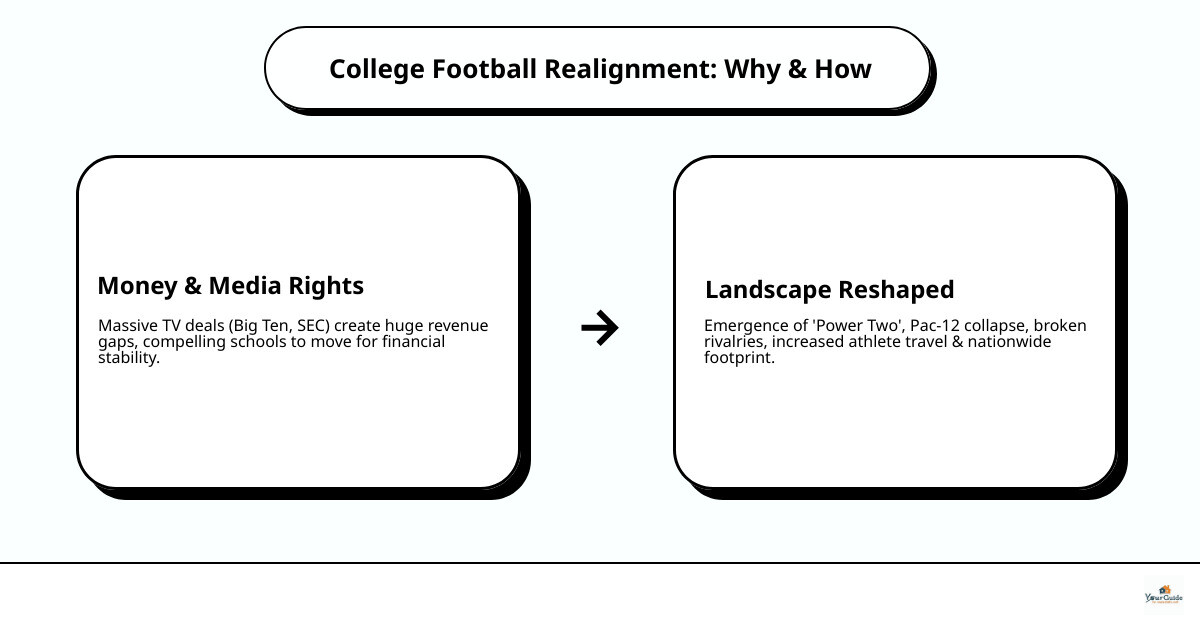
The driving force behind these seismic shifts is simple: money. Television deals now exceed $7 billion for conferences like the Big Ten, creating massive revenue gaps that force schools to chase the biggest payouts. The SEC’s deal with ESPN and the Big Ten’s partnership with FOX, CBS, and NBC have created a “Power Two” dynamic that leaves other conferences scrambling to keep up.
This realignment wave has casualties beyond just conference affiliations. Historic rivalries like Oklahoma vs. Oklahoma State’s “Bedlam Series” have been broken up, while student-athletes now face cross-country travel that would have been unthinkable just five years ago.
The Pac-12’s near-collapse serves as the most dramatic example of how quickly things can change. After losing ten members to other conferences, only Oregon State and Washington State remained, forcing a complete rebuild with schools like Boise State and San Diego State joining for 2026.
As media rights deals continue to expire through the 2030s, more change is inevitable. The growing financial gap between the biggest conferences and everyone else suggests we may be heading toward an even more consolidated future – possibly even a “super league” structure that completely separates college football’s biggest brands from the rest.
College football conference realignment vocabulary:
The “Why”: Unpacking the Financial Drivers of Realignment
When you strip away all the talk about tradition and rivalries, college football conference realignment comes down to one simple truth: money talks. And right now, it’s shouting louder than a stadium full of fans on game day.
The numbers tell the whole story. The Big Ten’s eye-popping $7 billion media deal with FOX, CBS, and NBC makes other conferences look like they’re playing with pocket change. Meanwhile, the SEC’s long-standing partnership with ESPN has created a financial powerhouse that draws schools like a magnet.
To put this in perspective, consider the Mountain West Conference. They signed what seemed like a decent $270 million deal in 2020, paying each school about $4 million per year. That sounds good until you compare it to what Big Ten and SEC schools are pulling in. The revenue gap is so massive it’s almost comical – if you’re not the one getting left behind.
As CNBC perfectly explained, when Texas and Oklahoma decided to jump ship to the SEC, you just had to follow the money trail. It led straight to significantly bigger paychecks.
But there’s more pressure cooking in this financial pot. The NCAA v. House settlement has opened the floodgates for direct revenue sharing with student-athletes. Add in the ongoing evolution of Name, Image, and Likeness (NIL) deals, and suddenly universities need even deeper pockets to stay competitive.
The new reality hits hard: schools can now share up to $20.5 million annually with their athletes. That’s a massive expense that makes those lucrative TV deals not just nice to have, but absolutely essential for survival.
Just like in real estate, where location and market value determine everything, universities are finding that their conference affiliation now determines their financial future. And everyone wants to be in the best neighborhood possible.
The Rise of the “Power Two”
The SEC and Big Ten didn’t just stumble into dominance – they strategically built it. These two conferences have effectively created their own tier of college football, leaving everyone else fighting for scraps.
Their expansion moves weren’t random. Both conferences now boast coast-to-coast footprints that would make any business jealous. The Big Ten stretches from New Jersey to California, while the SEC spans from Missouri to Texas. This geographic reach translates directly into larger TV markets and bigger audiences.
SEC Commissioner Gregg Sankey isn’t shy about his conference’s success, often noting how other conferences try to copy their playbook. Meanwhile, Big Ten Commissioner Tony Petitti confidently suggests his league can match anyone’s achievements.
This isn’t just about bragging rights. The competitive advantage these “Power Two” conferences offer is real and measurable. They can provide superior facilities, better resources, and best national exposure. For recruits and coaches, the choice becomes obvious.
The financial disparity between these super-conferences and everyone else continues to grow wider each year. It’s like watching a real estate market where only two neighborhoods keep appreciating while others stagnate.
The Scramble for Survival
Outside the Power Two bubble, the atmosphere feels more like a survival reality show than organized college athletics. Every conference is scrambling to secure their future, and some are getting desperate.
The ACC finds itself in a particularly tough spot. Despite being a “Power Five” conference, their media deal runs through 2036 – an eternity in today’s fast-moving landscape. This long-term commitment has created serious tension among member schools.
Florida State and Clemson have both filed lawsuits challenging the conference’s grant of rights, calling the exit fees “exorbitant.” The ACC’s escape clause is brutal: $75 million to leave, or 50% of that if six or more schools bolt together. Talk about being stuck between a rock and a hard place.
The Big 12 took a proactive approach after losing Texas and Oklahoma. Instead of panicking, they went on an expansion spree, adding eight new schools to rebuild their foundation. It’s like renovating your house after the foundation cracks – you fix it fast or risk losing everything.
Meanwhile, the Group of Five conferences are playing a completely different game. The American Athletic Conference (AAC) and Sun Belt Conference are trying to position themselves as the best of the rest, hoping to catch any schools that fall from higher conferences.
The AAC is even pursuing a unique strategy, hoping to add Air Force to join Army and Navy. Having all three service academies could provide protection in College Football Playoff negotiations and political influence in Washington D.C. It’s smart positioning in an increasingly unpredictable market.
This constant jockeying for position reminds us why having a clear strategy matters, whether you’re navigating conference realignment or the real estate market. Understanding the landscape and making calculated moves can mean the difference between thriving and merely surviving.
A New Map: Major Conference Shake-Ups and the Impact of college football conference realignment

If you pulled out a college football map from 2020 and compared it to today, you’d barely recognize the landscape. College football conference realignment has completely redrawn the boundaries of college sports, turning what were once regional conferences into sprawling, coast-to-coast operations.
Gone are the days when the Big Ten was actually made up of ten teams from the Midwest, or when Pac-12 schools could count on playing their conference games within a reasonable time zone. Today’s reality features UCLA traveling to New Jersey to play Rutgers, and Stanford heading to North Carolina for an ACC matchup. It’s a brave new world where geography takes a backseat to television dollars.
The change has been so dramatic that college football has evolved from a collection of regional rivalries into a truly nationwide sport. While this creates exciting new matchups and broader exposure for programs, it also means increased travel costs, longer trips for fans, and student-athletes spending more time on planes than ever before.
Here’s how the major conferences have been reshuffled since 2021:
| Conference | Teams Joining | Teams Leaving | Effective Year(s) |
|---|---|---|---|
| SEC | Texas, Oklahoma | N/A | 2024 |
| Big Ten | USC, UCLA, Oregon, Washington | N/A | USC/UCLA (2024), Oregon/Washington (2024) |
| Big 12 | BYU, Cincinnati, Houston, UCF, Colorado, Arizona, Arizona State, Utah | Texas, Oklahoma | BYU/Cincinnati/Houston/UCF (2023), Colorado/Arizona/Arizona State/Utah (2024) |
| ACC | Stanford, Cal, SMU | N/A | 2024 |
| Pac-12 | Boise State, Colorado State, Fresno State, San Diego State, Utah State, Texas State | Arizona, Arizona State, Cal, Colorado, Oregon, Oregon State, Stanford, UCLA, USC, Utah, Washington, Washington State | 2026 (new members) |
Just like tracking housing markets across different regions, following these conference moves requires understanding that each change creates ripple effects throughout the entire system.
The Power Conferences Get Stronger
The biggest winners in this reshuffling have been the conferences with the deepest pockets and strongest television deals. They’ve used their financial advantages to poach the most attractive programs, creating an even wider gap between the haves and have-nots.
The SEC made perhaps the most seismic move by adding Texas and Oklahoma in 2024. These aren’t just any programs – they’re college football royalty with massive fan bases, rich traditions, and the kind of brand recognition that makes television executives smile. When Texas and Oklahoma officially joined the SEC, they brought decades of championship history and some of the sport’s most passionate rivalries.
Not to be outdone, the Big Ten shocked the college sports world by reaching all the way to California to grab USC and UCLA in 2024. If that wasn’t bold enough, they followed up by adding Oregon and Washington, creating a conference that literally stretches from coast to coast. The UCLA move was so controversial that it required a special “Calimony” agreement, where UCLA agreed to pay Cal $10 million annually to help offset the revenue difference their departure created.
The Big 12 found itself in survival mode after losing its two biggest brands, but responded with impressive speed and strategy. They quickly added BYU, Cincinnati, Houston, and UCF in 2023, then successfully raided the crumbling Pac-12 to bring in Colorado, Arizona, Arizona State, and Utah in 2024. It was like watching a real estate investor quickly pivot to acquire undervalued properties in a changing market.
Even the ACC got in on the action, adding Stanford, Cal, and SMU in 2024. While these moves helped shore up their membership numbers, they also created some head-scratching travel scenarios that would make even the most frequent business traveler wince.
The Domino Effect: The Collapse and Rebirth of the Pac-12
The most dramatic story in this entire realignment saga has been the near-death and attempted resurrection of the Pac-12. Once known as the “Conference of Champions” for its Olympic sports success, the Pac-12 became the poster child for how quickly things can fall apart in modern college athletics.
The conference’s downfall began with its inability to secure a competitive media rights deal. While other conferences were signing billion-dollar agreements, the Pac-12 struggled to find partners willing to pay premium prices for its content. This created a financial death spiral that led to an unprecedented exodus.
Ten of the conference’s twelve members announced their departures for the 2024-25 academic year, leaving only Oregon State and Washington State behind. These two schools, affectionately dubbed the “Pac-2,” suddenly found themselves owning the rights to a conference that barely existed.
But here’s where the story gets interesting. Instead of folding their cards, Oregon State and Washington State decided to rebuild. They filed lawsuits to gain control of the conference’s assets and began an ambitious plan to resurrect the Pac-12 for the 2026 season.
Their rebuilding strategy focused primarily on raiding the Mountain West Conference. Boise State, Colorado State, Fresno State, San Diego State, and Utah State all agreed to join the new-look Pac-12. They also added Texas State from the Sun Belt, giving them a footprint in the football-crazy Lone Star State.
Of course, this rebuilding effort hasn’t been smooth sailing. The Pac-12 is facing a lawsuit from the Mountain West over “poaching penalties” that could exceed $50 million, while each departing Mountain West school will pay $17 million to leave. It’s a expensive game of musical chairs that shows just how high the financial stakes have become.
The End of Tradition? Impact on Rivalries and Competitive Balance
Perhaps the saddest casualty of college football conference realignment has been the loss of traditional rivalries that took decades to build. The Bedlam Series between Oklahoma and Oklahoma State, which dated back to 1904, has been put on indefinite hold. The Apple Cup between Washington and Washington State faces an uncertain future with the schools now in different conferences.
These rivalries weren’t just games – they were cultural events that brought families, communities, and entire states together. They represented everything that made college football special compared to professional sports. Watching them disappear feels a bit like seeing a historic neighborhood get torn down for a shopping mall.
The competitive balance of the sport has also shifted dramatically. While the Power Two conferences continue to stockpile talent and resources, other leagues struggle to maintain relevance. The increased travel demands are particularly hard on non-revenue sports, where soccer and volleyball teams now face cross-country trips that would have been unthinkable just a few years ago.
Student-athletes find themselves spending more time traveling and less time focusing on academics and training. It’s a trade-off that many question, especially when the primary beneficiaries are television networks and athletic administrators rather than the young people actually playing the games.
The new landscape has created exciting opportunities and concerning challenges in equal measure. Just as the real estate market constantly evolves based on economic factors, college football continues to adapt to new financial realities – even when those changes come at the cost of tradition and common sense.
The Future Landscape: Playoffs, Super Leagues, and the Next Wave

The whirlwind of college football conference realignment shows no signs of slowing down. If anything, the changes we’ve seen are just the beginning of an even more dramatic change. The road to a national championship keeps shifting beneath our feet, and frankly, nobody knows exactly what college football will look like in five years.
Think of it like watching a neighborhood transform – what starts with one new development often leads to a complete makeover of the entire area. That’s exactly what’s happening in college sports right now, and the ripple effects will touch every corner of college athletics.
Reshaping the Path to a Title: The College Football Playoff
The College Football Playoff is getting a major makeover with its new 12-team format, and this change is reshaping how teams think about their conference affiliations. The “5+7 model” guarantees spots for the five highest-ranked conference champions, while seven at-large bids fill out the bracket.
Here’s where it gets interesting for conference realignment: the four highest-ranked teams get byes, regardless of whether they won their conference. This straight seeding approach, starting in 2025, puts even more pressure on schools to join conferences that can consistently produce top-ranked teams.
For Power Four conferences, winning your conference championship becomes absolutely crucial – it’s your golden ticket to the playoff. But for Group of Five schools, the math is still pretty tough. They have more theoretical access, but climbing high enough in the rankings to earn a favorable seed? That’s a whole different challenge.
The rebuilt Pac-12 faces a particularly tricky situation. They’ll need to prove their new lineup can compete with the big boys, which isn’t easy when you’re starting from scratch. The New College Football Playoff Format will definitely intensify the scramble for those coveted top spots.
The “Super League” Theory and What’s Next for college football conference realignment
The Power Two breakaway theory isn’t just idle speculation anymore – it’s becoming a serious conversation. With the SEC and Big Ten pulling so far ahead financially, some experts wonder if they’ll eventually form their own exclusive league entirely.
The numbers are staggering. A private equity firm actually proposed a 70-team league in 2023, complete with a $9 billion upfront investment and projections of $15 billion in revenue over 12 years. When you’re talking about that kind of money, everything else starts to look like small change.
But here’s the catch: creating a true super league would likely need an antitrust exemption to bundle media rights effectively. Without that legal protection, the whole thing could crumble under lawsuits faster than you can say “monopoly.”
Meanwhile, conferences like the Mountain West and Conference USA are trying to figure out their survival strategies. Some are exploring stronger alliances, others are considering mergers. It’s like watching smaller businesses adapt when major corporations move into their market – creativity and flexibility become essential.
Beyond the Gridiron: Consequences for All College Athletics
While football grabs all the headlines, the real story of college football conference realignment is how it’s reshaping every single college sport. Olympic sports like soccer, volleyball, and gymnastics are dealing with travel schedules that would make a touring rock band exhausted.
Picture this: a Stanford volleyball team now regularly travels to play schools on the East Coast. The logistics alone are mind-boggling, not to mention the impact on student-athletes trying to balance academics with their sport. Athletic departments are feeling the financial strain too, as travel budgets explode and resources get stretched thin.
Even college basketball isn’t immune to these changes. When powerhouse programs like Gonzaga are having serious conversations about joining Power conferences, you know the change reaches far beyond football fields.
The harsh reality is that football revenue drives most of these decisions, which means other sports often get squeezed. It’s a tough trade-off that athletic directors across the country are wrestling with every day.
Just like in real estate, where one major development can transform an entire neighborhood’s character and economics, these conference moves are fundamentally changing the landscape of college sports – and we’re still only seeing the beginning of this change.
The Lower Divisions: FCS Transitions and Restructuring

Think of college football conference realignment as a massive game of musical chairs – when the big players move, everyone else has to scramble for new seats. The dramatic changes at the FBS level don’t happen in a vacuum. They create ripple effects that flow down to the Football Championship Subdivision (FCS), where smaller schools face their own challenging decisions about moving up, staying put, or sometimes even moving down.
Just like how changes in the housing market affect everything from luxury homes to starter properties, the reshuffling at college football’s highest level forces FCS programs to constantly reevaluate their position and future prospects.
Moving On Up: FCS Teams Joining the FBS
The dream of moving from FCS to FBS is like upgrading from a cozy townhouse to a sprawling estate – it sounds amazing, but it requires serious financial commitment and planning. For FCS schools, the lure of increased television revenue, better exposure, and the chance to compete on college football’s biggest stage has proven irresistible.
The transition isn’t simple, though. Schools must steer a multi-year reclassification process, dramatically increase their athletic budgets, and meet strict NCAA requirements. It’s a major investment that can reshape an entire university’s identity.
James Madison successfully made the leap to the Sun Belt Conference, proving that FCS programs can thrive at the higher level. Jacksonville State, Sam Houston, and Kennesaw State all found new homes in Conference USA, taking advantage of that league’s need to replace departing members.
The most recent addition to this group was Delaware, which joined Conference USA after decades as an FCS powerhouse. Missouri State also accepted an invitation to Conference USA, with university officials announcing the move as a strategic step forward for their athletic program. As Missouri State accepts invitation to join Conference USA, they highlighted the improved opportunities for student-athletes and increased visibility for the university.
Not every FCS program gets to make this jump, though. Sacramento State has been vocal about their FBS aspirations, but the NCAA Division I Council recently denied their waiver to transition as an independent program. This rejection shows just how challenging the approval process can be, even for schools with strong football traditions.
A Shifting FCS Landscape and the future of college football conference realignment
While some FCS schools are moving up, the division itself is experiencing its own version of musical chairs. The key challenge? The NCAA requires at least six eligible teams for a conference to receive an automatic bid to the FCS playoffs. This rule drives many of the strategic decisions we’re seeing.
Conference mergers have become a popular survival strategy. The Big South and Ohio Valley Conference (OVC) formed a football association called the Big South-OVC Association to ensure both leagues maintain playoff eligibility. Similarly, the ASUN and Western Athletic Conference (WAC) took their football alliance even further, formally rebranding as the United Athletic Conference (UAC) starting in 2026.
Individual schools are also making strategic moves. Richmond, William & Mary, and Villanova are all leaving CAA Football to join the Patriot League for football, seeking better competitive balance and reduced travel costs. Stephen F. Austin tried life in the WAC but decided to return home to the Southland Conference, showing that sometimes the grass isn’t always greener elsewhere.
Looking westward, Southern Utah and Utah Tech are joining the Big Sky Conference in 2026, which will bring that league’s football-playing membership to 13 schools – creating one of the larger FCS conferences.
In a move that surprised many, Saint Francis University announced it would reclassify to NCAA Division III, joining the Presidents’ Athletic Conference in 2026. This downward move demonstrates that not every school sees growth as the answer – sometimes finding the right fit means scaling back rather than expanding.
These constant shifts in the FCS landscape mirror what we see in real estate markets during times of change. Schools, like homeowners, are constantly evaluating whether their current situation serves their long-term goals or if it’s time to make a strategic move to a better position.
Frequently Asked Questions about College Football Conference Realignment
If you’re scratching your head trying to make sense of all the moves happening in college sports, you’re not alone. College football conference realignment has become so complex that even longtime fans struggle to keep up. Let’s tackle the most common questions we hear about this ongoing shake-up.
Why is conference realignment happening?
The answer is straightforward: money. We’re talking about massive media rights deals worth billions of dollars from networks like ESPN and FOX. These aren’t just nice bonuses – they’re essential revenue streams that schools desperately need.
Think about it this way: universities now face unprecedented expenses. They need to fund entire athletic departments, compete for top coaches and facilities, and under the recent House v. NCAA settlement, they may soon be sharing revenue directly with student-athletes. The gap between what conferences pay can be staggering – we’re talking about differences of $30-40 million per year between the top conferences and everyone else.
Beyond the financial pressure, schools are also chasing greater exposure and recruiting advantages. Being in a premier conference means your games are on national television more often, which helps with everything from recruiting to alumni engagement. It’s similar to how location affects property values in real estate – being in the right “neighborhood” can make all the difference.
What happened to the Pac-12?
The Pac-12’s story is perhaps the most dramatic example of how quickly things can change in modern college sports. The conference that once called itself the “Conference of Champions” essentially collapsed because it couldn’t secure a media rights deal competitive enough to keep its members happy.
The dominos started falling when USC and UCLA shocked everyone by announcing their move to the Big Ten. Then Oregon and Washington followed suit to the Big Ten, while Colorado, Arizona, Arizona State, and Utah headed to the Big 12. Stanford, Cal, and others found new homes in the ACC. When the dust settled, only Oregon State and Washington State remained.
These two schools, now dubbed the “Pac-2,” didn’t just give up. They fought back legally to control the conference’s assets and began an ambitious rebuilding project. For 2026, they’re bringing in Boise State, Colorado State, Fresno State, San Diego State, Utah State from the Mountain West, plus Texas State from the Sun Belt. It’s a complete reinvention of what the Pac-12 will look like going forward.
Is college football realignment over?
Not by a long shot. The landscape remains surprisingly unstable, especially when you look at some of the warning signs still flashing.
The ACC is facing serious internal pressure, with powerhouse programs like Florida State and Clemson filing lawsuits to challenge the conference’s grant of rights and what they consider excessive exit fees. These schools are clearly looking for ways out, which could trigger another major wave of moves.
The massive revenue gap between the Big Ten/SEC and everyone else isn’t going away either. In fact, it’s likely to get worse as their media deals continue to dwarf what other conferences can offer. This creates constant pressure for schools to find better financial situations.
Looking ahead, major media rights deals for several conferences expire in the early 2030s, which could create another perfect storm for realignment. There’s even ongoing speculation about a potential “Super League” where the biggest programs break away entirely from the current system.
Just like in real estate, where market conditions are always evolving and creating new opportunities, college sports will likely see continued movement as schools position themselves for maximum value and long-term success.
Conclusion
The wave of college football conference realignment we’re witnessing isn’t just another round of changes – it’s a complete change of America’s favorite college sport. What started as schools chasing bigger paychecks has evolved into a fundamental reshaping of how college athletics operates.
The numbers tell the story. When conferences like the Big Ten can secure $7 billion media deals while others struggle to reach even $300 million, the motivation becomes crystal clear. Universities are making strategic moves that would have seemed impossible just a decade ago, with traditional rivals now scattered across different conferences and student-athletes traveling coast-to-coast for what used to be regional competitions.
The consolidation into super-conferences has created clear winners and losers. The SEC and Big Ten have emerged as the “Power Two,” while conferences like the Pac-12 have essentially collapsed under the financial pressure. Traditional rivalries like the Bedlam Series and the Apple Cup have become casualties of this pursuit for television revenue.
But perhaps most significantly, this realignment has shown us that change in college football is far from over. With major media deals expiring in the early 2030s and ongoing legal battles in conferences like the ACC, we’re likely looking at several more waves of movement. The growing revenue gap between the biggest conferences and everyone else suggests we might even see a “super league” emerge.
For student-athletes, coaches, and fans, this means adapting to a new reality where geography matters less than television markets, and where century-old traditions can disappear overnight in pursuit of financial stability.
Just as in real estate, where location and market value drive every decision, universities are strategically positioning themselves to maximize their worth in an increasingly competitive landscape. Understanding these market dynamics and making informed decisions requires the right guidance and expertise – principles we apply every day at Your Guide to Real Estate to help our clients succeed in the property market.
Find your perfect property neighborhood with our expert guidance