
A New Era for College Sports
College football realignment has fundamentally reshaped the landscape of college athletics over the past few years. Here’s what you need to know:
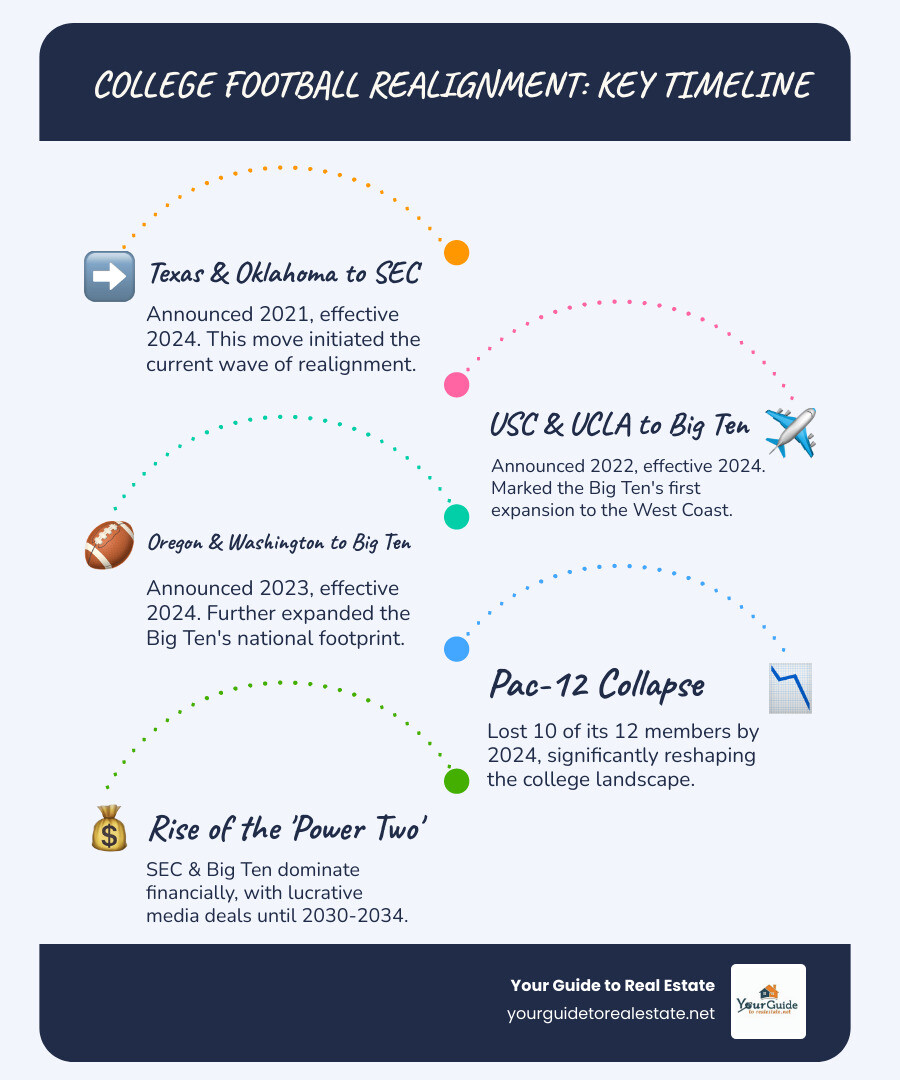
Major Moves (2021-2026):
- Texas and Oklahoma → SEC (2024)
- USC and UCLA → Big Ten (2024)
- Oregon and Washington → Big Ten (2024)
- Pac-12 collapsed – lost 10 of 12 members
- “Power Two” – SEC and Big Ten dominate financially
Key Drivers:
- Media rights deals worth billions
- Revenue sharing with players (House v. NCAA settlement)
- Financial gap between conferences
As one sports writer put it: “College athletics is relentlessly consolidating its power and profits in the hands of the few.” The Associated Press even named conference realignment and the collapse of the Pac-12 as the 2023 story of the year in U.S. sports.
The changes go far beyond just moving teams around. We’re seeing the end of regional rivalries, massive travel costs, and a new professionalized model of college sports. The financial stakes have never been higher, with media deals determining which schools survive and thrive.
The “Power Two” conferences – the SEC and Big Ten – now generate significantly more revenue than other conferences. Their media deals don’t expire until 2030-2034, while the vulnerable ACC is locked in until 2037, creating tension as schools like Clemson and Florida State explore exit strategies.
This change mirrors major shifts in any industry – those who adapt to new financial realities prosper, while others get left behind.
Quick college football realignment terms:
The Driving Forces: Money, Media, and the End of Amateurism
Think of college football realignment like a massive real estate market shift. Just as location, market conditions, and financial opportunities drive property values, three major forces are reshaping college sports: media money, revenue gaps, and the end of amateur athletics.
The biggest driver? Cold, hard cash. Media rights deals have become the lifeblood of college athletics. When the Pac-12 could only offer schools between $4 million and $10 million per year, while the Big Ten and SEC were throwing around much larger numbers, the writing was on the wall.
It’s like watching a bidding war for prime real estate – schools naturally gravitate toward the highest offer. The financial gap became impossible to ignore, especially when athletic departments need money for everything from coaching salaries to fancy new facilities.
The House v. NCAA settlement changed everything. This landmark agreement opened the floodgates for direct player compensation, officially ending the “amateur” era of college sports. The settlement requires $2.7 billion in payouts over 10 years, with conferences scrambling to find the money.
Suddenly, every school needs even more revenue to cover these new player payments. It’s created a financial arms race where conferences must secure bigger, better media deals just to survive. The pressure is intense – and it’s only getting worse.
Media contracts don’t last forever, and their expiration dates are like ticking time bombs. The Big Ten’s deal expires in 2030, the Big 12’s in 2031, the SEC’s in 2034, and the ACC’s in 2037. These dates represent massive opportunities for renegotiation – or dramatic conference changes.
Schools are already positioning themselves for these contract renewals. When UCLA and USC jumped to the Big Ten, it wasn’t just about football prestige – it was about securing their financial future through better media deals.
The Financial Engine of college football realignment
The ACC’s grant of rights perfectly illustrates how money drives these moves. While the agreement provides stability by locking schools in until 2037, it also creates a revenue problem. ACC schools are watching SEC and Big Ten programs rake in significantly more cash, and they’re getting restless.
Florida State’s lawsuit against the ACC shows just how desperate schools have become. They’re arguing the conference breached its contract and calling the exit fees “exorbitant.” Clemson followed with their own lawsuit, claiming the grant of rights is “unconscionable” and shouldn’t be legally binding.
These aren’t frivolous lawsuits – they’re calculated business decisions. Schools are willing to spend millions on legal fees for a chance at the financial promised land of the SEC or Big Ten.
The SEC’s ESPN deal and the Big Ten’s multi-network agreement have created the “Power Two” dynamic we see today. These conferences generate so much revenue that they can offer member schools financial packages that others simply can’t match.
The stunning demise of the Pac-12 serves as a cautionary tale. When you fall behind in the media rights race, schools bolt for better opportunities. The Pac-12’s inability to secure a competitive deal led to a mass exodus, leaving just two schools behind.
It’s a harsh reminder that in modern college football realignment, financial strength isn’t just important – it’s everything. Schools that can’t keep up with the revenue game get left behind, no matter their history or traditions.
The Super League Concept and the Widening ‘Power Two’ Gap
The money chase in college football realignment has led us to something that feels almost inevitable: talk of a super league. And honestly, when you look at what’s happening with the SEC and Big Ten, we’re already pretty much there.
These two conferences have become what sports analysts call the “Power Two” – and the gap between them and everyone else keeps getting wider. It’s like watching two luxury high-rises being built while the rest of the neighborhood stays in ranch houses. The financial difference is that stark.
The super league concept isn’t brand new. A billionaire investor actually pitched this idea seven years ago, but now it’s gaining real traction. Private equity groups like “College Sports Tomorrow” and “Project Rudy” are actively working to create a standalone league featuring college football’s biggest brands. Their vision? A streamlined, football-focused entity that maximizes broadcast revenue and pays players directly.
The potential benefits of a super league are pretty obvious. We’re talking about unprecedented revenue streams, faster decision-making without all the bureaucratic red tape, and direct compensation for athletes who’ve been generating billions in revenue for decades.
But the drawbacks of a super league are equally serious. Former Big 12 commissioner Bob Bowlsby put it bluntly: this system would create a world where “traditional winners become traditional losers.” Even more concerning, many non-revenue sports like swimming and wrestling would likely disappear entirely. ACC commissioner Jim Phillips strongly opposes any football-only model, arguing it would abandon core NCAA structures that support medical research and academic oversight.
The competitive imbalance we’re seeing is already reshaping college football. The Big Ten and SEC have become what one analyst called “fully weaponized versions” of themselves. They’re attracting the best recruits, commanding the largest TV audiences, and leaving other conferences scrambling to keep up.
The ACC is feeling this pressure most acutely. Some experts worry it could become a “glorified Group of Five league” if key members like Clemson and Florida State manage to escape. That’s a far cry from its traditional status as a power conference.
Legal and Political Problems
Creating an actual super league or pushing college football realignment much further runs into some serious legal roadblocks. The biggest hurdle? Antitrust exemptions. Right now, college sports operate under intense antitrust scrutiny, which means any major consolidation effort could face expensive legal challenges.
There’s hope on the horizon with Congressional legislation like the SCORE Act, which could provide the antitrust exemption needed to make super leagues legally viable. This bill could resolve thorny issues around player eligibility, economic freedom, and bundled media rights. But here’s the catch – navigating Congress is complicated, and private equity firms have finded that “ambushing the government is a risk.”
State politics add another layer of complexity. Look at what happened with UCLA’s move to the Big Ten. The UC Regents stepped in and required UCLA to pay “Calimony” – a $10 million annual payment to UC Berkeley to help offset the estimated $50 million difference in media rights revenue. It’s a perfect example of how state governing bodies can intervene in conference moves.
The NCAA authority challenges keep mounting too. Florida State’s lawsuit against the ACC and Clemson’s similar legal battle are directly challenging whether conferences can legally bind their members with long-term grant of rights agreements and what they call “exorbitant” exit fees.
These cases could set major precedents for how conferences operate going forward. If schools can successfully challenge these agreements, it could trigger another massive wave of realignment. The legal landscape is shifting as fast as the conference map itself.
The Domino Effect: Who’s Next to Move?
The dust hasn’t settled from the massive shifts we’ve already seen, and honestly, it probably never will. The world of college football realignment feels like a never-ending game of musical chairs, where everyone’s constantly looking over their shoulder, wondering if their seat will disappear next.
The ACC sits in the hot seat right now, and everyone knows it. With their media deal locked in until 2037 while the “Power Two” conferences rake in significantly more cash, ACC schools are feeling the financial squeeze. It’s like being stuck in a long-term lease while property values skyrocket around you – frustrating doesn’t begin to cover it.
Florida State and Clemson have already taken the bold step of filing lawsuits against their own conference, desperately seeking a way out of what they see as a financially limiting situation. These aren’t idle threats – both schools have too much at stake to stay put while watching other programs pull ahead financially.
The most intriguing development might be the rumors of North Carolina exploring a move to the SEC. If the Tar Heels make that jump, it could trigger an avalanche. The ACC’s grant of rights has a interesting wrinkle – if six or more schools leave together for a football-only conference, the exit fees get reduced. That’s a recipe for a mass exodus if we’ve ever seen one.
Oregon State and Washington State represent a different kind of vulnerability entirely. These schools got left behind when the Pac-12 imploded, and now they’re scrambling to rebuild something meaningful from the wreckage. They’re actively courting Mountain West teams like Boise State, San Diego State, Fresno State, and Colorado State to join their reconstructed conference.
The Mountain West Conference finds itself caught in the middle – stable enough to survive but attractive enough to get picked apart. Their $4 million annual media deal keeps the lights on, but it’s not enough to fend off bigger conferences looking to expand. The ongoing legal battle between the Pac-12 and Mountain West over “poaching penalties” shows just how cutthroat this environment has become.
Predicting the next wave of college football realignment
When we look at the crystal ball of college football realignment, certain names keep coming up. Clemson and Florida State top everyone’s list because they bring something special to the table – recent national championships and massive fan bases. These are two of only three schools with national titles since 2002 that aren’t already in the SEC or Big Ten, making them incredibly valuable commodities.
North Carolina represents another fascinating possibility. If they do make the jump to the SEC, the on-field impact would be immediate and dramatic. Going from ACC competition to facing Alabama, Georgia, and LSU every year? That’s a completely different level of weekly warfare.
The reality is that these moves create a ripple effect throughout college football. New rivalries emerge while historic ones disappear. Schedule difficulty increases dramatically for schools moving to tougher conferences, which could hurt their win-loss records but boost their national profile and recruiting power.
Oregon State and Washington State are fighting for their survival in a different way. They’re not trying to join a super conference – they’re trying to build something sustainable from scratch. Their partnership with the Mountain West for scheduling and their efforts to add new members show there’s still room for creative solutions in this chaotic landscape.
Even the Group of Five conferences are feeling the movement. Teams like Delaware and Missouri State are making the jump to FBS level, while Sacramento State tried (unsuccessfully) to go independent. Everyone wants a piece of major college football, and the constant shuffling creates opportunities at every level.
The truth is, predicting the next wave of realignment feels a lot like trying to time the real estate market – there are trends and indicators, but surprises happen all the time. What we do know is that the financial pressures driving these moves aren’t going away anytime soon.
Beyond the Gridiron: The Broader Impact of College Football Realignment
College football realignment isn’t happening in a vacuum – and it’s certainly not the first time we’ve seen major shake-ups in college sports. If you look back at history, we’ve witnessed similar upheavals before, like when the Southwest Conference collapsed in the mid-1990s or when the Big East broke apart in the early 2010s. But here’s the thing: what we’re seeing now feels different. The current wave, driven by multi-billion-dollar media deals and the end of amateurism, is pushing us toward something we’ve never really seen before – a truly professionalized model of college sports.

While everyone focuses on football, there’s a whole other side to this story that doesn’t get nearly enough attention: what happens to all the other sports? When conferences stretch across the entire country, it creates a massive headache for Olympic sports like swimming, tennis, track and field, and golf.
Picture this: UCLA’s gymnastics team now has to fly cross-country to compete against Rutgers. Oregon’s baseball players are traveling to Maryland for weekend series. That’s not just inconvenient – it’s expensive, exhausting, and frankly unfair to these student-athletes who are trying to balance academics with their sport.
The travel burden goes way beyond just being tired on the plane. These athletes are missing more class time, dealing with different time zones, and athletic departments are watching their budgets explode with travel costs. It’s like moving your family across the country for work – sure, the salary might be better, but there are hidden costs everywhere you look.
But here’s where it gets really concerning. All this talk about super leagues and football-only conferences has people in Olympic sports genuinely worried about their future. Former Big 12 commissioner Bob Bowlsby put it bluntly: if we drastically reduce the number of football-playing institutions, many non-revenue sports would likely disappear entirely.
ACC Commissioner Jim Phillips has been vocal about opposing a football-only model, and for good reason. He argues that breaking away from traditional NCAA structures would abandon important things like academic oversight and medical research that benefit all student-athletes, not just the football players.
The NCAA itself is feeling the pressure like never before. With the “Power Two” conferences hoarding all the financial and competitive power, the NCAA’s influence over its biggest members is shrinking fast. We might be heading toward a completely fragmented landscape where football exists in its own semi-professional bubble while other sports stay under the traditional NCAA umbrella.
Think of it like a neighborhood where a few houses become mansions while the rest stay the same – eventually, you’re not really the same community anymore. The decisions being made right now about college football realignment will shape what college athletics looks like for decades to come, affecting everything from a swimmer’s travel schedule to whether your local university even has a tennis team.
It’s a complex situation without easy answers, but one thing is clear: the ripple effects of chasing football dollars reach far beyond the gridiron.
Frequently Asked Questions about College Football Realignment
Let’s tackle the biggest questions everyone’s asking about college football realignment. These are the same concerns we hear from folks trying to understand this massive shift in college sports.
Why is college football realignment happening now?
The short answer? Money talks, and right now it’s shouting.
College football realignment is exploding because of two major financial pressures hitting at the same time. First, media rights deals have become absolutely massive – we’re talking billions of dollars that can make or break an athletic program. Conferences are scrambling to secure the most lucrative TV contracts possible because this money flows directly to member schools.
But here’s what’s really accelerated everything: the House v. NCAA settlement changed the game entirely. This landmark agreement means colleges now have to share revenue directly with players, ending the old amateur model once and for all. Suddenly, every school needs even more money to cover these new player payments on top of their existing expenses.
The timing creates perfect storm conditions. Media rights contracts for major conferences expire in the early 2030s, creating urgent deadlines for schools to find better deals. It’s like when a great property comes on the market – you have to move fast or miss out. The SEC and Big Ten struck gold with their media deals, and now everyone else is trying to catch up or get left behind.
Which conferences are the most powerful after the latest changes?
There’s really no debate here – the “Power Two” have separated themselves from everyone else.
The Southeastern Conference (SEC) and Big Ten Conference now dominate college football in ways we’ve never seen before. Their media rights deals generate so much more money per school that it’s created a completely different tier of college athletics. We’re talking about financial gaps that allow these conferences to outspend everyone else on coaching salaries, facilities, and now player compensation.
The numbers don’t lie. While other conferences scramble for media deals worth millions, the SEC and Big Ten are working with contracts worth hundreds of millions. This cash advantage lets them attract the best high school recruits, hire top coaching talent, and build state-of-the-art facilities that other schools simply can’t match.
Their strategic expansion moves have been brilliant too. The SEC adding Texas and Oklahoma brought two massive football brands into the fold. Meanwhile, the Big Ten’s addition of USC, UCLA, Oregon, and Washington created a coast-to-coast powerhouse that commands national TV audiences.
What will happen to the schools left behind by major conferences?
Here’s where things get interesting – being left behind doesn’t mean giving up.
Schools like Oregon State and Washington State, who got caught in the Pac-12 collapse, are showing remarkable resilience. They’re not just sitting around feeling sorry for themselves. Instead, they’re actively rebuilding by forming new partnerships and exploring creative solutions.
These schools are pursuing several strategies to stay competitive. They’re creating scheduling agreements with conferences like the Mountain West to ensure they have opponents and maintain their visibility. They’re also working to add new members to meet NCAA requirements for conference status, which keeps them eligible for postseason play, including the expanded College Football Playoff.
The financial reality will be different – there’s no sugar-coating that. They won’t have the same revenue streams as the Power Two conferences. But they’re carving out new identities and finding ways to compete within their means. It’s similar to finding the right neighborhood for your budget in real estate – you adapt your strategy to match your resources while still achieving your goals.
The key is staying flexible and creative. These schools are proving that with the right approach, you can build something sustainable even when the landscape shifts dramatically around you.
Conclusion: Navigating the Uncharted Territory of College Football
The change we’re witnessing in college football realignment feels like watching a century-old house get completely renovated. What was once a charming, regional sport built on amateur ideals has been stripped down to its foundation and rebuilt as a billion-dollar entertainment industry.
We’ve walked through the major forces reshaping college football – from the massive media rights deals that make conferences scramble for the biggest payday, to the House v. NCAA settlement that officially ended the amateur model. The “Power Two” conferences (SEC and Big Ten) have essentially become their own exclusive club, leaving everyone else fighting for scraps or plotting their escape routes.
The domino effect continues to unfold. Schools like Florida State and Clemson are literally suing their way out of conferences, while others like Oregon State and Washington State are picking up the pieces and trying to rebuild something new. It’s a high-stakes game where making the wrong move could mean getting left behind permanently.
What strikes me most is how these changes reach far beyond Saturday football games. Student-athletes in swimming, tennis, and track now face cross-country flights just to compete. Olympic sports programs worry about their very survival. The NCAA itself seems to be losing control of its biggest revenue generators.
Navigating this complex new landscape requires a clear strategy, much like making a major investment. You need to understand market forces, timing, and long-term consequences before making your move. The schools that thrive will be those that adapt quickly to this new professionalized model, while others may find themselves in conferences that no longer match their ambitions.
The future remains uncertain, but one thing is clear: college football will never look the same again. Whether this evolution ultimately benefits the sport, the athletes, or the fans remains to be seen. What we do know is that in this new era, financial strength trumps tradition, and those who understand the game’s new rules will have the best chance of success.
Learn how to steer your next big move with our expert guidance