

Why Understanding Condo vs Coop Matters for Your Housing Decision
When condo vs coop comes up in your housing search, you’re looking at two fundamentally different ways to own a home in a shared building. More than 74 million Americans live in community associations, with condominiums and housing cooperatives being two of the most popular options.
Quick Answer: Key Differences
| Condo | Co-op |
|---|---|
| You own real property (your unit + share of common areas) | You own shares in a corporation that owns the building |
| Easier financing (as low as 3% down) | Higher down payment required (20-50%) |
| Simpler approval process | Rigorous board approval with interviews |
| More freedom to renovate and sublet | Strict rules on changes and rentals |
| Higher purchase price | Lower purchase price (about 10% less) |
The main difference comes down to what you actually own. With a condo, you get a deed to real property. With a co-op, you buy shares in a corporation and receive a proprietary lease to occupy your unit.
This isn’t just a legal distinction – it affects everything from how much money you need upfront to whether you can rent out your unit or paint your walls without permission. Co-ops typically cost less to buy but require more cash down and have stricter rules. Condos cost more upfront but offer greater flexibility and easier financing.
Your choice between these two options will impact your finances, lifestyle, and future selling process. It’s both a financial decision and a lifestyle choice that determines how much control you’ll have over your living space and community.
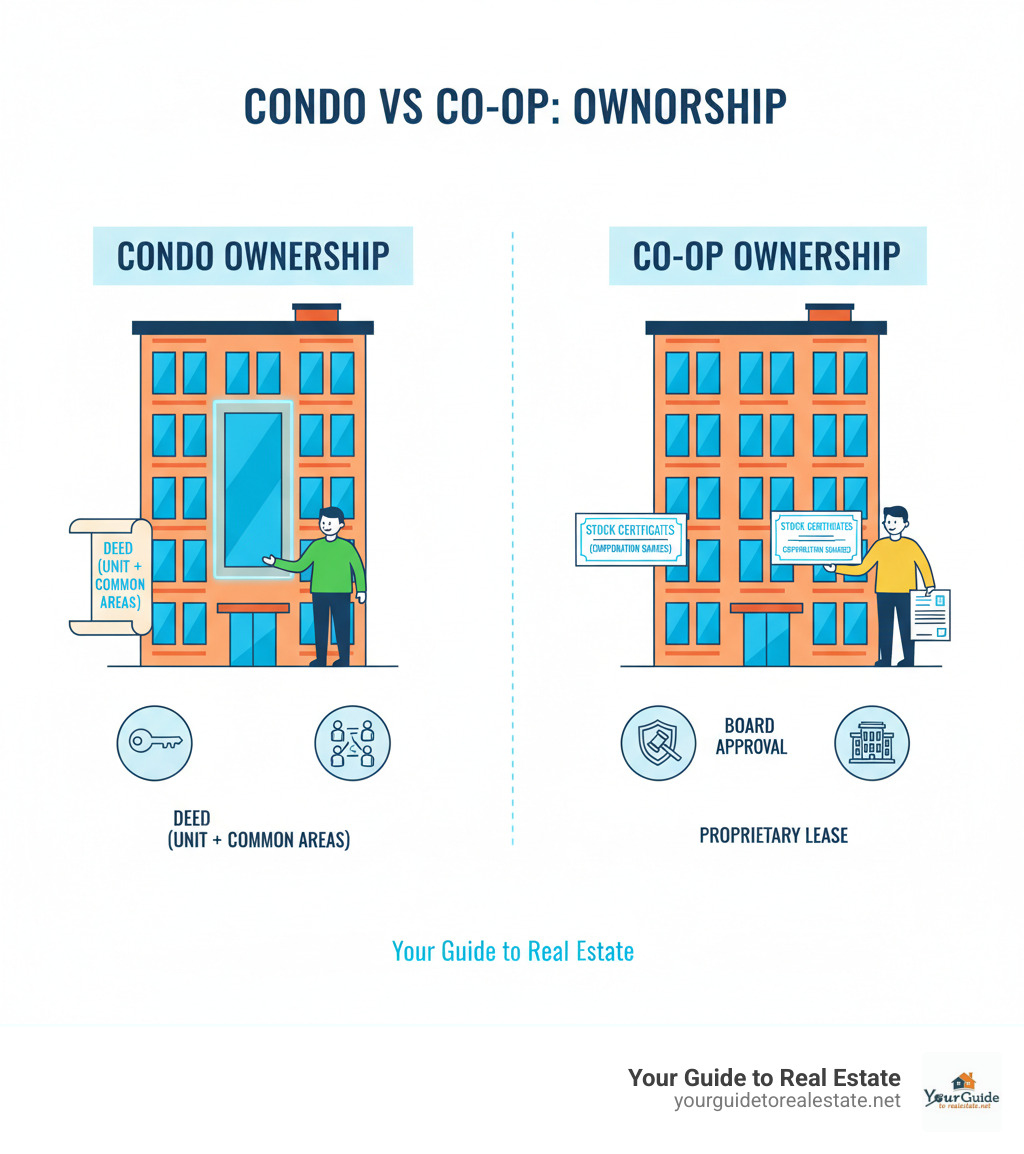
Condo vs coop vocabulary:
The Core Difference: Ownership, Governance, and Approval
Think of the condo vs coop decision like choosing between owning your own car versus buying shares in a car company. Both get you where you need to go, but the experience is completely different. These fundamental differences shape everything from your upfront costs to how much freedom you’ll have in your own home.
| Category | Condo (Condominium) | Co-op (Cooperative) |
|---|---|---|
| Ownership Type | Real Property | Personal Property (Shares in a Corporation) |
| What You Buy | A deed to your individual unit + an undivided interest in common areas | Shares of stock in a corporation that owns the entire building |
| Governance | Condo Association (Board of Managers) | Co-op Board (Board of Directors) |
| Approval Process | Generally simpler; board has “right of first refusal” but rarely uses it | Rigorous; extensive financial vetting, interviews, and references required |
| Best For | Buyers seeking autonomy, investment flexibility, easier financing, and resale | Buyers seeking stability, strong community, lower purchase price, and willing to follow strict rules |
What You Actually Own: Real Property vs. Corporate Shares
Here’s where the condo vs coop distinction gets really interesting. When you buy a condo, you’re getting exactly what you’d expect – you own your apartment. You receive a deed just like buying a house, giving you ownership of your individual unit plus a share of all the common areas like the lobby, gym, and rooftop deck.
Co-ops work completely differently. You don’t actually own your apartment at all. Instead, you’re buying shares in a corporation that owns the entire building. Think of it like owning stock in Apple – you own a piece of the company, but you don’t own the actual iPhone factory. Your shares come with a proprietary lease that gives you the right to live in a specific unit, but the corporation technically owns everything.
This might sound like legal mumbo-jumbo, but it has real-world consequences. Your condo is considered real property that you can mortgage, sell, or renovate more freely. Your co-op shares are personal property with strings attached.
Governance and Decision-Making
Both types of buildings have boards, but their power levels are worlds apart.
Condo associations operate more like neighborhood HOAs. The board of managers handles common area maintenance, enforces community bylaws, and makes decisions about shared spaces. They have some authority, but their control over your individual unit is pretty limited. Once you close your front door, you’re largely the boss of your own space.
Co-op boards, on the other hand, wield serious power. Since the corporation owns everything, the board essentially runs the building like a business. They make building-wide decisions about everything from finances to who gets to live there. Shareholders do get voting rights on major issues, but the board has the final say on most matters that affect daily life.
The difference is striking. Co-op boards often have stricter control because they’re protecting the financial stability of all residents. When everyone’s investment is tied together through shared ownership, the board takes a more hands-on approach to maintaining property values and community standards.
The Application and Approval Process
If you’re comparing condo vs coop buying experiences, this is where you’ll really feel the difference.
Condo approval is refreshingly straightforward. The board typically has a “right of first refusal,” meaning they could theoretically buy your unit themselves if they don’t like your buyer. In practice, this almost never happens. Once your financing is approved, you’re usually good to go. The process feels similar to buying a regular house.
Co-op board approval is an entirely different beast. Picture applying for a job, a loan, and membership to an exclusive club all at once. You’ll need to submit comprehensive financial disclosures, several years of tax returns, reference letters from employers and banks, and personal character references. Then comes the interview – yes, you’ll sit down with board members who will ask about your finances, lifestyle, and plans for the unit.
The board can reject buyers for almost any lawful reason, and sometimes they don’t even have to explain why. This process typically takes 4-8 weeks after you submit your application, and that’s if everything goes smoothly.
Navigating this complex approval process, especially for co-ops, is where having expert guidance becomes invaluable. Understanding How to Find a Good Buyer’s Agent can make the difference between a successful purchase and a frustrating rejection.
Financial Deep Dive: Condo vs Coop Costs
When you’re weighing a condo vs coop decision, the real story isn’t just in the listing price you see online. The financial picture includes everything from how much cash you need upfront to what bills arrive in your mailbox each month. Let’s break down the real costs so you can budget properly.

Purchase Price, Down Payment, and Financing
Here’s where co-ops can look tempting at first glance. Co-ops are often priced about 10% lower than comparable condos in the same area. If you’re shopping in expensive cities like New York or Chicago, this difference can mean tens of thousands of dollars in savings on the purchase price.
But here’s the catch – co-ops usually demand much more cash upfront. While you might snag a condo with as little as 3% down (especially if you’re a first-time buyer), co-ops typically require 20% to 50% down payments. In competitive markets like Manhattan, some co-op boards won’t even look at your application unless you’re putting down 50% or more.
The reason comes down to how financing works. When you buy a condo, you’re purchasing real property, so lenders treat it just like a house. You can get a traditional mortgage with competitive rates and terms. Co-ops are different because you’re buying shares in a corporation, not real estate. This means you need what’s called a “share loan” or “co-op loan.”
Here’s the problem: fewer banks offer these loans, and they see them as riskier. That translates to stricter requirements and higher down payments. It’s like the difference between buying a car (lots of financing options) versus buying shares in a car company (fewer lenders interested).
If you’re trying to steer these financing options, Understanding Mortgages: A Beginner’s Guide to Home Loans can help you understand what to expect.
Closing Costs and Property Taxes
Let’s talk about the money you’ll spend at the closing table. Condos typically come with higher closing costs because you’re buying real property. You’ll pay for title insurance, mortgage recording taxes, appraisal fees, and various legal charges. On a $1 million condo, don’t be surprised if closing costs hit $32,000 or more.
Co-ops generally have lower closing costs since you’re not technically buying real estate. You won’t need title insurance, which can save you several thousand dollars right there. The total closing costs for a co-op are usually significantly less than a comparable condo.
Property taxes work differently too. As a condo owner, you’ll get your own property tax bill based on your unit’s assessed value, just like homeowners do. You pay this separately from your monthly HOA fees.
Co-op owners pay property taxes indirectly through their monthly maintenance fees. You’re essentially paying your share of the building’s total tax bill based on how many shares you own. It’s already bundled into your monthly payment, so you don’t get a separate tax bill.
Monthly Fees: What’s Included?
This is where the condo vs coop comparison gets interesting. The monthly fees tell very different stories about what you’re actually paying for.
Condo HOA fees cover the basics: maintaining common areas, running amenities like gyms or pools, and paying building staff. But as a condo owner, you’ll pay separately for your property taxes, all your utilities, and insurance on your individual unit.
Co-op maintenance fees are usually higher, but they include much more. Your monthly check typically covers your share of the building’s property taxes, the building’s underlying mortgage payments, and often utilities like heat, hot water, and sometimes electricity. Some co-ops even include cable or internet.
The key is doing an apples-to-apples comparison. A co-op maintenance fee of $2,000 might actually cost less than a condo with $1,200 HOA fees once you add property taxes, utilities, and insurance to the condo costs.
To help you crunch these numbers and understand your total monthly housing costs, our Mortgage Payment Calculator Online can be a valuable planning tool.
The bottom line? Co-ops often cost less to buy but require more cash upfront, while condos cost more but offer flexible financing. Your monthly costs might be surprisingly similar once you factor in everything that’s included.
Living There: Rules, Renovations, and Resale
Once you’ve steerd the purchase process, your daily life and future plans will be shaped by your choice between a condo vs coop. From redecorating your kitchen to deciding when to move, the type of ownership you choose has significant implications that affect everything from your weekend renovation projects to your long-term investment strategy.

Rules and Restrictions: Renovations and Subletting
Think of condo ownership like owning your own house within a shared building. Condo owners generally enjoy much more freedom when it comes to renovations within their unit. Want to knock down that wall between your kitchen and living room? Update your bathroom with a luxurious soaking tub? Install hardwood floors throughout? As long as you’re not affecting the building’s structural integrity and you comply with local building codes, you can typically move forward without extensive board approval.
Co-op renovations, however, require a different approach entirely. Since the corporation technically owns your unit, any changes – and we mean any changes – often require board approval first. This includes major renovations like kitchen remodels, but it can also extend to seemingly minor updates like installing new windows, changing flooring, or even certain cosmetic improvements. The board wants to ensure that alterations maintain the building’s standards and don’t negatively impact other residents or the building’s overall value.
When it comes to subletting your unit, the differences become even more pronounced. Condo owners typically enjoy significant flexibility in renting out their units. Most condo associations have minimal restrictions, though some may impose rules about rental caps or minimum lease terms. This flexibility makes condos particularly attractive for investors or anyone who might need to relocate temporarily for work.
Co-ops take a much stricter stance on subletting. Many co-ops prohibit renting entirely, while others allow it only under very specific circumstances and for limited time periods – perhaps 1-2 years within any 5-7 year period. When subletting is allowed, board approval of potential tenants is almost always required, and you might face significant fees for the privilege. This strictness stems from co-op boards wanting to maintain the residential character of their building and ensure a stable community. After all, co-op boards like to “pick their neighbors.” For detailed information about these policies, check out Co-op Sublet Policy Rules.
Marketability, Appreciation, and the Resale Process
When it’s time to sell and move on, your condo vs coop decision continues to impact your experience in meaningful ways.
Condos generally offer broader buyer appeal and a much simpler resale process. Since condos are real property and easier to finance, they naturally attract a larger pool of potential buyers. The approval process for new condo owners is also less stringent, which helps streamline the entire sale. This broader market appeal and easier transaction process typically translate to higher appreciation rates, with condos seeing average annual appreciation of 3-5%.
Co-ops face a more challenging resale environment. The strict board approval process and more difficult financing requirements can significantly limit your buyer pool. Requiring new buyers to undergo rigorous financial vetting and personal interviews – coupled with the board’s ability to reject applicants without providing any reason – can prolong the selling process and deter potential buyers. This often results in slower appreciation rates, with co-ops typically seeing annual increases of just 1-3%.
While the lower purchase price of a co-op can be appealing when you’re buying, these resale challenges become a significant consideration for your long-term financial planning. If you’re thinking about selling your property down the road, our comprehensive guide Sell My Condo offers valuable insights into navigating the market successfully.
Amenities and Community
Both condos and co-ops can offer desirable amenities like gyms, pools, communal lounges, and doormen, but there are often notable differences based on building age and location.
Newer condo developments – which have been predominantly built from the 1970s onward – frequently boast extensive, modern amenities and state-of-the-art facilities. Think rooftop terraces with city views, high-tech fitness centers, and sleek community spaces designed for today’s lifestyle.
Many co-ops, especially in major metro areas like New York City, are housed in older, pre-war buildings. While these buildings often feature classic architectural charm and generous room layouts that you simply can’t find in newer construction, their amenities might be less extensive or modern compared to a recently built condo.
However, co-ops offer something that’s harder to quantify but equally valuable: a strong sense of community. Because residents are shareholders in the same corporation and everyone has undergone that rigorous vetting process, there’s often a greater sense of shared responsibility and genuine camaraderie. Co-op boards are focused on “establishing a stable, in-for-the-long-run group of residents.”
This creates a more tight-knit living environment where neighbors actually know each other and are genuinely invested in the building’s well-being. Condos, with their easier entry and exit processes, can sometimes have a more transient population, leading to a less cohesive community feel. It’s the difference between living in a building where you wave to familiar faces in the hallway versus one where you might not recognize your neighbors from one year to the next.
Which Is the Better Choice for You?
After diving deep into the condo vs coop comparison, you might be wondering which path is right for your situation. The honest answer? There’s no universal “winner” here. The best choice depends entirely on your financial picture, lifestyle preferences, and where you see yourself in five or ten years.
Think of it like choosing between a sports car and an SUV. Both will get you where you need to go, but one might be perfect for weekend adventures while the other suits a family with kids and dogs. Similarly, condos and co-ops serve different needs and priorities.
The Pros and Cons of Condo vs Coop
Let’s break down what each option brings to the table, so you can see which advantages matter most to you.
Condos shine when it comes to easier financing – you might put down as little as 3% in some cases, compared to the 20-50% typically required for co-ops. The approval process is refreshingly simple, often wrapping up in 30-45 days without invasive interviews or extensive financial disclosure. You’ll have more freedom to renovate your space and greater flexibility for subletting, which makes condos attractive for investors looking to generate rental income. When it’s time to sell, you’ll enjoy a broader buyer pool and easier resale process, typically leading to higher appreciation rates of 3-5% annually. Plus, you actually own real property with a deed, giving you that sense of true ownership.
However, condos typically come with higher purchase prices and higher closing costs, including expenses like title insurance. You’ll pay property taxes and utilities separately from your HOA fees, which means more bills to juggle. The community can sometimes feel more transient, with neighbors moving in and out more frequently.
Co-ops offer compelling advantages for the right buyer. The lower purchase price – often 10% less per square foot than comparable condos – can make expensive urban markets more accessible. Lower closing costs help at purchase, and the monthly maintenance fees bundle more expenses like property taxes and utilities, simplifying your budget. You’ll often find a stronger, more stable community thanks to the careful vetting process, and the strict rules protect property values by ensuring financially sound neighbors.
The trade-offs include more challenging financing with fewer lender options, significantly higher down payment requirements, and a rigorous approval process that can feel intrusive and lengthy. You’ll face strict rules on renovations and subletting, slower appreciation rates of 1-3% annually, and less individual control over your living space decisions.
Who Should Buy a Condo?
Condos make the most sense if you’re looking for flexibility and autonomy. Maybe you’re an investor who wants the freedom to rent out your unit without jumping through hoops, or you simply value being able to renovate your kitchen without asking permission from a board.
First-time homebuyers often find condos more accessible thanks to lower down payment options. If you’re working with limited cash upfront, that 3-10% down payment can be a game-changer compared to a co-op’s 20-50% requirement. For guidance through this process, our First-Time Homebuyer Tips can help you steer your options.
Condos also suit buyers who prioritize easy resale. If you anticipate moving in the next few years – whether for career changes, family growth, or lifestyle shifts – the broader buyer pool and simpler selling process can save you significant time and stress down the road.
Who Should Buy a Co-op?
Co-ops work beautifully for buyers seeking stability and community. If you’re planning to stay put for many years and value having neighbors who are equally invested in the building’s long-term success, a co-op’s careful vetting process creates exactly that environment.
Financially strong buyers who can comfortably handle a substantial down payment often find co-ops appealing, especially in expensive metropolitan areas where that lower per-square-foot price can mean the difference between affording your dream neighborhood or settling for something further out.
Co-ops also suit people who actually appreciate structure and rules. If you like the idea that your neighbors can’t turn their unit into a revolving door of short-term rentals, or that renovation decisions go through a thoughtful approval process, then a co-op’s governance might feel protective rather than restrictive.
The key is being honest about your priorities. Do you value maximum flexibility, or do you prefer the stability of a close-knit community? Are you comfortable with a rigorous approval process, or does the thought of a board interview make you break out in a cold sweat? Your answers will point you toward the right choice in the condo vs coop decision.
Frequently Asked Questions about Condos and Co-ops
When people are weighing their options in the condo vs coop debate, we hear the same questions over and over. Let’s explore the most common concerns that come up during our conversations with buyers.
Is a condo or co-op a better investment?
The honest answer? It really depends on what you’re hoping to achieve with your investment.
If you’re looking to maximize your returns and keep your options open, condos typically come out ahead. They tend to appreciate faster – we’re talking about 3-5% annually compared to co-ops’ more modest 1-3%. Plus, if you want to generate some rental income, condos give you the flexibility to sublet without jumping through hoops. When it’s time to sell, you’ll likely find the process smoother and faster since more buyers can actually qualify and get approved.
But here’s where co-ops can shine: they offer stability and an affordable entry point into expensive markets. Think of it this way – you might pay less upfront for a co-op in Manhattan than you would for a comparable condo. The strict rules that some people see as drawbacks actually work to protect property values and ensure your neighbors are financially stable. For long-term residents who value community over quick profits, this can be incredibly appealing.
The bottom line is simple. If your main goal is building wealth through real estate and you want rental income potential, condos usually win. But if you’re looking for a stable home in a premium location at a more accessible price point, co-ops can be a smart choice.
Why are co-ops so much cheaper than condos?
This is one of those questions where the answer reveals why real estate can be so fascinating. Co-ops are cheaper because of a perfect storm of factors that all work together to limit demand.
First, there’s the ownership structure itself. When you buy a co-op, you’re purchasing shares in a corporation rather than actual real estate. This makes some buyers uncomfortable – and rightfully so. It’s just different from what most people expect when they think about “owning” a home.
Then you have the approval gauntlet. The rigorous board interviews, financial scrutiny, and the fact that boards can reject you without explanation? That scares away a lot of potential buyers. When fewer people can or want to buy something, prices naturally stay lower.
The financing challenges add another layer of complexity. Not every lender offers co-op loans, and those that do often require hefty down payments of 20-50%. This immediately eliminates buyers who might be perfectly qualified for a condo with just 10% down.
Finally, all those strict rules about renovations and subletting make co-ops less appealing to investors and people who value flexibility. When you remove investors from the buyer pool, you’re cutting out a significant source of demand.
As one real estate expert put it, co-ops are “cheap for a very real reason.” It’s not because they’re inferior – it’s because they come with trade-offs that many buyers aren’t willing to make.
What are the biggest disadvantages of living in a co-op?
Let’s be frank about this – co-ops aren’t for everyone, and the disadvantages can be deal-breakers depending on your personality and lifestyle.
The biggest challenge is living under strict board governance. Imagine needing permission to install new kitchen cabinets, being told you can’t have certain pets, or finding you can’t rent out your place when you get transferred for work. For people who value autonomy in their own homes, this level of oversight can feel suffocating.
The approval process is another major headache. Not just for buying, but for selling too. You might find the perfect buyer for your co-op, only to have the board reject them for mysterious reasons they’re not required to explain. This can drag out transactions for months and add significant stress to what should be a straightforward process.
Then there’s the financial risk that comes with shared ownership. When the building needs a new roof or the boiler dies, you could face special assessments that cost thousands of dollars. Unlike condo ownership where you’re only responsible for your unit and your share of common areas, co-op ownership means you’re tied to the financial health of the entire building and all your neighbors.
The subletting restrictions can be particularly painful if your circumstances change. Maybe you get married and want to move in with your spouse, or perhaps you land a dream job in another city. With a condo, you could rent out your place fairly easily. With a co-op, you might be stuck with a home you can’t use and can’t rent.
For buyers who prefer a more hands-off approach to homeownership – people who want to paint their walls purple if they feel like it or rent their place out on a whim – these restrictions can make co-op living feel more like a burden than a benefit.
Conclusion: Making the Right Housing Decision

Choosing between a condo vs coop isn’t just about picking a home – it’s about choosing a lifestyle that fits your financial reality and personal values. Throughout this guide, we’ve walked through the fundamental differences that make each option unique, from what you actually own to how much control you’ll have over your daily life.
The decision really comes down to what matters most to you right now and in the future. Condos shine when you value flexibility and autonomy. You get real property ownership with a deed, easier financing options, and the freedom to renovate or rent out your unit without jumping through hoops. They’re typically the better choice if you’re looking at real estate as an investment or if you might need to move in a few years.
Co-ops excel when you prioritize community and stability. Yes, the rules are stricter and the approval process can feel intense, but you’re buying into something special – a tight-knit community where your neighbors are invested in maintaining both the building’s character and its financial health. The lower purchase price can also make expensive markets more accessible, especially if you have substantial savings for that higher down payment.
Your financial situation plays a huge role in this decision. If you’re working with limited cash for a down payment, a condo’s 3-10% requirement might be more realistic than a co-op’s 20-50%. On the flip side, if you have plenty of liquid assets and want to minimize your monthly housing costs in an expensive city, a co-op’s lower purchase price could be perfect.
Think about your personality too. Are you someone who appreciates clear rules and a strong sense of community? Or do you prefer making your own decisions about your living space without asking permission? Neither approach is right or wrong – they just serve different types of people.
At Your Guide to Real Estate, we’ve seen countless buyers steer this exact decision. The key is being honest about your priorities and realistic about your finances. Some people think they want total freedom until they realize they actually love having engaged neighbors who care about the building. Others find that co-op restrictions feel too limiting, even with the financial benefits.
The housing market varies dramatically by location too. In cities like New York, co-ops are everywhere and well-understood by local professionals. In other markets, condos dominate the shared-living landscape. This is where having the right guidance becomes invaluable.
Making the right choice requires more than just reading articles (though we hope this one helped!). You need someone who understands your local market, can crunch the real numbers for your specific situation, and will advocate for your interests whether you’re facing a condo association or a co-op board. For expert help navigating your options and finding the right fit, Choosing a Real Estate Broker who understands both types of properties can make all the difference in your home-buying journey.
There’s no universal “better” option in the condo vs coop debate. There’s only what works better for you, your budget, and the life you want to build in your new home.