
Why the Condo vs House Decision Matters More Than Ever
The condo vs house choice is one of the biggest decisions you’ll face when buying your first home or making your next real estate move. With condos typically priced around $275,666 compared to houses at $318,000, the financial gap has narrowed significantly in recent years.
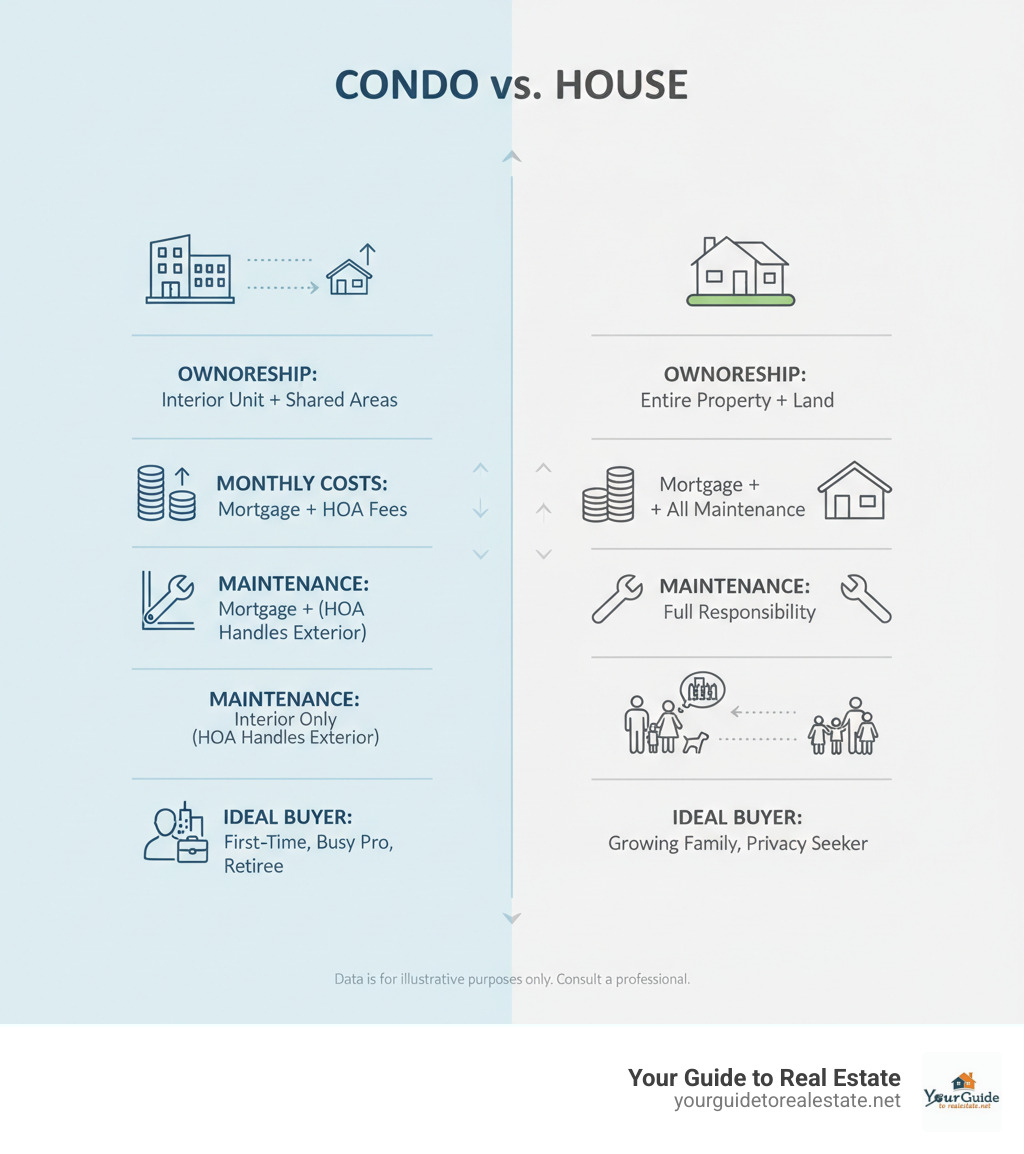
Quick Answer: Key Differences at a Glance
| Factor | Condo | House |
|---|---|---|
| Ownership | Interior unit + shared common areas | Entire property + land |
| Monthly Costs | Mortgage + HOA fees ($200-$1,000) | Mortgage + all maintenance |
| Maintenance | Interior only (HOA handles exterior) | Full responsibility |
| Privacy | Shared walls, less privacy | More privacy, space |
| Location | Often urban, walkable | Suburban, more space |
| Control | HOA rules and restrictions | Full control (within local laws) |
Here’s the reality: there’s no universal right answer. Your choice depends on your budget, lifestyle, and long-term goals.
Condos offer affordability and convenience – perfect for first-time buyers, busy professionals, or retirees who want amenities without yard work. Houses provide space and control – ideal for growing families who value privacy and the freedom to customize their property.
The decision becomes more complex when you consider factors like HOA fees (which can reduce your mortgage qualification), resale value differences, and lifestyle trade-offs between urban convenience and suburban space.
Learn more about condo vs house:
Ownership, Costs, and Responsibilities
When you’re weighing the condo vs house decision, it’s easy to get caught up in pretty pictures and dream kitchens. But here’s the real talk: understanding what you actually own, what you’ll pay, and who handles that 2 AM emergency call makes all the difference.
Think of it this way – buying a condo is like joining a well-organized club with shared responsibilities, while buying a house is like becoming the CEO of your own little empire. Both have their perks and their headaches.
| Feature | Condo | House |
|---|---|---|
| Ownership Structure | Interior unit + shared ownership of common areas | Entire property, including land and structures |
| Upfront Costs | Generally lower purchase price | Typically higher purchase price |
| Ongoing Costs | Mortgage, property taxes, insurance (interior), HOA fees, utilities | Mortgage, property taxes, insurance (full), all maintenance, utilities |
| Maintenance Duties | Interior only; HOA handles exterior, common areas, and landscaping | Full responsibility for interior, exterior, and yard |
| Insurance | Lower, covers interior; HOA policy covers exterior/common areas | Higher, covers entire property |
| Control/Flexibility | Subject to HOA rules; limited modifications | Full control over modifications (within local regulations) |
| Privacy | Shared walls/floors; less privacy | More privacy; detached living |
| Amenities | Access to shared facilities (pool, gym) | Must install/maintain own amenities (or none) |
| Resale Market | Can be more limited/volatile; HOA compliance crucial | Broader appeal; generally more straightforward |
What You Actually Own
Here’s where the condo vs house choice gets interesting. What you “own” isn’t always as straightforward as you might think.
Condo ownership is like owning your apartment plus having a stake in everything else. You own the interior space of your unit – basically everything from the paint on your walls inward, including the airspace within your four walls. But step outside your front door? That hallway, the elevator, the roof above your head, the gym, the pool – you share ownership of all these common areas with your neighbors.
This shared ownership gets managed through a Homeowners Association (HOA). Think of it as a mini-government for your building. You get voting rights and a say in how things run, but you also have to follow the rules everyone agrees on.
House ownership is the full package deal. When you buy a house, you own the entire structure and every square inch of land it sits on. That garage? Yours. The shed out back? Yours too. The weird garden gnome the previous owner left behind? Congratulations, you’re now a gnome owner.
You answer to local zoning laws and city regulations, but there’s no HOA breathing down your neck about your landscaping choices or exterior paint color.
The Financial Breakdown: Upfront vs. Ongoing Costs
Let’s talk money – because this is where the condo vs house decision often gets made or broken.
Purchase price is usually where condos win the affordability contest. In many markets, especially cities, condos cost significantly less upfront than houses. Take Toronto, where the average condo runs about $729,005 compared to $1,097,300 for houses. That’s nearly $370,000 difference – enough to make anyone’s calculator smoke.
Property taxes tend to be friendlier to condo owners too. Since the building’s total value gets divided among all the units, your individual tax bill is usually lower than what you’d pay for a comparable house.
Condo insurance is beautifully simple and cheaper. You only insure what’s inside your four walls – your stuff, your interior improvements, maybe some liability coverage. The HOA handles a master policy that covers the building’s exterior and all those shared spaces.
House insurance? You’re covering everything from the roof shingles to the basement foundation. It’s comprehensive, necessary, and more expensive.
Here’s where condos throw you a curveball: association fees. These monthly payments typically range from $200 to $1,000, depending on your building’s amenities and location. These fees aren’t just disappearing into thin air – they cover exterior maintenance, common area utilities, landscaping, building insurance, and access to amenities.
A portion also goes into a reserve fund for big-ticket items like new roofs or elevator replacements. It’s like a forced savings account for building emergencies.
But sometimes even the reserve fund isn’t enough. Special assessments can pop up when unexpected repairs or financial shortfalls happen. Imagine getting a bill for your share of a new parking lot or emergency structural repairs. It’s not fun, but it happens.
Houses skip the monthly HOA fees (unless you’re in a planned community), but you’re flying solo on all maintenance costs. That new water heater? Your problem. Roof replacement? Start saving.
Maintenance Duties: Who Fixes What?
This is where the condo vs house lifestyle difference really hits home – literally.
Condo living means your maintenance world ends at your front door. Inside your unit, you handle everything – broken appliances, interior painting, flooring replacement, plumbing issues within your walls. But step outside? Not your problem.
That leaky roof? The HOA’s got it. Broken elevator? They’ll call the repair company. Snow removal, landscaping, exterior painting – all handled by professionals hired with your HOA fees. It’s perfect for busy professionals, retirees, or anyone who’d rather spend weekends doing literally anything other than yard work.
House ownership makes you the maintenance manager of your own little kingdom. Inside, outside, top to bottom – if it breaks, you fix it (or pay someone to fix it).
You’ll become intimately familiar with hardware stores, contractor phone numbers, and the joy of weekend home improvement projects. Some people love this control and take pride in maintaining their property. Others find they’re not as handy as they thought and miss having an HOA to call.
The upside? When you want to install that hot tub or paint your house purple (local regulations permitting), there’s no committee to ask permission from. Your house, your rules.
Lifestyle, Location, and Rules
The condo vs house decision isn’t just about brick and mortar; it deeply impacts your daily lifestyle, where you live, and how much freedom you have to express yourself within your home.
Amenities and Community vs. Privacy and Space
Picture this: you wake up on a Saturday morning and decide you want to swim some laps. If you live in a condo, you might just grab your towel and head downstairs to the building’s pool. If you live in a house, you’re either driving to the community center or installing a very expensive backyard addition.
Condo living offers access to shared amenities that would cost a fortune to own privately. We’re talking swimming pools, fitness centers, business centers, lounges, tennis courts, and sometimes even concierge services. The beauty is that these costs get divided among all residents through HOA fees, making luxury amenities surprisingly affordable. Having a gym just steps from your front door without a separate membership fee? That’s the condo advantage.
Many condo complexes also create a built-in community with organized social events, group activities, and regular meetings. This can be fantastic if you’re new to an area or simply enjoy having neighbors who become friends.
But here’s the trade-off: condo living means shared walls, floors, and ceilings. Your upstairs neighbor’s late-night yoga session might become your unwanted soundtrack. Your outdoor space is typically limited to a balcony or small patio rather than a sprawling backyard where the kids can run wild.
House ownership puts you in the driver’s seat of your amenities. Want that pool? You’ll pay for installation and maintenance. Dream of a home gym? It’s entirely your investment. The upside is complete privacy and control. You get more space between you and your neighbors, plus private yards or gardens for relaxation, gardening, or hosting barbecues without checking community rules.
Urban Core vs. Suburban Sprawl
Where you live shapes everything from your morning commute to your weekend plans. The typical placement of condo vs house options can define your entire daily rhythm.
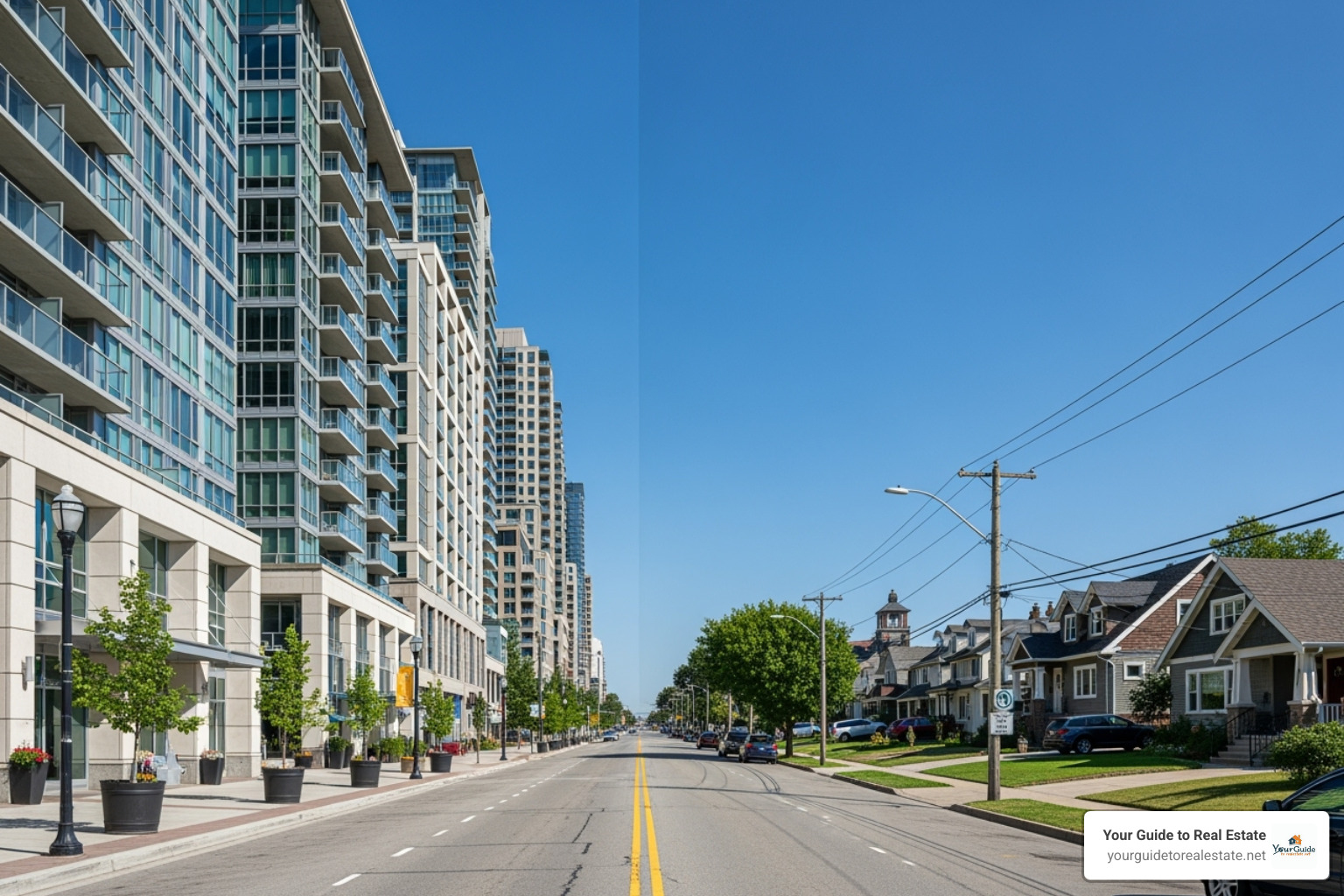
Condos naturally gravitate toward densely populated urban areas and vibrant city centers. It makes perfect sense – when land is scarce and expensive, building up instead of out maximizes the number of homes. This urban location often means you can walk to restaurants, hop on public transportation, and enjoy cultural attractions without ever starting your car.
Your commute might shrink from an hour-long suburban slog to a pleasant 15-minute walk or subway ride. The urban buzz becomes part of your daily life, with coffee shops on every corner and entertainment options just outside your door.
Houses typically spread out into suburbs and rural areas where land is more plentiful and affordable. You get larger lots, quieter streets, and that sense of spaciousness that comes with having actual distance between you and your neighbors. The trade-off? You might spend more time in your car getting to work, restaurants, or entertainment venues.
Some people love the suburban tranquility and space to breathe. Others feel isolated without the energy and convenience of city living.
The Pros and Cons of the Condo vs House Lifestyle
Your home choice creates a ripple effect through every aspect of your daily life, from the rules you follow to the privacy you enjoy.
Condo living offers incredible convenience – less maintenance means more time for the things you actually enjoy. You get access to amenities you probably couldn’t afford on your own, plus a built-in community and often improved security with gated entrances or surveillance systems.
But condo life comes with HOA rules and regulations that can feel restrictive. These associations might dictate what types of pets you can have, where you park, whether you can rent out your unit, and sometimes even interior paint colors for visible changes. Your flexibility to truly personalize your space gets limited by community standards.
The privacy factor is real too. Shared walls mean you’ll hear your neighbors’ music, conversations, and footsteps – and they’ll hear yours. Common facilities mean sharing pool time, gym equipment, and elevator rides with dozens of other residents.
House ownership gives you freedom and autonomy that condo dwellers can only dream about. Want to paint your front door bright purple? Go ahead! Planning a major renovation? No HOA board approval needed (though you’ll still need local permits). You get more space both inside and out, with private yards for gardening, entertaining, or just enjoying solitude.
The flip side is full responsibility for every repair, upgrade, and maintenance task. When the furnace breaks at midnight in January, there’s no building manager to call – it’s all on you. This responsibility can be costly and time-consuming, turning weekends into home improvement projects rather than relaxation time.
Houses can also feel more isolating compared to the built-in community of condo living. If social connections matter to you, you’ll need to work harder to build relationships with neighbors and find your community.
While some single-family home communities do have HOAs, they’re generally less restrictive than condo associations, giving you more control over your property decisions.
The Long-Term View: Investment and Resale Value in the Condo vs House Debate
Beyond the immediate costs and lifestyle considerations, thinking about your future financial picture is absolutely crucial when weighing a condo vs house purchase. After all, for most of us, buying a home represents our largest single investment. Let’s explore how these two property types perform over time and what that means for your wallet.

Getting a Mortgage: What Lenders Think about the condo vs house choice
Here’s something that might surprise you: getting a mortgage for a condo can actually be trickier than financing a house. Lenders don’t just look at you when you’re buying a condo – they’re also scrutinizing your future neighbors and the building’s financial health.
When you apply for a condo vs house mortgage, lenders treat condos with extra caution. They’ll dig deep into the HOA’s financial statements, looking for red flags like insufficient cash reserves, pending lawsuits, or poor budget management. Think of it this way: if the HOA is struggling financially, your investment could be at risk too.
The HOA’s reserve fund is particularly important to lenders. This money pot covers major repairs like roof replacements or elevator upgrades. If it’s underfunded, you might face surprise special assessments down the road – and lenders know this.
Here’s another curveball: monthly HOA fees directly impact your mortgage qualification. Lenders include 50% of these fees when calculating your debt-to-income ratio. So if you’re paying $400 monthly in HOA fees, that’s like having an extra $200 monthly debt payment in the lender’s eyes. This can significantly reduce the mortgage amount you qualify for.
House mortgages, on the other hand, are generally much more straightforward. Lenders focus on the usual suspects: your income, credit score, down payment, and the home’s appraised value. No HOA drama to worry about!
Cashing Out: Selling Your Property
When it’s time to move on, the condo vs house selling experience can feel like night and day.
Selling a condo comes with unique problems that house sellers never face. First, you’ll need to be current on all HOA dues and in good standing with the association. Some HOAs even have the right to approve or screen potential buyers, which can slow down your sale or limit your buyer pool.
The market for condos can also be more volatile. If several units in your building are for sale simultaneously, you’re competing directly with nearly identical properties. Buyers might also hesitate if they’re concerned about restrictive HOA rules or the association’s financial stability.
Houses typically enjoy a broader market appeal. Families looking for space, privacy, and freedom from HOA restrictions often prefer houses. You won’t need HOA approval to sell, and you’re not competing with identical units down the hall. This wider appeal often translates to quicker sales and potentially better prices.
Appreciation and Investment Potential
Let’s talk about the money you’ll make (or lose) over time – because this is where the condo vs house debate gets really interesting.
Historically, houses have been the steady performers in the appreciation game. They tend to grow in value more consistently over time, largely because you own the land beneath them. Land is finite, and as the saying goes, “they’re not making any more of it!” Houses also offer more flexibility for value-adding renovations – you can add a deck, finish a basement, or even build an addition.
The rental income potential for houses is also strong, especially in family-friendly neighborhoods where tenants might stay longer and take better care of the property.
Condos present a more complex investment picture. While they do appreciate in value, the growth is often slower and more volatile than houses. However, don’t write them off completely! In high-demand urban centers, condos can be excellent rental investments. Their lower purchase prices make them accessible to first-time investors, and their prime locations often attract professional tenants willing to pay premium rents.
The key with condo investments is location and timing. A well-located condo in a growing urban market can outperform a house in a stagnant suburban area. But generally speaking, if you’re looking for steady, long-term wealth building, houses have historically been the safer bet.
The bottom line? Both property types can build wealth over time, but houses typically offer more predictable returns while condos can provide higher yields in the right markets. Your choice should align with your risk tolerance and investment timeline.
Who is the Ideal Buyer?
Here’s the truth about the condo vs house decision: there’s no universal winner. Your perfect choice depends entirely on where you are in life, what makes you happy, and what your wallet can handle comfortably.
Think of it this way – choosing between a condo and a house is like choosing between a sleek sports car and a family SUV. Both will get you where you need to go, but one might be perfect for your daily commute while the other excels at weekend camping trips with the kids.
Let’s explore who typically thrives in each type of home, so you can see where you fit best.
A Condo is Perfect For You If…
First-time homebuyers often find condos to be their golden ticket into homeownership. With lower purchase prices and reduced maintenance responsibilities, condos let you start building equity without feeling completely overwhelmed. You’re getting your feet wet in real estate without diving into the deep end of home repairs and yard work.
Busy professionals absolutely love the convenience factor. When your career demands long hours or frequent travel, the last thing you want is to come home to a leaky roof or overgrown lawn. Condos offer that wonderful lock-and-leave lifestyle – perfect for those who’d rather spend their weekends exploring the city than fixing sprinkler systems.
Downsizers and retirees often find that condos are exactly what they’ve been dreaming about. After years of maintaining a large family home, the idea of someone else handling the exterior upkeep feels like pure luxury. Many condo communities also offer built-in social opportunities, which can be wonderful for staying connected and active.
Urban enthusiasts who thrive on city energy find condos irresistible. If you love being able to walk to your favorite restaurant, catch public transit easily, and feel the pulse of downtown life, condos typically deliver this lifestyle in spades. You’re trading square footage for location – and for many people, that’s an excellent trade.
The amenity lovers among us appreciate having access to facilities that would cost a fortune to install privately. That rooftop pool, state-of-the-art gym, or neat party room becomes affordable when the costs are shared among all residents.
Aspiring real estate investors often start with condos because they’re more accessible financially. In high-demand urban areas, condos can generate solid rental income, and they’re generally easier for newcomers to manage than houses.
A House is the Right Choice For You If…
Growing families typically need the space that houses provide. When you’re juggling kids, pets, toys, and all the beautiful chaos of family life, those extra bedrooms, bathrooms, and private yards become absolute lifesavers. There’s something magical about having your own outdoor space where children can play safely.
Privacy seekers who value their peace and quiet often find shared walls challenging. If you’re someone who wants to play music, have friends over, or simply enjoy complete silence without worrying about neighbors, a detached house offers that precious buffer zone.
DIY enthusiasts and creative types love the freedom that comes with house ownership. Want to paint your front door bright yellow? Install a garden shed? Create an elaborate outdoor kitchen? With a house, you’re limited only by local regulations and your imagination – no HOA approval needed.
Pet owners with larger dogs or multiple pets often find houses more accommodating. Many condos have strict pet restrictions, and even when pets are allowed, small spaces and shared areas can be challenging for our furry family members.
Control-oriented individuals who want complete autonomy over their living space tend to prefer houses. You decide everything – from landscaping choices to renovation timing. It’s your kingdom, and you make all the rules (within local laws, of course).
Long-term wealth builders often gravitate toward houses because historically, they’ve shown more consistent appreciation over time. The combination of owning the land and having more flexibility for value-adding improvements can make houses stronger long-term investments.
The reality is that both condos and houses can be wonderful homes – it all comes down to matching the property type with your personality, lifestyle, and goals. Take some time to honestly assess what matters most to you, and the right choice will become clear.
Frequently Asked Questions about Condo vs House
Let’s tackle the most common questions people ask when wrestling with the condo vs house decision. These are the real-world concerns that keep buyers up at night!
Are condos always cheaper than houses?
Here’s where things get interesting – and a bit more complicated than you might expect.
The upfront answer is usually yes. Condos typically have lower purchase prices than houses in the same neighborhood. We’re talking about potentially tens of thousands of dollars in savings on your initial investment. This makes condos incredibly attractive for first-time buyers who are stretching their budget to get into homeownership.
But here’s the plot twist: cheaper to buy doesn’t always mean cheaper to own.
Those monthly HOA fees can really add up over time. While houses don’t have HOA fees (unless they’re in a planned community), you’ll face all maintenance costs yourself. A new roof might cost $15,000, but it’s a one-time expense rather than $400 every single month for years.
The smart approach? Calculate your total monthly housing costs for both options. Include your mortgage payment, property taxes, insurance, and either HOA fees (for condos) or a realistic maintenance budget (for houses). You might be surprised to find that the “cheaper” condo actually costs more per month when you factor in those association fees.
Don’t forget that HOA fees also affect your mortgage qualification. Lenders count these fees when determining how much house you can afford, which could reduce your borrowing power.
Can I renovate my condo?
The short answer is yes – but with some important asterisks attached.
Interior renovations are generally fair game. Want to knock out that wall between the kitchen and living room? Paint your bedroom bright orange? Install new flooring? You can usually do these things without asking permission from anyone.
But here’s where it gets tricky. Any changes that affect the building’s structure, plumbing, electrical systems, or common elements will need approval from your HOA board. This includes moving walls that might be load-bearing, changing plumbing locations, or anything that could impact your neighbors.
Exterior modifications are typically off-limits entirely. That balcony is part of the common elements, so you can’t just decide to enclose it or paint it a different color without going through the proper channels.
Before you start swinging that sledgehammer, review your condo association’s CC&Rs (Covenants, Conditions, and Restrictions). These documents spell out exactly what you can and can’t do. Some associations are pretty relaxed, while others require approval for something as simple as changing your front door color.
The approval process usually involves submitting plans, getting contractor information, and waiting for board approval. It’s not necessarily a dealbreaker, but it does add time and potential frustration to your renovation dreams.
Is a condo a good first home?
Absolutely! Condos can be fantastic starter homes, and here’s why so many first-time buyers fall in love with them.
Affordability is the biggest draw. With lower purchase prices, you’ll need less money for your down payment and can get into homeownership sooner. Instead of renting for another three years while saving for a house, you could be building equity in your own place next month.
The low-maintenance lifestyle is perfect for busy first-time owners. Learning to be a homeowner is overwhelming enough without worrying about roof repairs, landscaping, and exterior maintenance. With a condo, you can focus on making your interior space feel like home while the HOA handles the rest.
You’ll start building equity immediately instead of paying rent that disappears into your landlord’s pocket. Even if you outgrow your condo in five years, you’ll likely have built up enough equity to help with your next home purchase.
The amenities and community aspect can be a huge bonus for young professionals or anyone new to an area. Having a gym downstairs and organized social events makes it easier to meet people and settle into your new neighborhood.
The key is making sure the HOA fees fit comfortably in your budget alongside all your other homeownership costs. But for many first-time buyers, a condo offers the perfect stepping stone into real estate ownership.
Conclusion: Making Your Final Decision
After walking through all the ins and outs of the condo vs house decision, you might be feeling a bit overwhelmed. That’s totally normal! This is one of the biggest choices you’ll make, and there’s a lot to consider.
Here’s the thing: there’s no magic formula that spits out the perfect answer for everyone. What matters most is finding the home that fits your life, your budget, and your dreams.
Maybe you’re that busy professional who lights up at the thought of a downtown condo with a rooftop pool and a five-minute walk to your favorite coffee shop. Or perhaps you’re the growing family who gets excited about weekend projects in your own backyard, where the kids can run around freely.
Your budget plays a huge role, of course. If those monthly HOA fees make you nervous, a house might feel more financially comfortable in the long run. But if the thought of replacing a roof or dealing with a broken furnace at 2 AM makes you break out in a cold sweat, that condo’s maintenance-free lifestyle could be worth every penny of those association fees.
Think about where you see yourself in five or ten years. Are you planning to stay put and build long-term equity? A house often wins on appreciation potential. Looking for flexibility to move with your career? A condo in a desirable urban area might be easier to rent out or sell quickly.
Don’t forget about the lifestyle factors that will affect your daily happiness. Do you thrive in a community setting with organized events and shared spaces? Or do you need your own private sanctuary where you can blast music, paint walls purple, or have your dog run free in the yard?
The beautiful truth is that both condos and houses can be wonderful homes and smart investments – it just depends on what wonderful looks like to you.
We at Your Guide to Real Estate understand that navigating this decision can feel daunting. That’s exactly why we’re here. Our proven framework takes the stress out of the process, helping you weigh all these factors in a way that makes sense for your unique situation.
You don’t have to figure this out alone. A good real estate professional will listen to your priorities, understand your budget, and help you explore options you might not have considered. They’ll also connect you with mortgage specialists who can crunch the numbers and show you exactly what each path looks like financially.
Ready to turn all this thinking into action? Let us help you find the right professional to guide you through this exciting journey.