

Understanding CoreWeave’s Market Position and Investment Potential
At Your Guide to Real Estate, we primarily focus on the tangible world of property investment. However, understanding major shifts in other markets, like the tech sector, is crucial as they often create ripple effects in real estate. CoreWeave stock has captured significant investor attention since its March 2025 IPO, representing a key player in the AI revolution. This boom not only presents a different type of investment opportunity but also drives demand for physical infrastructure, like data centers, impacting local real estate markets. Here’s what you need to know about this pivotal company:
Key CoreWeave Stock Facts:
- Ticker Symbol: CRWV (NASDAQ)
- Current Price Range: $33.52 – $187.00 (52-week range)
- Market Cap: Approximately $48-49 billion
- IPO Date: March 28, 2025
- Business Focus: AI cloud computing and GPU infrastructure
- Stock Status: Publicly traded with high volatility
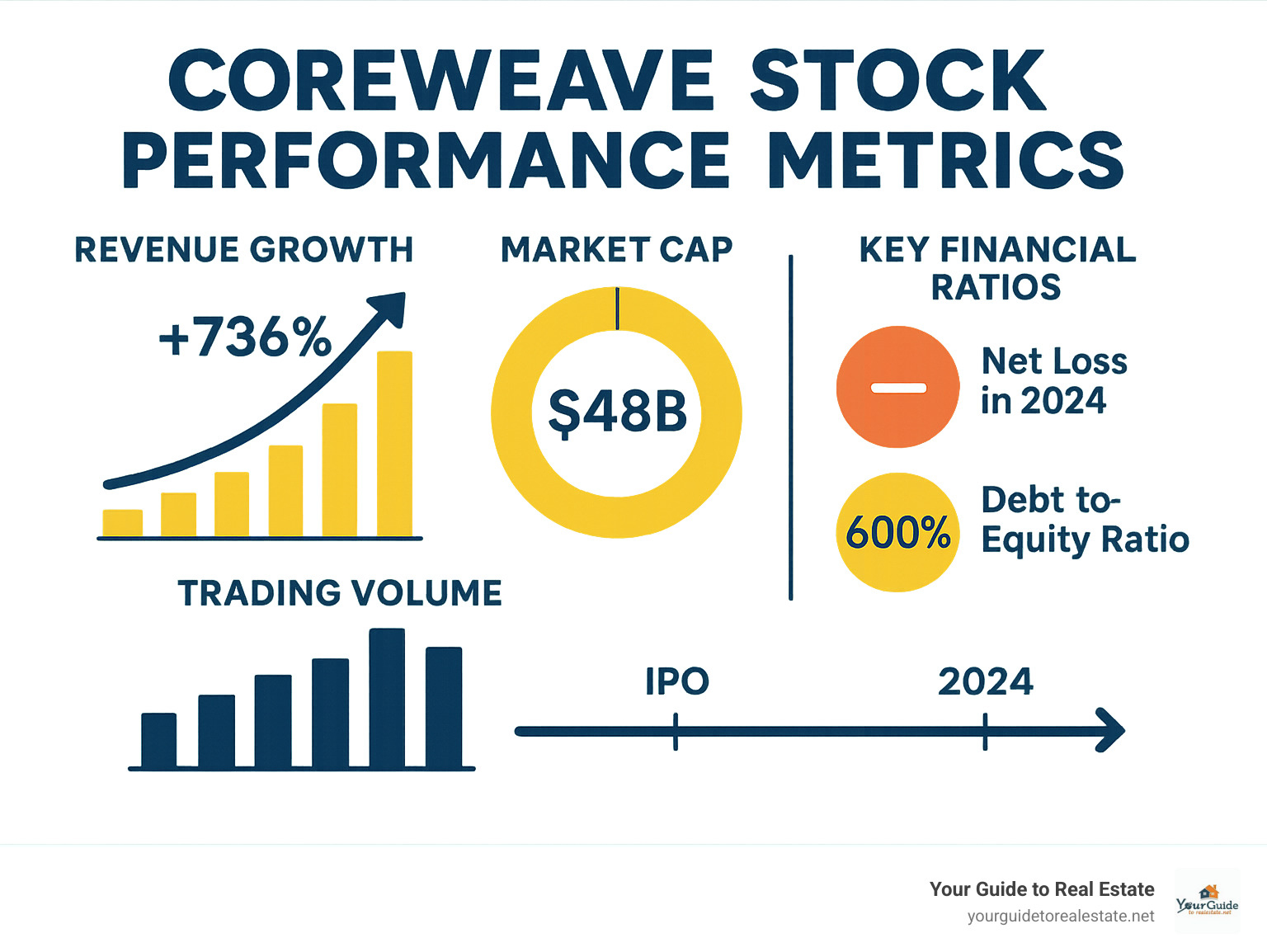
CoreWeave Inc. operates as a specialized cloud infrastructure company that provides the backbone for artificial intelligence applications. The company has experienced explosive revenue growth – jumping from just $15.83 million in 2022 to over $1.9 billion in 2024, representing a staggering 736% year-over-year increase.
However, this growth story comes with significant challenges. Despite massive revenue increases, CoreWeave reported net losses of $863 million in 2024, and the stock has shown extreme volatility since going public. The company’s high debt-to-equity ratio of over 600% has raised concerns among some analysts about its financial sustainability.
For investors weighing their options between stocks and property, or looking to diversify, understanding CoreWeave’s potential and risks is a fascinating case study in modern capital-intensive growth.
Coreweave stock helpful reading:
What is CoreWeave? Understanding the Business Behind the Stock
Imagine you’re trying to teach a computer to recognize millions of images, or training an AI to understand human language. You’d need incredibly powerful hardware – the kind that can crunch massive amounts of data at lightning speed. That’s exactly where CoreWeave comes in.
Founded in 2017 in Livingston, New Jersey, CoreWeave Inc. isn’t your typical cloud computing company. While others try to do everything, CoreWeave has laser-focused on one crucial mission: providing the specialized infrastructure that artificial intelligence needs to thrive.
Think of CoreWeave stock as your investment in the backbone of the AI revolution. The company operates as a specialized cloud provider, but instead of offering generic computing power, they’ve built their entire business around what AI actually needs most – advanced GPU compute power.
Why GPUs matter so much for AI
Here’s the thing about artificial intelligence: it’s incredibly hungry for a specific type of computing power. While your regular computer processor (CPU) handles tasks one at a time, Graphics Processing Units (GPUs) can tackle thousands of calculations simultaneously. For AI training and complex simulations, this parallel processing power is absolutely essential.
CoreWeave recognized this early on and built their CoreWeave Cloud Platform specifically around high-performance GPU infrastructure. They’re not just renting out computer space – they’re providing the specialized tools that AI developers desperately need.
What CoreWeave actually offers
The company’s approach centers on High-Performance Computing (HPC) designed for AI workloads. Their GPU Compute services use the latest NVIDIA GPUs, giving customers access to the kind of processing power that would cost millions to build in-house.
But they don’t stop there. CoreWeave also provides CPU Compute for traditional processing needs, high-speed storage solutions for the massive datasets AI requires, and advanced networking to keep everything running smoothly. They even offer bare metal servers – essentially giving customers direct access to the hardware without any virtual layers slowing things down.
Some of their other key services include managed Kubernetes services for easier deployment, observability tools for monitoring performance, and specialized software like Tensorizer for optimizing GPU performance. They’ve even expanded into VFX and rendering services, leveraging their powerful infrastructure for visual effects work.
The real-world impact
What really sets CoreWeave apart is the scale and quality of their infrastructure—a crucial intersection of technology and real estate. They’re building massive data centers specifically designed for AI workloads. A prime example is their $1.6 billion supercomputer facility in Plano, Texas. From a real estate perspective, a project of this magnitude is transformative. It involves acquiring vast tracts of land, massive construction projects, and drives significant economic activity, which can boost local commercial and residential property values.
This isn’t just impressive—it’s a strategic move that anchors billions in physical assets. Major tech companies like Microsoft and Google are partnering with CoreWeave because they need exactly this kind of specialized infrastructure for their AI projects. When you invest in CoreWeave stock, you’re not just betting on AI; you’re indirectly investing in the immense physical footprint required to power it.
The company has positioned itself as more than just a vendor – they’re a critical partner in powering some of the world’s most ambitious AI initiatives. For investors interested in understanding how AI is reshaping the investment landscape, our analysis at 5StarsStocks.com AI offers valuable insights.

Analyzing the Coreweave Stock (CRWV) Performance
The CoreWeave stock journey since its March 2025 IPO reads like a thrilling financial novel – complete with dramatic plot twists, surprising comebacks, and nail-biting suspense. For a real estate investor accustomed to steady appreciation, this stock’s behavior is a different world. If you’re considering investing in CRWV, buckle up, because this stock doesn’t believe in boring, steady climbs.
Since joining the NASDAQ, CoreWeave has shown the kind of price swings that make day traders both wealthy and gray-haired. The company’s market cap has settled around $48-49 billion, while daily trading volumes often hit tens of millions of shares. That’s a lot of people buying and selling, which tells us investors are definitely paying attention.
The numbers paint a vivid picture of volatility: CoreWeave’s 52-week range spans from $33.52 to $187.00. That’s not a typo – we’re talking about a stock that can swing from around $33 to nearly $200 in a single year. Recent earnings reports have been the main culprits behind these dramatic moves, often sending the stock soaring or plummeting based on whether the numbers beat or missed expectations.

Post-IPO Journey and Key Milestones
CoreWeave’s big debut on March 28, 2025 started with what you might call a stumble. The stock opened nearly 3% below its IPO price, leading some market watchers to call it a “lackluster IPO.” But here’s where the story gets interesting – this initial disappointment was short-lived.
Like a phoenix rising from the ashes, CoreWeave stock quickly found its wings. By the third trading day, shares had soared past their IPO price, proving that sometimes the market just needs a moment to recognize a good thing when it sees one.
Several key events have shaped CoreWeave’s stock story since going public. The company’s explosive revenue growth – jumping from just $15.83 million in 2022 to $1.92 billion in 2024 – caught investors’ attention fast. That’s the kind of growth that makes people sit up and take notice.
CoreWeave’s strategic partnerships have also been game-changers. Their close relationship with NVIDIA, including building what’s been called the “fastest AI supercomputer” for the chip giant, has boosted investor confidence significantly. Add in reports about capturing business from tech giants like Microsoft and Google, and you’ve got a compelling growth story.
Earnings reports have become must-watch events for CRWV investors. Each announcement can send the stock on a wild ride. As reported in CoreWeave Stock Pops on Earnings News, positive earnings news has led to notable stock price jumps, showing just how closely investors tie the company’s performance to its financial results.
The company’s aggressive expansion plans have also moved the needle. These plans are fundamentally tied to real estate, involving the acquisition and development of new data centers. While this physical expansion excites growth-hungry investors, it also introduces financial risks—like zoning, construction delays, and capital costs—that are familiar to any property developer.
Recent Financials and Key Metrics
CoreWeave’s financial story is like watching a startup grow up in fast-forward. The Q2 2025 earnings report, released on August 12, 2025, perfectly captured this growth-versus-investment dynamic. Revenue continued its impressive climb, but the company also reported wider-than-expected losses, causing the stock to dip despite the revenue success.
| Metric | 2022 (Millions USD) | 2023 (Millions USD) | 2024 (Millions USD) | Latest TTM (Millions USD) |
|---|---|---|---|---|
| Revenue | 15.83 | 228.94 | 1,915.43 | 3,530.00 (as of Aug 2025) |
| Gross Profit | 3.71 | 160.16 | 1,422.08 | N/A |
| Net Income | -31.06 | -593.75 | -863.45 | -1,100.00 (as of Aug 2025) |
| EPS (TTM) | N/A | N/A | -2.02 | -3.82 (as of Aug 2025) |
| Market Cap | N/A | N/A | N/A | 47,900.00 (as of Aug 2025) |
| Debt to Equity | N/A | 290.91% | 612.78% | N/A |
| Gross Margin | N/A | 74.24% | N/A | N/A |
The revenue growth story is simply stunning. CoreWeave went from less than $16 million to nearly $2 billion in just two years, reaching over $3.5 billion on a trailing twelve-month basis. That’s the kind of explosive growth that venture capitalists dream about.
But here’s the reality check: net income remains deeply negative, and losses are actually widening. This isn’t necessarily bad news – it’s typical for fast-growing tech companies that are investing heavily in their future. CoreWeave is spending massive amounts on data centers and GPUs, which shows up as capital expenditures that hurt current profits but should drive future revenue.
The debt-to-equity ratio of 612.78% in 2024 is worth paying attention to. For real estate investors, this metric is similar to a loan-to-value (LTV) ratio, and this one is high. It means CoreWeave is borrowing heavily to fund its expansion, making the company sensitive to interest rate changes and market conditions. It’s like financing a large commercial real estate development with minimal equity down—a high-leverage strategy that can lead to spectacular gains or significant losses.
Despite these financial pressures, there’s encouraging news: the company’s CEO noted that “inference” now makes up over 50% of their AI workloads. This signals that their platform is maturing beyond just training AI models to actually running them in production – a more stable and potentially profitable business.
Future Outlook: Growth Drivers vs. Potential Risks
When you’re looking at CoreWeave stock, you’re essentially betting on the future of artificial intelligence. For a real estate investor, it’s analogous to buying property in a neighborhood that’s just been announced as the site of a major new tech campus – the potential for appreciation is huge, but so are the risks before the project is complete. The company sits right in the middle of the AI revolution, which makes it both incredibly exciting and nerve-wracking for investors.
Think of it this way: CoreWeave is building the digital highways that AI needs to travel on. And right now, there’s a massive traffic jam of companies trying to get their AI projects running. That’s great news for CoreWeave’s business, but it also means they need to keep building bigger and better roads – and the real estate to support them – fast.
For investors trying to understand the market landscape better, our guide on Stock Market Terminology can help you steer the investment jargon you’ll encounter.

Key Growth Drivers for Coreweave Stock
The excitement around CoreWeave stock isn’t just hype – there are some solid reasons why investors are paying attention. The biggest driver is simply that AI isn’t going anywhere. In fact, it’s growing faster than anyone expected.
Surging AI demand is the rocket fuel behind CoreWeave’s growth story. Every time you use ChatGPT, ask Siri a question, or see an AI-generated image, there’s specialized computer power working behind the scenes. CoreWeave provides exactly that power, and companies can’t get enough of it. While big cloud companies offer some AI services, CoreWeave specializes in it – like choosing a commercial real estate broker over a residential one for a complex office lease.
Data center expansion is happening at breakneck speed, representing a massive investment in specialized commercial real estate. CoreWeave is acquiring land and building huge, power-hungry facilities. Their project in Texas, dubbed the “fastest AI supercomputer in the world,” is a prime example of how tech growth translates directly into large-scale property development, creating jobs and stimulating local economies.
Strategic partnerships give CoreWeave serious credibility. When tech giants like Microsoft and Google choose your services, and when NVIDIA invests in your company, it’s like getting a five-star review from the most respected names in tech. These aren’t just customers – they’re endorsements that other companies notice.
CoreWeave also has a strong project backlog, which means they’ve already signed contracts for future work. This gives investors some confidence about where revenue is headed, even in uncertain times. It’s like a developer having a building fully pre-leased before construction is even finished.
The company’s recent strategic initiatives show they’re thinking beyond just renting out computer power. They’re building tools and platforms that make it easier for companies to develop AI applications. This creates stronger relationships with customers and makes it harder for them to switch to competitors.
Potential Challenges and Risks for Coreweave Stock
But let’s be honest – investing in CoreWeave stock isn’t a sure thing. There are some real challenges that could trip up even the best-laid plans.
Profitability concerns are probably the biggest worry. CoreWeave is losing money – a lot of money. While their revenue is growing like crazy, they’re spending even more to build their business. It’s like a property developer who keeps buying land and starting new projects but hasn’t generated positive cash flow yet. Eventually, the math has to work.
The high capital expenditure required to stay competitive is staggering, a challenge familiar to any large-scale real estate developer. Building data centers and filling them with chips costs billions. This constant need for capital to fund physical infrastructure makes the company highly dependent on favorable lending conditions and investor sentiment, much like a developer relies on financing for new projects.
Speaking of money, CoreWeave’s significant debt load is a major risk, similar to a property portfolio that is overleveraged. With a debt-to-equity ratio over 600%, the company’s financial structure is aggressive. While debt is a common tool in both tech and real estate to fuel growth, it creates fixed costs (like a mortgage payment) that must be met, adding pressure and risk if revenue streams become unstable.
The evolving cloud market presents another challenge. CoreWeave specializes in AI, but the big cloud companies aren’t sitting still. Amazon, Microsoft, and Google have deep pockets and existing relationships with millions of customers. They’re all racing to offer better AI services too.
Perhaps most immediately concerning is the upcoming IPO lockup expiration. Early investors and company insiders haven’t been allowed to sell their shares since the IPO, but that restriction is about to lift. When it does, there could be a flood of shares hitting the market as people cash out their investments. This doesn’t necessarily mean the company is in trouble, but it could push the stock price down temporarily. You can read more about this situation in CoreWeave’s lockup is about to expire and what that could mean for the stock.
The bottom line? CoreWeave has tremendous potential, but it’s not a safe, steady investment. It’s more like investing in a promising startup that could either become the next big thing or flame out trying to grow too fast.
Frequently Asked Questions about CoreWeave
We know investing in tech stocks can feel overwhelming, especially when you’re dealing with a company as complex as CoreWeave. That’s why we’ve gathered the most common questions people ask us about this AI infrastructure company. Think of this as your friendly neighborhood guide to understanding CoreWeave stock better, with a real estate investor’s perspective.
Is CoreWeave a publicly traded company?
Absolutely! CoreWeave Inc. became a publicly traded company when it launched its IPO on March 28, 2025. You can find it trading on the NASDAQ under the ticker symbol CRWV.
This means anyone can buy and sell CoreWeave shares just like they would with Apple, Microsoft, or any other public company. The fact that it’s listed on NASDAQ (rather than a smaller exchange) shows that CoreWeave meets pretty strict financial and regulatory standards.
Being publicly traded is actually a big deal for CoreWeave. It gives them access to capital markets to fund their massive data center expansion plans—a process similar to how a large Real Estate Investment Trust (REIT) raises funds to acquire more properties. But it also means they’re now under the microscope of public investors and analysts who scrutinize every quarterly report.
Why is CoreWeave stock so volatile?
CoreWeave stock has been on quite the roller coaster since its IPO, and there are several reasons why. This level of volatility is common in high-growth tech sectors and stands in stark contrast to the typically slower, more stable appreciation of real estate assets.
First, it’s still the new kid on the block. New IPOs often experience wild price swings as investors try to figure out what the company is actually worth. Add to that the fact that CoreWeave operates in the red-hot AI sector, where emotions and expectations can run high.
The company’s financials tell a fascinating but nerve-wracking story. On one hand, their revenue growth is absolutely explosive. On the other hand, they’re burning through cash at an alarming rate, with net losses exceeding $800 million.
This creates a constant tug-of-war between investors. Some see the massive growth potential, similar to buying into a rapidly gentrifying neighborhood early. Others look at the mounting losses and high debt load (remember that 600%+ debt-to-equity ratio?) and prefer the relative safety of traditional, income-producing assets like property.
Then there’s the AI hype factor. When AI stocks are hot, CoreWeave soars. When there’s any negative news about AI spending or concerns about a bubble, it can drop just as quickly. The upcoming lockup expiration, where early investors can finally sell their shares, adds another layer of uncertainty to the mix.
What is the analyst consensus on CRWV stock?
The analyst community is pretty divided on CoreWeave stock, which honestly makes sense given how complex the investment thesis is.
As of our latest research, the average analyst rating sits at “Hold.” That’s Wall Street speak for “we’re not sure which way this is going to go.” The 12-month price target hovers around $106.79, suggesting analysts see some upside potential but aren’t wildly optimistic.
The bulls make a compelling case. They point to the insatiable demand for AI computing power and CoreWeave’s strong relationships with tech giants like NVIDIA, Microsoft, and Google. These analysts argue that any weakness in the stock price might actually be a great buying opportunity, especially given the company’s impressive revenue backlog.
The bears, however, have legitimate concerns. They’re worried about the path to profitability and whether CoreWeave can manage its aggressive expansion without drowning in debt. The company’s capital-intensive business model means they need to keep spending big money on data centers and GPUs just to stay competitive.
What’s interesting is that both sides often agree on the fundamentals – AI demand is real, CoreWeave has strong partnerships, and the market opportunity is massive. Where they disagree is on timing, valuation, and execution risk. This ongoing debate among smart people is exactly why the stock remains so volatile.
The bottom line? Even the experts are still trying to figure out what CoreWeave is really worth. That uncertainty creates both opportunity and risk for individual investors.
Conclusion
When we look at CoreWeave stock (CRWV), we see a fascinating intersection of the digital and physical worlds. On one hand, it’s a pure-play bet on the AI revolution. On the other, its success is fundamentally tied to massive real estate endeavors—the acquisition and construction of billion-dollar data centers that reshape local economies. This high-stakes drama, with its explosive growth and significant debt, offers a powerful lesson in risk and reward.
At Your Guide to Real Estate, we believe in making informed investment decisions, whether you’re analyzing a rental property’s cap rate or a tech stock’s volatility. The principles of due diligence, understanding leverage, and assessing market demand are universal. CoreWeave’s journey highlights the extreme volatility of high-growth stocks, which can be a stark contrast to the tangible, long-term stability that real estate often provides.
The stock’s 52-week range tells the whole story: from $33.52 to $187.00. This isn’t an investment for the faint of heart or those seeking predictable returns. It’s a bet on a future that is still being built, both digitally and physically.
Before diversifying your portfolio, it’s crucial to understand your own risk tolerance. Just like you wouldn’t buy a house without an inspection, you shouldn’t buy a stock without understanding the business behind it, its financial health, and how it fits into your overall investment strategy.
The company’s success will ultimately depend on whether it can turn all that demand into actual profits while managing its massive debt load. It’s a high-stakes game with potentially huge rewards, but also very real risks.
Before making any investment decisions, take the time to understand your own financial situation and risk tolerance. Just like in real estate, having the right guidance makes all the difference. Learn how to choose the right professional for your investments – because whether you’re investing in stocks or properties, having expert support can help you make smarter, more confident decisions.