Why Dallas Property Taxes Matter for Every Homeowner
Dallas property taxes are one of the biggest ongoing costs of homeownership, often running thousands of dollars per year. Understanding how they work can save you money and help you make smarter real estate decisions.
Quick Dallas Property Tax Facts:
- Current combined rate: $2.24 per $100 of property value (2024)
- Median rate: About 1.72% of your home’s value annually
- Recent trend: Property taxes increased 32.7% in recent years
- Key deadline: May 15th to protest your appraised value
- Major exemption: $100,000 homestead exemption for school taxes
- Payment due: January 31st each year
Dallas County property taxes fund essential services like schools, police, fire departments, and hospitals. The Dallas Central Appraisal District (DCAD) determines your home’s value each year, while multiple taxing entities – including the City of Dallas, Dallas County, and Dallas ISD – each set their own tax rates.
With home values rising rapidly, many Dallas homeowners have seen their tax bills jump significantly. The good news? You have options to lower your burden through exemptions and protests.
Why This Matters Now
Property taxes in Dallas County have increased by around 32.7% in recent years, making tax planning more important than ever. Whether you’re buying your first home, considering an investment property, or trying to manage rising costs, understanding the system helps you budget better and spot opportunities to save.
How Your Dallas Property Taxes Are Calculated

Your Dallas property taxes are determined by a straightforward process involving two main components: your home’s value and the tax rates set by local governments.
The process begins each year with the Dallas Central Appraisal District (DCAD), which determines your home’s appraised value. This is their estimate of what your house would sell for on the open market. DCAD analyzes recent sales of similar homes, market trends, and your property’s specific features. This annual reassessment means your tax bill can change yearly, even without property improvements.
The Two Key Components: Appraised Value and Tax Rates
Your tax bill is a product of these two factors:
Appraised Value: This is the market value assigned to your property by DCAD. As local real estate values rise, so does your appraised value. For a deeper dive into how properties are valued, check out our guide on Valuation and Market Analysis in Real Estate.
Tax Rates: Each local taxing entity sets its own “ad valorem” (according to value) tax rate, expressed as an amount per $100 of taxable value.
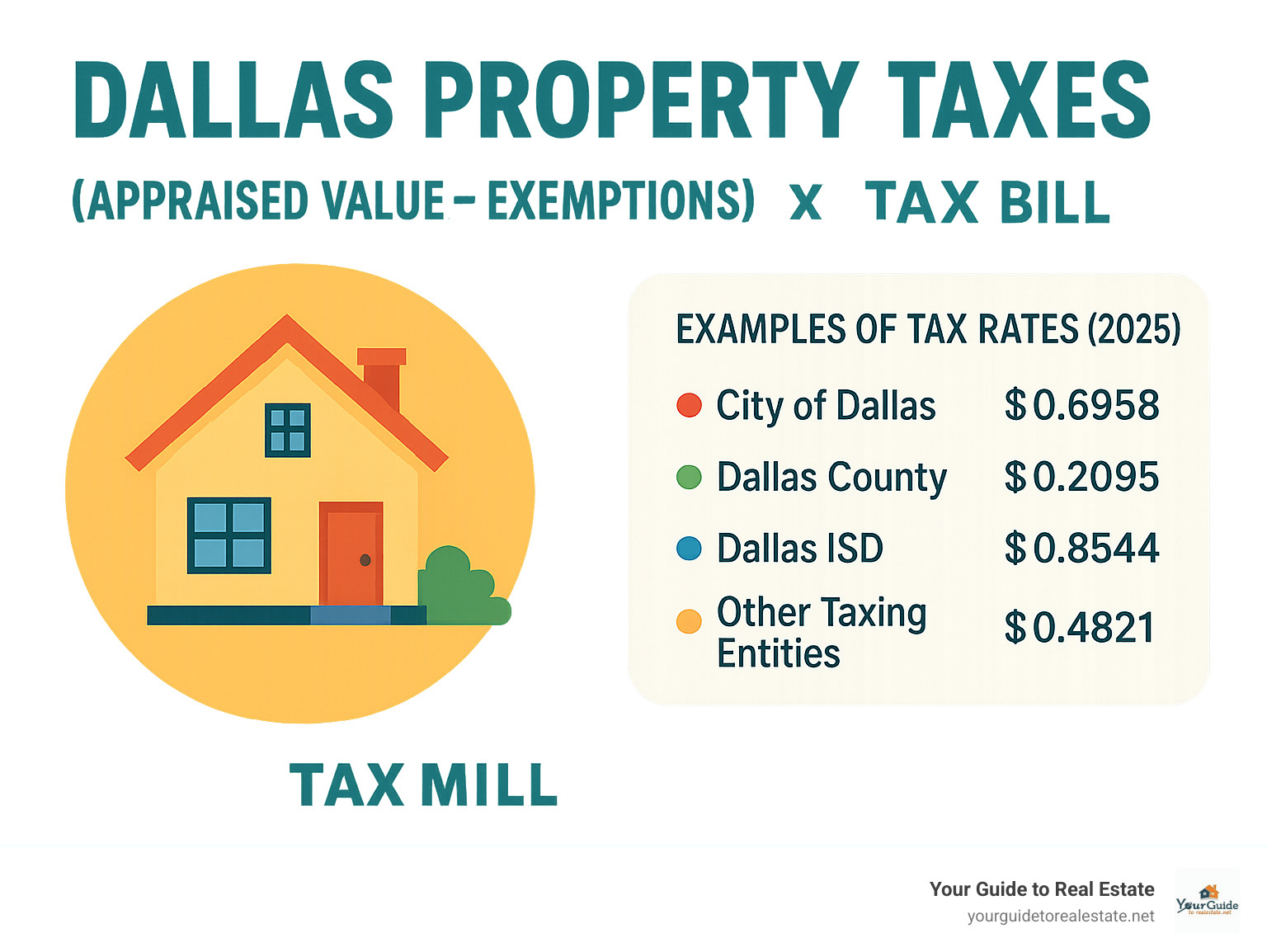
The formula is simple: (Appraised Value – Exemptions) x Tax Rate = Your Tax Bill. You pay several different rates to different entities, which are combined into one bill.
Who Gets a Piece of the Pie?
Your Dallas property taxes are divided among several entities to fund community services:
- The City of Dallas: Funds police, fire, street maintenance, parks, and libraries. The city’s tax rate has declined annually since 2018.
- Dallas County: Covers county-wide services like courts, roads, and health services.
- Dallas Independent School District (DISD): Typically the largest portion of your bill, funding public education. This portion is significantly reduced by the $100,000 homestead exemption.
- Dallas College: Supports community college programs and workforce training.
- Parkland Hospital: Funds the county’s major public hospital.
- Special Districts: Depending on your location, you may pay for Municipal Utility Districts (MUDs) or Public Improvement Districts (PIDs) that fund specific infrastructure.
Decoding the Numbers: Dallas Tax Rates and Comparisons
Understanding the numbers behind your Dallas property taxes can lead to significant savings. These rates are set publicly each year, and knowing the components helps you make sense of your total bill.
Current Tax Rates in Dallas County
Your complete Dallas property tax bill includes several rates. Here are the key players (per $100 of value):
- City of Dallas: $0.7047 (Note: the city’s rate has declined annually since 2018).
- Dallas County: $0.2155
- Dallas Independent School District: $0.9972 (the largest portion)
- Dallas College: $0.1056
- Parkland Hospital: $0.2120
Together, these create a combined rate of approximately $2.24 per $100 of assessed value. On a $300,000 home, that’s about $6,720 in annual taxes before exemptions. Rising home values have caused Dallas County property taxes to increase by about 32.7% in recent years.
Comparing Dallas to Other Major Texas Counties
Since Texas has no state income tax, local property taxes are relatively high. The median property tax rate in Dallas is around 1.72% of a home’s value, but this varies by location. For example, some school districts like Arlington ISD can have rates as high as 2.72%.
How does Dallas compare to other Texas metros? The reliance on property taxes is a statewide characteristic.
| County | General Rate Pattern |
|---|---|
| Dallas County | Around 1.72% median rate, with significant variation by specific location and school district |
| Tarrant County | Comparable rates, varying by city and school district within the county |
| Harris County | Similar reliance on property taxes, with Houston-area rates fluctuating based on local taxing entities |
| Travis County | Austin-area rates often competitive with Dallas, though individual districts vary widely |
| Bexar County | San Antonio region rates generally follow statewide patterns of property tax reliance |
The takeaway is that while rates differ slightly between counties, the most significant variations come from the specific city, school district, and special districts where a property is located.
How Your Dallas Property Taxes Are Calculated
At the heart of your Dallas property taxes lies a straightforward formula: (Appraised Value – Exemptions) x Tax Rate = Your Tax Bill. Let’s break down these crucial components to explain how your annual property tax is determined.
The Two Key Components: Appraised Value and Tax Rates
The journey of your property tax bill begins with the Appraised Value of your home. This critical figure is determined annually by the Dallas Central Appraisal District (DCAD). DCAD’s job is to assess the market value of every property in Dallas County each year. They do this through a mass appraisal process, analyzing market trends, recent sales of comparable properties in your neighborhood, and the specific characteristics of your home (such as size, age, and condition). This annual reassessment ensures that your property’s value for tax purposes reflects the current real estate market.
Once your property’s value is appraised, the second key component comes into play: the Tax Rate. These rates are set independently by various local government entities, often referred to as “taxing units.” Each taxing unit determines its rate based on its budgetary needs to fund public services. The tax rate is an “ad valorem tax,” meaning it’s based on the value of your property. It’s typically expressed as a rate per $100 of valuation. For example, a rate of $0.7047 means that for every $100 of your property’s assessed value, you’ll pay $0.7047 in taxes to that specific entity. We encourage you to dig deeper into how property values are determined and analyzed by exploring our guide on Valuation and Market Analysis in Real Estate.
Who Gets a Piece of the Pie?
Your total Dallas property taxes are not levied by a single authority. Instead, your tax bill is a mosaic of contributions to various independent taxing entities, each responsible for funding specific services within your community. This multi-layered approach ensures that essential public services are well-funded.
Here’s a breakdown of the primary taxing entities that receive a portion of your property tax payments:
- City of Dallas: This portion of your tax bill supports a wide array of municipal services. These include the vital operations of police and fire departments, maintenance of our roads and infrastructure, upkeep of public parks and libraries, and general city administration. We’re pleased to note that the City of Dallas has made efforts to manage its tax burden, with the total tax rate for the City of Dallas having declined annually since 2018.
- Dallas County: This component funds services that operate at the county level. These encompass the county court system, maintenance of county roads, public health initiatives, and the broader administrative functions of Dallas County.
- Dallas Independent School District (DISD): For most homeowners, the DISD portion represents the largest share of their property tax bill. These funds are directly allocated to public education, covering everything from teacher salaries and school operations to facility maintenance and educational programs for students within the Dallas ISD boundaries. It’s particularly impactful to know that the general homestead exemption for school district taxes is $100,000, which can significantly reduce your taxable value for this component.
- Dallas College (formerly Dallas County Community College District): This tax supports the comprehensive community college system, which provides accessible higher education and crucial workforce training programs for residents.
- Parkland Hospital: As a leading public hospital, Parkland often has its own dedicated tax rate. This ensures the hospital can continue to provide essential healthcare services, including emergency care and specialized treatments, to the community.
- Special Districts: Depending on your property’s specific location, you might also be subject to taxes from various special districts. These can include Municipal Utility Districts (MUDs), which fund water, sewer, and drainage infrastructure in developing areas, or Public Improvement Districts (PIDs) that support specific local improvements. These additional components contribute to the overall combined local tax rate.
Each of these entities plays a vital role in our community, and understanding their individual contributions to your total tax bill can provide a clearer picture of how your Dallas property taxes are put to use.
Decoding the Numbers: Dallas Tax Rates and Comparisons
Understanding your Dallas property taxes goes beyond simply knowing your total bill. It involves decoding the individual tax rates set by various entities and comparing them to historical trends and rates in other parts of Texas. This helps us gauge the overall tax burden and its evolution. We’ve seen how these rates contribute to your combined tax liability, and it’s a dynamic landscape influenced by property values and community needs.
Current Tax Rates in Dallas County
To give you a precise understanding of your Dallas property taxes, let’s look at the current tax rates for the major entities in Dallas County. These rates are typically expressed per $100 of your property’s appraised value (after exemptions).
Here are the key rates you’ll find on your tax bill:
- City of Dallas Rate: $0.7047 per $100 in valuation. It’s worth noting that the City of Dallas has shown a positive trend, with its total tax rate having declined annually since 2018. This reflects the city’s efforts to manage its budget and ease the burden on homeowners.
- Dallas County Rate: $0.2155 per $100 in valuation.
- Dallas Independent School District (ISD) Rate: $0.9972 per $100 in valuation. As mentioned, this is often the largest component.
- Dallas College Rate: $0.1056 per $100 in valuation.
- Parkland Hospital Rate: $0.2120 per $100 in valuation.
When we combine these major rates for properties located within the City of Dallas and Dallas County, the total combined local tax rate is approximately $2.23503 per $100 in valuation. This figure gives you a comprehensive view of what you’re paying in taxes for every $100 of your home’s value.
It’s also important to acknowledge recent changes: Dallas County property taxes recently increased by 3.27%, and looking at the broader picture, property taxes in Dallas County have increased by around 32.7% in recent years. This significant increase highlights the impact of rising property values on homeowners’ tax bills. For specific and verified tax rate information, we always recommend checking official sources like the Dallas County Tax Office or the Dallas Central Appraisal District.
Comparing Dallas County Property Tax Rates to Other Major Texas Counties
Texas is unique in its tax structure, as it does not have a state income tax. This absence means that local governments heavily rely on property taxes to fund essential services. Consequently, Texas tends to have higher property tax rates compared to many other states in the U.S. The median property tax rate in Dallas, TX, is about 1.72%, which is generally in line with the state average.
When we compare Dallas property taxes to those in other major Texas counties, we find that while the specific rates might differ slightly based on the unique taxing entities within each county, the overall burden remains significant across the board. For example, the total combined rates in counties like Harris (Houston), Travis (Austin), Bexar (San Antonio), and Tarrant (Fort Worth) will also reflect a combination of city, county, school district, and special district taxes.
While we don’t have a direct table comparing all current rates for these specific counties within our immediate research, we can infer that the situation is similar. Each county’s total rate is influenced by its distinct mix of taxing jurisdictions and their individual budgetary needs. For instance, some school districts, like Arlington ISD within Tarrant County, can have rates as high as 2.72%, which significantly impacts the overall property tax burden in those areas.
The key takeaway is that whether you’re in Dallas, Houston, Austin, or San Antonio, property taxes will be a substantial part of your homeownership costs. This reliance on property taxes is a fundamental characteristic of the Texas tax landscape. Therefore, understanding the components of your bill and exploring ways to reduce your taxable value becomes universally important for Texas homeowners.
Proactive Strategies to Lower Your Tax Bill

You have powerful tools to lower your Dallas property taxes and save thousands annually. The key is to be proactive and understand your options before deadlines pass.
Open uping Savings with Property Tax Exemptions
Exemptions are the easiest way to lower your tax bill. They are straightforward discounts for homeowners in specific situations.
- Homestead Exemption: If your Dallas home is your primary residence, you qualify for a $100,000 reduction in your home’s value for school district taxes. This can save you over $1,000 annually. This exemption also caps the annual increase of your taxable value at 10%, protecting you from sudden tax spikes.
- Over-65 Exemption: Homeowners 65 and older receive an additional value reduction and, most importantly, a freeze on their school district taxes. Your school tax bill will not increase above the amount you paid in the year you qualified.
- Disability Exemption: This works similarly to the over-65 benefit, offering tax relief and freezing the school tax portion of your bill for individuals with a qualifying disability.
- Disabled Veteran Exemption: Texas offers generous benefits to disabled veterans. Depending on the disability rating from the VA, you may qualify for a partial or even a 100% exemption from property taxes on your homestead.
Applying for these exemptions involves filing a simple, one-time application with the Dallas Central Appraisal District (DCAD). Understanding these benefits is crucial, especially for new homeowners. Learn more in our First-Time Homebuyer Tips.
How to Protest Your Appraised Value in Dallas County
If you believe your home’s appraised value is too high, you have the right to protest it. This ensures you’re paying taxes on an accurate valuation.
The deadline to file a protest is May 15th (or 30 days after you receive your appraisal notice). You can file online using DCAD’s uFILE Online Protest System or by mail.
The process typically involves two stages:
- Informal Review: You meet with a DCAD appraiser to present your evidence and discuss your home’s value. Many protests are resolved at this stage.
- Appraisal Review Board (ARB): If you can’t reach an agreement, your case goes before an independent panel that hears evidence from both you and DCAD before making a final decision.
Strong evidence is key to a successful protest. This includes:
- Recent sales data for comparable homes that sold for less than your appraised value.
- Photos and repair estimates for condition issues (e.g., bad roof, foundation problems).
- Proof of inaccuracies in DCAD’s records (e.g., wrong square footage).
- Your recent purchase price, if you bought the home for significantly less than its appraised value.
The protest process ensures your Dallas property taxes are fair and accurate. The time invested can result in significant savings.
Navigating Deadlines, Payments, and Consequences

Once you’ve explored ways to reduce your Dallas property taxes, managing the payment process is the next critical step. Missing deadlines can lead to severe penalties, but staying on top of your obligations is straightforward.
Key Deadlines and Payment Options
The property tax timeline is consistent each year. The Dallas County Tax Office mails bills in October, giving you several months to plan.
- Payment Deadline: Taxes are due by January 31st.
- Delinquency Date: Payments not received or postmarked by January 31st become delinquent on February 1st.
Delinquent taxes immediately begin accruing interest at 1.5% per month, which compounds quickly. Fortunately, the Dallas County Tax Office offers several convenient payment methods:
- Online: Pay via their user-friendly online portal with an electronic check (no fee) or credit/debit card (convenience fee may apply).
- Mail: Ensure your payment is postmarked by the January 31st deadline.
- In-Person: Pay at a Dallas County Tax Office location.
What Happens If You Can’t Pay?
If you face financial hardship, it’s crucial to act quickly. Ignoring the problem will only make it worse.
The consequences for non-payment are serious. In addition to the 1.5% monthly interest, the county can add collection penalties of up to 20% of your bill. The most severe consequence is tax foreclosure, where the county can sue to sell your home to recover the unpaid taxes and legal fees.
However, Dallas County offers assistance. They provide payment plans that allow you to pay your bill in manageable monthly installments. Homeowners with over-65 or disabled person exemptions may also qualify for tax deferral programs, which postpone tax payments until the home is sold. Interest still accrues, but penalties are waived.
If you’re struggling to pay, contact the Dallas County Tax Office immediately. Proactive communication is the best way to avoid the worst-case scenarios and find a solution to keep you in your home.
The Broader Impact on the Dallas Housing Market

Dallas property taxes do more than just affect your personal finances; they shape the entire Dallas housing market, influencing decisions for buyers, sellers, and investors.
How Rising Values Affect Homeowners and Buyers
As Dallas-Fort Worth home values have climbed, so have property tax bills. This creates an “equity trap” for many homeowners–their property is worth more, but their monthly housing costs increase due to higher taxes. This is especially challenging for those on fixed incomes, like seniors. This is why exemptions like the over-65 tax freeze are so critical, as they prevent longtime residents from being priced out of their homes.
For potential buyers, high property taxes are a major factor in affordability. A buyer must budget not just for a mortgage but also for taxes that can add hundreds or thousands to their monthly payment. This can push buyers toward smaller homes or different neighborhoods with lower tax rates, potentially slowing market activity.
However, there is a flip side. These Dallas property taxes fund the essential services that make neighborhoods desirable: good schools, safe streets, and well-maintained parks. When managed well, this creates a “virtuous cycle” where quality services attract residents, increasing property values and generating revenue for even better services. For buyers and investors, finding a property in an area with strong local services can be a wise investment, even if taxes are higher.
Understanding how to factor these costs into your budget is key. Our guide on Understanding Mortgages: A Beginner’s Guide to Home Loans can help. For a look at future trends, see our Housing Market Forecast.
Frequently Asked Questions about Dallas Property Taxes
We’ve compiled answers to the most common questions we receive about Dallas property taxes.
How often are properties reassessed in Dallas County?
Your property gets a fresh look every single year. The Dallas Central Appraisal District (DCAD) reassesses all properties in Dallas County annually, which means your home’s appraised value can change each year. This process involves analyzing recent sales, market conditions, and your property’s characteristics to ensure your appraised value reflects the current market.
Where can I find my specific property tax information?
The easiest way is to use the Dallas County Tax Office’s online Property Tax Search Tool. You can look up your information in three different ways: by your account number, by the owner’s name, or by your property address. This official tool shows your current balance, payment history, and due dates. You can access it from the Dallas County Tax Office Home Page.
What is the general homestead exemption for school taxes in Dallas?
Here’s some great news for Dallas homeowners: the general homestead exemption for school district taxes is $100,000. This is a substantial benefit that can significantly reduce your tax burden. If your home is your primary residence as of January 1st of the tax year, this amount is subtracted from your home’s appraised value before your school district taxes are calculated. Since school district taxes are the largest part of your bill, this exemption provides significant savings–often over a thousand dollars per year. You only need to apply once, and the exemption renews automatically.
Conclusion
Understanding Dallas property taxes is the first step toward managing them effectively. We’ve covered how your bill is calculated, which local entities receive funding, and how you can take control of this significant homeownership cost.
The most important takeaway is that you can proactively manage your tax burden. Applying for the $100,000 homestead exemption, exploring other exemptions for which you may qualify, and protesting your appraised value before the May 15th deadline are powerful strategies that can save you money.
Your Dallas property taxes fund the vital services that make our community a great place to live. While the recent 32.7% increase in taxes has been a challenge, knowledge and action lead to financial empowerment. By staying informed, you can budget effectively and reduce your tax burden.
The Dallas housing market is always evolving. For deeper insights into how market trends might affect your property’s value and tax implications, we encourage you to explore our Housing Market Forecast.
At Your Guide to Real Estate, we are committed to providing the knowledge you need to make informed decisions on your real estate journey.