

Why Did Interest Rates Go Down Today Matters for Your Next Home Purchase
Did interest rates go down today? Yes – both the U.S. Federal Reserve and Bank of Canada cut their key interest rates by 25 basis points on September 17, 2025. Here’s what happened:
U.S. Federal Reserve:
- Cut rates to 4.00%-4.25% range
- First rate cut of the year
- Driven by weakening job market
Bank of Canada:
- Cut policy rate to 2.50%
- Response to rising unemployment (7.1%)
- Economic impact from trade disruptions
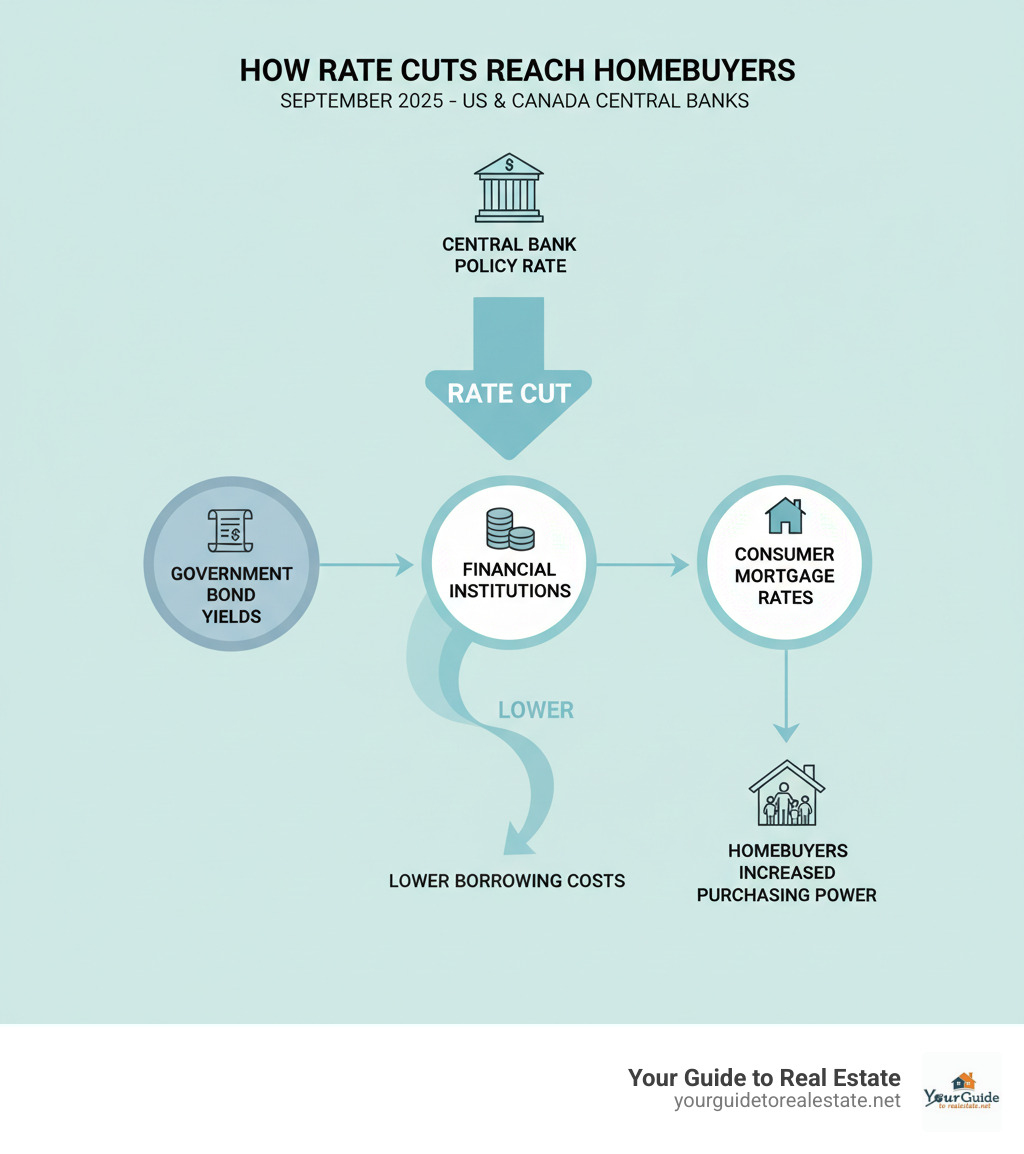
When central banks cut rates, it ripples through the entire economy. Your mortgage payments, home equity lines of credit, and purchasing power all get affected. But here’s the tricky part – mortgage rates don’t always follow central bank moves exactly.
As Fed Chair Jerome Powell noted during Wednesday’s press conference, the rate cut was about “risk management” in response to a softening labor market. Meanwhile, Canada’s central bank cited the need to “revive an increasingly beleaguered labour market.”
For real estate buyers and sellers, these rate changes can shift market dynamics quickly. Lower rates typically mean more affordable borrowing costs, but they also influence buyer demand and home prices.
Did interest rates go down today terms to remember:
The Latest News: Did Interest Rates Go Down Today?
September 17, 2025 will be remembered as a pivotal day in financial markets. Both the U.S. Federal Reserve and Bank of Canada made the same move – cutting their key interest rates by 25 basis points. If you’ve been wondering “did interest rates go down today,” the answer is absolutely yes.
This wasn’t just a coincidence. Both central banks are responding to similar economic pressures: softening job markets, trade disruptions, and the delicate balance between supporting growth and controlling inflation. These decisions will ripple through everything from your mortgage payments to the broader housing market.
The timing matters too. After months of holding rates steady, both banks decided it was time to act. This coordinated approach signals that economic challenges aren’t just local – they’re affecting North America as a whole.

U.S. Federal Reserve: Why Interest Rates Went Down Today
The Federal Reserve broke its nine-month streak of keeping rates unchanged, cutting the federal funds rate to a new range of 4.00%-4.25%. This quarter-point reduction was the Fed’s first rate cut of 2025, and markets saw it coming from a mile away.
Fed Chair Jerome Powell didn’t mince words about why they acted. The biggest concern? A weakening labor market that’s showing troubling signs. August’s job report was particularly disappointing – only 22,000 new jobs were added, and previous months’ numbers were revised downward. The unemployment rate ticked up to 4.3%.
Powell described it perfectly as a “low firing, low hiring” job market. Companies aren’t laying people off in droves, but they’re also not hiring much. This creates a tough situation for anyone looking for work, especially people entering the job market for the first time.
Inflation played a supporting role in this decision. While prices have cooled dramatically from the 9.1% peak we saw in 2023, there’s been a recent uptick. Consumer prices accelerated to 2.9% in August, with core inflation holding at 3.1%. The Fed is walking a tightrope – they want to support the economy without letting inflation run wild again.
Powell called this a “risk management cut” – essentially an insurance policy against economic weakness. The Fed isn’t panicking or signaling a series of aggressive cuts. They’re just being cautious about protecting the economy from potential downturns.
There’s also been considerable political pressure for rate cuts, with public calls from various officials. While Powell maintains the Fed’s independence, these external voices add complexity to an already challenging situation. The Fed’s official announcement emphasized their commitment to making data-driven decisions.
For American homebuyers and homeowners, this rate cut is designed to make borrowing cheaper and stimulate economic activity. However, mortgage rates don’t always move in lockstep with Fed decisions – other factors like housing supply shortages can complicate the picture. If you’re trying to understand how these changes might affect your home loan options, our guide on Understanding Mortgages can help you steer the basics.
Bank of Canada: Why Interest Rates Went Down Today in Canada
The Bank of Canada made a similar move, cutting their policy rate by 25 basis points to 2.50%. This brings the Bank Rate to 2.75% and the deposit rate to 2.45%. It’s the BoC’s first rate cut since March, and it reflects growing concerns about Canada’s economic health.
The Canadian economy has been struggling more visibly than its southern neighbor. GDP actually declined by 1.5% in the second quarter – a significant contraction that caught many economists off guard. The central bank expects growth to remain sluggish at around 1% for the rest of the year.
Canada’s job market tells an even starker story. The unemployment rate jumped to 7.1% in August, up from 6.8% the previous month. Unlike the U.S. “low hiring” situation, Canada has seen actual job losses in recent months, particularly in trade-sensitive industries.
Trade disruptions have hit Canada especially hard. The BoC specifically mentioned the “disruptive effects of shifts in trade” and tariffs as major economic headwinds. Canadian exports plummeted 27% in the second quarter, showing just how vulnerable the economy is to global trade tensions.
The silver lining for Canada? Inflation has remained relatively stable at 1.9% in August, well within the BoC’s target range of 1-3% annually. This gave the central bank more room to focus on supporting economic growth without worrying about runaway prices.
The BoC’s official press release described the rate cut as “appropriate to better balance the risks” given the weaker economy and manageable inflation pressures. For Canadian consumers, this means potentially lower costs for variable mortgages, home equity lines of credit, and other loans tied to the central bank’s rate.
While the BoC doesn’t expect a full recession under current trade scenarios, they’ve made it clear that escalating trade tensions could change that outlook quickly. For anyone following the Canadian real estate market, understanding these economic shifts is crucial for making informed decisions about Real Estate Market Projections for 2025.
3 Ways to Track Interest Rate Changes Yourself
Understanding whether did interest rates go down today is about more than just checking a headline. It’s about knowing where to look and how to interpret the information. Here at Your Guide to Real Estate, we believe in empowering you with the knowledge to make informed decisions. Here are three quick and easy ways to stay on top of interest rate movements that affect your financial life, especially if you’re navigating the real estate market in places like Dallas, Oklahoma City, or anywhere across the U.S.

1. Follow Official Central Bank Announcements
When you want to know “did interest rates go down today” with absolute certainty, there’s no better place to look than the source itself. Central banks don’t keep their decisions secret – they actually want you to know what they’re doing and why.
Think of it this way: the Federal Reserve and Bank of Canada are like the weather forecasters of the financial world. They study economic conditions, make predictions, and then tell everyone what they’ve decided. The difference? Their forecasts can directly impact your mortgage payment.
The U.S. Federal Reserve makes its big announcements eight times a year through something called the Federal Open Market Committee (FOMC) meetings. After each meeting, Fed Chair Jerome Powell doesn’t just release a statement – he holds a full press conference where reporters ask tough questions about the decision.
These aren’t surprise announcements either. The Fed publishes its meeting schedule well in advance, so you can mark your calendar. When they do make a decision, you’ll find the official press release right on the Federal Reserve’s website, usually within minutes of the announcement.
The Bank of Canada follows a similar playbook with eight scheduled announcement dates each year. They’re equally transparent, publishing detailed press releases that explain their thinking. What’s particularly helpful about the BoC is how clearly they connect their rate decisions to what’s happening in the Canadian economy – whether it’s job losses, trade disruptions, or inflation trends.
Here are the key dates to watch for the rest of 2025:
Federal Reserve FOMC Meetings: October 31-November 1, December 12-13
Bank of Canada Rate Announcements: October 29, December 10
The best part? Both central banks offer email alerts and RSS feeds, so you don’t have to remember to check. You can access the Bank of Canada’s announcements directly through their Bank of Canada Press Releases page.
Pro tip: Don’t just read the headlines. The actual press releases often contain hints about future rate moves, which can be just as valuable as the current decision for your real estate planning.
2. Monitor Key Financial News and Government Bond Yields
Here’s something that catches many people off guard: did interest rates go down today from the central bank doesn’t always mean your mortgage rate will drop tomorrow. In fact, sometimes it goes the other way entirely.
The real secret to tracking mortgage rates lies in understanding government bond yields. These are the invisible puppet strings that actually control what you’ll pay for your home loan. When you’re shopping for a mortgage, lenders don’t just look at what the Fed announced – they’re watching the bond market like hawks.
Why bonds matter more than Fed announcements: Fixed mortgage rates, especially 30-year loans, follow the 10-year Treasury yield much more closely than the federal funds rate. Think of it this way – when investors buy government bonds, they’re essentially lending money to the government. The yield they demand reflects their confidence in the economy. Mortgage lenders use these yields as their starting point, then add their own spread for profit and risk.
The bond market never sleeps. While central banks meet just eight times a year, bonds react instantly to every piece of economic data that hits the wires. Employment reports, inflation numbers, retail sales figures – they all send ripples through the bond market. This is why you might see mortgage rates jump on a Tuesday morning even though nothing happened with the Fed.
Here’s a perfect example: After the Fed cut rates on September 17, 2025, you’d expect mortgage rates to fall, right? Instead, they actually rose by 15 basis points because the bond market decided the economy wasn’t as weak as feared. The 10-year Treasury yield climbed to 4.10% as investors interpreted other economic data as showing resilience.
Following financial news becomes crucial when you understand this relationship. Reputable outlets like Reuters, CNBC, and Bloomberg don’t just report what happened – they explain why bond traders are reacting the way they are. You’ll start to notice patterns in how the market interprets different types of news.
The tone and language from Fed officials also moves these markets. If Jerome Powell sounds less committed to future cuts than investors hoped, bond yields can spike even after a rate cut. It’s like the market is constantly reading between the lines of every central bank statement.
For a deeper understanding of these complex relationships, our guide on government bond yields reaction breaks down exactly how these moving parts affect your wallet. And if you’re wondering about recent trends, check out Why Are Mortgage Rates Going Up? for the full story behind these seemingly contradictory movements.
3. Use Your Guide to Real Estate’s Mortgage Rate Tools
Here’s where things get personal and practical. While central bank announcements and bond market movements give you the big picture, you need tools that show you exactly what did interest rates go down today means for your specific situation. That’s where we come in.
Daily rate tracking is crucial because mortgage rates shift constantly – sometimes multiple times in a single day. Take what happened after the Fed’s September 17th rate cut: while the central bank lowered rates, actual mortgage rates climbed to 6.375% within days. The 30-year fixed-rate mortgage that averaged 6.35% on September 11th according to Freddie Mac suddenly looked like a bargain.
This is exactly why we built our mortgage rate tracking tools at Your Guide to Real Estate. Instead of wondering whether rates moved up or down, you can see the current numbers and understand what they mean for your monthly payment.
Your real buying power changes with every rate shift. A quarter-point difference might not sound like much, but on a $400,000 home loan, that’s roughly $60 more per month – or $21,600 over the life of the loan. Our Mortgage Calculator lets you plug in today’s rates and see exactly what your payments would be.
Comparison shopping becomes much easier when you have the right tools. Different lenders offer different rates, and various loan products (15-year, 30-year, ARM) react differently to rate changes. Our guide on How to Compare Mortgages walks you through the process step-by-step.
The beauty of using dedicated mortgage rate tools is that you’re not just getting generic information – you’re getting insights custom to real estate markets and loan scenarios. Whether you’re house hunting in Dallas, refinancing in Oklahoma City, or exploring investment properties elsewhere, having current rate data at your fingertips means you can act quickly when opportunities arise.
Timing matters in real estate. When rates drop, competition often heats up. When they rise, some buyers step back. Having reliable, up-to-date information gives you the confidence to make smart decisions in any market condition.
How Central Bank Rate Cuts Affect Your Wallet
When you hear that did interest rates go down today, your first thought might be “Great! My money goes further now!” But the reality is more nuanced. Rate cuts don’t affect everyone’s wallet the same way, and understanding these differences can help you make smarter financial decisions, especially if you’re navigating the real estate market.
Think of it this way: some loans are like speedboats that quickly follow the current, while others are like cruise ships that take much longer to change course. Let’s explore how these rate cuts actually impact your day-to-day finances.

Impact on Variable-Rate vs. Fixed-Rate Loans
The biggest factor determining how quickly you’ll feel relief from rate cuts is whether your loans have variable or fixed rates. It’s the difference between having a thermostat that automatically adjusts to the weather versus one that stays locked at the same temperature.
Variable-rate loans are the speedboats – they react quickly to central bank changes. If you have an adjustable-rate mortgage (ARM), you’ll likely see your rate drop at your next adjustment period. For Home Equity Lines of Credit (HELOCs), the change often happens within one or two billing cycles. Suddenly, more of your payment goes toward paying down what you actually owe instead of just covering interest.
In Canada, variable-rate mortgages work a bit differently. If you have fixed monthly payments, the rate cut means more of each payment chips away at your principal balance – you’re building equity faster without changing your budget. If you have variable payments, you’ll likely see your monthly bill shrink, freeing up cash for other expenses.
Fixed-rate loans are the cruise ships – they’re much slower to respond. Your 30-year fixed mortgage payment won’t budge just because the Fed or Bank of Canada cut rates today. These loans are tied to longer-term government bond yields, which march to their own drummer based on broader economic expectations.
However, fixed-rate borrowers aren’t completely left out. Rate cuts can make refinancing more attractive down the road, and new fixed-rate mortgages may become cheaper for future borrowers. If you’re thinking about refinancing, our guide on Mortgage Refinancing Explained can walk you through the process.
Here’s how a typical 0.25% rate cut might affect different loan types:
| Loan Type | What Happens |
|---|---|
| Variable-Rate Mortgage | Monthly payment likely drops, or more goes to principal |
| HELOC | Interest costs decrease, minimum payment shrinks |
| Fixed-Rate Mortgage | No immediate change, but refinancing might become worthwhile |
What This Means for the Housing Market
Rate cuts are like adding fuel to the housing market engine, but the engine’s performance depends on many other factors too.
Housing becomes more affordable for buyers when borrowing costs drop. A quarter-point rate cut might not sound like much, but over a 30-year mortgage, it can save thousands of dollars. For first-time buyers in markets like Dallas or Oklahoma City, this improved affordability can be the difference between renting and owning. We’ve already seen seven straight weeks of double-digit growth in purchase applications, with buyers responding to these better conditions.
Existing homeowners get new opportunities too. Those with higher fixed-rate mortgages might find refinancing suddenly makes financial sense. Variable-rate mortgage holders often see immediate monthly payment relief, giving their household budgets more breathing room.
But here’s where it gets tricky – central banks usually cut rates because the economy is struggling. The same economic weakness that prompted these rate cuts can make buyers and sellers more cautious. Rising unemployment, trade war impacts, and general economic uncertainty can dampen enthusiasm even when borrowing becomes cheaper.
The housing shortage adds another wrinkle to the equation. As Fed Chair Powell noted, America’s housing shortage is a “deeper problem” that limits how much rate cuts can actually help. Even with cheaper borrowing, there simply aren’t enough homes for sale in many markets, which keeps prices liftd and competition fierce.
Trade disruptions are particularly affecting Canada’s housing market. The Bank of Canada specifically cited trade war impacts as weighing on their economy, creating uncertainty that goes beyond what lower interest rates can fix.
Despite these challenges, the overall trend is encouraging for anyone considering a move. Buyer demand is strengthening, refinancing applications are picking up, and the market is showing signs of renewed energy. For insights into where the market might head next, check out our Housing Market Forecast.
The key takeaway? Rate cuts are generally good news for your wallet, but the benefits show up differently depending on your specific situation. Whether you’re a first-time buyer looking to enter the market or a homeowner considering refinancing, understanding these dynamics helps you make the most of changing conditions. Our First-Time Homebuyer Tips can help you steer this evolving landscape with confidence.
Frequently Asked Questions about Interest Rate Changes
When central banks make moves like the September 17 cuts, we get flooded with questions from homebuyers and homeowners trying to make sense of it all. The relationship between did interest rates go down today and your actual borrowing costs isn’t always straightforward. Let’s clear up the most common confusion points.
Why do mortgage rates sometimes go up when the Fed cuts rates?
This drives people absolutely crazy, and rightfully so! You hear that the Fed cut rates, yet your mortgage broker quotes you a higher rate than last week. It’s not a mistake – it’s actually quite common. Here’s the thing: mortgage rates march to their own drummer, and that drummer is the bond market, not the Federal Reserve.
Fixed mortgage rates follow government bond yields, particularly the 10-year Treasury, rather than the Fed’s overnight rate. Think of it this way – when the Fed cuts rates but investors interpret this as a sign the economy is actually stronger than feared, they might sell their “safe” government bonds to chase higher returns elsewhere. When bond prices fall, their yields rise, and mortgage rates follow them up.
This exact scenario played out after the September 17 Fed cut. The next day brought better-than-expected jobless claims data, which made investors think, “Hey, maybe the job market isn’t as weak as we thought.” Bond yields jumped, and mortgage rates rose by about 15 basis points, even though the Fed had just cut rates.
Investor sentiment and inflation expectations also play huge roles. If the market thinks Fed cuts might spark inflation down the road, bond investors demand higher yields to protect their purchasing power. The Fed’s tone matters too – if Chair Powell doesn’t sound “dovish enough” (meaning, not committed to aggressive future cuts), the market can react by pushing rates higher.
Mortgage spreads – the difference between what the government pays to borrow and what you pay – can also widen based on lender risk appetite and market conditions. It’s a complex dance, but understanding this helps explain why a Fed cut doesn’t guarantee lower mortgage rates. For deeper insights into these market dynamics, check out our analysis on Will Mortgage Rates Go Down?.
How many more rate cuts are expected this year?
Crystal balls are notoriously unreliable in economics, but we can look at what the Fed itself is signaling and what markets are betting on. The picture for 2025 suggests more cuts are coming, but the pace remains uncertain.
The Fed’s own projections, revealed through their famous “dot plot,” indicated two more “normal-sized” cuts (25 basis points each) for the remainder of 2025 following their September decision. That would bring the federal funds rate down to around 3.50%-3.75% by year-end.
Market futures paint a similar picture, with about 70 basis points of cuts priced in for 2025. This translates to roughly an 86% probability of another cut at the October meeting, though economists are split on whether a third cut happens in October or gets pushed to December.
Professional economists are divided too. A recent Bloomberg survey found over 40% expecting three total cuts for the year, while the median forecast calls for just two. TD Economics, for example, predicts two more Fed cuts before 2025 wraps up.
North of the border, the Bank of Canada’s path looks similar. Most economists expect one more 25-basis point cut before year-end, which would lower their policy rate to 2.25%.
Remember though – central banks love to remind us their decisions are “data-dependent.” Strong economic data, stubborn inflation, or unexpected global events could easily change these projections. The key is staying informed about the economic indicators that drive these decisions. Our Real Estate Financing guide can help you steer these changing conditions.
Will a rate cut make it easier to get a mortgage?
The short answer is yes, but with important caveats. Rate cuts generally make mortgages more accessible, but they don’t wave a magic wand over lending requirements or housing market challenges.
Lower monthly payments are the most direct benefit. When rates drop, your monthly payment for the same loan amount decreases, which improves your debt-to-income ratio – a crucial metric lenders scrutinize. A better DTI can transform you from a “maybe” into a “yes” in a lender’s eyes.
Increased purchasing power follows naturally. With lower payments, you might qualify for a larger loan amount while keeping your housing costs within budget. This effectively expands your home shopping range, whether you’re looking in Dallas, Oklahoma City, or anywhere else.
Competitive lender environment often accompanies rate cuts, as banks and mortgage companies compete for the increased business that typically follows. This can lead to better terms and more flexible offerings, though the fundamentals of lending haven’t changed.
However, your creditworthiness still reigns supreme. A rate cut won’t fix a poor credit score, shaky employment history, or high existing debt levels. Lenders still want to see financial stability and responsible borrowing history.
Housing inventory challenges remain a major hurdle, particularly in the U.S. market. Even if you can afford the mortgage, finding available homes can be tough. Ironically, rate cuts can intensify competition by bringing more buyers into the market, potentially leading to bidding wars that drive up prices.
Economic uncertainty that often prompts rate cuts can also make lenders more cautious about who they approve. While the mechanics of affordability improve, some lenders might tighten other requirements to offset perceived risks in a weakening economy.
The bottom line? Rate cuts definitely help, but they’re just one piece of the homebuying puzzle. Focus on strengthening your overall financial profile and understanding the complete process. Our comprehensive Loan Process for Buying a House guide walks you through everything you need to know to position yourself for success, regardless of where rates are heading.
Stay Ahead of the Market
So, did interest rates go down today? Absolutely – and now you know exactly what that means for your financial future. The September 17, 2025 rate cuts by both the Federal Reserve and Bank of Canada weren’t just numbers on a screen. They were real responses to real economic challenges, from softening job markets to the ripple effects of global trade tensions.
But here’s what we’ve learned together: understanding interest rates goes way beyond catching a single headline. The bond market has its own personality, sometimes moving in the opposite direction of what you’d expect. Mortgage rates can climb even when central banks cut rates, all because investors are reading the economic tea leaves differently.
The three tracking methods we covered – following official announcements, monitoring bond yields through financial news, and using our dedicated mortgage rate tools – give you the complete picture. You’re no longer dependent on someone else’s interpretation of whether rates are good or bad for your situation.
Whether you’re house hunting in Dallas, considering a refinance in Oklahoma City, or anywhere else across the country, these rate movements directly impact your monthly payments and purchasing power. A quarter-point cut might seem small, but over the life of a mortgage, it can save you thousands of dollars.
The real power comes from staying proactive. Markets move fast, and opportunities can appear and disappear quickly. By bookmarking those central bank websites, keeping an eye on Treasury yields, and regularly checking our mortgage rate updates, you’re positioning yourself to act when the timing is right.
At Your Guide to Real Estate, we’re here to turn this complex financial world into actionable insights for your real estate journey. Whether you’re taking your first steps toward homeownership or you’re a seasoned investor, understanding how interest rate changes affect your wallet gives you a significant advantage in today’s dynamic market.
Ready to put this knowledge to work? Start with our comprehensive guide to Understanding Mortgages: A Beginner’s Guide to Home Loans and take control of your real estate future today.