

Understanding the Complete U.S. Stock Market Picture
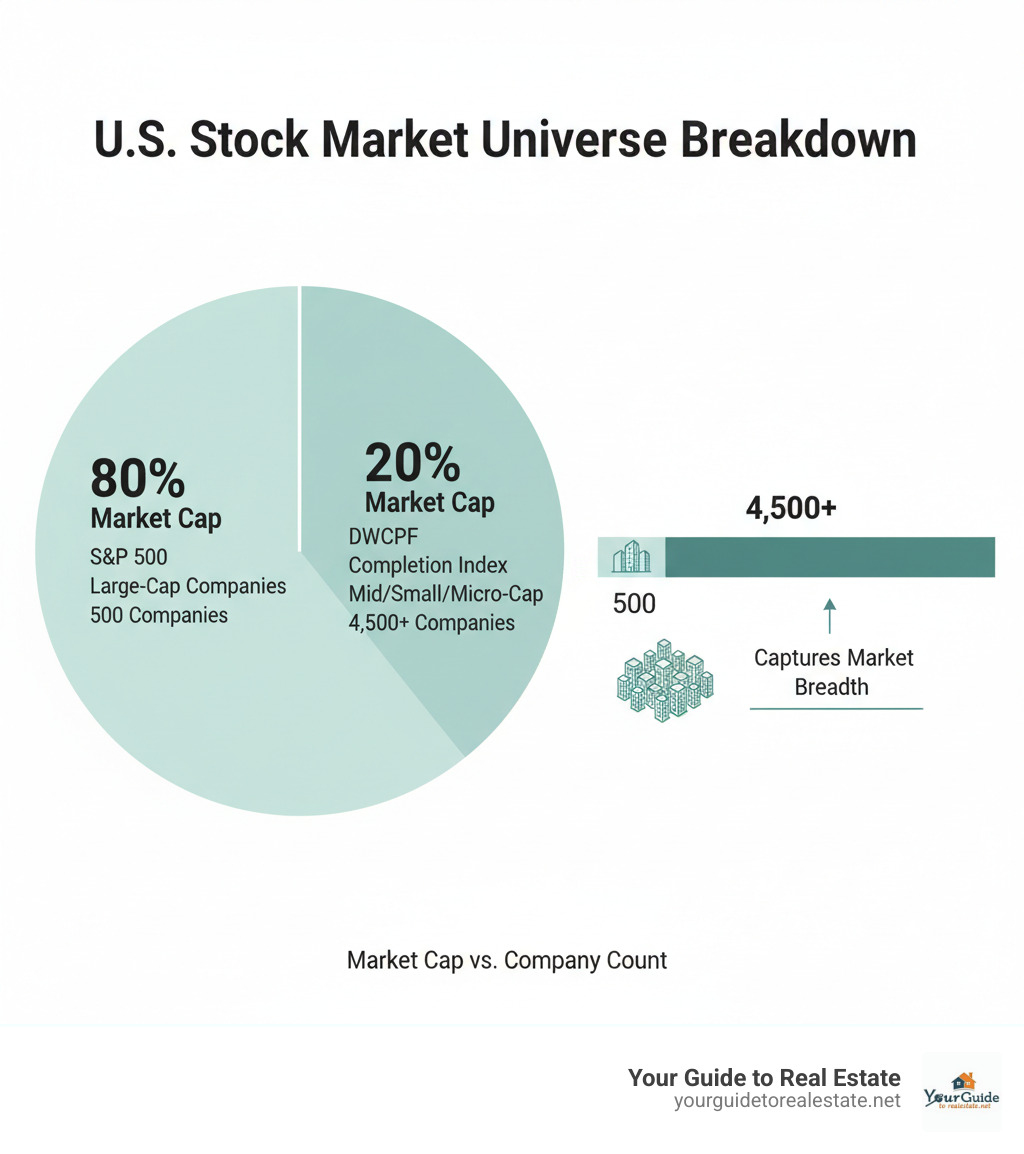
The dow jones u.s. completion total stock market index (DWCPF) is a float-adjusted market capitalization-weighted index of approximately 4,500 common stocks of U.S. companies that are not included in the S&P 500. Here’s what you need to know:
Key Facts About the DWCPF:
- What it tracks: Mid-cap, small-cap, and micro-cap U.S. stocks excluded from the S&P 500
- Number of companies: Approximately 4,500 stocks
- Ticker symbol: ^DWCPF
- Rebalancing: Reconstituted annually in June
- Purpose: Provides exposure to the “rest” of the U.S. stock market beyond large-cap companies
Most investors know about the S&P 500, which tracks the largest U.S. companies. But what about the thousands of smaller companies that make up a significant portion of the American economy?
The DWCPF fills this gap by capturing the performance of mid-cap, small-cap, and micro-cap companies that don’t make it into the S&P 500. Think of it as the “completion” piece of the U.S. stock market puzzle.
This index matters because smaller companies often drive innovation and economic growth. They can also provide different risk-return characteristics compared to large-cap stocks, making them valuable for portfolio diversification.
For real estate professionals and investors, understanding broader market indices like the DWCPF can provide insights into economic trends that affect property markets and investment decisions.
Dow jones u.s. completion total stock market index word guide:
What is the Dow Jones U.S. Completion Total Stock Market Index?
Picture this: you’re trying to understand the entire U.S. stock market, but everyone keeps talking about the same 500 big companies. What about all the other thousands of businesses out there? That’s exactly where the Dow Jones U.S. Completion Total Stock Market Index comes in, and it’s more important than you might think.
The dow jones u.s. completion total stock market index, known by its ticker symbol DWCPF, serves as a crucial market benchmark for the U.S. equity market. Think of it as the missing piece that completes your understanding of American stocks. While most people focus on the giants, this index shines a spotlight on the thousands of smaller companies that are quietly driving innovation and growth across the country.
This isn’t just another random collection of numbers. The DWCPF represents a vital slice of the American economy that often gets overlooked, yet these companies can be some of the most dynamic and fastest-growing businesses in the market.
The “Completion” Concept Explained
Here’s where it gets really clever. The dow jones u.s. completion total stock market index is actually a subindex of the broader Dow Jones U.S. Total Stock Market Index. Its job is beautifully simple: capture everything the S&P 500 doesn’t.
The S&P 500 tracks the 500 largest publicly traded companies in America. But what about company number 501? Or 1,001? Or 4,501? That’s where the DWCPF steps in. By specifically excluding S&P 500 companies, it focuses on capturing the rest of the market.
Imagine you’re putting together a puzzle of the entire U.S. stock market. The S&P 500 gives you the big, central pieces that everyone notices first. The DWCPF provides all those smaller edge pieces that actually complete the picture. Without both parts, you’d never see the full image.
This approach means the DWCPF is literally designed to give you everything else – thousands of mid-sized, small, and micro companies that represent vibrant segments of the American economy.

What Does the DWCPF Represent?
The dow jones u.s. completion total stock market index opens a window into some of the most interesting parts of the American business landscape. It provides significant mid-cap exposure to established companies with proven business models but plenty of room to grow. These firms typically have market values between $2 billion and $10 billion.
The index also offers substantial small-cap exposure to younger, more nimble companies valued between $300 million and $2 billion. These businesses often operate in specialized markets and can deliver impressive growth when they hit their stride.
Even micro-cap companies with market values below $300 million find their place in this index. While these represent the most speculative segment, they’re often where tomorrow’s breakthrough innovations are happening today.
What makes this particularly valuable is how these companies serve as an economic health indicator. Smaller businesses are typically more sensitive to domestic economic conditions, so their performance can signal broader market trends before they show up in large-cap stocks.
For investors, the DWCPF provides crucial diversification beyond large-caps. These smaller companies often move differently than their giant counterparts, which can help smooth out portfolio performance over time. If you’re still getting familiar with these concepts, our Stock Market Terminology guide breaks down these terms in simple language.
The beauty of understanding indices like the DWCPF is that it gives you a more complete picture of where the economy is heading – knowledge that’s valuable whether you’re investing in stocks or making decisions in real estate markets.
Composition and Calculation Methodology
Think of building an index like creating the perfect recipe – you need the right ingredients, proper measurements, and a reliable method that works every time. The dow jones u.s. completion total stock market index follows this same principle, using a carefully crafted approach to capture the performance of thousands of smaller U.S. companies.
This index is what we call a float-adjusted market capitalization-weighted index. That might sound complicated, but it’s actually pretty straightforward. Companies with larger market values get more influence on the index’s performance – kind of like how the loudest voice in a room tends to be heard most clearly. The index includes approximately 4,500 common stocks, making it one of the broadest measures of the non-S&P 500 U.S. equity market you’ll find.
What makes this index particularly reliable is that it’s not set in stone. The composition gets a fresh look through an annual reconstitution process that happens every June. During this review, new eligible companies join the party while others graduate to bigger leagues (like the S&P 500) or exit for various reasons. This keeps the index current and relevant – no stale data here!
The sector breakdown of the index reflects the diverse nature of mid-cap, small-cap, and micro-cap companies across industries like technology, healthcare, financials, and industrials. This diversity is part of what makes the DWCPF such a valuable tool for understanding the broader U.S. economy.

How the dow jones u.s. completion total stock market index is Calculated
The math behind the dow jones u.s. completion total stock market index might remind you of calculating property values in real estate – it’s all about weighing different factors appropriately. The index uses market capitalization-weighted methodology, which means bigger companies (by market value) have more influence on the index’s daily movements.
Here’s where it gets interesting: the index uses float-adjustment to make sure it reflects reality. Not every share of a company is available for regular folks like us to buy. Some shares are locked up by company insiders, governments, or strategic investors. Float-adjustment focuses only on shares that are actually trading in the open market – the ones you and I could purchase tomorrow if we wanted to.
The index divisor is like the secret sauce that keeps everything consistent. When companies merge, split their stock, or join and leave the index, this divisor adjusts to prevent artificial jumps or drops in the index value. It’s mathematical housekeeping that ensures smooth, meaningful data.
Let’s break this down with a simple example. Imagine three companies in our mini-completion index: Company A worth $2 billion, Company B worth $4 billion, and Company C worth $6 billion. The total market cap is $12 billion. Company A would represent about 17% of our index (2÷12), Company B would be 33% (4÷12), and Company C would be 50% (6÷12). If Company C’s stock jumps 10%, it would move our index much more than if Company A jumped the same percentage.
The beauty of this system is that it naturally reflects what investors actually experience in the market. If you’re curious about the financial world and these kinds of calculations, you might want to explore whether Is Finance a Good Career Path? for you.
Key Characteristics of the Index
The DWCPF has some important ground rules that keep it focused and reliable. First, only companies headquartered in the United States make the cut. This isn’t about being exclusive – it’s about maintaining a clear focus on domestic market performance.
All constituent stocks must have their primary listing on a major U.S. exchange. This requirement ensures that the stocks are accessible to American investors and meet certain trading standards. You won’t find obscure companies that only trade a few shares per day cluttering up this index.
The annual rebalancing process in June is like spring cleaning for the index. Companies that have grown large enough to join the S&P 500 graduate out, while new smaller companies that meet the criteria join in. This maintains the index’s role as the “completion” piece of the market puzzle.
Finally, there are liquidity requirements that ensure all included companies trade with enough volume to be meaningful. Think of it as quality control – the index wants to include companies that represent real investment opportunities, not just paper entities that rarely see trading activity.
These characteristics work together to create a benchmark that’s both comprehensive and practical, giving investors a clear window into the performance of America’s mid-sized and smaller public companies.
Why the DWCPF Matters to Investors
When you’re building an investment portfolio, it’s easy to get caught up in the big names – the Apples, Microsofts, and Amazons of the world. But here’s the thing: focusing only on large-cap stocks is like judging a city’s potential by visiting just the downtown skyscrapers. You’d miss the vibrant neighborhoods, emerging businesses, and innovative startups that often drive real growth.
That’s exactly where the dow jones u.s. completion total stock market index becomes invaluable. It opens the door to thousands of companies that might not make headlines but could be the next big thing in their industries.
Think about it this way: many of today’s household names started as small companies. Amazon began selling books from a garage. Google started in a Stanford dorm room. The DWCPF captures companies at various stages of this growth journey, giving you exposure to potential future giants while they’re still growing.

Using the DWCPF as a Performance Benchmark
One of the smartest ways to use the DWCPF is as your measuring stick for smaller company investments. Just like how real estate professionals use comparable sales to value properties, investors need benchmarks to evaluate their portfolio performance.
Tracking non-large-cap performance becomes much clearer when you have the DWCPF as your reference point. If you’ve invested in mid-cap or small-cap stocks, this index shows you how that entire market segment is doing. Are your picks keeping up with their peers? The DWCPF gives you that answer.
Gauging portfolio diversification is another key benefit. A well-balanced portfolio typically includes companies of different sizes, not just the mega-corporations. By comparing your results against both the S&P 500 and the DWCPF, you get a complete picture of how your diversification strategy is working.
Comparing fund managers becomes much more meaningful when you understand what the DWCPF represents. If you’re paying fees for an actively managed small-cap fund, you want to know if that manager is actually adding value beyond what you could get from a simple index approach. Resources like 5StarsStocks.com Best Stocks can help you understand which individual stocks are performing well within these smaller market segments.
Approaches for Extended Market Exposure
Getting exposure to the companies tracked by the dow jones u.s. completion total stock market index doesn’t have to be complicated. There are several practical approaches that work well for different types of investors.
Index-based strategies offer the most straightforward path. While you can’t buy a fund that tracks the DWCPF directly, many funds follow similar “extended market” indices that capture the same companies. These passive investment alternatives give you broad exposure to thousands of smaller companies without the headache of picking individual stocks.
Diversification techniques using mid-cap and small-cap exposure can actually reduce your portfolio’s overall risk while potentially boosting returns. Smaller companies often move differently than large ones – when big companies struggle, smaller ones might thrive, and vice versa. It’s like having different income streams in real estate investing.
Understanding market segments helps you make smarter investment decisions overall. The companies in the DWCPF often respond more quickly to economic changes, making them valuable indicators of where the broader economy might be heading. This knowledge can inform not just your stock investments, but your real estate decisions too.
For those interested in exploring ETF options that provide this type of exposure, platforms covered in our Fintechzoom.com ETF Market guide can be helpful resources for research and comparison.
The bottom line? The DWCPF matters because it represents opportunity – the chance to participate in the growth of America’s emerging companies while building a more resilient, diversified portfolio.
DWCPF Performance and Comparison to Major Indices
Let’s explore the numbers that really matter! When you’re thinking about investing, performance is where the rubber meets the road. The dow jones u.s. completion total stock market index has quite a story to tell, and understanding how it stacks up against the big names can help you make smarter investment decisions.
What makes this particularly interesting is how these smaller and mid-sized companies often march to their own beat. They can be more sensitive to economic changes, which means they might swing higher during good times and dip lower during tough periods. But that volatility? It’s often where the growth opportunities hide.
Historical Performance of the dow jones u.s. completion total stock market index
The numbers tell an encouraging story about the dow jones u.s. completion total stock market index. Recent performance data shows some impressive figures that might surprise you if you’ve been focused solely on the household-name companies.
The index delivered a 1-year performance of 18.17% and an even more impressive 5-year performance of 51.07%. Another recent snapshot showed a 1 Year % Change of 22.03% with a YTD % Change of 4.88%. The 52-week range stretched from 1,905.72 to 2,471.41, showing the kind of movement that creates both opportunities and challenges.
These figures highlight something important: while the giant corporations grab all the headlines, the thousands of smaller companies in the DWCPF have been quietly delivering solid returns. It’s a reminder that innovation and growth aren’t just happening in the boardrooms of Fortune 500 companies.
If you want to stay on top of the latest numbers, you can always check real-time data to see how things are moving day by day.
How the DWCPF Stacks Up
Now for the fun part – seeing how our index compares to the heavy hitters! Understanding these differences helps you see exactly what role the DWCPF plays in the broader market picture.
| Index | Primary Focus | Number of Stocks (approx.) | Weighting Method | Relationship to U.S. Total Market |
|---|---|---|---|---|
| S&P 500 | Large-cap U.S. Equities | 500 | Market Cap-Weighted | Represents the largest segment |
| Nasdaq Composite | Tech-heavy, Growth | 3,000+ | Market Cap-Weighted | Concentrated in technology |
| Dow Jones Industrial Average | 30 Large-cap “Blue-chip” | 30 | Price-Weighted | Narrow, iconic benchmark |
| Russell 2000 | Small-cap U.S. Equities | 2,000 | Market Cap-Weighted | Pure small-cap exposure |
| Dow Jones U.S. Completion Total Stock Market Index (DWCPF) | Mid, Small, Micro-cap U.S. Equities | 4,500 | Float-Adjusted Market Cap-Weighted | Completes the S&P 500 to form the total market |
Versus the S&P 500: Think of this as David and Goliath, but in a good way! The DWCPF is the perfect partner to the S&P 500. While the S&P tracks the corporate giants, the DWCPF covers everyone else. This means it tends to be more volatile – these smaller companies can move faster in both directions. But here’s the exciting part: during economic growth periods, these companies often outpace their larger cousins because they have more room to grow.
Versus the Nasdaq Composite: The Nasdaq is famous for its tech focus and growth story. The DWCPF includes tech companies too, but it’s much more diversified across all sectors. You’ll find everything from regional banks to specialty manufacturers to emerging healthcare companies.
Versus the Dow Jones Industrial Average: The Dow is like that exclusive club with only 30 members, and it uses an unusual price-weighting system. The DWCPF, with its 4,500 companies and market-cap weighting, gives you a much broader and more democratic view of what’s happening in the extended market.
Versus the Russell 2000: Here’s where it gets interesting! The Russell 2000 is the go-to benchmark for small-cap stocks, and many of those companies are also in the DWCPF. But the DWCPF goes further, including mid-cap companies and even micro-cap companies that are too small for the Russell 2000. It’s like getting the Russell 2000 plus a whole lot more.
What makes the dow jones u.s. completion total stock market index special is that it captures a huge slice of American business that often flies under the radar. These companies represent innovation, local economic strength, and the entrepreneurial spirit that drives long-term growth. While they might not make the evening news, they’re quietly building the economy’s future.
Frequently Asked Questions
When we talk about the dow jones u.s. completion total stock market index with friends and clients, we notice the same thoughtful questions coming up again and again. It’s natural to wonder about these less familiar indices, especially when you’re trying to build a complete picture of your investment strategy. Let’s explore the most common questions we hear.
What is the most comprehensive US stock market index?
Here’s something that might surprise you: while the dow jones u.s. completion total stock market index covers an impressive 4,500 stocks, it’s not actually the single most comprehensive index out there. That honor goes to the Wilshire 5000 Total Market Index.
The Wilshire 5000 is like the ultimate stock market collector – it aims to capture virtually all actively traded stocks on major U.S. exchanges. We’re talking about total market coverage here, including everything from the biggest tech giants to the smallest publicly traded companies. It encompasses large-cap, mid-cap, small-cap, and micro-cap stocks in one comprehensive package.
Think of it this way: the DWCPF works with the S&P 500 as a team to give you the complete market picture. The Wilshire 5000, on the other hand, is designed to capture that entire picture all by itself. Both approaches have their merits, but if you’re looking for the most comprehensive single index, the Wilshire 5000 takes the crown.
How often is the DWCPF updated?
Keeping an index accurate and relevant requires regular maintenance, much like how we keep our real estate market analyses current. The dow jones u.s. completion total stock market index follows a disciplined schedule to stay fresh and representative.
The big event happens once a year in June during the annual reconstitution. This is when the index gets its most thorough makeover. Companies that have grown large enough to join the S&P 500 get removed, while new eligible smaller companies get added. It’s a careful balancing act to ensure the index truly reflects the “completion” segment it’s meant to represent.
But the maintenance doesn’t stop there. The index also gets rebalanced quarterly throughout the year. These smaller adjustments help account for market fluctuations and keep the market capitalization-weighted methodology working properly. It’s like fine-tuning a well-oiled machine to make sure it keeps running smoothly.
This regular schedule of updates ensures that when you’re looking at DWCPF data, you’re seeing an accurate snapshot of the extended market, not outdated information.
Are there ways to gain exposure to the DWCPF?
This is probably the most practical question we get, and here’s the honest answer: there are currently no active ETFs directly tracking the Dow Jones U.S. Completion Total Stock Market Index by name. But before you feel disappointed, let us share some good news!
You can absolutely get similar exposure through what we call extended market strategies. Many ETFs and mutual funds are designed to capture the U.S. stock market performance excluding the S&P 500. A great example is the Vanguard Extended Market ETF (VXF), which tracks the S&P Completion Index. These funds serve essentially the same purpose as a direct DWCPF tracker would.
When you’re shopping for passive investment alternatives, look for funds that explicitly mention covering the “total U.S. stock market ex-S&P 500” or similar broad small-cap and mid-cap benchmarks. These are your best bet for getting the market exposure that the DWCPF represents.
The beauty of this approach is that while you might not find an ETF with the exact “DWCPF” ticker symbol, the market segment and investment opportunity it represents are readily accessible through other well-established investment products. It’s like finding a different route to the same destination – you’ll still get where you want to go.
Conclusion: A Complete View for the Savvy Investor
Understanding the dow jones u.s. completion total stock market index has been quite a journey, hasn’t it? What started as another financial acronym has revealed itself to be something much more valuable – a window into the heart of American business innovation and growth.
Think about it this way: when you’re looking at real estate, you wouldn’t just focus on the mansion on the hill and ignore all the charming homes that make up the neighborhood. The same principle applies to investing. The DWCPF shows us that small and mid-cap growth companies – those thousands of businesses working hard outside the S&P 500 spotlight – deserve our attention too.
These companies often drive innovation in ways that larger, more established firms simply can’t match. They’re nimble, hungry, and frequently represent the next generation of market leaders. By understanding what the DWCPF captures, we’re not just expanding our investment knowledge – we’re positioning ourselves to spot opportunities that others might miss.
At Your Guide to Real Estate, we see clear parallels between comprehensive market analysis and smart investing. Just as we emphasize the importance of thorough competitive market analysis in real estate to uncover hidden gems and avoid costly mistakes, understanding indices like the DWCPF helps us see the complete investment landscape.
The skills you develop applying market analysis techniques – whether you’re evaluating neighborhoods or stock indices – create a foundation for better decision-making across all your financial endeavors. You learn to look beyond the obvious, dig deeper into the data, and appreciate how different market segments work together to create the bigger picture.
Whether you’re benchmarking your portfolio performance, seeking diversification opportunities, or simply wanting to understand what drives economic growth in America, the DWCPF offers invaluable insights. It reminds us that significant value often lives just outside the mainstream spotlight, waiting for savvy investors who take the time to look.
By incorporating this broader market perspective into your investment approach, you’re building the kind of comprehensive understanding that leads to more robust and resilient financial decisions. That’s the kind of complete view every savvy investor needs.