
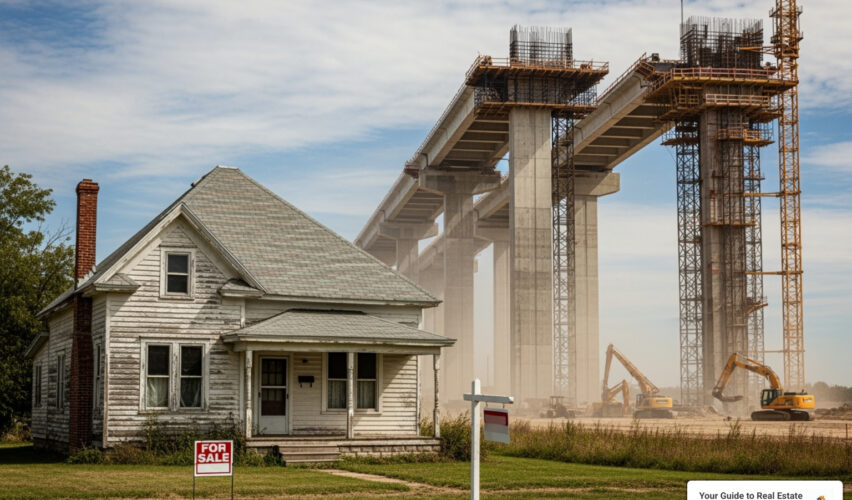
Why Understanding Eminent Domain Examples Matters for Property Owners
Eminent domain examples show how government can legally take private property for public use – and why every property owner needs to understand this power. From historic projects like Central Park to controversial modern cases, these examples reveal when, how, and why your property rights might be challenged.
Quick Answer: Top Eminent Domain Examples
- Central Park (1850s) – Displaced 1,600 residents for public green space
- Hoover Dam (1930s) – Federal land acquisition for infrastructure
- Interstate Highway System – Massive property takings for national transportation
- Kelo v. New London (2005) – Private homes taken for economic development
- AT&T Stadium (Texas) – Sports venue using eminent domain powers
The government’s power of eminent domain rests on the Fifth Amendment’s Takings Clause, which states private property cannot be taken for public use without just compensation. This constitutional protection has shaped American development for over 200 years.
But what does “public use” really mean? How is “just compensation” determined? And what rights do you have as a property owner?
These questions matter more than ever. Since the controversial Kelo decision in 2005, 47 states have strengthened their protections against eminent domain abuse. Recent cases involving pipelines, sports stadiums, and infrastructure projects show this issue affects property owners nationwide.
Understanding real eminent domain examples helps you recognize the warning signs, know your rights, and protect your property’s value. Whether you’re buying, selling, or investing in real estate, these cases provide crucial lessons about property rights in America.
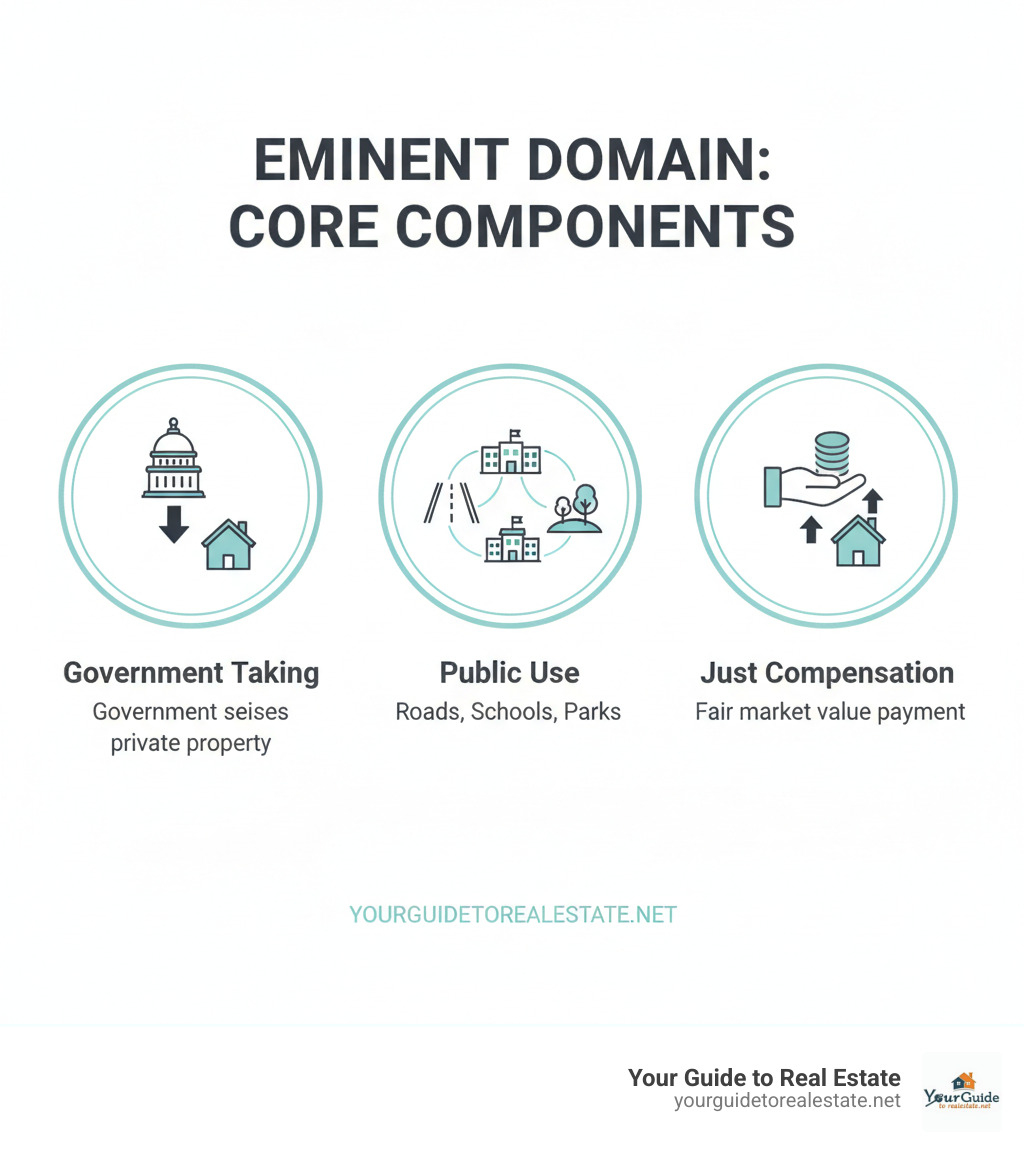
Know your eminent domain examples terms:
What Is Eminent Domain and Its Constitutional Basis?
Picture this: you’re enjoying your morning coffee when a government official knocks on your door with paperwork saying they need your land for a new highway. While this scenario might sound like a nightmare, it’s actually a legal process called eminent domain – and understanding it could save you thousands of dollars.
Eminent domain is the government’s power to take private property for public use, even when you don’t want to sell. It’s not some modern invention either – this authority has been shaping America’s landscape for centuries, creating everything from the roads you drive on to the schools your children attend.
But here’s the good news: the government can’t just swoop in and take your property willy-nilly. The Fifth Amendment of our Constitution, specifically the Fifth Amendment’s Takings Clause, puts strict limits on this power. This part of the Bill of Rights states that private property cannot be taken “for public use, without just compensation.”
Those twelve words pack a powerful punch. They create two non-negotiable requirements: any government taking must serve a public use, and you must receive just compensation for your property.
The meaning of “public use” has evolved significantly over the decades. Back in the day, it meant exactly what it sounds like – the public had to directly use the property, like for a post office or park. But as America grew more complex, so did our interpretation of this phrase.
Today’s courts often consider a broader “public purpose” as valid justification. This shift has opened the door for government takings in blighted areas that need urban renewal, or even economic development projects that promise jobs and tax revenue. These changes have created some of the most controversial eminent domain examples in recent history.
Just compensation means the government must pay you fairly – typically the fair market value of your property. This isn’t just about the land itself; it’s about making you whole financially. Understanding Real Estate Valuation becomes crucial when the government comes knocking, because their first offer might not reflect your property’s true worth.
There’s also something called inverse condemnation – a fancy term for when government actions damage your property value without formally taking it. Maybe they build a noisy highway right next to your quiet home, or new regulations make your land unusable. In these cases, you can actually sue the government for compensation.
How Is ‘Public Use’ Defined?
The definition of “public use” is surprisingly flexible – and that flexibility has sparked decades of legal battles. A look at how the federal government defines public use reveals a fascinating history of creative interpretations.
What started as a narrow concept has expanded to include “public benefit,” “public advantage,” and even “public employment.” This broader interpretation allows governments to take private property for projects that serve the community indirectly rather than through direct public access.
Infrastructure projects like roads, bridges, and utility lines are the most common and least controversial uses. We all benefit from having electricity, clean water, and ways to get around town. Public buildings such as schools, courthouses, and government offices also fall clearly within acceptable public use.
Parks and recreational areas create obvious public benefit by providing green spaces for everyone to enjoy. Environmental protection efforts protect sensitive ecosystems that benefit current and future generations. Historical preservation projects, like protecting important battlefields, preserve our shared heritage.
Military readiness has justified massive land acquisitions, especially during wartime when the government needed training grounds and defense installations quickly. The federal government’s power here is considered essential for national security and independence.
But here’s where things get interesting – and controversial. Economic revitalization projects have pushed the boundaries of “public use” further than ever before. These involve taking private property for commercial developments that promise jobs, tax revenue, and community improvement. While the economic benefits might be real, the question remains: is helping private developers truly “public use”?
What Is ‘Just Compensation’?
When the government takes your property, the Constitution requires “just compensation” – but what does “just” actually mean? In most cases, it equals the fair market value of your property on the day of the taking.
Fair market value represents what a willing buyer would pay a willing seller, with neither party under pressure and both having reasonable knowledge about the property. Professional appraisers determine this value by examining your property’s location, size, condition, and recent sales of similar properties nearby.
But here’s something many property owners don’t realize: the government’s initial offer often falls short of true fair market value. That’s where the appraisal process becomes your best friend. You have every right to challenge their valuation with your own independent appraisal and Competitive Market Analysis Real Estate.
Negotiation isn’t just possible – it’s smart business. Many property owners who fight for fair compensation end up with settlements significantly higher than the government’s first offer. The key is knowing your property’s worth and having the documentation to prove it.
“Just compensation” can include more than just your property’s base value. Severance damages apply when the government takes only part of your land, but the remaining portion loses value due to reduced access or usability. If you run a business on the property, you might be entitled to compensation for business losses, including lost profits, relocation expenses, or damaged goodwill.
The goal is putting you in the same financial position you were in before the taking. While you can’t force the government to pay an unreasonable price, you absolutely shouldn’t accept less than what your property and related losses are truly worth. Understanding these rights is your first line of defense in any eminent domain situation.
5 Landmark Historical Eminent Domain Examples
The story of America’s development is deeply intertwined with eminent domain examples that shaped our nation’s landscape. These landmark cases show how government power has literally built the country we know today, from busy city parks to massive dams that power entire regions.
Think about it – nearly every major piece of infrastructure you use daily exists because the government exercised eminent domain at some point. That highway you drive to work? The park where your kids play? The electricity powering your home? All made possible through this constitutional power.
The most dramatic period came during World War II, when the federal government acquired more than 20 million acres for defense needs, factories, and wartime infrastructure. This era, combined with Franklin Delano Roosevelt’s New Deal programs, demonstrated eminent domain’s role in national change. Suddenly, the government wasn’t just taking small parcels for post offices – it was reshaping entire regions.
These historical eminent domain examples reveal both the promise and the problems of this power. While they created incredible public benefits that we still enjoy today, they also displaced thousands of families and communities. Understanding these cases helps us see how eminent domain has evolved and why modern property owners need to stay informed about their rights.
The projects we’ll explore next weren’t just construction jobs – they were exercises in balancing individual property rights against collective public benefit. Each case set important precedents that still influence how eminent domain works today.
1. Central Park, New York City
Picture New York City in the 1850s – a busy metropolis growing by the day, with barely any green space for its residents to breathe. City leaders had a bold vision: create a magnificent public park that would rival anything in Europe. What resulted was Central Park, one of America’s most beloved public spaces. But behind this success story lies one of the most significant eminent domain examples in our nation’s history.
The creation of Central Park required the city to acquire over 700 acres of land in Manhattan through eminent domain. While much of the area appeared undeveloped to outsiders, it was actually home to thriving communities. The most notable was Seneca Village, a stable African American settlement that had existed since the 1820s. This community included property-owning families, churches, and a school – a remarkable achievement for Black Americans in that era.
When the city moved forward with its park plans, approximately 1,600 poor residents were displaced from their homes. The government offered what it considered “just compensation,” but many residents felt the payments were inadequate. More importantly, entire communities were scattered to the winds, destroying social networks and forcing families to start over elsewhere.
This historic case reveals an uncomfortable truth about eminent domain: Americans with lower incomes often bear a disproportionate burden when governments exercise this power. Wealthier property owners typically have better legal representation and more resources to fight unfavorable takings or negotiate higher compensation. The residents of Seneca Village and surrounding areas had fewer options and less political influence.
The irony is striking – a park designed to serve “the public good” was built by displacing some of the city’s most vulnerable residents. While Central Park now provides immeasurable benefits to millions of New Yorkers and visitors, its creation came at a significant human cost that was largely overlooked at the time.
Today, Central Park stands as both a testament to visionary urban planning and a reminder that eminent domain examples often involve complex moral questions about whose rights matter most when public and private interests collide.
2. The Hoover Dam
The 1930s brought one of America’s most ambitious infrastructure projects – the Hoover Dam. This massive concrete structure, rising from the Colorado River between Arizona and Nevada, represents a perfect eminent domain example of how government power can literally reshape the landscape for public benefit.
Picture the challenge facing engineers and planners: controlling one of America’s most unpredictable rivers while providing electricity and water to millions of people across the Southwest. The Colorado River had flooded regularly, destroying crops and communities. At the same time, growing cities like Los Angeles desperately needed reliable water sources and power.
The federal government knew this project would require enormous amounts of land – not just for the dam itself, but for the massive reservoir that would form behind it. Lake Mead, as it came to be known, would stretch for miles upstream, flooding entire valleys and requiring the acquisition of thousands of acres of private property.
Using its eminent domain authority, the government systematically acquired all the necessary land along the Colorado River. Property owners received compensation for their holdings, but they had little choice in the matter. The project was simply too important to national interests to allow individual property owners to block it.
This eminent domain example demonstrates the federal government’s power to undertake projects that affect interstate commerce. The dam would provide flood control, irrigation water, and hydroelectric power to multiple states – clearly serving a public purpose that no single state could accomplish alone.
The Hoover Dam’s construction during the Great Depression also provided thousands of jobs when Americans desperately needed work. It became a symbol of what government could accomplish when it combined constitutional authority with engineering ambition.
Today, the dam continues to serve millions of people across the Southwest, proving that sometimes eminent domain can create lasting public benefits that justify the temporary disruption to private property rights.
3. The Interstate Highway System
Picture America in the 1950s: a nation ready to connect its cities and suburbs with ribbons of concrete and asphalt. The Interstate Highway System became the largest public works project in American history, and it required one of the most extensive uses of eminent domain ever seen.
This wasn’t just about building roads. The federal government envisioned a network that would serve both economic development and national defense – a way to move troops quickly across the country if needed, while also boosting commerce and connecting communities. The scale was breathtaking: thousands of miles of multi-lane highways crisscrossing the entire nation.
But here’s what made this such a significant eminent domain example: the government needed to acquire millions of individual property parcels to make it happen. We’re talking about farmland, urban lots, suburban homes, and everything in between. Some neighborhoods found themselves literally cut in half by new highways. Others disappeared entirely, their residents forced to relocate as bulldozers cleared the path for progress.
The human cost was real and often heartbreaking. Families who had lived in the same neighborhood for generations suddenly found themselves facing condemnation notices. Small businesses that relied on foot traffic watched their customer base vanish as highways rerouted traffic away from Main Street.
Yet the economic and strategic benefits were undeniable. The Interstate Highway System transformed how Americans lived, worked, and traveled. It made coast-to-coast commerce efficient, enabled the growth of suburbs, and created countless jobs. This massive undertaking shows how eminent domain can reshape an entire nation’s landscape – for better and for worse.
The project demonstrated the government’s willingness to use its eminent domain power on an unprecedented scale when it believed the public benefit justified the private cost. It remains one of the most dramatic examples of how property rights can give way to what officials determine serves the greater good.
4. Gettysburg Battlefield

Sometimes the most meaningful eminent domain examples aren’t about building something new, but about preserving something precious from our past. The story of Gettysburg Battlefield shows how the government can use eminent domain to protect our shared history for future generations.
Picture this: it’s 1896, and the sacred ground where thousands of American soldiers fought and died during the Civil War’s most famous battle is under threat. The Gettysburg Electric Railroad Company owned part of this hallowed battlefield, and Congress decided this land was too important to remain in private hands.
The federal government stepped in and used eminent domain to acquire the battlefield property. As you might expect, the railroad company wasn’t happy about losing their land and took the fight all the way to the Supreme Court.
In the landmark case United States v. Gettysburg Electric Railroad Co., the company argued that the government had no right to seize their property. But the Supreme Court disagreed. The justices ruled unanimously that taking the Gettysburg Battlefield for public memory was a legitimate use of eminent domain power.
This decision was groundbreaking because it expanded what “public use” could mean. The Court recognized that preserving historic sites serves the public interest, even if people don’t use the land in the same way they’d use a road or a bridge. The battlefield would become a place where Americans could learn about their history and honor those who sacrificed their lives.
This eminent domain example established an important precedent: the government can take private property not just for practical public needs like infrastructure, but also for the intangible yet vital purpose of preserving our national heritage. Today, millions of visitors walk those fields each year, understanding our nation’s history in a way that wouldn’t be possible if the land had remained in private hands.
5. Berman v. Parker (1954)
Sometimes a single court case can change everything about how we think about property rights. That’s exactly what happened with Berman v. Parker in 1954, one of the most influential eminent domain examples in American legal history.
The case began with an urban renewal project in Washington D.C. The city wanted to clear what it considered blighted areas – run-down neighborhoods that officials believed were dragging down the surrounding community. It was part of a larger movement to revitalize American cities after World War II.
But here’s where it gets interesting. A department store owner named Max Morris found himself right in the middle of this redevelopment zone. His store wasn’t run-down or blighted at all. In fact, it was a perfectly functional business. Yet the city wanted to take his property anyway as part of their larger redevelopment plan.
Morris wasn’t having it. He challenged the taking in court, making what seemed like a reasonable argument: his property wasn’t blighted, and the city planned to transfer it to another private developer. How could that possibly be “public use” as required by the Constitution?
The case made its way all the way to the Supreme Court, and the result was groundbreaking. In a unanimous Supreme Court ruling, the justices sided with the District of Columbia Redevelopment Land Agency.
The Court’s reasoning marked a major shift in thinking about eminent domain. They ruled that if the overall purpose of the taking served the public good – like improving community aesthetics, reducing crime, or boosting economic development – then the taking was legitimate. It didn’t matter that Morris’s individual property wasn’t blighted, or that it would eventually be transferred to a private developer.
This decision fundamentally broadened “public use” to include “public purpose.” Suddenly, government agencies had much more flexibility in using eminent domain for urban planning and community revitalization projects. The Court essentially said that improving a neighborhood’s overall well-being was a valid public benefit, even if it meant taking perfectly good private property in the process.
Berman v. Parker became the legal foundation for countless urban renewal projects across America. It paved the way for cities to use eminent domain not just for obvious public projects like roads and schools, but for broader community development initiatives. This eminent domain example set the stage for even more controversial cases that would follow decades later, fundamentally changing how we balance private property rights against community development goals.
Modern Controversies and Key Eminent Domain Examples

The face of eminent domain has changed dramatically in recent decades. While our grandparents might have accepted government takings for obvious public needs like highways and schools, today’s eminent domain examples often involve much more controversial scenarios. We’re seeing property taken from one private owner and handed to another private entity, all in the name of economic development or increased tax revenue.
These modern cases have sparked fierce debates about whether a shopping mall, sports stadium, or private development truly serves the “public good” enough to justify taking someone’s home or business. The backlash has been so intense that it’s actually changed laws across the country, with states scrambling to protect their residents from what many see as government overreach.
The shift toward economic development takings and private-to-private transfers has fundamentally altered how Americans view property rights. When your neighbor’s house can be seized to make room for a hotel that promises more tax revenue, suddenly eminent domain feels much more personal and threatening.
The Kelo Case: A Turning Point for Eminent Domain Examples
No single case has done more to change the eminent domain landscape than Kelo v. City of New London in 2005. This wasn’t just another legal decision – it became a rallying cry for property rights advocates and a wake-up call for homeowners everywhere.
The story began in New London, Connecticut, a struggling city looking for an economic boost. When pharmaceutical giant Pfizer announced plans to build a research facility nearby, city officials saw an opportunity. They crafted an ambitious redevelopment plan featuring hotels, retail spaces, and upscale housing that would complement Pfizer’s investment and hopefully revitalize the area.
There was just one problem: people were already living there. Susette Kelo’s little pink house sat right in the middle of the planned development zone, along with several other homes in the Fort Trumbull neighborhood. These weren’t abandoned or blighted properties – they were well-maintained homes where families had lived for years.
When the city tried to use eminent domain to clear the land, Kelo and her neighbors fought back. They argued that taking their homes for a private development project wasn’t really “public use” at all. How could handing their property over to private developers possibly justify the constitutional requirement for public benefit?
The case wound its way to the Supreme Court, where the justices faced a crucial question: Does economic development count as “public use” even when private parties will ultimately profit? In a controversial 5-4 decision, the Court said yes. This controversial case expanded ‘public purpose’ by ruling that if a taking serves a broader public benefit – like increasing tax revenue or creating jobs – it satisfies constitutional requirements, even when private developers are the direct beneficiaries.
The public reaction was swift and furious. Americans across the political spectrum were outraged by the idea that their homes could be taken simply because someone else might generate more tax revenue. The phrase “reverse Robin Hood” became popular, describing how eminent domain was being used to take from ordinary families to benefit wealthy developers.
The irony makes the story even more compelling: New London’s grand development plan completely failed. The land sat empty for years, Pfizer eventually left the city anyway, and the promised economic benefits never materialized. Meanwhile, 47 states strengthened their protections against eminent domain abuse through new laws and constitutional amendments, showing just how deeply the Kelo decision disturbed Americans’ sense of property security.
Recent Eminent Domain Examples in Action
Despite the post-Kelo reforms, eminent domain continues to shape communities across America. Modern eminent domain examples show how this power adapts to new challenges while still generating controversy and legal battles.
The AT&T Stadium in Texas demonstrates how sports facilities have become a common justification for eminent domain. When Arlington wanted to lure the Dallas Cowboys from nearby Irving, they used eminent domain to assemble the massive site needed for the stadium complex. City officials argued that displacing existing residents and businesses served the public good by bringing economic development, tourism, and civic pride to Arlington. It’s the Kelo logic applied to professional sports – taking private property for private benefit while claiming broader public advantages.
A recent victory for property owners came through the Atlanta Beltline lawsuit, where persistence paid off in a big way. After the federal government seized land for this public transit and trail project, affected landowners lost their initial state court challenge. But they didn’t give up. Six years later, in February 2022, a federal judge awarded them $12 million, ruling that their property had been illegally taken in violation of the Fifth Amendment. This case proves that even seemingly straightforward public infrastructure projects can face successful legal challenges when proper procedures aren’t followed.
Pipeline projects have created some of the most complex modern eminent domain examples. In PennEast Pipeline Co. v. New Jersey (2021), a gas company wanted to build a natural gas pipeline across state-owned lands that New Jersey didn’t want to give up. The case reached the Supreme Court, where the justices faced questions about federal versus state power. In a 5-4 decision, the Supreme Court sided with the gas company, ruling that private pipeline companies with federal authority can condemn state-owned land for interstate energy projects. The decision reinforced federal supremacy in energy infrastructure, even when states strongly oppose specific projects.
Infrastructure needs continue driving eminent domain actions, as seen with the Sagamore Bridge replacement in Massachusetts. Residents of the Round Hill neighborhood recently received the dreaded notices that their homes would be seized to make way for replacing an 85-year-old bridge. While few would argue against the public safety necessity of replacing a failing bridge, it’s still heartbreaking for families who must leave homes they love for the greater good.
These current cases show that eminent domain remains as relevant and controversial as ever. Whether it’s energy infrastructure, transportation projects, or economic development schemes, this government power continues to reshape communities while forcing difficult questions about the balance between individual rights and collective needs.
What Are Your Rights as a Property Owner?
When you first receive notice that the government wants your property, it can feel like David facing Goliath. The whole situation might seem hopeless – after all, how can one person fight city hall? But here’s the thing: you have real constitutional rights that give you significant power in this process.
The Fifth Amendment doesn’t just allow the government to take your property – it also protects you with specific requirements they must follow. Understanding these rights is your first line of defense.
Your right to challenge the taking means you can question whether this really serves a legitimate public purpose. While it’s tough to stop a genuine public project like a new school or highway, you can make sure the government proves their case and follows all the rules.
Your right to just compensation is probably your strongest protection. The government can’t just write you a check for whatever they think is fair. You’re entitled to the full fair market value of your property, plus compensation for any other losses you might suffer. This could include moving expenses, lost business income, or even reduced value to your remaining property if they only take part of your land.
Due process rights ensure the government can’t just show up and take your keys. They must give you proper notice, follow all legal procedures, and give you a chance to respond. Any shortcuts they take could work in your favor.
Most importantly, that first offer letter isn’t set in stone. You have the right to negotiate for better terms and higher compensation. Think of it as the opening move in a chess game, not the final word. Understanding your property’s true value through methods like a How to Do a Competitive Market Analysis Real Estate gives you the knowledge you need to negotiate effectively.
While stopping a legitimate public taking is difficult, ensuring you get every dollar you deserve? That’s absolutely achievable.
Common Strategies to Fight Eminent Domain
Fighting eminent domain isn’t about being difficult – it’s about protecting what’s rightfully yours. Property owners who understand their options often achieve much better outcomes than those who simply accept the first offer.
Challenging improper use remains your most direct approach to stopping a taking entirely. You might argue that the project doesn’t truly serve the public, or that it primarily benefits a private company rather than the community. While the Kelo case made this harder, many states have since strengthened their laws to give property owners better protection against questionable takings.
Questioning public necessity can work in some situations. Maybe the government could build their project somewhere else, or perhaps they’re taking more land than they actually need. While courts generally give governments wide latitude here, it’s worth exploring with legal help.
Finding procedural errors is surprisingly common. Governments must follow strict rules about notices, appraisals, and timelines. Any mistakes could delay the process or even invalidate the taking until they start over and do it right.
Negotiating a higher price is where most property owners see real success. Government appraisers often lowball their initial offers. We’ve seen cases where owners who fought back increased settlements from $21,000 to over $73,000, or from $377,000 to more than $2.3 million. These aren’t rare exceptions – they’re examples of what happens when property owners stand up for fair treatment.
The key is getting your own professional appraisal and understanding all the ways the taking might impact you financially. Lost business income, moving costs, and reduced value to remaining property all count toward your compensation.
Hiring an experienced eminent domain lawyer often makes the biggest difference of all. These experienced eminent domain lawyers know exactly how to value your losses, negotiate with government attorneys, and present your case effectively. The increase in compensation they typically achieve far exceeds their fees.
Are Some Properties Exempt?
While eminent domain is powerful, it’s not unlimited. Some properties receive special protection under state laws, reflecting what communities value most.
Cemeteries enjoy strong protection in most states. There’s something deeply unsettling about disturbing final resting places, and lawmakers generally agree these sacred spaces should remain untouched.
Places of worship often receive similar protection. Churches, synagogues, mosques, and other religious buildings serve communities in ways that go far beyond their monetary value.
Gardens and agricultural land sometimes get special consideration, especially if they provide food for local communities or have been in agricultural use for generations.
Here’s the catch though – you can’t suddenly convert your backyard into a “cemetery” after receiving an eminent domain notice and expect protection. Courts look at the timing and intent behind such conversions very carefully.
It’s also worth understanding that civil forfeiture is completely different from eminent domain. While eminent domain requires public use and just compensation, civil forfeiture involves seizing property allegedly connected to crimes, often without any compensation at all. They’re separate legal processes with different rules and protections.
The specific exemptions vary significantly by state, so understanding your local laws is crucial. What protects property in Texas might not apply in New York, making local legal expertise invaluable when facing these eminent domain examples in real life.
Frequently Asked Questions about Eminent Domain
Property owners facing potential eminent domain actions often feel confused and overwhelmed. These are the questions we hear most often from people trying to understand their rights and options.
Can the government take my property for any reason?
No, the government cannot take your property for just any reason. The Fifth Amendment creates clear boundaries around this power, requiring that any taking be for “public use” and include “just compensation.”
While “public use” has been interpreted more broadly over the years – especially after controversial eminent domain examples like the Kelo case – it still can’t be for purely private benefit. The government must show a legitimate public purpose, whether that’s building a road, creating a park, or even pursuing economic development that benefits the community.
If the government can’t prove a valid public use, you have strong legal grounds to fight the taking. This is one area where property owners sometimes succeed in stopping eminent domain actions entirely.
Can I refuse to sell my property to the government?
You can absolutely refuse the government’s initial offer – and we often recommend doing exactly that. Government agencies frequently start with lowball offers, hoping property owners will accept without question.
When you refuse their first offer, the government typically files a condemnation lawsuit. This might sound scary, but it’s actually good news for you. The legal process gives you leverage to negotiate better compensation and challenge whether the taking is legitimate in the first place.
Here’s the reality though: if the government proves the taking serves a valid public use and they’re willing to pay just compensation, you usually can’t stop the taking completely. But you can fight hard for every dollar you deserve – and that fight is often very successful.
How is the value of my property determined?
The government determines “just compensation” based on your property’s fair market value – what a willing buyer would pay a willing seller in today’s market. They’ll hire an appraiser to assess your land, considering factors like location, size, condition, and recent sales of similar properties.
But here’s what many property owners don’t realize: you have the right to get your own independent appraisal. This is crucial because government appraisals often come in low. Your appraiser might find higher comparable sales, identify special features the government missed, or determine your property’s “highest and best use” – which could be worth much more than its current use.
Just compensation can include more than just land value. If only part of your property is taken, you might receive severance damages for how the taking hurts your remaining land. Business owners can seek compensation for lost profits and relocation costs. Some property owners even receive help with moving expenses.
The appraisal process becomes your main tool for maximizing compensation. Understanding methods like competitive market analysis helps you build a strong case for your property’s true worth. The government’s first offer is just a starting point – not the final word on what your property is worth.
Conclusion

Throughout this journey exploring eminent domain examples, we’ve witnessed the tremendous power that government holds to reshape our communities and nation. From the creation of beloved Central Park to the controversy surrounding Susette Kelo’s little pink house, these stories reveal both the promise and the peril of eminent domain.
These examples teach us that eminent domain isn’t just ancient history or legal theory – it’s a living force that continues to affect property owners today. Whether it’s a new highway cutting through your neighborhood, a pipeline crossing your farmland, or an urban renewal project targeting your business district, understanding this power could make the difference between receiving fair compensation and being shortchanged.
The most important lesson from all these eminent domain examples is this: knowledge is your greatest protection. When you understand your rights, know your property’s true value, and recognize the warning signs, you’re no longer just hoping for the best – you’re actively defending your interests.
Your property represents more than just an address or an investment. It’s your home, your livelihood, your legacy. That’s why we’re so passionate about helping you understand every aspect of property ownership, including the challenging situations like eminent domain that no one wants to face but everyone should be prepared for.
Fair property valuation stands as your strongest shield in any eminent domain proceeding. When government officials come knocking with their initial offer, you’ll want to know – with absolute certainty – what your property is truly worth. This isn’t the time for guesswork or wishful thinking.
At Your Guide to Real Estate, we believe every property owner deserves to steer these waters with confidence. Whether you’re buying your first home, building a real estate portfolio, or facing an unexpected eminent domain challenge, having the right information and proven strategies makes all the difference.
Ready to strengthen your real estate knowledge and protect your investments? Learn more about Valuation and Market Analysis in Real Estate and find the frameworks that can help you succeed in any real estate situation. Because when it comes to protecting your property rights, being prepared isn’t just smart – it’s essential.