

Why Real Estate Professionals Need Financial Protection
Errors and omissions insurance real estate is a specialized form of professional liability coverage that protects agents, brokers, and property managers from claims of negligence or mistakes. It covers legal defense costs, settlements, and judgments when clients claim financial harm from your professional services. Common claims involve misrepresentation, failure to disclose defects, and contract errors. While costs vary, they typically range from $500-$1,000 per agent annually. This insurance is mandatory for real estate professionals in 14 U.S. states. Unlike general liability insurance, which covers bodily injury, E&O specifically covers financial losses from professional mistakes.
Buying or selling property is a major life event, and agents are crucial to its success. However, with the average real estate lawsuit exceeding $80,000, even a simple typo or missed disclosure can trigger a career-threatening lawsuit.
E&O insurance is your first line of defense. It’s not just about protecting your finances—it’s about demonstrating professionalism, building client trust, and ensuring you can continue serving clients even when disputes arise. Whether required by law or chosen as a smart business decision, E&O insurance is essential for managing professional risk.
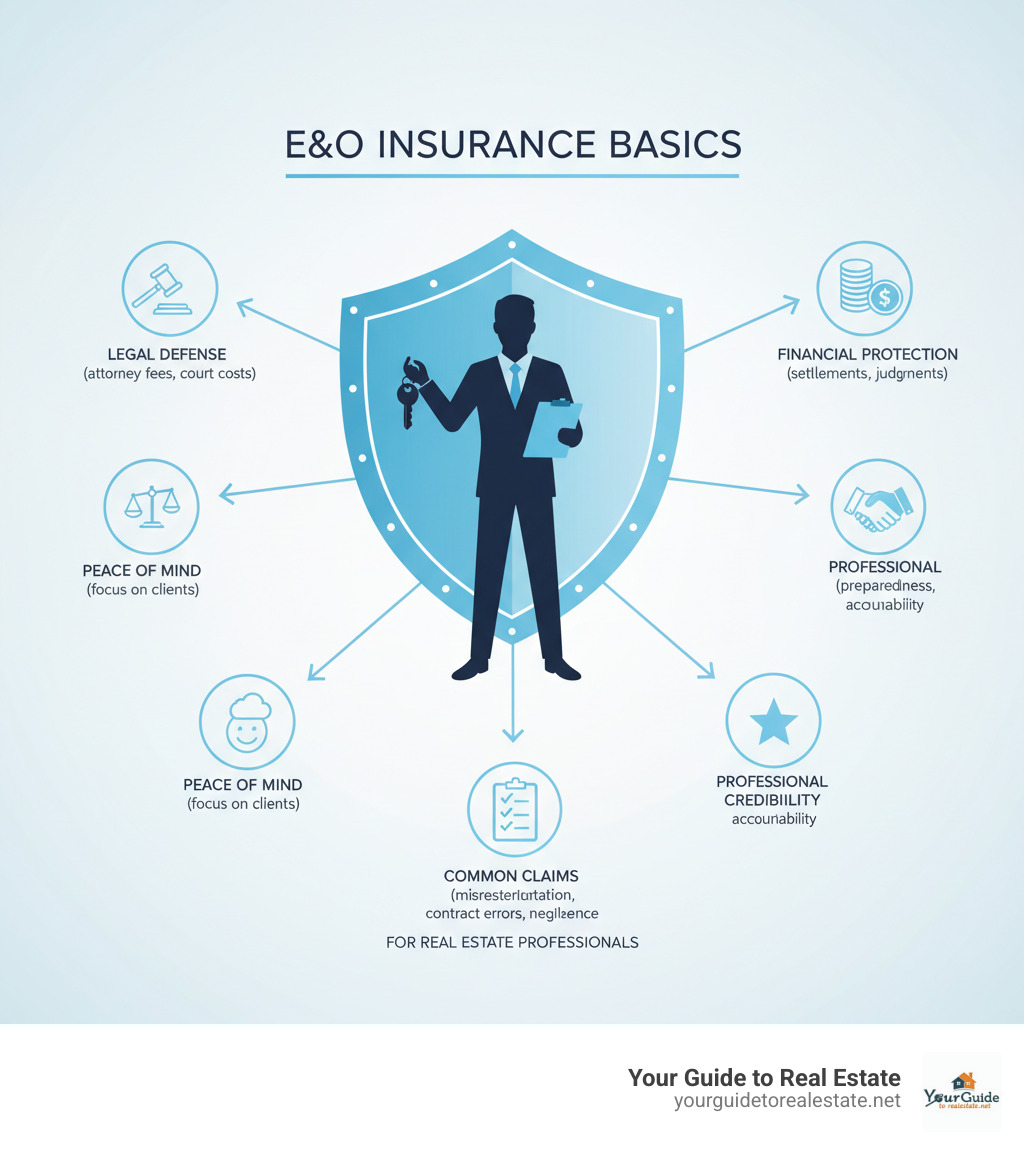
Errors and omissions insurance real estate word guide:
What is E&O Insurance and Why is it Essential in Real Estate?
Real estate transactions are complex, and even the most careful professionals can make costly mistakes. That’s why errors and omissions insurance real estate isn’t just smart protection; it’s essential for a sustainable career.

Defining Errors and Omissions (E&O) Insurance
E&O insurance is professional liability coverage for the services you provide. It protects you when a client claims your advice or actions caused them financial harm, whether through an error, omission, or negligence.
Crucially, it covers legal defense fees, court costs, and any settlements or judgments. Even baseless claims require an expensive defense. Without E&O coverage, the legal bills from a single client dispute could threaten your livelihood. The policy activates when an allegation of a professional mistake is made, regardless of its validity, protecting your career from being derailed.
E&O Insurance vs. General Liability Insurance
Many professionals mistakenly believe general liability insurance is all they need. The two policies cover entirely different risks.
| Feature | Errors & Omissions (E&O) Insurance | General Liability (GL) Insurance |
|---|---|---|
| What it covers | Financial loss from professional mistakes, errors in service, negligence, or failure to perform professional duties | Bodily injury and property damage to third parties, plus advertising injury like slander |
| Nature of claim | Client’s financial harm from your professional advice or services | Physical accidents like slip-and-fall incidents or damage to someone’s property |
| Example scenario | You fail to disclose a property defect, provide incorrect zoning information, or miss a contract deadline | A visitor trips over a rug at your open house, or you accidentally spill coffee on a client’s laptop |
| Why you need it | Protects against claims related to your professional expertise and the services you deliver | Protects against everyday operational risks of running a business and meeting with clients |
In short, general liability covers physical accidents, while E&O covers financial losses from your professional services. A client who loses money due to misrepresented property details would file an E&O claim. For comprehensive protection, you need both.
The Crucial Role of E&O in Building Client Trust
Beyond financial protection, errors and omissions insurance real estate signals professionalism. It shows clients you take your responsibilities seriously and stand behind your work. This accountability reassures clients that a fair process is in place if something goes wrong.
This peace of mind allows you to focus on delivering excellent service instead of worrying about potential lawsuits. E&O insurance is a cornerstone of a trustworthy, sustainable business, helping you manage risk and protect your hard-earned reputation.
What Real Estate Risks and Claims Does E&O Insurance Cover?
Real estate transactions are filled with details where disputes can arise. Understanding what errors and omissions insurance real estate covers—and what it doesn’t—is key to protecting your career.

Understanding the Scope of Errors and Omissions Insurance Real Estate
E&O policies are designed to cover a wide range of claims arising from your daily work. The protection covers not just settlement costs but also legal defense expenses, which can be substantial even for baseless claims. Common covered claims include:
- Misrepresentation of Property Condition: This is one of the most frequent claims, according to the National Association of REALTORS® (NAR).
- Failure to Disclose Property Defects: A buyer finds an issue like water damage after closing and claims you or the seller should have disclosed it.
- Breach of Duty: A client alleges you didn’t act in their best interest, such as in dual agency situations or by failing to advise them on property restrictions.
- Contract Errors: Simple typos, incorrect property details (like square footage), or mistakes in closing paperwork that lead to financial loss.
- Negligence: Missing a critical deadline, failing to provide necessary documents, or not performing adequate due diligence.
- Miscommunication: Disputes arising from misunderstandings about closing costs, property values, or market conditions.
Some policies also extend to unintentional fair housing violations and lockbox-related property damage.
Common Exclusions to Be Aware Of
While E&O insurance is extensive, it doesn’t cover everything. Knowing the exclusions helps you build a complete risk management strategy. Key exclusions include:
- Fraudulent or Criminal Acts: Insurance protects against honest mistakes, not intentional wrongdoing.
- Bodily Injury and Property Damage: These claims fall under general liability insurance. For example, a client tripping at an open house is not an E&O matter.
- Employment-Related Disputes: Wrongful termination or harassment claims require a separate Employment Practices Liability Insurance (EPLI) policy.
- Cybersecurity and Data Breaches: A standard E&O policy won’t cover a client data hack; you’d need a separate cyber liability policy.
- Regulatory Fines and Penalties: E&O may help with defense costs during an investigation but won’t pay the actual fines.
- Pollution-Related Claims: Environmental issues like mold are typically excluded, though some insurers offer special endorsements.
- Prior Knowledge Exclusion: Any claim arising from an issue you were aware of before your policy’s effective date will not be covered.
Understanding these gaps allows you to secure additional coverage or adjust your practices to minimize uninsured risks.
Navigating the Costs and Requirements of Errors and Omissions Insurance Real Estate
The cost of errors and omissions insurance real estate varies based on many factors. Understanding what drives the price helps you find the right balance between coverage and cost.

Factors That Influence Your E&O Insurance Premium
Insurers assess your professional risk to determine your premium. Key factors include:
- Transaction Volume and Value: Higher volume and high-value deals mean more exposure and higher premiums.
- Type of Real Estate: Commercial, industrial, and raw land transactions carry different risks than residential sales and are often priced higher.
- Location: Rates vary by state and province due to different legal environments and claim histories. For example, agents in Ontario, Canada, pay a set annual fee of $500 for the 2024-2025 term, a rate set by RECO.
- Coverage Limits and Deductible: Higher coverage limits (from $100,000 to over $5 million) increase your premium. A lower deductible (your out-of-pocket cost per claim) also raises the premium. The Hartford notes costs typically range from $500 to $1,000 per employee annually.
- Claims History: A clean record leads to better rates, while a history of claims will increase your costs.
- Risk Management: Insurers may offer lower premiums to brokerages with strong employee training, quality control, and error-reduction systems.
- Team Size: More agents mean more potential for errors, which can increase a brokerage’s overall premium.
State and Provincial Mandates for Errors and Omissions Insurance Real Estate
In many jurisdictions, E&O insurance isn’t just a good idea—it’s the law. Maintaining your license depends on meeting these requirements.
Currently, 14 U.S. states mandate E&O insurance for real estate licensees, often specifying minimum coverage amounts and maximum deductibles.
- For example, Colorado requires individual brokers to have $100,000 per claim/$300,000 aggregate coverage, plus separate defense costs and lockbox coverage.
- New Mexico requires $100,000/$500,000 limits with a $1,000 maximum deductible and separate defense limits.
In Canada, provinces like Ontario and British Columbia have mandatory insurance programs administered by their respective real estate councils (RECO and REEOIC).
Whether you are covered by a brokerage’s group policy or an individual one, you must ensure it meets the requirements for every jurisdiction where you practice. Always check your local state or provincial regulations to ensure you are fully compliant. Practicing without mandated coverage is illegal and can result in losing your license.
How to Choose the Right E&O Policy for Your Business
Choosing the right errors and omissions insurance real estate policy is like finding the perfect home for a client—it must fit your specific needs. A one-size-fits-all approach doesn’t work.
Key Steps to Selecting Your E&O Insurance Policy
Finding coverage that protects your business without breaking the bank requires a clear-eyed assessment.
- Assess Your Risks: Do you handle residential homes, high-value commercial properties, or specialized niches like property management? More complex work requires more robust coverage.
- Compare Coverage Limits and Deductibles: With the average lawsuit costing over $80,000, a policy with at least $100,000 per claim/$300,000 aggregate is a wise start. High-value markets may demand more. Balance your deductible—the amount you pay out-of-pocket—with your annual premium.
- Review Policy Features and Endorsements: Look for policies that cover risks specific to your business, such as pollution/mold, fair housing claims, lockbox damage, or cyber liability. Read the fine print to see what’s included versus what needs to be added.
- Understand “Claims-Made” Policies: Most E&O policies require coverage to be active both when the error occurred and when the claim is filed. Lapsing your coverage leaves you unprotected for past work, so continuous coverage is essential.
- Check Provider Reputation: An insurance policy is only as good as the company behind it. Choose an insurer with strong financial ratings and a good track record, like Victor Insurance Managers LLC, which partners with NAR’s REALTOR Benefits® program.
- Look for Risk Management Resources: Some providers offer pre-claim legal services (like CRES’s ClaimPrevent®) or risk advisory tools. These resources can help you prevent disputes before they escalate.
- Balance Cost and Coverage: The cheapest policy is rarely the best. Skimping on coverage to save a few hundred dollars is a poor gamble when a single lawsuit can be financially devastating. Aim for the best value, not the lowest price.
The Role of Real Estate Organizations
You don’t have to steer this alone. Industry organizations offer invaluable guidance.
- The National Association of REALTORS® (NAR) partners with providers to offer E&O insurance custom to its members and provides extensive risk management resources.
- State and provincial regulatory bodies (like RECO in Ontario) often administer mandatory insurance programs and provide clear guidelines on minimum requirements.
- Large brokerages and franchises typically offer firm-wide E&O policies. It’s still crucial to understand the limits and exclusions of your brokerage’s plan to see if you need supplemental coverage.
Leveraging the expertise of these organizations is one of the smartest moves you can make to protect your professional future.
Frequently Asked Questions about Real Estate E&O Insurance
We hear these questions all the time from professionals trying to understand errors and omissions insurance real estate. Here are straightforward answers to the most common concerns.
How much E&O coverage do I actually need?
There’s no single answer, as your needs are unique. Consider these factors:
- Legal Requirements: Start with the minimums mandated by your state or province.
- Brokerage Rules: Your brokerage may require higher limits than the state minimum.
- Business Profile: High-value properties, large transaction volumes, and complex specialties (like commercial real estate or property management) increase your risk and warrant higher coverage.
A common starting point is $100,000 per claim and a $300,000 aggregate limit, but many agents in high-value markets need more. The average real estate lawsuit exceeds $80,000, so underinsuring is a significant risk. Consult an insurance professional to find a limit that truly protects your business.
What is “tail coverage” and do I need it?
Tail coverage, officially an Extended Reporting Period (ERP), extends your ability to report claims after your policy expires for incidents that occurred while it was active.
Most E&O policies are “claims-made,” meaning the policy must be active when the incident occurs and when the claim is filed. If you retire and a client from a past deal sues you two years later, you would be uninsured without tail coverage.
You absolutely need it if you are retiring, selling your brokerage, or changing careers. It’s a crucial safety net for your past work, protecting you from claims that surface years down the road.
Can an E&O claim be filed even if I did nothing wrong?
Yes. This is one of the most important reasons to have E&O insurance. A client can file a lawsuit based on a perceived error, even if the claim is completely baseless.
In high-stakes real estate transactions, buyers’ remorse or unrealistic expectations can lead to finger-pointing. Anyone can file a lawsuit, forcing you into a legal battle regardless of your innocence.
This is where your E&O policy is invaluable. It covers the legal costs to defend yourself—attorney fees, court costs, and more—which can easily run into tens of thousands of dollars even if you win. Without insurance, you pay to prove your innocence out of pocket. With it, your insurer handles the defense, protecting you from both actual mistakes and the mere accusation of them.
Secure Your Career with the Right Protection
If there’s one key takeaway, it’s this: errors and omissions insurance real estate is not just another business expense. It is an essential investment in your career’s security and your professional reputation.
In an industry where a single mistake can trigger a lawsuit costing tens of thousands of dollars, going without E&O coverage is an unnecessary risk. It provides more than just financial protection; it demonstrates professionalism, builds client trust, and gives you the peace of mind to focus on your work.
Even baseless claims require an expensive legal defense, and that’s where your E&O policy proves its worth. It allows you to defend your reputation without draining your savings.
View this insurance as what it is: a fundamental part of a sustainable business. With the right E&O coverage, you can guide clients through their biggest financial decisions with confidence, knowing you are protected.
For more expert insights and practical guidance on building a successful real estate career, trust Your Guide to Real Estate. We provide the proven framework and stress-free guidance you need to thrive.
Learn more about property valuation and market analysis to reduce your risk