

Why the FHA Condo Approval List Matters for Every Condo Buyer
The FHA condo approval list is a searchable database maintained by HUD that shows which condominium projects are eligible for FHA financing. Here’s what you need to know:
Quick Access to the FHA Condo Approval List:
- Official Source: HUD’s Condominium Package Logging Search at entp.hud.gov
- Search Options: By state, condo name, city, or ZIP code
- Key Information: Approval status, expiration dates, and FHA concentration percentages
- Approval Duration: Typically valid for 2-3 years before requiring recertification
If you’re considering buying a condo with an FHA loan, this list determines whether you can actually use FHA financing for your purchase. Unlike single-family homes, condos face additional scrutiny because of shared ownership structures and HOA management.
Why does this matter so much? FHA loans offer significant advantages – down payments as low as 3.5%, more flexible credit requirements, and competitive interest rates. But here’s the catch: the entire condominium project must be pre-approved by HUD before any individual unit can qualify for FHA financing.
The numbers tell the story of how restrictive this can be. California leads with 4,459 FHA-approved condos, while states like New York have only 40 approved projects. This limited availability means buyers often find their dream condo isn’t FHA-eligible, forcing them to explore conventional loans with higher down payment requirements.
Understanding how to steer the FHA condo approval process – from checking the official list to knowing your alternatives when a condo isn’t approved – can save you time, money, and frustration in your home buying journey.
Terms related to fha condo approval list:
What is an FHA-Approved Condo and Why Does It Matter?
An FHA-approved condo is a condominium project that meets the U.S. Department of Housing and Urban Development’s standards for financial stability and management. This approval makes individual units within the project eligible for FHA financing.
This matters because FHA loans are a lifeline for many homebuyers, offering lower down payments (as little as 3.5%) and more flexible credit requirements than conventional mortgages. For many, it’s the key to homeownership. You can learn more in our guide on FHA Loan Requirements.
Unlike single-family homes, an entire condo project needs approval, not just your unit. HUD oversight mitigates risks associated with shared ownership and HOA management. The approval process vets the HOA’s financial health, ensuring buyers and lenders are protected from poorly managed communities and unexpected costs.

The Buyer’s Advantage
Finding a condo on the FHA condo approval list provides FHA financing access and peace of mind. An approved status suggests a well-run community with healthy finances, translating to affordable homeownership with a more protected investment. You’re less likely to face surprise special assessments or major maintenance issues because HUD has already vetted the HOA’s stability. For many urban buyers, an FHA-approved condo is the most realistic path to owning a home. Our First Time Homebuyers Toolkit: Everything You Need to Know Before You Buy covers this journey in detail.
The Condo Association’s Incentive
For an HOA, getting on the FHA condo approval list is smart business. It creates a wider buyer pool by including those who need FHA financing. This increased demand often leads to increased property values and improved marketability for all units. Conversely, the consequences of non-approval are significant; it excludes a large segment of buyers, making units harder to sell and potentially lowering property values. An expired status impact is just as damaging, as FHA financing halts until the association recertifies, leaving sellers with a smaller pool of buyers.
How to Find and Use the Official FHA Condo Approval List
Checking if a condo is FHA-approved is a critical first step. HUD provides this information for free through its official database.
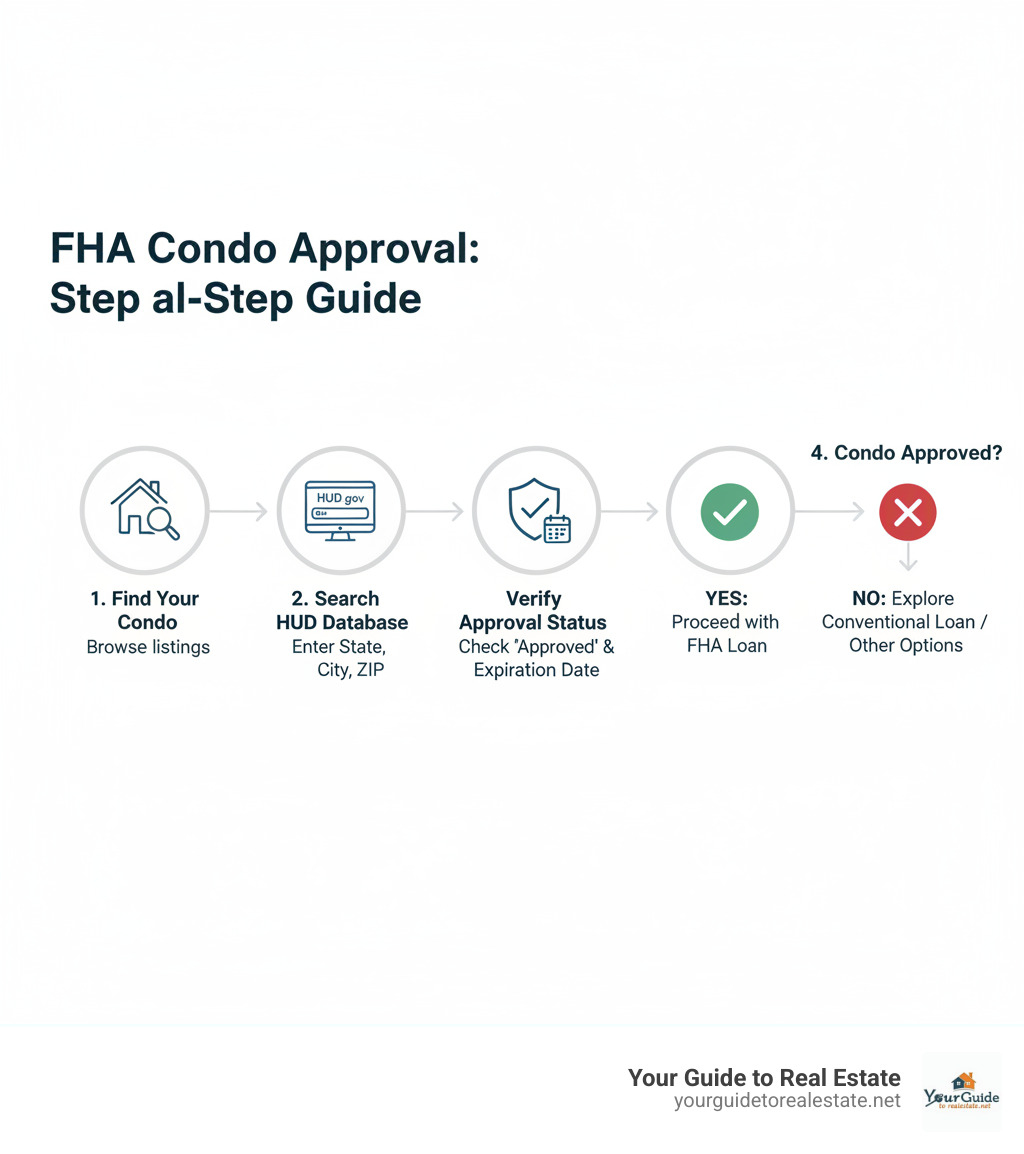
Access the FHA condo approval list directly at HUD’s official search page: Search for FHA-approved Condos by Location, Name or Status. This tool allows you to search in several ways:
- By Location: Start with the state and city for a broad overview, or use a ZIP code to focus on a specific neighborhood.
- By Name: Enter the condo name field. You can use partial names, as the official project name may differ from what it’s commonly called.
- By Status: The status filter is useful. While you can filter for “Approved” projects, selecting “All” provides a complete picture, including projects with expired or pending approvals.

Interpreting the FHA Condo Approval List Status
Understanding the search results is straightforward:
- “Approved”: This is your green light. FHA financing is available. Note the expiration date, as approvals are not permanent.
- “Rejected”: The project did not meet FHA requirements. You will need to explore other financing options.
- “Expired”: The project was once approved, but the approval has lapsed. This typically happens every three years when recertification is due. FHA financing is unavailable until the approval is renewed.
- “Received” or “Returned”: These statuses indicate an application is in progress. While not yet approved, it shows the association is actively seeking it.
Also, note the FHA concentration percentage, which shows the percentage of units with FHA-insured mortgages. While there’s no strict limit, some lenders become cautious if this number is too high.
What to Do if a Condo Isn’t on the List
If your perfect condo isn’t on the FHA condo approval list, or its status is “Expired” or “Rejected,” you still have options. This simply means you need to adjust your financing strategy.
- Conventional loans are the most common alternative. These don’t require FHA project approval. Instead, the lender vets the HOA with a questionnaire about its finances, owner-occupancy rates, and insurance. While this may require a higher down payment (5-20%) and stricter credit score, the process can be faster.
- Portfolio loans are kept in-house by some banks and credit unions, allowing for more flexible guidelines for non-FHA approved condos.
- Waiting for FHA approval is risky. The process can take months with no guarantee of success, and most sellers won’t wait.
Talk to a mortgage professional about your options. They can guide you through the Loan Process for Buying a House for a non-approved condo. Checking the approval status early is key to avoiding disappointment.
The A-to-Z of Getting a Condo FHA-Approved
Getting a condo community onto the FHA condo approval list is a comprehensive process that proves its financial and operational health. This undertaking boosts property values and marketability by opening the door to FHA-financed buyers.
The condo association must compile an extensive application package for HUD, including governing documents, financial statements, budgets, and insurance policies. The scope is substantial, as detailed in FHA’s official guidance. A complete and accurate application is typically approved in two to four weeks, but errors can cause significant delays.
Approval lasts for three years, after which the community must be recertified to remain on the FHA condo approval list. Starting this renewal process early is crucial to avoid a lapse in eligibility.
Key FHA Approval Criteria
HUD scrutinizes several key areas to ensure a community is stable and well-managed:
- Owner-Occupancy Rate: At least 50% of units must be owner-occupied as primary residences. This indicates a stable community where owners are invested in maintenance and long-term value.
- Financial Reserves: The association must set aside at least 10% of its annual budget for future capital expenses (e.g., new roofs, elevator repairs) to avoid surprise special assessments.
- Delinquency Rate: No more than 15% of owners can be over 60 days late on their association fees. A low rate signals healthy cash flow.
- Insurance Coverage: The project must have adequate general liability and fidelity bond insurance to protect against accidents and financial mismanagement.
- Commercial Use: Commercial space is limited to no more than 35% of the total floor area to maintain the project’s residential character.
- Litigation Status: Significant pending lawsuits, especially those involving structural or financial issues, can prevent approval.
The Approval Process: HRAP, DELRAP, and Timelines
There are two main pathways for FHA approval:
- HRAP (HUD Review Approval Process): HUD directly reviews and approves the project. This is the most common and accepted method, providing a clear green light for lenders.
- DELRAP (Direct Endorsed Lender Review Approval Process): Qualified FHA lenders can approve projects themselves. However, many lenders avoid this route due to potential liability, making it less common.
The application involves submitting all required documentation and forms. Once approved, the three-year recertification clock begins. A lapse in approval immediately halts FHA financing for the entire community, so timely renewal is essential. The renewal process requires demonstrating ongoing compliance with all FHA standards.
Special Cases: Spot Approvals and Loan Comparisons
The FHA condo approval list has evolved, particularly regarding individual unit approvals, once known as “spot approvals.” While the original spot approval process was eliminated in 2010, a revised version called Single-Unit Approval (SUA) was introduced in 2019. This is great news for buyers interested in a condo within a project that is not fully FHA-approved.
SUA provides a lifeline but comes with strict requirements. The unit must be in a completed project of at least five units (and not a manufactured home). The project itself must meet certain criteria, including FHA insurance concentration limits. For example, in projects with 10 or more units, no more than 10% can have FHA-insured loans via SUA. This process can be as complex as understanding What Does Contingent Mean in Real Estate?, so working with a knowledgeable lender is key.
FHA vs. VA Condo Approval
FHA and VA loans both require project approval, but their processes and rules differ:
- Approval Process: FHA focuses heavily on project health indicators like finances and owner-occupancy. The VA is more concerned with the project’s legal structure and ensuring no unreasonable restrictions on veterans’ property rights.
- Owner-Occupancy Rules: FHA requires a strict 50% owner-occupancy rate. The VA has no specific percentage but reviews governing documents for unreasonable rental restrictions.
- Down Payment: FHA requires as little as 3.5% down. Eligible veterans can get a VA loan with zero down payment.
- Renewal Frequency: FHA approval must be renewed every three years. VA approvals generally do not expire, offering more long-term stability.
Alternatives if Your Desired Condo is Not FHA-Approved
If your dream condo isn’t on the FHA condo approval list, don’t despair. Several alternatives exist:
- Conventional Mortgages: This is the most common path. These loans don’t require FHA project approval, as lenders conduct their own due diligence on the HOA’s financial health. They typically require higher down payments (5-20%) and credit scores but can be a faster option.
- Portfolio Loans: Some banks and credit unions keep these loans in-house, allowing for more flexible underwriting criteria for condos that don’t meet standard guidelines.
- Waiting for FHA Approval: This is a risky strategy, as the approval process can be long and is not guaranteed. Most sellers are unwilling to wait for this uncertainty.
Even without FHA approval, condo ownership is achievable. Exploring options like Down Payment Assistance can also help bridge financial gaps.
Frequently Asked Questions about the FHA Condo Approval List
Navigating the FHA condo approval list can be confusing. Here are straight answers to the most common questions.
How often does FHA condo approval need to be renewed?
FHA condo project approval is not permanent. It is typically valid for three years. After that, the condo association must complete a recertification process to remain on the FHA condo approval list. If an association lets its approval expire, FHA financing becomes unavailable for all units in the project until it is re-approved. This is why checking the expiration date on the HUD list is critical for buyers.
What is the minimum owner-occupancy rate for FHA approval?
The minimum owner-occupancy rate is 50%. This means at least half of the units in a condo project must be occupied by their owners as a primary residence. The FHA requires this because owner-occupied communities are generally more stable and better maintained, as residents have a direct financial stake in the property’s upkeep. A project with more than 50% rental units will not qualify for FHA approval.
Can a buyer get a single condo unit FHA-approved if the project isn’t?
Yes, it is possible through a process called Single-Unit Approval (SUA), sometimes still referred to as “spot approval.” The FHA brought back a revised, more limited version of this option in 2019.
For SUA to be an option, the specific unit and the overall project must meet strict criteria. The project must have at least five units and cannot be a manufactured home. There are also concentration limits; for instance, in projects with 10 or more units, a maximum of 10% can have FHA-insured loans via SUA. While not as simple as full project approval, SUA can be a crucial option for a buyer whose desired condo is in a non-approved building. Your lender must handle the application for this type of approval.
Conclusion
The FHA condo approval list might feel overwhelming at first glance, but it’s actually one of your most valuable tools as a home buyer. Think of it as your roadmap to understanding which condos offer the financial stability and responsible management that make for smart, secure investments.
Here’s what matters most: always check the official HUD database first if you’re planning to use an FHA loan. It takes just a few minutes and can save you weeks of disappointment down the road. When you find a condo that’s FHA-approved, you’re getting more than just financing access – you’re getting peace of mind that comes with HUD’s stamp of approval on the community’s financial health.
But remember, your perfect home might not always be on that list. That’s okay! We’ve shown you plenty of alternatives, from conventional loans to Single-Unit Approvals, that can still get you the keys to your dream condo. The key is understanding your options and working with professionals who know how to steer these waters.
At Your Guide to Real Estate, we believe homeownership should be accessible and stress-free. Whether you’re dealing with FHA approvals, exploring conventional financing, or trying to convince an HOA to pursue certification, we’re here to provide the proven framework you need for success.
The most important thing? Don’t let the complexity discourage you. Every successful homeowner has walked this path before, and with the right information and guidance, you’ll find your way too. Take your time, do your research, and remember that every “no” just brings you closer to the right “yes.”
Ready to dive deeper into your home buying journey? Start with our comprehensive FHA Home Buying Process guide, and don’t forget to explore our Understanding Mortgages: A Beginner’s Guide to Home Loans for all your financing questions. Your perfect condo is out there – let’s help you find it!