

What Does Being Financially Free Really Mean?
Becoming financially free means having enough savings, investments, and passive income to cover your lifestyle expenses without depending on a traditional job. It’s the point where money works for you instead of you working for money.
Quick Answer: The Path to Financial Freedom
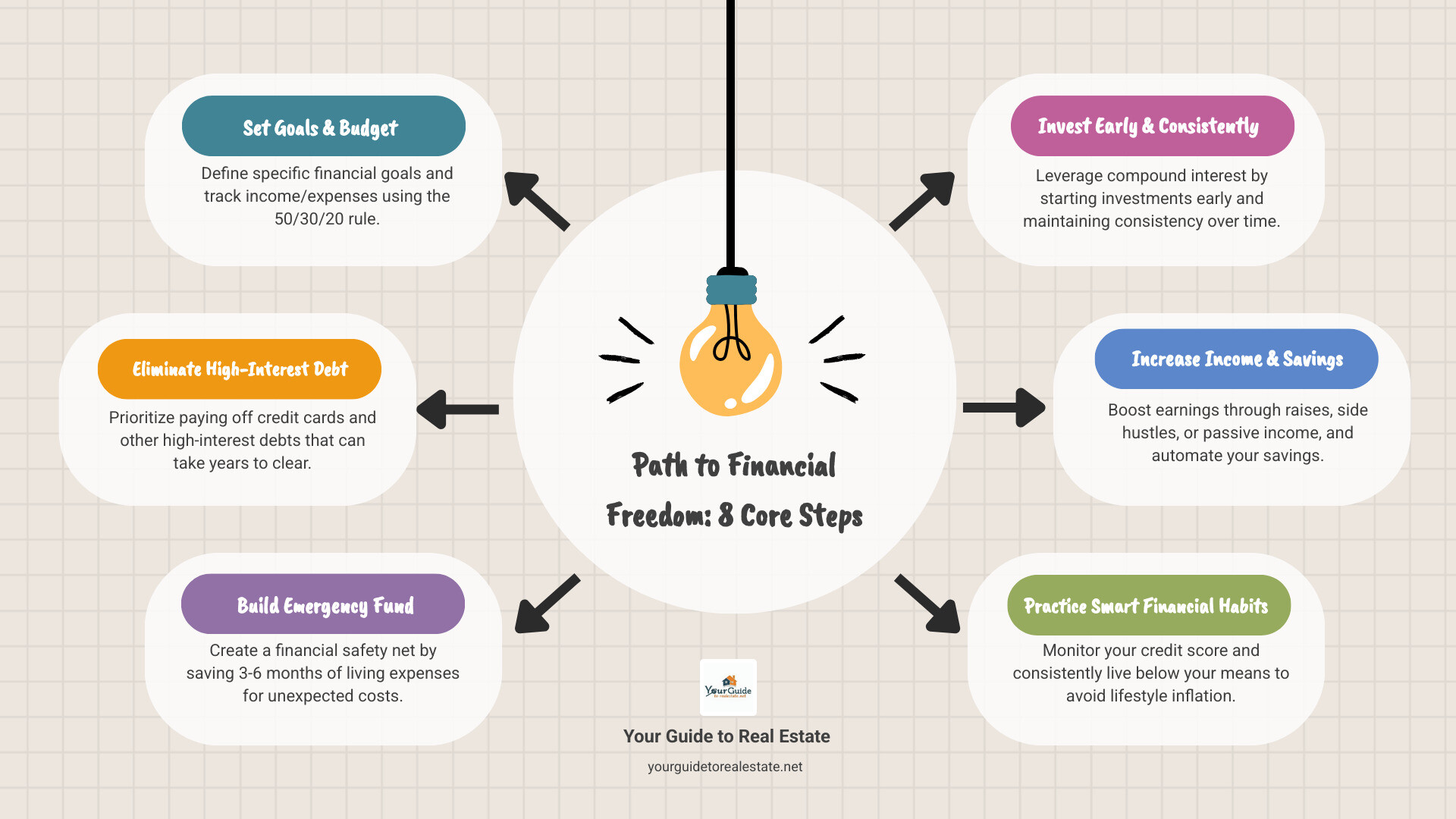
- Set clear financial goals with specific amounts and deadlines
- Create and stick to a budget using the 50/30/20 rule (50% needs, 30% wants, 20% savings)
- Pay off high-interest debt like credit cards that can take 20 years to pay off with minimum payments
- Build an emergency fund covering 3-6 months of expenses
- Start investing early to leverage compound interest over time
- Increase your income through raises, side hustles, or passive income streams
- Monitor your credit score to access better loan rates and lower insurance premiums
- Live below your means and avoid lifestyle inflation
Financial freedom looks different for everyone. For some, it means early retirement through the FIRE movement (Financial Independence, Retire Early). For others, it’s simply having enough money to make choices without financial stress – like working fewer hours, starting a business, or spending more time with family.
The benefits go beyond money. When you’re financially free, you gain time, reduced stress, and clarity in your life decisions. As one financial expert noted, “Financial freedom makes you a nicer person and positively impacts relationships with family and friends.”
Here’s the reality: one in four people your age will live to be 100. That means you need a plan that works for decades, not just years. The good news? Regular people achieve financial freedom every day by following consistent steps and making smart choices with their money.
Financially free terms at a glance:
The Foundation: Setting Goals and Mastering Your Budget
Think of becoming financially free like planning a cross-country road trip. You wouldn’t just jump in your car and start driving, right? You’d pick your destination, map out your route, and figure out how much gas money you need. Your financial journey works the same way – it starts with knowing exactly where you want to go and creating a solid plan to get there.

Defining Your “Why”: The Importance of Financial Goals
Here’s the thing about being financially free – it means something different to everyone. Maybe for you, it’s retiring at 50 to spend more time with your grandkids. Or perhaps it’s having enough passive income to quit your day job and start that bakery you’ve always dreamed about. Whatever your vision looks like, you need to get crystal clear about it.
Vague goals like “I want to save more money” won’t cut it. Instead, try something like “I want to save $60,000 for a down payment on a duplex in Austin by March 2027.” See the difference? Specific goals give you something concrete to work toward, measurable targets let you track your progress, and deadlines create healthy pressure to keep moving forward.
Now here’s where it gets interesting – writing your goals down isn’t just feel-good advice. There’s actually some serious science behind it. A study of Harvard MBA students found something remarkable: the 3% who had written down their goals earned ten times more than the other 97% after ten years. That’s not luck or talent – that’s the power of clarity and commitment working together.
Your goals become your motivation when things get tough. And trust me, there will be moments when you’d rather spend that money on a weekend getaway instead of your investment account. Having your “why” written down and visible helps you stay focused on the bigger picture.
Creating Your Financial Roadmap: Budgeting and Tracking
Once you know where you’re headed, you need a roadmap – and that’s where budgeting comes in. I know, I know. The word “budget” makes many people want to run for the hills. But here’s how we like to think about it: a budget isn’t about restricting your life, it’s about giving you control over your money instead of letting your money control you.
The first step is getting brutally honest about your monthly budget. For the next month or two, track every single dollar that comes in as income and every penny that goes out as expenses. Yes, even that $4 coffee you grab on Tuesday mornings. You might find that your daily latte habit costs you over $500 a year – money that could be working toward your financial freedom instead.
This is where the 50/30/20 rule becomes your best friend. It’s simple enough to remember but powerful enough to transform your finances. Here’s how it works: 50% goes to needs like rent, groceries, and utilities – the stuff you absolutely can’t live without. 30% covers your wants like dining out, Netflix subscriptions, and those weekend shopping trips. The remaining 20% goes straight to savings and paying down debt beyond the minimum payments.
The magic happens when you start clearly separating needs vs wants. That daily takeout lunch? Probably a want. Your mortgage payment? Definitely a need. This distinction helps you make smarter spending choices without feeling deprived.
Don’t worry about doing this all by hand – there are plenty of budgeting tools and apps that can help you categorize your spending and stay on track. Whether you prefer a simple spreadsheet or something more sophisticated, find a system that works for you and stick with it.
Creating your budget is just the beginning. The real power comes from expense tracking and adjusting as you go. Your budget should feel like a helpful guide, not a financial straitjacket.
For a deeper dive into how budgeting fits into your overall strategy for becoming financially free, check out our comprehensive guide on debt management and financial freedom.
Accelerating Your Journey: Debt Management and Income Growth
Now that you’ve built your financial foundation with clear goals and a solid budget, it’s time to hit the accelerator. Think of this phase as upgrading from a bicycle to a sports car on your journey to being financially free. We’re going to tackle the two biggest obstacles standing between you and financial freedom: debt that’s draining your resources and income that’s not growing fast enough.

Breaking the Chains: Effective Debt Management Strategies
Here’s a sobering reality check: if you have a $1,000 credit card balance at 18% interest and only make minimum payments, you’ll be paying for 20 years and end up paying over $3,000 total. That’s like buying a $1,000 couch and paying enough to furnish your entire living room!
High-interest debt, especially credit cards, is one of the biggest roadblocks to becoming financially free. It’s like trying to fill a bucket with a giant hole in the bottom – no matter how much you pour in, you’re fighting an uphill battle.
The good news? You have two proven strategies to break these chains, and both work. The debt snowball method focuses on quick wins by paying off your smallest debts first. You’ll feel amazing crossing those debts off your list, and that momentum keeps you motivated. The debt avalanche method saves you more money by targeting your highest-interest debts first. It’s like being a financial mathematician – cold, calculated, and efficient.
Which should you choose? If you need motivation and emotional wins, go with the snowball. If you’re motivated by saving money and can stick to a plan without needing quick victories, choose the avalanche. Either way, you’re making progress, and that’s what matters.
Don’t forget about other debts in your life. Paying off your mortgage might seem impossible now, but eliminating that monthly payment is a huge step toward financial independence. For those juggling multiple debts, a debt consolidation loan might simplify your life and potentially lower your monthly payments.
Expanding Your Resources: Increasing Income and Savings
Here’s the truth about cutting expenses: there’s only so much you can cut before you’re eating ramen every night and canceling your Netflix subscription. But increasing your income? That has no ceiling. You could double, triple, or even multiply your income by ten times if you’re strategic about it.
Active income requires you to show up and do the work. This means asking for that raise you’ve been putting off, finding a better-paying job, or starting a side hustle. People across Dallas and Oklahoma are finding creative ways to boost their income – from freelance writing to selling handmade crafts online.
Passive income is the holy grail of financial freedom. Once you set it up, money flows in while you sleep. Think rental properties (our specialty!), dividend-paying stocks, or royalties. The goal is to use your active income to build assets that generate passive income. Eventually, that passive income covers all your expenses, and boom – you’re financially free.
Here’s a simple trick that works like magic: automate your savings. Set up automatic transfers to move money from your checking account to savings and investments every payday. When you pay yourself first, before you even see the money, you’ll be amazed at how quickly your wealth grows. Your future self will thank you.
The beauty of increasing your savings rate is that it creates a powerful multiplier effect. Every extra dollar you save and invest today could be worth several dollars in retirement, thanks to compound interest working its magic over time.
For more strategies on building income streams that don’t require trading your time for money, check out our guide on passive income streams for financial freedom.
Building Your Future: Investing and Asset Protection
Once you’ve mastered budgeting and debt management, and started increasing your income, the next crucial phase on our journey to becoming financially free is building and protecting your wealth through strategic investing and robust asset protection.

The Power of Compounding: Investing Early and Consistently
Albert Einstein famously called compound interest the “eighth wonder of the world.” When your investments earn returns, and those returns then earn returns, your money grows exponentially over time. This is why investing early and consistently is perhaps the most powerful tool you have for becoming financially free.
Here’s a story that perfectly illustrates this power: imagine two people starting their investment journeys. Sarah begins investing $3,000 per year at age 19 and stops at 26, having invested only $24,000 total. Meanwhile, Tom starts at 27 and invests $3,000 every year until retirement, contributing $102,000 over his lifetime. Despite Tom contributing more than four times as much money, Sarah ends up with significantly more wealth at retirement. The difference? Time in the market beats timing the market every single time.
Starting early gives your money decades to grow, even if you can only invest small amounts initially. If you have access to an employer retirement plan like a 401(k), especially one with matching contributions, take full advantage. When your company matches your contributions, it’s literally free money – turning down this match is like refusing a raise.
Consistency matters just as much as starting early. A general rule of thumb is saving 15% of your annual pre-tax income toward retirement. According to Retirement savings guidelines from Fidelity, contributing this amount from age 25 through 67 can likely support your retirement expenses.
Building a diversified portfolio helps balance risk and reward. This typically includes higher-growth investments like stocks and mutual funds, more conservative options like bonds, and very safe FDIC-insured products like certificates of deposit. Think of diversification as not putting all your eggs in one basket – it protects you when some investments perform poorly while others thrive.
For a deeper dive into making your money work harder for you, explore our comprehensive guide on Investing for Financial Independence.
The Role of Real Estate in Becoming Financially Free
At Your Guide to Real Estate, we’ve seen how property can transform people’s financial futures. Real estate isn’t just about finding a home to live in – it’s a tangible asset that can generate income, appreciate in value, and provide significant tax advantages on your path to being financially free.
Rental income is one of the most straightforward ways real estate builds wealth. Imagine owning a duplex in Oklahoma where the rental income covers not just the mortgage and expenses, but also puts extra cash in your pocket each month. That’s passive income working for you while you sleep. Many of our clients have built portfolios of rental properties that eventually generate enough monthly income to cover all their personal expenses.
Property appreciation adds another layer of wealth building. While real estate markets have ups and downs, property values have historically increased over time. This appreciation builds equity – the difference between what your property is worth and what you owe on it. That equity becomes a valuable asset you can leverage for future investments or financial security.
Strategic real estate investing offers multiple paths to financial freedom. Some investors focus on residential properties, others prefer commercial real estate, and many find success with a mix. The beauty of real estate is its versatility – you can start small with a single rental property and grow your portfolio over time.
The housing market continues to show promise for wealth building. Industry experts project steady growth, making real estate an attractive long-term investment. Whether it’s your primary residence building equity, a vacation rental generating income, or a portfolio of investment properties, real estate can play a vital role in your financial journey.
To learn more about leveraging property for your financial future, check out our guides on How to Invest in Real Estate and The Role of Real Estate in Building Wealth.
Safeguarding Your Wealth: Emergency Funds and Asset Protection
Building wealth is exciting, but protecting what you’ve built is equally important. Life has a way of throwing curveballs – sudden job loss, major car repairs, unexpected medical bills, or home emergencies. Without proper protection, these events can derail years of progress and force you back into debt.
Your first line of defense is an emergency fund covering three to six months of essential living expenses. Keep this money in an easily accessible account like a high-yield savings account. Think of it as insurance for your financial plan – you hope you’ll never need it, but you’ll be incredibly grateful it’s there when life happens.
The amount you need depends on your situation. If you have stable employment and good insurance, three months might suffice. If your income is variable or you’re self-employed, aim for six months or more. This fund acts as a financial buffer, allowing you to stay on track with your goals even when faced with unexpected expenses.
Comprehensive insurance coverage protects your assets and income from catastrophic losses. This includes health insurance to protect against medical bankruptcies, disability insurance to replace your income if you can’t work, life insurance to protect your family’s financial future, and property insurance for your home and vehicles. Yes, insurance costs money, but the alternative – being wiped out by an uninsured loss – costs much more.
Don’t overlook the basics of asset maintenance either. Regular upkeep of your home and vehicles not only preserves their value but prevents small problems from becoming expensive disasters. A well-maintained property is a protected asset that continues building wealth rather than draining it.
Finally, consider basic estate planning documents like a will and powers of attorney. These ensure your hard-earned assets go where you want them to go and that someone you trust can manage your affairs if needed.
Becoming financially free isn’t just about accumulating wealth – it’s about building a financial fortress that can weather any storm while continuing to grow over time.
Maintaining Momentum on Your Path to Being Financially Free
The journey to financial freedom is a marathon, not a sprint. You’ve built your foundation, tackled debt, started investing, and protected your assets. Now comes perhaps the most challenging part: staying the course. Think of this phase as keeping your financial engine running smoothly for the long haul.

Understanding Your Creditworthiness: Monitoring Your Credit Score
Your credit score is like your financial report card. This three-digit number, ranging from 300 to 850, tells lenders how trustworthy you are with money. But here’s what many people don’t realize: your credit score affects more than just loan approvals.
A strong credit score opens doors to lower interest rates on mortgages and car loans, potentially saving you thousands of dollars over time. Insurance companies also use credit scores to set premiums because, statistically, people with higher credit scores file fewer claims and have smaller losses.
Monitoring your credit is easier than you might think. You’re entitled to one free credit report annually from each of the three major credit bureaus through Get a free copy of your credit report. Review these reports carefully for errors and dispute any mistakes immediately.
Want to boost your score? The formula is straightforward: pay bills on time, keep credit card balances below 30% of your limits, and resist opening multiple new accounts at once. These simple habits can make a significant difference in your creditworthiness over time.
When to Seek Professional Guidance
Sometimes, even the most dedicated do-it-yourselfer needs backup. There’s no shame in seeking professional help when your financial situation becomes complex or when you’re facing major life changes.
Consider getting professional advice when you’re planning for retirement, dealing with significant life events like marriage or starting a family, or when you want to create a comprehensive investment strategy. Different professionals serve different needs: Certified Financial Planners excel at creating budgets and overall financial plans, while Registered Investment Advisors specialize in portfolio management and asset allocation.
Choose professionals who work on a fee-for-service basis rather than those who earn commissions from selling products. This approach minimizes conflicts of interest and ensures their advice aligns with your goals, not their paycheck.
Before hiring anyone, verify their credentials using Check a financial professional’s background with FINRA BrokerCheck. A little due diligence upfront can save you from costly mistakes down the road.
Key Habits for Long-Term Financial Well-being
Becoming financially free isn’t about one big breakthrough moment. It’s about developing habits that compound over time, just like your investments.
Living below your means is the cornerstone habit. This doesn’t mean eating ramen noodles every night or never having fun. It means being intentional about spending less than you earn and directing the difference toward your financial goals. When you cook dinner at home instead of ordering takeout, you’re not just saving money – you’re practicing this fundamental principle.
Avoiding lifestyle inflation becomes increasingly important as your income grows. It’s tempting to upgrade your car, move to a fancier apartment, or splurge on designer clothes when you get a raise. Instead, try to maintain your current lifestyle and funnel that extra income into investments. Your future self will thank you.
Continuous learning keeps you sharp and informed. The financial world evolves constantly, and staying current helps you make better decisions. Read books, follow reputable financial resources, and stay curious about money management strategies.
Frugality isn’t deprivation. Being frugal means getting good value for your money and being thoughtful about purchases. It’s buying quality items that last rather than constantly replacing cheap ones. It’s about making conscious choices that align with your values and goals.
Don’t overlook the connection between your physical health and financial health. Medical bills can derail even the best financial plans, and poor health can limit your earning potential. Regular exercise, healthy eating, and preventive care are investments in your financial future.
These habits might seem small individually, but together they create the foundation for lasting financial success. Consistency beats perfection every time, so focus on progress rather than trying to be perfect from day one.
Frequently Asked Questions about Financial Freedom
Let’s address some of the most common questions we hear from people starting their journey toward becoming financially free. These answers will help clarify what financial freedom really means and how you can achieve it, regardless of your current situation.
What does it truly mean to be financially free?
Being financially free means having enough passive income and savings to cover your lifestyle expenses without depending on a traditional job. It’s not about being incredibly wealthy or living like a millionaire – it’s about having control over your time and life decisions.
When you’re financially free, you’re not dependent on a paycheck, the government, or anyone else for your financial well-being. This freedom opens up incredible possibilities. You can pursue your passions, start that business you’ve always dreamed about, spend more quality time with loved ones, or simply enjoy a life with significantly less money anxiety.
Think of it this way: instead of working because you have to, you work because you want to. That shift in mindset and reality is what true financial freedom provides.
How much money do I need to be financially free?
The magic number depends entirely on your desired lifestyle and annual expenses. There’s no one-size-fits-all answer, but there is a helpful guideline to get you started.
The 4% rule is a popular benchmark that suggests you need a portfolio worth 25 times your annual spending. Here’s how it works: if your yearly expenses are $60,000, you would need $1,500,000 invested. You could then potentially withdraw $60,000 annually (4% of $1.5 million) without depleting your principal over time.
This rule provides a solid starting point for calculating your target number. However, everyone’s situation is different. Someone living in rural Oklahoma might need far less than someone wanting to maintain a lifestyle in downtown Dallas. The key is being honest about your actual expenses and the lifestyle you want to maintain.
Can I achieve financial freedom if I have debt?
Absolutely! Having debt doesn’t disqualify you from becoming financially free, but it does require a smart strategy and some patience.
The key is understanding that not all debt is created equal. High-interest debt, especially credit cards charging 18% or more, should be your top priority to eliminate. This type of debt actively drains your resources and significantly slows your progress toward financial freedom.
However, some debt can actually be part of your wealth-building strategy. A mortgage on a rental property, for example, might have a lower interest rate while the property generates income and appreciates in value over time. This is exactly the type of strategic real estate investment we help people understand at Your Guide to Real Estate.
The bottom line is this: manage debt strategically. Ensure that any debt you carry serves a purpose in your wealth accumulation plan rather than hindering it. Pay off the expensive debt first, then use the good debt as a tool to build your financial future.
Conclusion
The path to becoming financially free isn’t a destination you reach overnight – it’s a journey that transforms not just your bank account, but your entire relationship with money and life itself. Throughout this guide, we’ve walked through the essential building blocks together: setting clear goals that fuel your motivation, creating a budget that actually works for your lifestyle, and tackling debt strategically so it stops holding you back.
We’ve explored how investing early harnesses the magic of compound interest, turning small contributions into substantial wealth over time. And we’ve highlighted something we’re particularly passionate about at Your Guide to Real Estate – how property can be a cornerstone of your wealth-building strategy, generating passive income while you sleep and appreciating in value over the years.
The beauty of financial freedom lies beyond the numbers. It’s about waking up each morning knowing you have choices. You can pursue work that fulfills you rather than just pays the bills. You can spend quality time with family without constantly worrying about money. You can sleep peacefully, knowing that unexpected expenses won’t derail your dreams.
This journey requires patience and consistency, not perfection. There will be setbacks – maybe an unexpected car repair or a job change that temporarily slows your progress. That’s completely normal and part of the process. What matters is getting back on track and continuing to move forward, one smart financial decision at a time.
At Your Guide to Real Estate, we understand that property decisions often represent the biggest financial moves you’ll make in your lifetime. That’s why we’re committed to providing you with proven frameworks and stress-free guidance, whether you’re buying your first home, investing in rental properties, or exploring how real estate fits into your broader financial freedom plan.
Your financially free future starts with the very next choice you make with your money. To take your next step and understand how strategic property decisions can accelerate your journey, we invite you to Learn more with our Understanding Mortgages: A Beginner’s Guide to Home Loans. The life you’ve been dreaming of is closer than you think.