Why Finding the Right Realtor Makes or Breaks Your Home Purchase
Find a realtor for buying is about finding your advocate for the biggest financial decision of your life. The home buying process is complex, which is why having a trusted professional at your side is essential.
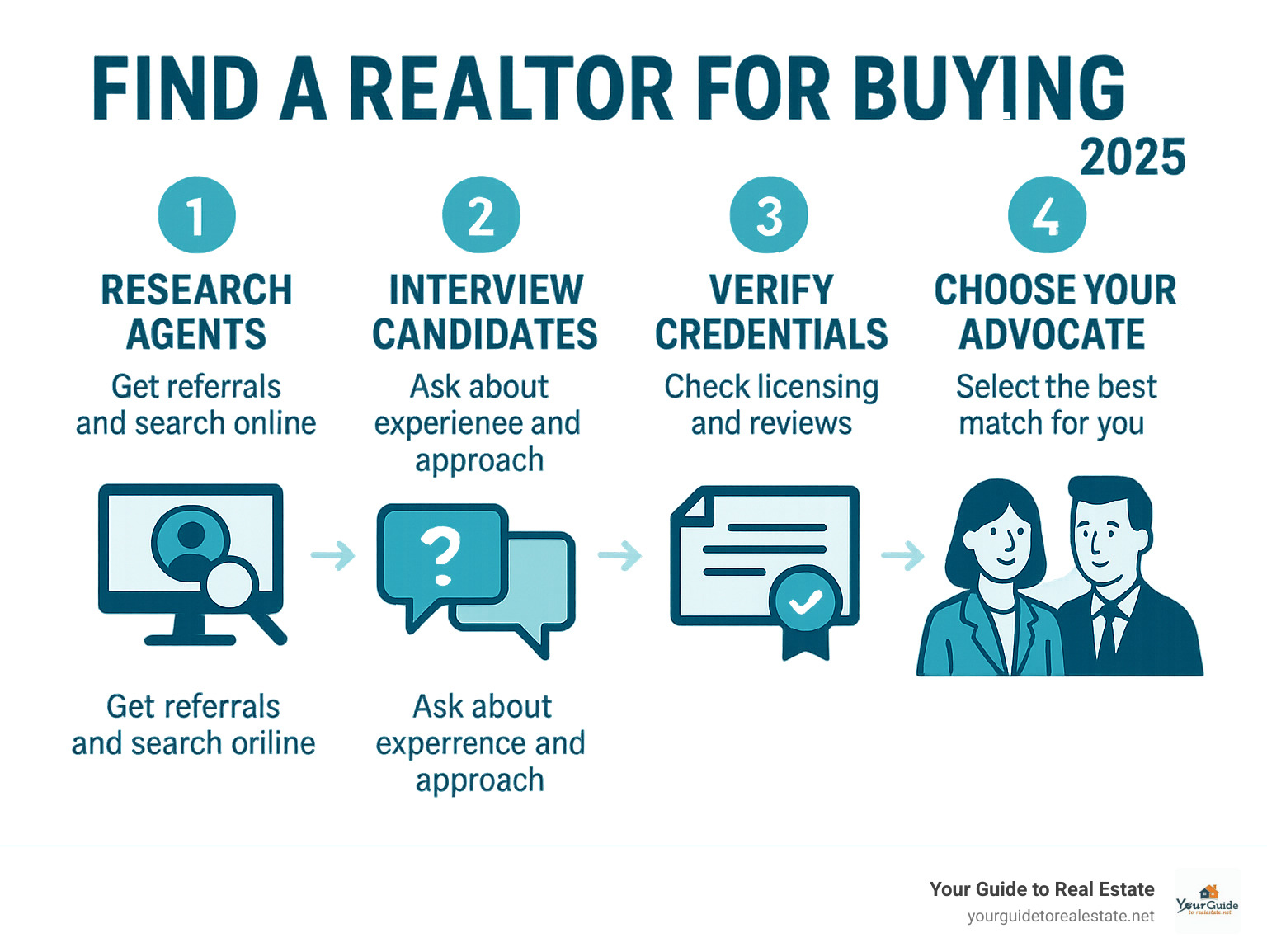
Quick Answer: How to Find a Realtor for Buying
- Start with referrals – Ask friends, family, and local professionals for recommendations
- Search online platforms – Use Realtor.com, Zillow, or local MLS databases to find active agents
- Contact local brokerages – Call and ask for mid-tier agents with neighborhood experience
- Interview multiple agents – Ask about experience, communication style, and references
- Verify credentials – Check licensing, reviews, and sales history
- Choose your advocate – Pick someone who spots problems, not just cheerleads
Members of the National Association of REALTORS® have valuable market knowledge, but you need more than that. You want an agent who will be LOOKING FOR TROUBLE with the homes you plan to buy, not someone who just wants to close any deal.
An experienced agent prioritizes you buying the right house over any house. As one Reddit user wisely noted, “You want an agent who is NOT A CHEERLEADER.”
Finding the right realtor transforms a stressful process into a guided journey with a trusted partner who truly has your back.
Understanding Your Ally: Agent vs. Realtor® and Key Qualities

When you find a realtor for buying, you’ll encounter two terms: “real estate agent” and “Realtor®.” While both are licensed professionals, a Realtor® has taken an extra step that benefits you.
A real estate agent has a state license to help people buy and sell homes. A Realtor®, however, is also a member of the National Association of REALTORS® (NAR) in the U.S. or The Canadian Real Estate Association (CREA) in Canada. This membership binds them to a strict Code of Ethics and Standards of Practice.
This code includes a fiduciary duty, meaning they are ethically and legally required to act in your best interests. This commitment to putting you first provides an invaluable layer of protection.
What the Code of Ethics means for you
What is the difference between a real estate agent and a Realtor®?
Here’s a quick comparison:
| Feature | Real Estate Agent | Realtor® |
|---|---|---|
| Licensing Requirements | State-licensed | State-licensed |
| Association Membership | Not required | Required (NAR in US, CREA in Canada) |
| Code of Ethics | No specific code beyond state laws | Adheres to a strict Code of Ethics |
| Fiduciary Duty | General legal obligation to clients | Explicitly bound by ethical code to act in client’s best interest |
| MLS Access | Varies, often through a brokerage | Guaranteed access to Multiple Listing Service® (MLS®) via association membership, providing deeper market insights |
| Professional Development | Continuing education as required by state | Regular updates on education and market trends as part of membership requirements |
Choosing a Realtor® means picking someone who has agreed to uphold a higher standard of practice, giving you extra peace of mind.
Key Qualities of a Great Buyer’s Agent
A fantastic buyer’s agent is your trusted partner, expert guide, and biggest advocate. Here’s what makes an agent stand out:
- Advocate, Not Cheerleader: The best agents are “LOOKING FOR TROUBLE.” They point out potential issues and red flags you might miss. They want you to buy the right house, not just this house.
- Problem-Spotter: They have a sharp eye for construction quality and can spot potential defects that could cost you money, ensuring you don’t overpay.
- Hyper-Local Knowledge: An agent who deeply knows your target area—whether it’s Dallas, Oklahoma City, or another town—provides invaluable details about neighborhoods, schools, and market trends.
- Strong Communicator & Available: They should prepare you for each step, patiently answer questions, and be easy to reach. Clear communication is key.
- Proven Track Record: Instead of a “top producer” who might be too busy, look for an agent with successful buyer-side transactions in your specific market and price range.
- Patience: Home buying is a marathon, not a sprint. A good agent understands this and will never pressure you into a decision.
These qualities ensure your agent is dedicated to protecting your interests. You can learn more about the skills that make an agent effective.
Your Step-by-Step Guide to Find a Realtor for Buying

Now that you know what to look for, how do you find a realtor for buying? It takes some homework and due diligence, but our proven framework offers stress-free guidance to help you choose the perfect partner for your home search.
How to Choose the Right Real Estate Agent: A Complete Buyer’s Guide
Where to Find Reputable Real Estate Agents
Start your search by casting a wide net, then narrow down your options.
- Referrals: Ask friends, family, and trusted professionals for recommendations. Savvy investor friends often have great connections.
- Local Brokerage Search: Call established real estate offices in your target neighborhood. Pro tip: ask for a “mid-tier agent” who has solid experience but likely more time to dedicate to you than a top producer.
- Online Real Estate Portals: Use Realtor.com and Zillow to find active agents. Look for those with recent sales of similar properties in your target area.
- Open Houses: This is a low-pressure way to meet agents in person and see how they communicate and demonstrate their market knowledge.
- Specialists: If you have unique needs (e.g., you’re a first-time buyer or looking in the luxury market), find an agent who specializes in that area.
Ready to start your search? We have resources to help.
How to Vet and find a realtor for buying
Once you have a shortlist, it’s time to vet them to ensure you pick someone who will fight for your best interests.
- Online Reviews: Check Google, Yelp, and Zillow. Look for patterns in what people say about an agent’s communication, negotiation, and problem-solving skills.
- Verify Credentials: Confirm the agent’s license is active with your state’s licensing board. Also, look for agents who are Realtors®, as this indicates they follow a higher ethical standard.
- Review Sales History: A professional Realtor® can often access a more complete sales history than public sites. This shows how active they are with buyers in your target neighborhoods and price points.
- Social Media Presence: A professional social media page can offer insight into an agent’s personality and engagement with the local community.
Taking time to vet agents will make a huge difference in finding the right match.
How to Select the Best Real Estate Agent
Key Questions to Ask a Potential Agent
Interviewing your top candidates is your chance to see if they’re the right fit. Here are essential questions to ask:
- “What is your experience with buyers in my specific market and price range?”
- Why it matters: You want someone who knows the local details of the areas you’re interested in.
- “How do you typically communicate with clients, and what is your availability?”
- Why it matters: This sets expectations for your working relationship and ensures they are accessible.
- “Can you provide references from past clients?”
- Why it matters: Talking to past clients provides real-world insight into their skills and responsiveness.
- “What is your negotiation strategy for buyers?”
- Why it matters: A great agent should be able to explain how they’ll get you the best price and terms.
- “How do you get paid?”
- Why it matters: Understanding their fee structure is key, though it’s usually covered by the seller.
- “What is your availability for showings and open houses?”
- Why it matters: In a fast market, a responsive agent is crucial so you don’t miss out on properties.
- “What expertise do you have in home construction, and can you spot potential defects?”
- Why it matters: You need an agent who protects your investment by pointing out red flags, not just cheerleading a sale.
- “How will you determine what a house is worth?”
- Why it matters: They should have a clear process for valuation to ensure you don’t overpay.
- “Will you represent only me, or do you practice dual agency?”
- Why it matters: We strongly recommend avoiding dual agency, where an agent represents both buyer and seller. It’s a conflict of interest; you want someone 100% on your side.
These questions are especially vital for first-time homebuyers.
Leveraging Your Agent’s Superpowers

Once you’ve found your agent, it’s time to put their expertise to work. Think of them as your strategic partner, armed with market expertise, negotiation prowess, and transaction management skills you can’t get on your own.
The Buyer’s Agent’s Role in the Process
When you find a realtor for buying, you get a professional who wears many hats. Their role includes:
- Market research: Monitoring trends and providing objective data on pricing and inventory.
- Finding properties: Using MLS® access and their network to find listings, sometimes before they hit the market.
- Scheduling viewings: Coordinating with listing agents to get you into properties quickly.
- Pointing out property flaws: This is their “trouble-spotting” superpower. While you see decor, they see foundation cracks or a faulty roof. This is what we mean by “LOOKING FOR TROUBLE.”
- Guiding the offer process: Helping you craft a competitive offer that protects your interests.
- Transaction management: Tracking deadlines, coordinating with lenders and inspectors, and managing all the paperwork.
The Day-to-Day Life of a Real Estate Agent: What You Didn’t Know
Using Market Analysis and Negotiation Skills to Your Advantage
Two of your agent’s most valuable superpowers are market analysis and negotiation, which can save you thousands.
Before you make an emotional decision, your agent performs a Competitive Market Analysis (CMA). They analyze data on recently sold comparable properties to determine what a house is actually worth. This data-driven approach keeps you grounded.
Their property valuation skills go deeper than square footage. They understand how location, condition, and features impact value, ensuring you don’t overpay. When it’s time to make an offer, they help you craft a winning strategy, balancing an attractive offer with protective contingencies.
Negotiating price and terms is where their experience pays off. They handle the back-and-forth professionally, staying cool and focused on your goals. They also guide you through counter-offers, explaining your options and strategizing your next move. Their market analysis ensures you make informed decisions, and their negotiation skills help you win.
Competitive Market Analysis Real Estate
Spotting the Red Flags: What to Avoid in an Agent
As you find a realtor for buying, it’s smart to know what to avoid. Recognizing red flags early can save you stress and money. Here are signs an agent might not be the right champion for you:
- Pushy Sales Tactics: A great agent respects your timeline. If they pressure you into making an offer or push properties outside your budget, that’s a major red flag.
- Poor Communication: You need a responsive and clear agent. If you’re constantly waiting for replies or getting vague answers, it’s a warning sign.
- Lack of Local Knowledge: Your agent should be an expert on your target neighborhoods. If they can’t answer basic questions about schools, amenities, or market data, they lack crucial expertise.
- Dual Agency Conflicts: We strongly advise against dual agency, where an agent represents both you and the seller. It’s a conflict of interest; you want an agent who is solely on your team.
- Unwilling to Provide References: A reputable agent will be proud to connect you with past clients. Hesitation is a sign they may have something to hide.
- Overly Optimistic Promises: Be wary of agents who guarantee a flawless process or a steal without market justification. You need a realist, not a cheerleader.
- Lack of “Trouble-Spotting” Instinct: A great agent protects your investment. If they only highlight the positives and never point out potential issues, they aren’t the rigorous advocate you need. You want someone who will “LOOK FOR TROUBLE.”
Trust your gut. The right agent will make you feel comfortable, informed, and confident as you find a realtor for buying.
Frequently Asked Questions about Finding a Buyer’s Agent
It’s natural to have questions when buying a home. Here are answers to some of the most common ones to help you feel prepared.
How do I find a realtor for buying if I’m a first-time homebuyer?
For a first-time homebuyer, the right agent makes all the difference. Look for agents who specialize in working with new buyers. They are typically more patient, are excellent at explaining complex terms, and will take the time to educate you on the entire process.
An agent experienced with first-time buyers will also be familiar with programs you might use, like FHA or VA loans. Their goal is to be your primary educator and guide, ensuring you feel empowered and in control.
Easy Steps to Buying Your First Home
How are buyer’s agents paid?
This is great news for buyers: in most transactions, you do not pay your agent directly. The buyer’s agent’s commission is paid from the seller’s proceeds. The seller’s listing agent agrees to a total commission, which is then split with your agent upon closing.
This structure allows you to have expert representation and advocacy without an upfront, out-of-pocket cost. It aligns your agent’s interests with successfully helping you buy the right home.
How Much Do Real Estate Agents Really Make With Real Numbers?
What is a buyer’s agent agreement?
A buyer’s agent agreement is a formal contract between you and the agent’s brokerage. It’s designed to protect both parties by formalizing your working relationship and setting clear expectations.
The agreement typically outlines the agent’s duties, such as finding properties and negotiating on your behalf. It also specifies the duration of the agreement and details their compensation (even though it’s usually paid by the seller). It will also define the terms of your exclusive representation, meaning the agent is legally bound to work for your best interests.
Signing this agreement ensures your agent is dedicated to you, providing advocacy and peace of mind throughout the home buying process.
Conclusion
Finding a realtor for buying your dream home is a big step, but it doesn’t have to be overwhelming. With the right approach, the process can be empowering.
This guide has shown you how to find a great buyer’s agent—an advocate, not a cheerleader—by providing a clear roadmap for finding, vetting, and choosing the right partner.
Your ideal agent is a trusted ally who spots problems, negotiates skillfully, and protects your interests. They will actively “LOOK FOR TROUBLE” on your behalf to help you avoid costly mistakes and make a smart investment.
At Your Guide to Real Estate, we believe a successful, stress-free home purchase begins with finding the right partner. Our proven framework is designed to provide the confidence and knowledge you need to steer the market like a pro.
Ready to take the next step? Let us help you find a realtor for buying who is the best fit for your needs.
Find the best buyer’s agent for your needs today!