

Why Understanding Government Land Values Is Critical for Your Property
Government valuation of land is the official assessment process used by local authorities to determine your property’s worth for tax purposes, eminent domain proceedings, and public policy decisions. Whether you’re a homeowner, investor, or simply curious about your property’s assessed value, understanding this process can save you thousands of dollars and help you make informed real estate decisions.
Quick Answer: Where to Find Government Land Valuations
- Online: County assessor websites, state revenue portals, or property search databases
- Offline: Visit your local tax assessor’s office or request valuation reports by mail
- Documents: Check your annual property tax notice for assessed land value
- Tools: Use your Property Identification Number (PIN) to search public records
Government valuation of land affects more than just your property taxes. These assessments influence everything from loan approvals to development projects. In 2024, U.S. farmland averaged $4,170 per acre according to USDA data, with significant regional variations – Corn Belt values nearly double the national average while Mountain region values fall below half.
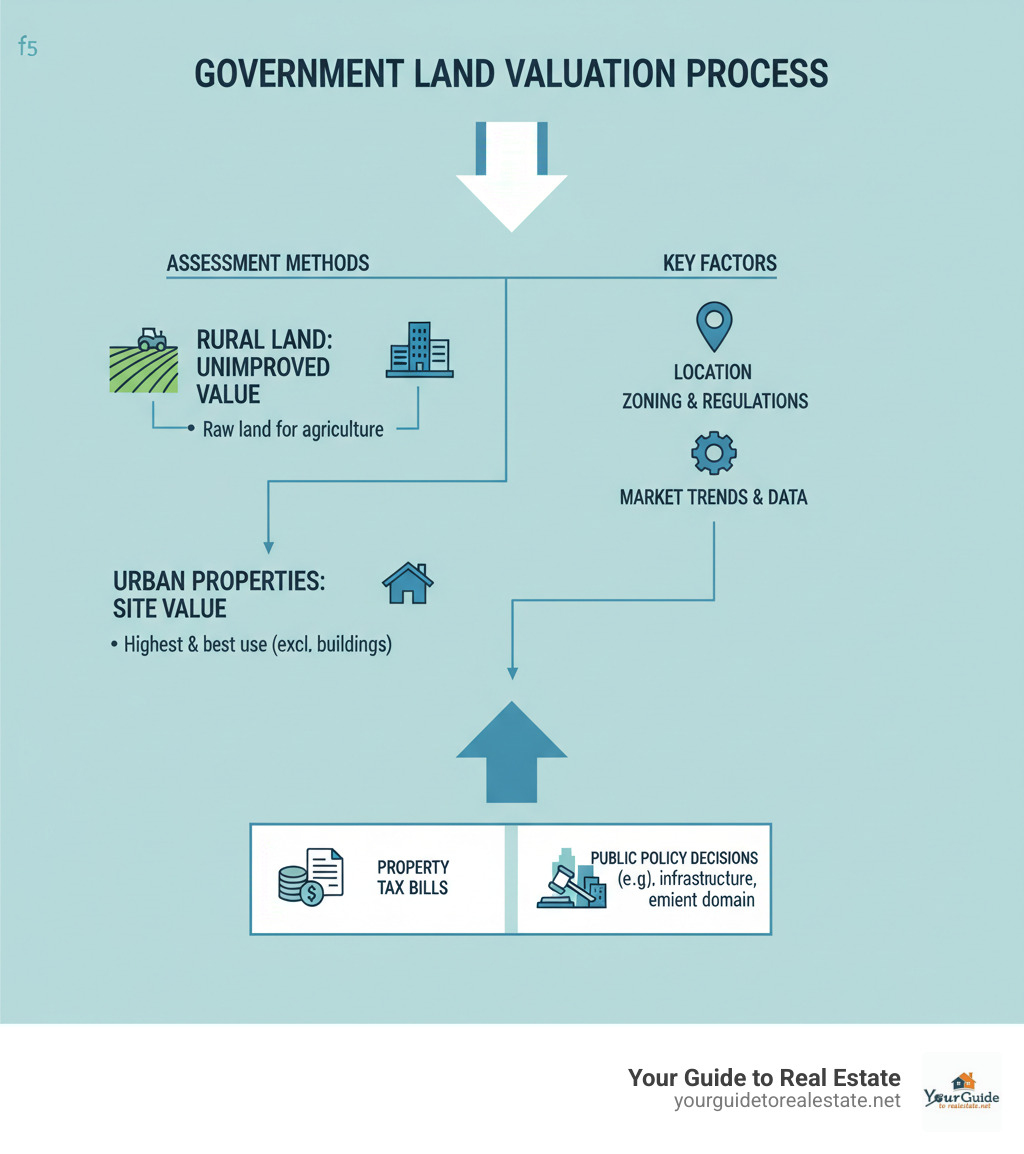
The process varies dramatically by location and land type. Rural agricultural land gets valued on its “unimproved value” – what the raw land is worth for farming. Urban properties focus on “site value” – the land’s worth for its highest and best use, separate from any buildings.
Understanding these valuations empowers you to challenge unfair assessments, plan investments, and negotiate better deals. Farm real estate alone accounts for over 80% of total U.S. farm sector assets, making accurate valuations crucial for millions of property owners.
Government valuation of land helpful reading:
Why Government Valuation Matters
Think of government valuation of land as the financial backbone of your community. Every time you drive on a smooth road, send your kids to school, or call 911, you’re experiencing the direct result of property tax assessments funded by these valuations.
The heart of government land valuation lies in creating fair property tax assessments. Local governments depend on these taxes to keep essential services running – from maintaining parks where your family plays to funding the fire department that protects your home. Without accurate and consistent valuations, some property owners might pay far more than their fair share while others pay too little.
But government valuation of land reaches far beyond your annual tax bill. When the government needs private land for public projects like new highways or utility lines, these valuations determine the compensation you’d receive through eminent domain or compulsory acquisition. This ensures you get fair market value, even when you’re not choosing to sell.
Urban planners and policymakers also rely heavily on these valuations. Higher land values in certain neighborhoods signal where demand is growing, helping officials decide where to invest in new infrastructure or adjust zoning regulations. It’s like having a pulse on your community’s economic health.
Your local bank might not directly use government valuations for your mortgage, but these assessments help paint the bigger picture of your area’s real estate market stability. Lenders consider this broader economic landscape when setting interest rates and making lending decisions.
Government agencies themselves own massive amounts of property and land. They need accurate valuations for their financial reporting – just like any large organization tracking its assets. This transparency helps taxpayers understand how public resources are managed.
Perhaps most importantly, government valuation of land helps officials understand how proposed policies might impact local economics. These estimates are sensitive to specific property characteristics, making them valuable tools for predicting policy outcomes.
The entire system creates a foundation for fiscal responsibility, economic planning, and fairness between public and private interests. It’s more complex than it appears on the surface, but this complexity serves an essential purpose in keeping our communities functioning smoothly.
For those interested in the broader economic theories behind real estate taxation, this scientific research on real estate taxation policies offers deeper insights into how these systems work across different countries.
How to Find Your Government Valuation of Land
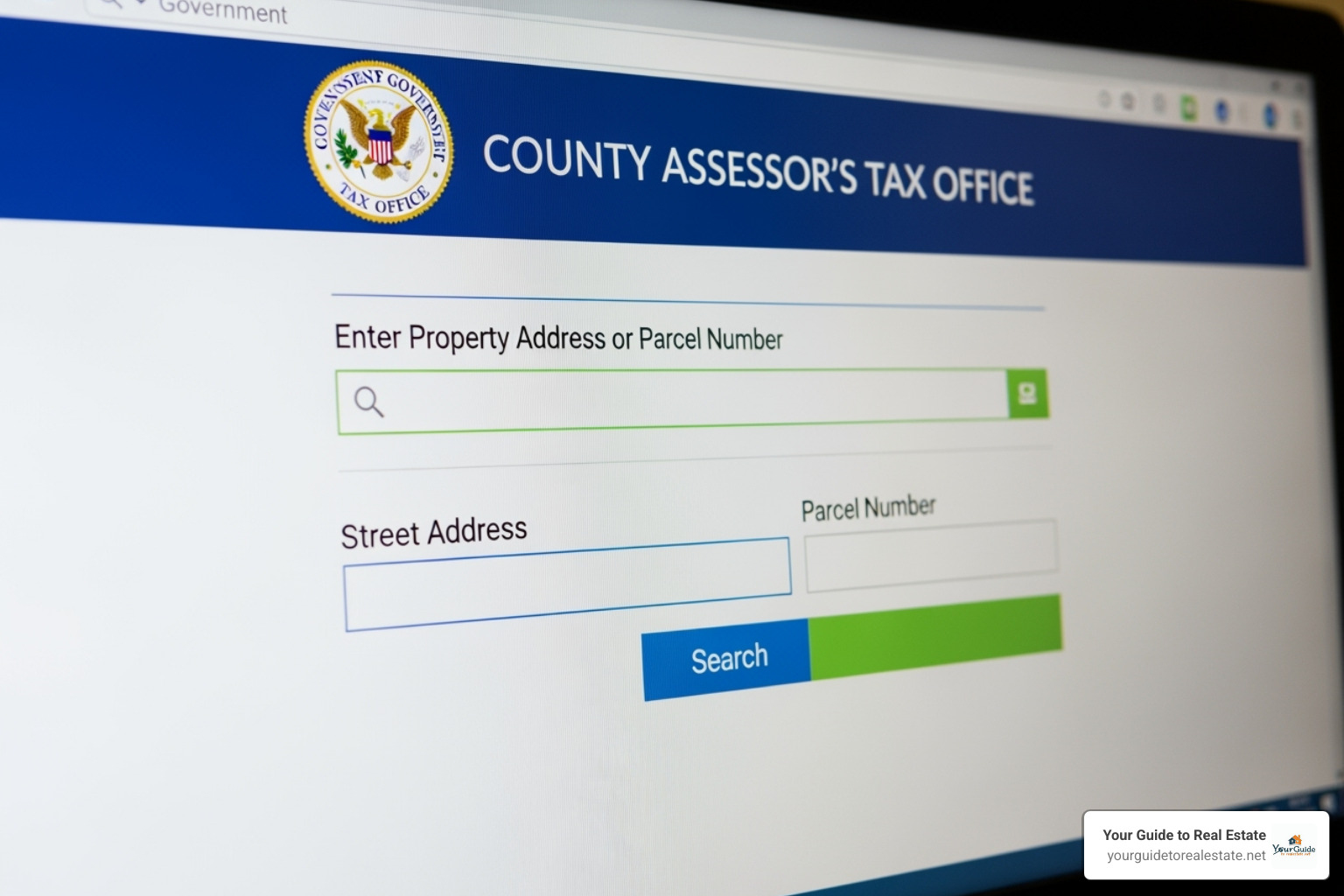
Finding your property’s government valuation of land is straightforward, with most information available online. Your local county appraisal district or tax assessor’s office is responsible for these valuations. Before you start, have your Property Identification Number (PIN), parcel number, or property address ready to streamline the search.
Checking Valuations Online
The easiest way to find your government valuation of land is online.
- County Assessor Websites: These are your best starting point. They have search tools to find detailed valuation information using your address or parcel number. For example, Dallas residents can use the Dallas Central Appraisal District site, while those in Oklahoma County can visit the Assessor of Oklahoma County Government portal. These platforms typically show both land and improvement values.
- State Revenue Departments: Some states offer centralized portals that link to local assessment data, which is useful for owners with property in multiple counties.
- Digital Portals: Advanced regions may offer interactive map overlays, like the Queensland Globe in Australia, showing how technology is improving access to property data.
When searching, look for terms like “Property Search,” “Tax Records,” or “Assessed Value,” and always use official government sources for accuracy.
Finding Your Government Valuation of Land Offline
If you need more detail or prefer direct contact, offline methods are effective.
- Visit the Assessor’s Office: Staff can explain valuation methods, guide you through records, and answer property-specific questions.
- Request a Report by Mail: You can often request a detailed valuation report that breaks down assessed land and improvement values. Contact your local office for their procedure.
- Check Your Annual Valuation Notice: This yearly document from your assessor outlines your property’s assessed value and taxes. It’s your primary official communication, so review it carefully.
- Use Public Terminals: Many government offices provide free-to-use computer terminals for searching property records if you lack internet access.
Whether online or offline, accessing your government valuation of land empowers you to make informed property decisions.
How Land Value is Assessed by the Government
Understanding how governments determine your government valuation of land is less mysterious than it seems. Unlike a private appraisal for a sale, government assessors value your land separately from any improvements like your house or barn. This separation allows for fairer tax policies and a better understanding of local real estate markets.

Assessors use site value for urban properties (the land’s worth if it were vacant) and unimproved value for rural land (its worth in a natural state). Key factors influencing this value include:
- Location: Proximity to schools, jobs, and transportation.
- Zoning Regulations: Commercial zoning typically yields a higher value than residential.
- Public Infrastructure: Access to water, sewer, and electricity adds significant value.
To ensure consistency, assessors use mass appraisal techniques. The sales comparison approach is fundamental, where they analyze recent sales of similar vacant land. This data is fed into Computer-Assisted Mass Appraisal (CAMA) systems. These powerful programs use statistical hedonic models to analyze how characteristics like size and location contribute to value, ensuring fairness across thousands of properties. Finally, assessors apply the highest and best use principle, valuing land based on its most profitable and legally permissible use, which might be for development rather than its current use.
Valuing Agricultural Land: The USDA’s Approach
The U.S. Department of Agriculture’s Economic Research Service (ERS) provides critical data on farmland values, which are a cornerstone of the U.S. farm economy. Farm real estate was valued at $3.52 trillion in 2024, making up 83.5% of all U.S. farm assets.
Key trends from the USDA’s 2024 data include:
- Average Value: U.S. farmland averaged $4,170 per acre, a 5.0% increase from 2023.
- Cropland vs. Pastureland: Cropland averaged $5,570 per acre, significantly higher than pastureland at $1,830 per acre.
- Regional Variation: Values vary dramatically by location. Corn Belt farmland is worth nearly double the national average, while Mountain region land is less than half.
Factors driving these values include soil quality, water access, commodity prices, interest rates, and even non-agricultural demand from those seeking a rural lifestyle or development potential. For detailed statistics, the USDA’s Land Values, 2024 Summary is the definitive source.
Understanding these methodologies demystifies the government valuation of land process, showing how it creates a foundation for property taxation and public policy.
A Progressive Approach: The Land Value Tax (LVT)
A Land Value Tax (LVT) is a tax system that rewards property improvement by taxing only the unimproved value of land, ignoring any buildings or landscaping. This concept, championed by economists like Adam Smith and Henry George, means your tax bill wouldn’t increase if you built a new home or business.

This approach offers several benefits. It’s economically efficient because taxing land, which has a fixed supply, doesn’t discourage production. It also reduces land speculation and urban sprawl by making it expensive to hold valuable land idle, encouraging development in urban centers. Because land ownership is concentrated among the wealthy, LVT is often seen as a progressive tax that can reduce inequality.
| Traditional Property Tax | Land Value Tax |
|---|---|
| Taxes land + improvements | Taxes only land value |
| Discourages development | Encourages development |
| Can penalize improvements | Rewards improvements |
| Complex to assess | Simpler to assess |
Arguments For and Against LVT
Proponents, including Nobel laureate William Vickrey, praise LVT for its progressive tax effects and ability to encourage development. By making it costly to leave valuable land vacant, it incentivizes productive use and promotes compact, sustainable communities.
However, critics like economist Murray Rothbard point to assessment challenges, arguing it’s difficult to separate land value from improvement value in a developed area. Transition issues are another concern, as an LVT could burden cash-poor, long-time residents in gentrifying areas with high tax bills. These political problems help explain “Why land value taxes are so popular, yet so rare”.
LVT in Practice: Global Examples
Despite challenges, variations of LVT have been implemented worldwide:
- Estonia: Operates a full LVT system, contributing to a high owner-occupancy rate.
- Denmark: Allows municipalities to set land value tax rates, providing local flexibility.
- Pennsylvania (U.S.): Uses a “split-rate” tax, taxing land at a higher rate than buildings to spur development in cities like Harrisburg.
- Singapore: Captures land value through development taxes and state land leases.
- Taiwan: Generates significant government revenue from land value and land value increment taxes.
- Australia: The Australian Capital Territory is transitioning from stamp duty to a broad-based land tax.
- Detroit (U.S.): Has proposed an LVT to cut homeowner taxes while increasing taxes on vacant and underused land to fight urban blight.
These examples show that land-based taxation can be adapted to achieve public policy goals like funding services and promoting smart development.
Frequently Asked Questions about Government Land Valuations
Here are answers to common questions about government valuation of land.
How often is government land valuation updated?
The frequency depends on state and local laws:
- Annual Valuations: Some areas, like Queensland, Australia, update valuations yearly to keep them aligned with the current market.
- Cyclical Reassessments: More common in the U.S., properties may be reassessed every three to seven years. This can lead to larger jumps in value when updates occur.
- Market-Driven Updates: Major market shifts can trigger special reassessments to maintain fairness.
Check your annual property tax notice or contact your local assessor’s office to find your area’s specific schedule.
Can I object to or appeal my land valuation?
Yes, you have the right to appeal an assessment you believe is unfair. The process generally involves:
- Filing a Formal Objection: You must file a written protest with your assessor’s office, usually on a specific form and by a strict deadline.
- Appearing Before a Review Board: If the initial protest is denied, you can present your case to an independent body like an Appraisal Review Board.
- Providing Evidence: The burden of proof is on you. You’ll need solid evidence, such as recent sales data of comparable properties, an independent appraisal, or documentation of errors in the assessor’s records (e.g., incorrect lot size). Photos of issues that lower value can also be compelling.
Deadlines are critical; missing them usually means you must wait until the next appeal period.
Does a high government valuation increase my property’s market value?
No, a high government valuation does not directly increase your property’s market value.
- Different Purposes: Assessed value is for calculating taxes, while market value is what a buyer is willing to pay today.
- Correlation, Not Causation: A high assessment often reflects a strong market, but it doesn’t create it. Both values are driven by factors like location and economic conditions.
- Buyer and Lender Perspective: Buyers and lenders rely on independent appraisals and comparative market analyses, not tax assessments, to determine a property’s worth for a sale or loan.
Think of your assessed value as a snapshot from the past. Your property’s true market value is determined by what’s happening in the market right now.
Take Control of Your Property’s Value
Now that you understand how government valuation of land works, you’re equipped with knowledge that puts you in the driver’s seat. This isn’t just about numbers on a tax bill – it’s about taking control of one of your most significant financial assets and ensuring you’re treated fairly by the system.
When you know how to find your property’s assessed value and understand the factors that influence it, you can spot potential errors before they cost you money. Maybe the assessor has your lot size wrong, or they’re not accounting for that flooding issue in your backyard. These details matter, and catching them can save you hundreds or even thousands of dollars in property taxes.
Government valuation of land knowledge also makes you a smarter investor. Whether you’re eyeing that farmland in rural Texas or considering a vacant lot in an up-and-coming neighborhood, understanding how land gets valued helps you spot opportunities others might miss. You’ll know when a property is fairly priced versus when it’s a hidden gem or an overpriced dud.
The broader impact goes beyond your individual property too. When more property owners understand and engage with the valuation process, it creates pressure for fair and accurate assessments across entire communities. This benefits everyone by ensuring that the tax burden gets distributed equitably.
At Your Guide to Real Estate, we believe that knowledge is your best investment tool. The real estate market doesn’t have to feel overwhelming when you have the right information and a proven framework to guide your decisions. Understanding property valuations is just one piece of the puzzle, but it’s a crucial one that many people overlook.
Ready to dive deeper into property values and market analysis? We’ve got you covered with comprehensive resources that break down complex topics into actionable insights. Check out our detailed guide: More info about valuation and market analysis in real estate
Every successful real estate decision starts with understanding the fundamentals. Government valuation of land is one of those fundamentals that can make the difference between a good investment and a great one.