
Why Healthcare Real Estate Financing is Essential for Your Property Investment
Healthcare real estate financing provides access to one of America’s most stable and growing property sectors. For healthcare providers wanting to own their practice space or investors seeking steady returns, understanding financing options is crucial.
Quick Answer: Healthcare Real Estate Financing Options
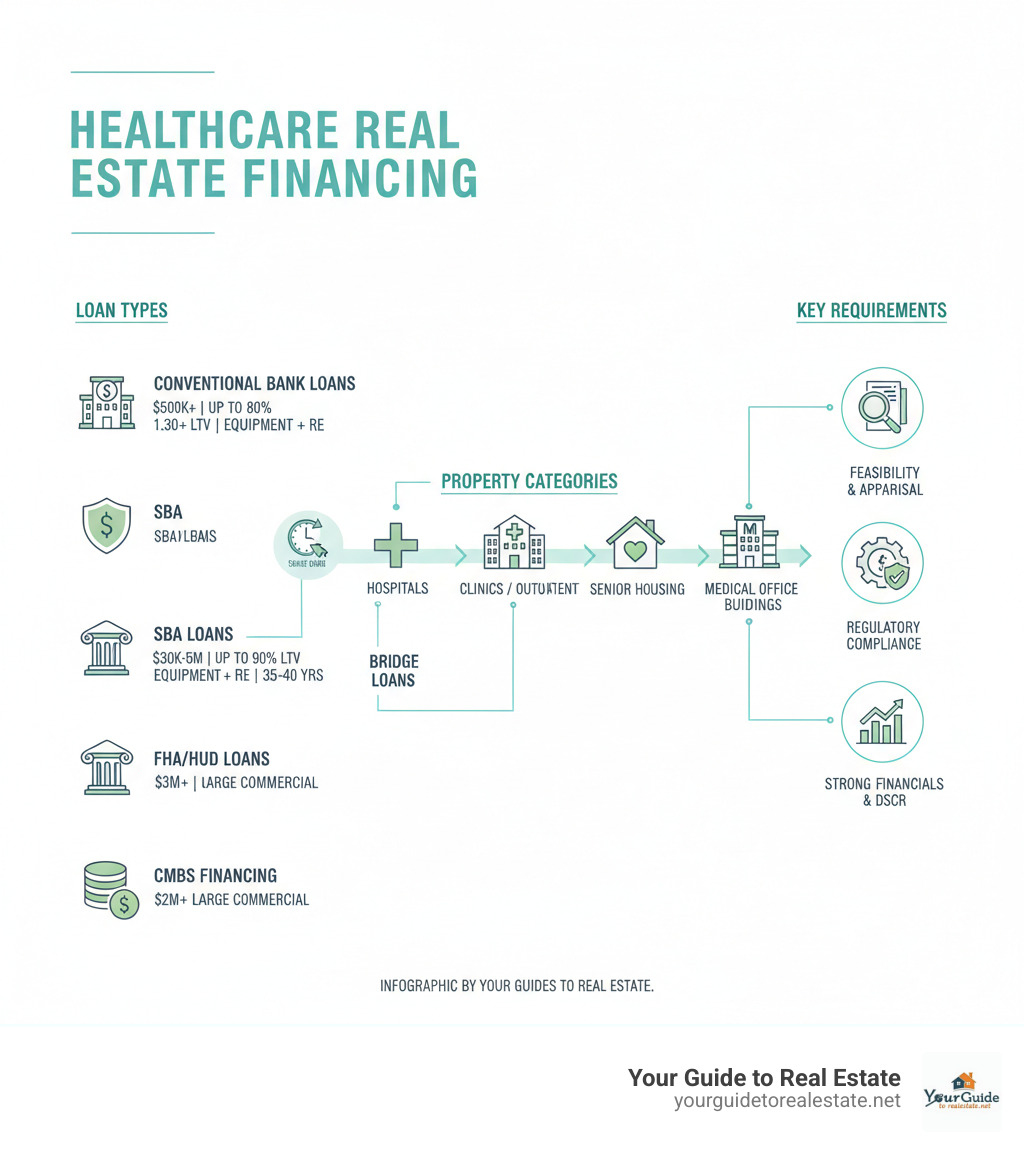
- Conventional Bank Loans: $500,000+ minimum, up to 80% LTV, 1.30+ DSCR.
- SBA Loans: $30,000-$5 million range, up to 90% LTV, covers real estate + equipment.
- FHA/HUD Loans: $3 million+ minimum, up to 83.3% LTV, 35-40 year terms.
- CMBS Financing: $2 million+ minimum, for larger commercial properties.
- Bridge Loans: Short-term financing for acquisitions and construction.
The healthcare real estate market is booming, driven by an aging population and demand for specialized care. This creates unique investment opportunities in senior housing, outpatient facilities, and more.
However, these properties require specialized financing knowledge. Unlike typical commercial spaces, healthcare facilities have specific regulatory, operational, and financial structures. The good news is that multiple financing options exist to match your needs, from conventional bank loans and versatile SBA loans to government-insured programs like FHA with high leverage and long terms.
Understanding which option fits your project—whether acquiring, building, or refinancing—is the key to success and profitability.
Simple guide to healthcare real estate financing terms:
Understanding Eligible Healthcare Properties and Loan Products
The world of healthcare real estate financing is diverse. Unlike standard commercial properties, healthcare facilities serve unique medical needs and require specialized financing. A small clinic’s requirements differ vastly from a hospital or biotech lab, making it vital to match the right property with the right loan product.
Eligible Property Types
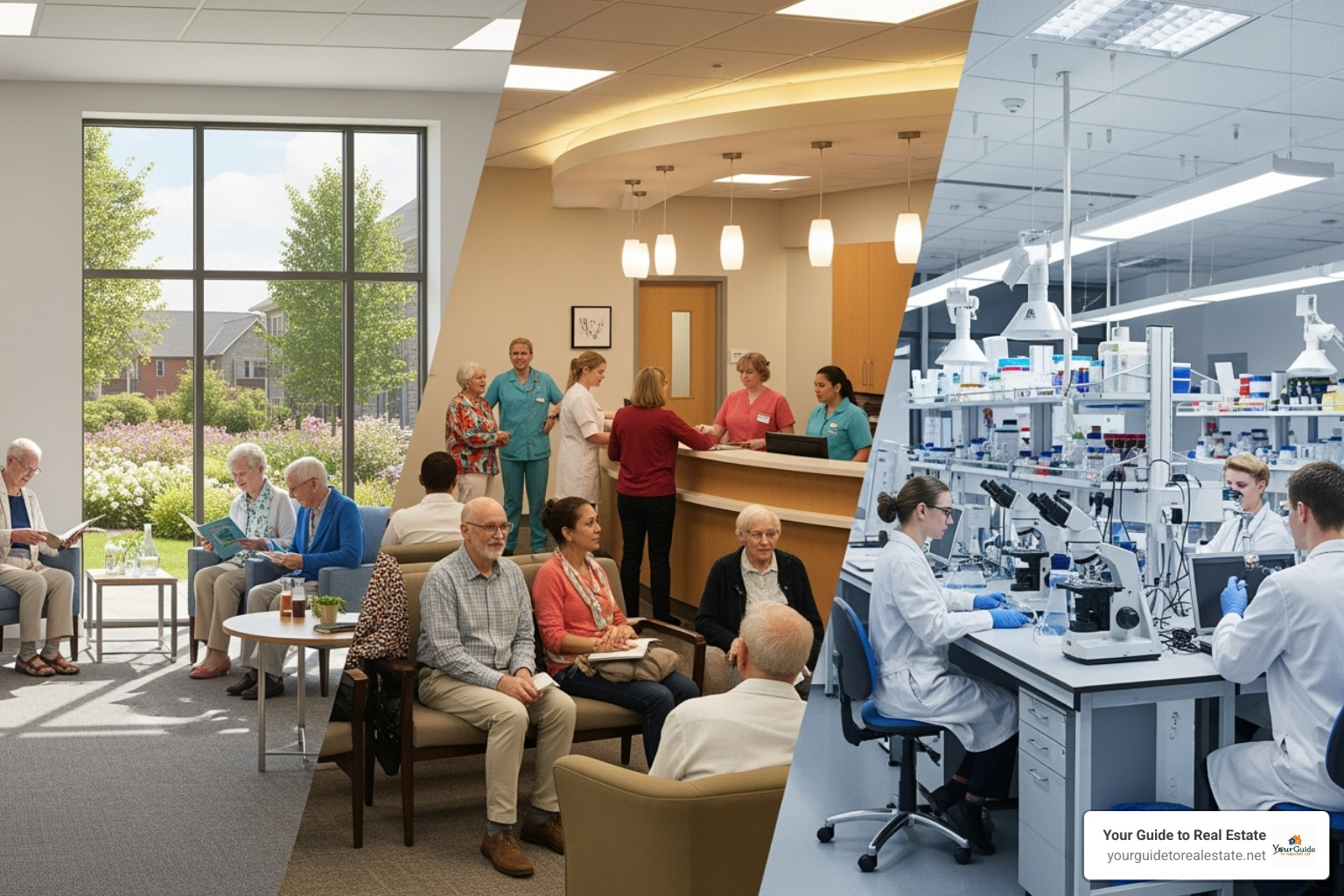
Nearly any property providing medical or health-related services can qualify for healthcare real estate financing. The range includes:
- Hospitals: From large acute-care facilities to smaller community hospitals, these are cornerstones of healthcare real estate.
- Clinics: This flexible category includes everything from family practices and urgent care centers to large multi-specialty complexes.
- Surgical and Outpatient Facilities: A fast-growing segment including ambulatory surgery centers, diagnostic imaging centers, and dialysis facilities.
- Senior Housing Properties: Driven by an aging population, this includes independent living, assisted living, and memory care centers.
- Skilled Nursing Facilities (SNFs): These provide 24/7 medical care and often have stable cash flows from Medicare/Medicaid.
- Medical Office Buildings (MOBs): Strategically located buildings that house physician practices, labs, and other services.
- Emerging Sectors: Life sciences real estate (research labs, biotech) and behavioral health facilities (mental health, addiction treatment) are experiencing rapid growth.
For a deeper dive into commercial property investing, see our guide on commercial real estate.
Typical Loan Products and Terms
Matching the right loan product to your timeline and goals is key. Common options include:
- Acquisition Financing: For purchasing existing healthcare properties with proven cash flow.
- Refinancing Loans: To secure better rates, pull out equity, or improve cash flow on properties you already own.
- Construction Loans: To fund new healthcare facilities from the ground up.
- Bridge Loans: Short-term capital for quick acquisitions or to bridge a gap until permanent financing is secured.
- Renovation Loans: To transform or update existing spaces for new healthcare uses.
When evaluating these loans, you’ll encounter three critical terms:
- Loan-to-Value (LTV): Typically up to 80% for healthcare properties, meaning a 20% down payment is needed. Some programs offer higher LTVs.
- Debt Service Coverage Ratio (DSCR): Measures if the property’s income can cover the mortgage. Lenders usually require a DSCR of 1.30 or higher. Our DSCR Loans Complete Guide explains this in detail.
- Amortization Periods: Usually 15 to 30 years. Government-insured programs can extend up to 40 years, resulting in lower monthly payments.
Comparing Major Loan Programs: Conventional, Government-Insured, and In-House Loans
Choosing the right healthcare real estate financing means picking the perfect tool for the job. Let’s break down the three main categories of loans to help you make an informed decision that fits your goals.
Conventional Bank Loans
Traditional bank loans are the workhorses of healthcare financing, ideal for established practices with solid financials.
- Loan Amounts: Typically start at $500,000.
- Loan-to-Value (LTV): Usually capped at 80%, requiring a 20% down payment.
- DSCR: A minimum Debt Service Coverage Ratio of 1.30 is standard, ensuring strong cash flow.
- Terms: Predictable fixed rates for 3, 5, 7, or 10 years, with amortization from 15 to 30 years.
- Recourse: Loans can be recourse (personal liability) or non-recourse (liability limited to the property), though non-recourse is harder to qualify for.
Government-Insured Loans
Government-backed programs often offer better terms to encourage lending in vital sectors like healthcare.
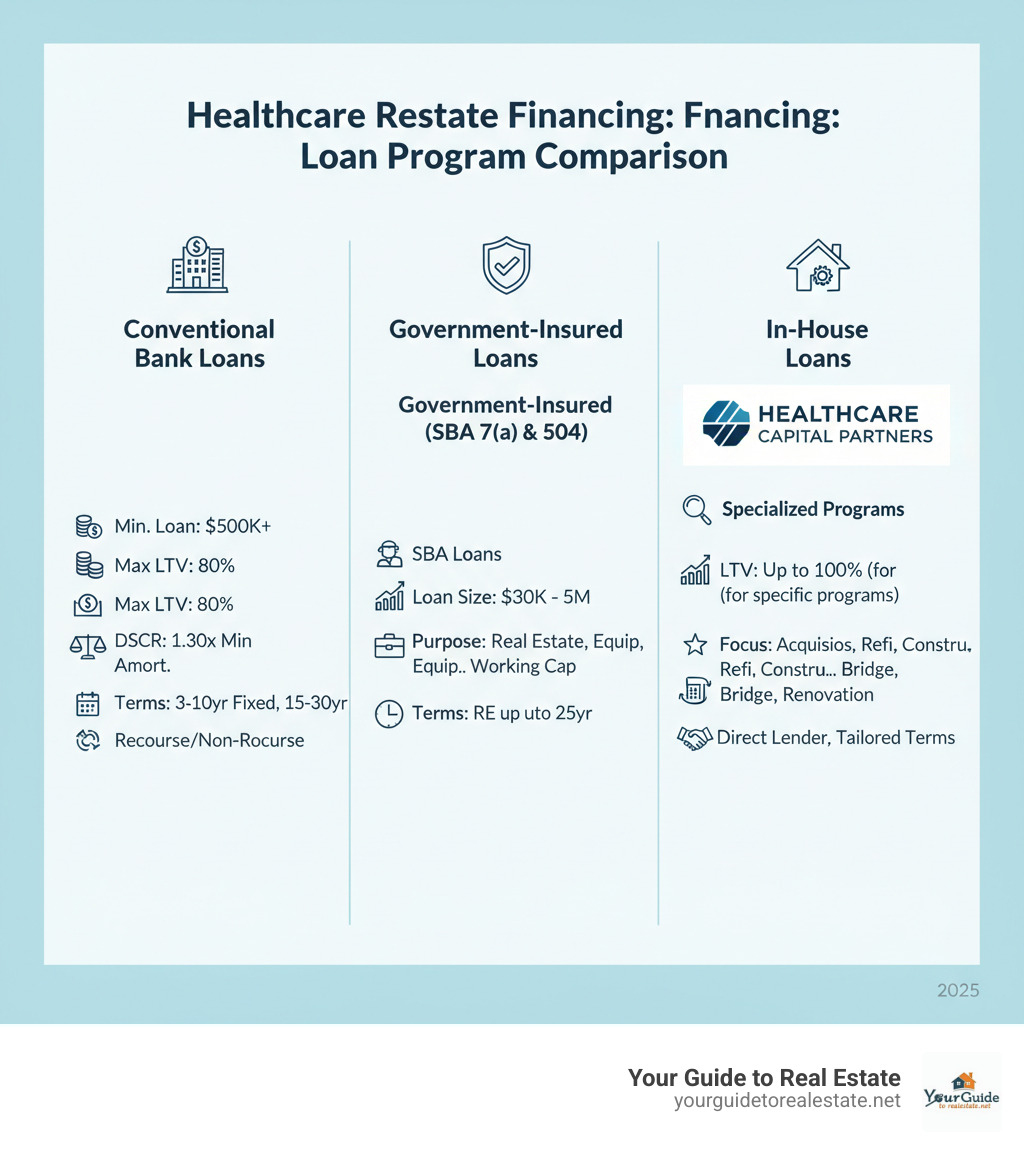
- SBA Loans: Versatile loans from $30,000 to $5 million. They can cover real estate, equipment, and working capital in one package. LTVs can reach 85-90%, with terms up to 25 years for real estate. A credit score of 660+ is generally required.
- FHA and HUD Programs: Excellent for senior housing and skilled nursing facilities, offering long amortization periods of 35-40 years, which significantly lowers monthly payments. Minimum loan amounts start around $3 million, with LTVs up to 83.3%. For more details, see our FHA Loan Requirements guide.
- CMBS Financing: For larger deals, typically starting at $2 million. These non-recourse loans are suited for substantial healthcare properties and sophisticated investors.
In-House Loans
Some lenders offer their own specialized loan products that don’t fit into other categories. These can be hidden gems for the right borrower.
These loans feature a flexible underwriting approach because lenders use their own capital, allowing for creative terms. They often rely on relationship-based lending, where a lender’s deep understanding of the healthcare market allows them to craft custom solutions. You might find fixed or variable rates and customizable terms that perfectly match your project’s needs.
Navigating Eligibility and the Application Process for Healthcare Real Estate Financing
Getting approved for healthcare real estate financing requires demonstrating your expertise and financial readiness. Understanding what lenders look for makes the process much more manageable.

Key Eligibility Requirements
Lenders will examine several aspects of your financial health before approving funding:
- Credit Score: Most lenders require a score of at least 660. Higher scores lead to better terms.
- Operator Experience: Crucial for facilities like skilled nursing or senior housing. Lenders need proof that you can run the facility profitably and provide quality care.
- Business Financial Health: Lenders will analyze your financial statements for consistent profits, steady cash flow, and manageable debt.
- Personal Financial Statements: Since many loans require personal guarantees, your personal assets, income, and debts are also considered.
- Property Cash Flow: The property must generate enough income to cover its mortgage payments, typically with a Debt Service Coverage Ratio (DSCR) of 1.30 or higher.
Our Loan Process for Buying a House guide offers more insight into the general loan application process.
Essential Documentation
Gathering your paperwork ahead of time will streamline the application. Be prepared to provide:
- Business tax returns (past two years)
- Year-to-date balance sheets
- Projected financial statements (1-3 years)
- Business licenses and certifications
- Personal tax returns and detailed resumes for all major owners
- The real estate purchase agreement (for acquisitions)
Financing for New Construction vs. Acquisition
Your financing journey differs depending on whether you build new or buy an existing property.
Construction financing is seen as higher risk due to variables like weather delays and material costs. Most are structured as bridge-to-permanent programs, where a construction loan converts to permanent financing upon completion. Lenders like Live Oak Bank and Henry Schein offer specialized construction loans for medical facilities.
Acquisition financing is often more straightforward because the property has an operating history and established cash flow. Permanent financing for acquisitions typically offers longer terms (15-30 years). If renovations are needed, repositioning loans can cover both the purchase and improvement costs. Lenders like MidCap Financial and KeyBank have experience in financing acquisitions and refinancing for facility upgrades.
For more business insights, explore these educational resources for business owners.
Key Factors That Influence Your Healthcare Real Estate Financing Approval
Getting approved for healthcare real estate financing goes beyond a good credit score. Lenders analyze multiple factors to assess the health of your investment, including your property, your operational track record, and broader market trends.
Property, Operator, and Location Analysis
Lenders evaluate these three core elements when considering your loan application:
- Property Type and Condition: A modern medical office building is evaluated differently than a specialized behavioral health facility. Lenders assess if the property is well-maintained, meets current healthcare standards, and has a suitable layout. Creative repurposing of older properties can also be attractive if the project meets modern healthcare needs.
- Operator’s Track Record: This is critical, especially for complex facilities like skilled nursing homes. Lenders want to see a history of successful management, strong patient satisfaction, and positive financial performance. A skilled operator can make a property more attractive to lenders.
- Geographic Location and Demographics: Lenders analyze if the local market needs your services. They look at factors like an aging population for senior care, gaps in local medical services, and the level of competition. Some lenders even provide demographic analysis to help you choose the best location.
Current Market Trends and Outlook
Smart lenders consider how evolving healthcare trends will impact your financing.
- Demand Growth: The growing demand for outpatient services and senior care makes these properties very attractive. Ambulatory surgery centers, rehabilitation centers, and senior housing are particularly strong segments.
- Emerging Sectors: The rise of life sciences (research labs, biotech) and behavioral health facilities presents new opportunities that specialized lenders are keen to finance.
- Economic Factors: Interest rates and the overall economic climate affect your project’s profitability. Lenders will scrutinize your financial projections to ensure they hold up under various conditions.
- Regulatory Environment: Changes in healthcare regulations, such as Medicare and Medicaid reimbursement rates, can impact your facility’s bottom line. Lenders who specialize in healthcare financing stay current on these issues and factor them into their risk assessment.
The Advantage of Specialized Lenders and Financial Advisors
For healthcare real estate financing, working with a specialist is essential. Generalist lenders may understand basics, but they lack the deep knowledge required for these complex properties.

Healthcare properties are unique ecosystems with challenges that require specific expertise.
Why Work with a Specialist?
- Industry Expertise: Specialists understand the operational differences between a skilled nursing facility, a medical office, and a life sciences lab. They are familiar with patient flow, specialized equipment needs, and healthcare business cycles.
- Understanding of Regulations: Healthcare is governed by a maze of regulations. Specialized lenders stay current on Medicare changes, FDA guidelines, and other rules that affect profitability and compliance.
- Access to Diverse Funding Sources: Specialists have relationships with a wide array of funding sources, including Fannie Mae, Freddie Mac, FHA, HUD, and private capital. This network allows them to find financing solutions that a local bank can’t offer.
- Custom Loan Structures: Specialists can craft creative financing deals, such as high-leverage loans for senior housing or complex construction-to-permanent financing for a new surgical center.
The Role of a Broker or Financial Advisor
A skilled broker or financial advisor acts as your translator and advocate in the complex financing landscape.
- Navigating Complexity: They help you understand the nuances between different loan products and identify the best fit for your project.
- Securing Competitive Options: A broker presents your deal to multiple qualified lenders at once, creating a competitive environment that often results in better rates and terms.
- Saving Time and Resources: They handle the paperwork and coordination, allowing you to focus on your core business of patient care or investment strategy.
- Providing Expert Guidance: A good advisor helps structure your deal, prepare financial projections, and anticipate roadblocks, creating a full support team for your project.
At Your Guide to Real Estate, we provide a proven framework and stress-free guidance for your real estate journey. Having the right expertise is crucial for a smooth transaction.
Frequently Asked Questions about Healthcare Real Estate Financing
Navigating healthcare real estate financing can bring up many questions. Here are answers to some of the most common ones we hear from healthcare professionals and investors.
What is the minimum loan amount I can get for a healthcare property?
The minimum loan amount varies significantly by program.
- SBA loans are ideal for smaller projects, with minimums as low as $30,000.
- Conventional bank loans typically start at $500,000.
- CMBS financing generally begins at $2 million.
- FHA/HUD programs for larger projects like hospitals often require a minimum of around $3 million.
The key is to match your project’s scale with the right financing program.
Can I use a business loan to buy medical equipment?
Yes, and this is a major advantage of certain healthcare financing options. SBA 7(a) and 504 loans are especially useful, as they allow you to finance your property, purchase essential medical equipment, and secure working capital all within a single loan package. This streamlines your financing and simplifies cash flow management by consolidating payments.
How long does it take to get a healthcare real estate loan?
The timeline depends on the loan type.
- Conventional loans are often the fastest, typically closing in 45 to 60 days.
- Government-insured loans (SBA, FHA, HUD) take longer due to additional review processes, usually 60 to 120 days.
- Specialized in-house loans have variable timelines but are often faster than government programs.
To speed up the process, have all your financial documents organized and ready. Working with an experienced professional who understands healthcare financing can also significantly reduce your closing time.
Conclusion
Investing in healthcare real estate financing opens the door to a stable and promising market. Whether you are a provider seeking to own your practice or an investor looking for recession-resistant returns, you now have a roadmap for success.
We’ve covered the diverse opportunities, from medical office buildings to senior housing, and the accessible financing landscape. SBA loans, conventional bank loans, and government-insured programs like FHA offer a range of options for projects of any scale.
Successful investors understand that financing is a tool for growth. The right loan can fuel expansion, improve facilities, and build lasting wealth. However, navigating this specialized field requires expert guidance. Specialized lenders understand the unique regulatory and operational challenges of healthcare properties and can craft solutions that general lenders cannot.
At Your Guide to Real Estate, we believe in empowering you with knowledge. Our proven framework removes the stress from complex financing decisions, allowing you to focus on what you do best. Your success story in healthcare real estate begins with the right financing strategy.
Ready to dive deeper into real estate financing fundamentals? Start with our comprehensive guide: Understanding Mortgages: A Beginner’s Guide to Home Loans.