Why Understanding Acre Size Matters in Real Estate
When you’re buying or selling property, how big is an acre becomes one of the most important questions you’ll ask. Whether you’re evaluating a suburban lot, considering rural land, or analyzing investment potential, understanding acreage directly impacts your decisions and your wallet.
Quick Answer:
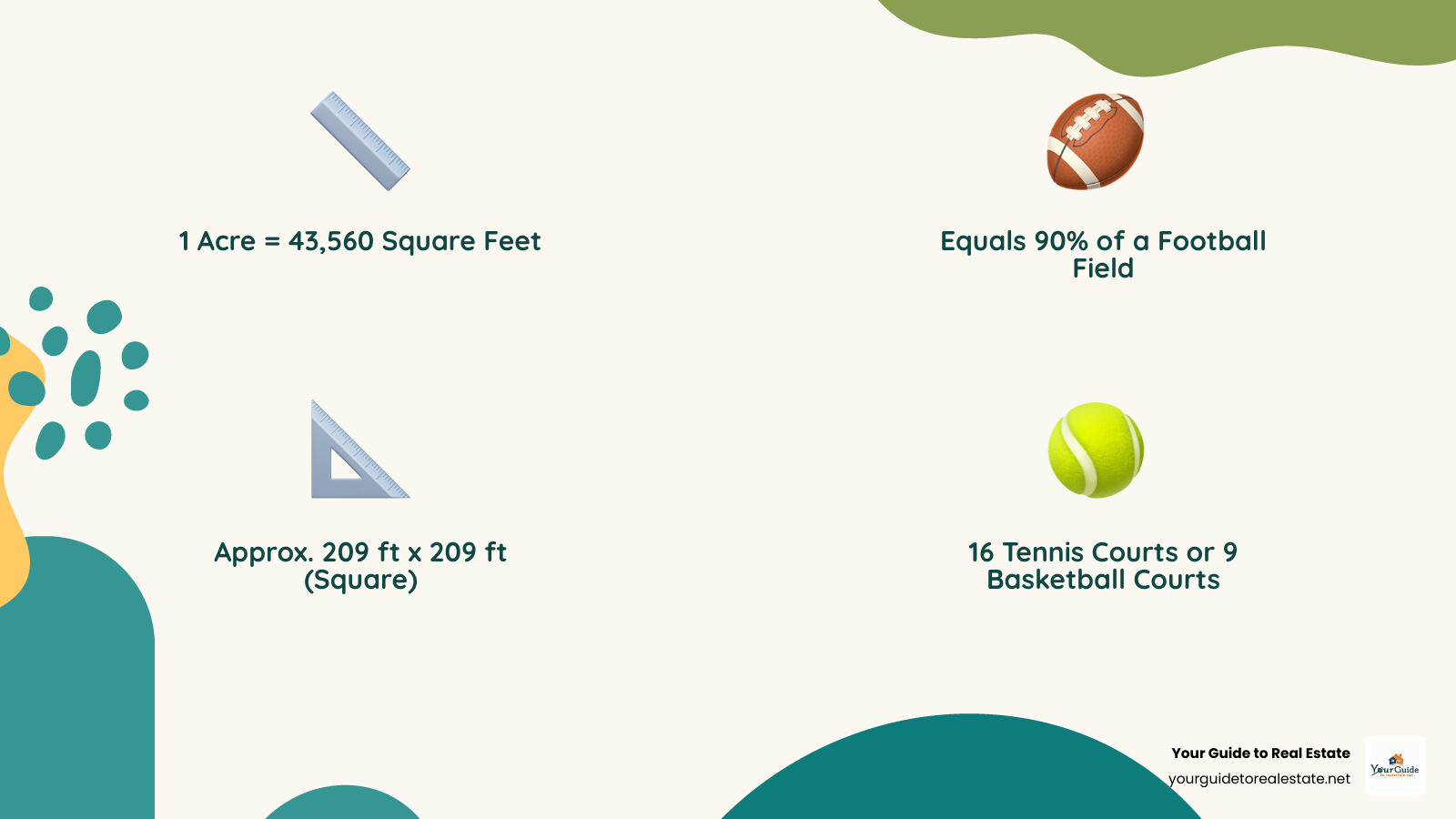
- 1 acre = 43,560 square feet
- Visualize it: About 90% of a football field (without end zones)
- Square dimensions: Approximately 209 feet × 209 feet
- Common comparison: 16 tennis courts or 9 basketball courts
The concept of an acre dates back to medieval times, when it represented “the amount of land a pair of oxen could plow in one day.” Today, this ancient measurement remains the foundation of land transactions across America.
For real estate buyers and investors, acre size affects everything from property value to development potential. A single acre might accommodate anywhere from one luxury estate to multiple suburban homes, depending on zoning laws and lot requirements.
Understanding acreage helps you evaluate whether that “spacious” lot listing actually delivers the space you need. It also prevents costly mistakes when comparing properties or assessing land value per square foot.
This guide breaks down everything you need to know about acre measurements, from official conversions to real-world comparisons that make this abstract concept tangible.
How big is an acre definitions:
What Exactly is an Acre? The Official Numbers
When people ask how big is an acre, they’re really asking about area – the amount of space something covers on the ground. Think of it like measuring your living room floor, not the length of a hallway.
Here’s the number you need to remember: one acre equals exactly 43,560 square feet. This isn’t an estimate or approximation – it’s the official measurement that’s been standardized across the United States and much of the English-speaking world.
But let’s be honest, 43,560 square feet is pretty abstract. So here are some other ways to think about that same space:
4,840 square yards if you’re thinking about your backyard in yard measurements. Approximately 4,047 square meters for those who prefer the metric system. About 0.4047 hectares when dealing with larger parcels (since a hectare equals 10,000 square meters, an acre is less than half a hectare).
And here’s a perspective that really puts things in context: there are 640 acres in one square mile. That means your single acre is just 1/640th of a square mile – which shows you how vast a square mile really is!
These conversions matter more than you might think. Whether you’re evaluating investment potential or comparing properties, understanding these relationships helps you make smarter decisions. For deeper insights into maximizing your property investments, check out our guide on Property Investment.
How Shape Affects Acreage
Here’s something that surprises most people: an acre can be any shape imaginable. Long and skinny, perfectly square, or even shaped like a boomerang – as long as the total area adds up to 43,560 square feet, it’s still one acre.
If you made an acre into a perfect square, each side would measure approximately 208.71 feet by 208.71 feet. Picture walking about 209 feet in one direction, then turning and walking the same distance – you’ve just traced the outline of a square acre.
But historically, acres weren’t square at all. The traditional acre was a long rectangle: one furlong by one chain, or 660 feet by 66 feet. This made perfect sense for farming – it was much easier for oxen to plow one long, straight line than to constantly turn corners in a square field.
In today’s real estate world, you’ll encounter irregular shapes all the time. Properties might follow natural boundaries like creeks, conform to street layouts, or work around existing structures. A piece of land could zigzag all over the place, but if a surveyor measures the total enclosed area at 43,560 square feet, you’ve got yourself one acre.
This flexibility is exactly why professional land surveys are so important when buying property – they ensure everyone agrees on where those boundaries actually fall.
How Big is an Acre? 10+ Real-World Comparisons
Numbers like 43,560 square feet can feel pretty abstract when you’re trying to picture how big is an acre really is. I mean, can you honestly visualize 43,560 of anything? Let’s make this way more concrete with comparisons to things you see every day.
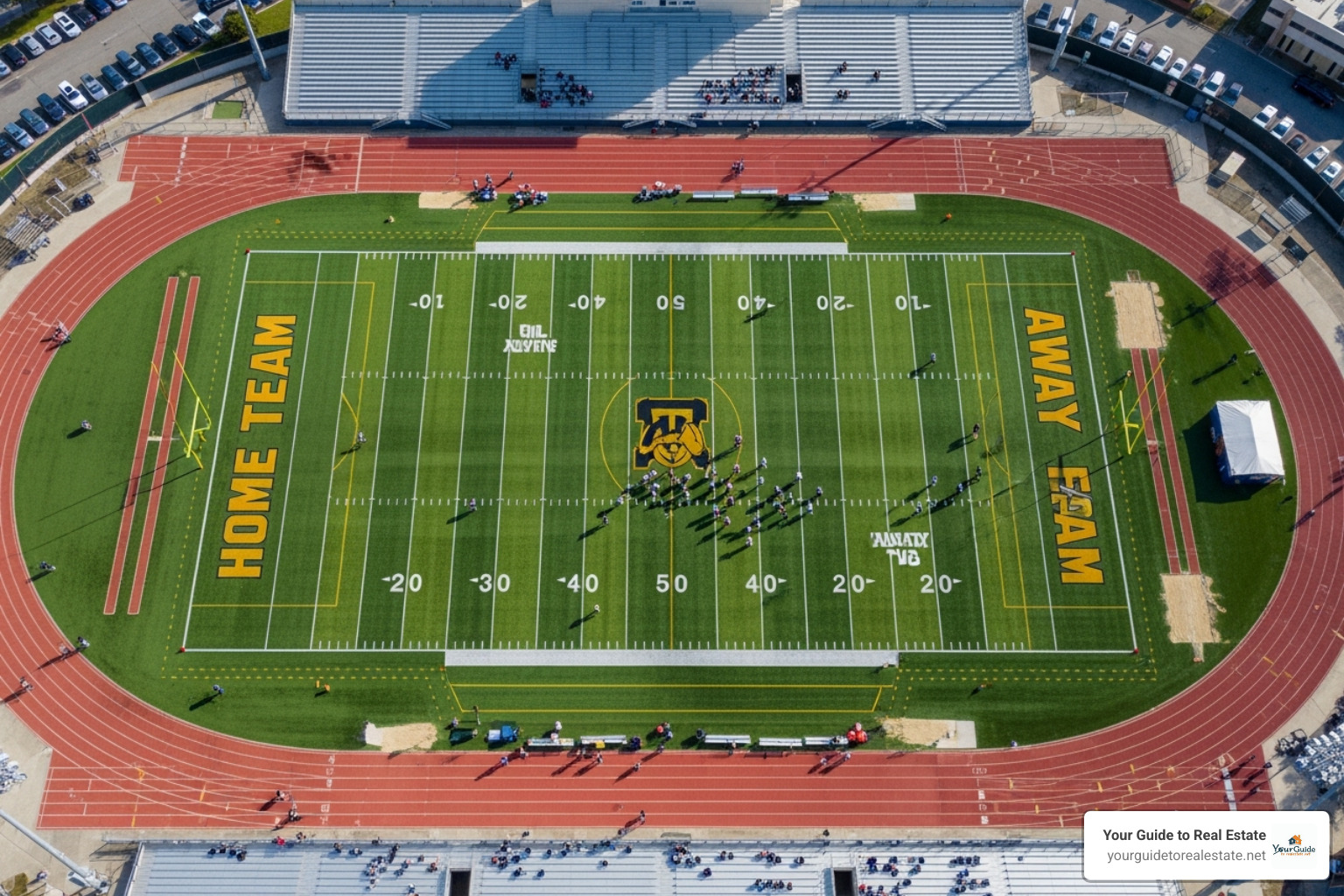
The easiest way to picture an acre? Think of a football field without the end zones. That playing area you watch every Sunday is about 90% the size of an acre. The full field with end zones is actually 48,000 square feet, making it slightly bigger than an acre at around 1.1 acres. So next time you’re watching the game, just trim off a little from each end zone in your mind – boom, that’s your acre.
For sports fans, here’s another fun way to think about it: you could squeeze 16 tennis courts onto a single acre. That’s enough for a serious tournament with room for spectators! Or if basketball’s more your thing, an acre could hold about nine NBA-regulation courts. Imagine the pickup games you could host.
Ever spent forever looking for a parking spot at the mall? Well, an acre can solve that problem in a big way. Depending on how you arrange them, you could fit anywhere from 240 to 284 standard parking spaces on one acre. That’s like having your own personal parking lot.
Now for some comparisons that might surprise you. The famous Roman Colosseum sits on about six acres total, so one acre is roughly one-sixth the size of that ancient wonder. When you think about walking around those massive ruins, dividing that space by six gives you a pretty good sense of scale.
The White House grounds cover 18.7 acres, making a single acre just a slice of that famous lawn. And here’s a weird one – you could fit about 1,031 king-size beds side by side on an acre. That’s enough for a really, really big sleepover.
Want to get really specific? You could lay out approximately 396,000 dollar bills flat across an acre. Just imagine walking across all that cash! Or if you’re more practically minded, depending on zoning laws and lot sizes, you might see anywhere from 2 to 5 suburban homes with yards on a single acre, though in high-density areas, you could potentially squeeze up to 15-20 units.
These real-world comparisons help bridge that gap between abstract numbers and actual space. When you’re out looking at properties, you can use these mental pictures to quickly assess whether a lot feels right for your needs. For more guidance on evaluating properties and making smart decisions, check out our First-Time Homebuyer Tips.
The key takeaway? An acre is substantial – it’s serious space – but it’s not overwhelmingly huge. It’s that sweet spot where you can really do something meaningful with the land, whether that’s building your dream home, starting a garden, or making an investment.
The History and Variations of the Acre
The story of how big is an acre begins centuries ago in medieval fields, where farmers worked alongside their faithful oxen from sunrise to sunset. This ancient measurement has quite literally shaped the landscape of property ownership as we know it today.
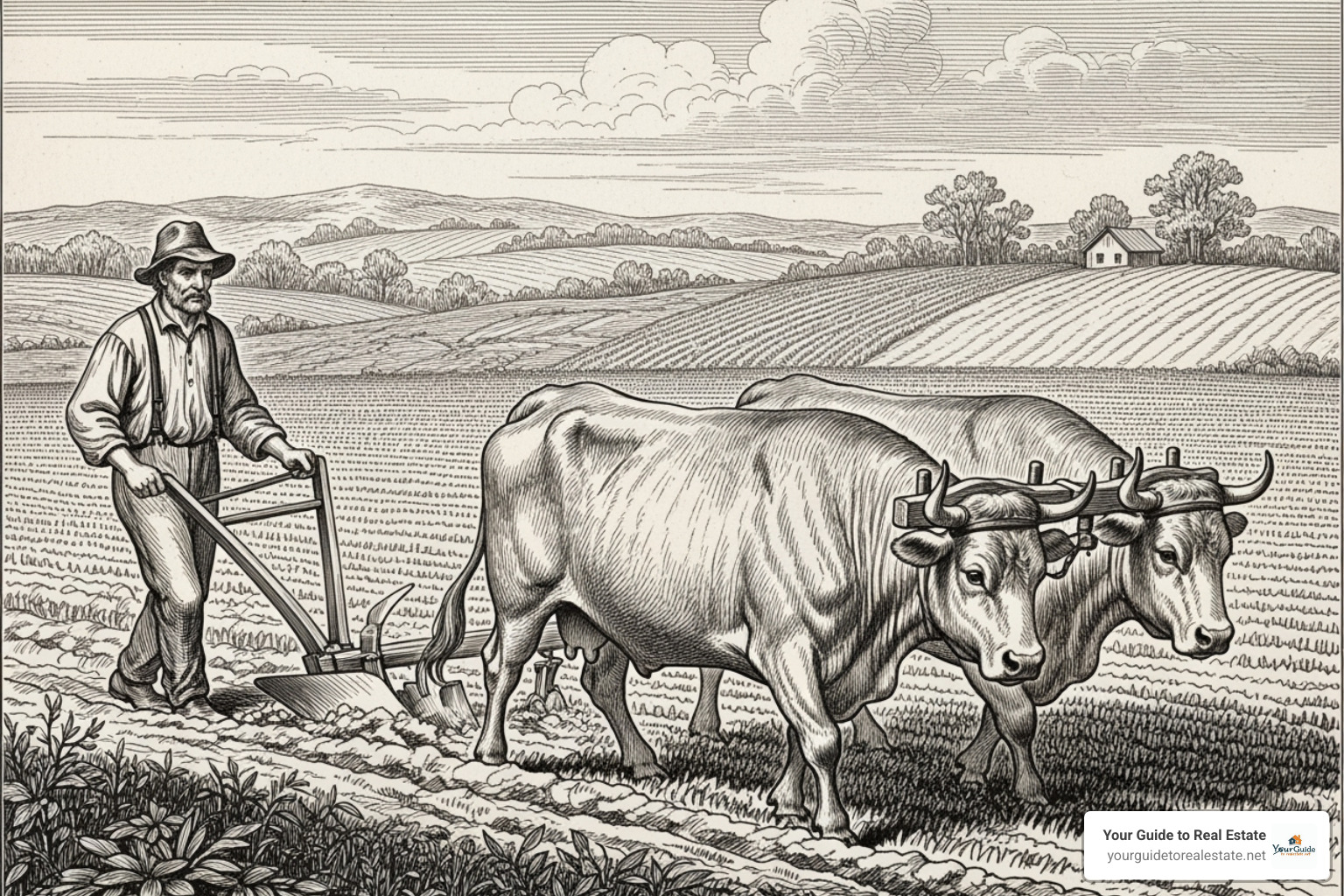
Picture this: a medieval farmer hitching up his yoke of oxen for a full day’s work. The amount of land those hardworking animals could plow from dawn to dusk became known as an acre. It wasn’t about precise measurements back then – it was about practical, everyday farming life. What could realistically be accomplished in one day became the foundation for how we measure land today.
The word itself tells a beautiful story. “Acre” comes from the Old English “æcer,” meaning “field.” You can hear echoes of this ancient word in similar terms across many languages, all pointing back to that fundamental concept of cultivated land. It’s remarkable how this simple farming term has survived through centuries of change.
Everything changed when King Edward I of England decided it was time for some order. In the 13th century, he officially standardized the acre as a strip of land four rods wide by 40 rods long. Since a rod measured 16.5 feet, this gave us those familiar dimensions of 66 feet by 660 feet – exactly 43,560 square feet. Suddenly, farmers, tax collectors, and land buyers could all speak the same language. For more context about this fascinating history, check out the Historical context of the acre.
How big is an acre in different contexts?
While we’ve settled on that standard 43,560 square feet in the United States, the story gets more interesting when you realize not everyone uses the same “acre.” It’s a bit like how different regions have their own dialects – same basic idea, but with local variations.
The standard acre we know and love measures exactly 43,560 square feet. This is what you’ll encounter in virtually every real estate transaction across America. It’s reliable, consistent, and legally recognized everywhere.
But then things get a little tricky. Some developers throw around terms like “builder’s acre,” which typically refers to about 40,000 square feet. Why the difference? Developers often account for space that’ll be eaten up by sidewalks, utility easements, and other infrastructure. While this makes sense from a planning perspective, it’s not legally recognized, and it can cause confusion if you’re not careful about the fine print.
Similarly, you might hear about a “commercial acre,” usually ranging from 30,000 to 40,000 square feet (often 36,000). Again, this accounts for space dedicated to roads, alleys, and commercial improvements. The key takeaway? Always ask for the actual square footage rather than relying on these informal terms.
The historical variations are even more fascinating. A Scottish acre was significantly larger – about 1.27 times our standard acre, covering roughly 55,000 square feet. The Irish acre was even more generous at about 1.6 times larger, encompassing around 70,000 square feet. Imagine the confusion when Scottish and Irish settlers arrived in America with completely different ideas about acre sizes!
| Acre Type | Approximate Size (Square Feet) | Notes |
|---|---|---|
| Standard (US) | 43,560 | Legal standard in the United States |
| Builder’s | ~40,000 | Informal term, not legally recognized |
| Commercial | ~36,000 | Accounts for infrastructure space |
| Scottish (historical) | ~55,000 | 1.27 times larger than standard |
| Irish (historical) | ~70,000 | 1.6 times larger than standard |
Understanding these variations becomes especially important when dealing with older property deeds or international land transactions. That “one acre” mentioned in your great-grandfather’s deed might not be the same acre we measure today, depending on where and when it was recorded.