

Why Understanding Interest-Only Payment Calculations Matters
An interest only loan calculator is a simple tool that determines your monthly payment when you’re only paying the interest on a mortgage. Using one helps you make informed financial decisions about your real estate investments or home purchase.
Quick Answer: How to Calculate Interest-Only Payments
- Formula: (Loan Amount × Interest Rate) ÷ 12 = Monthly Payment
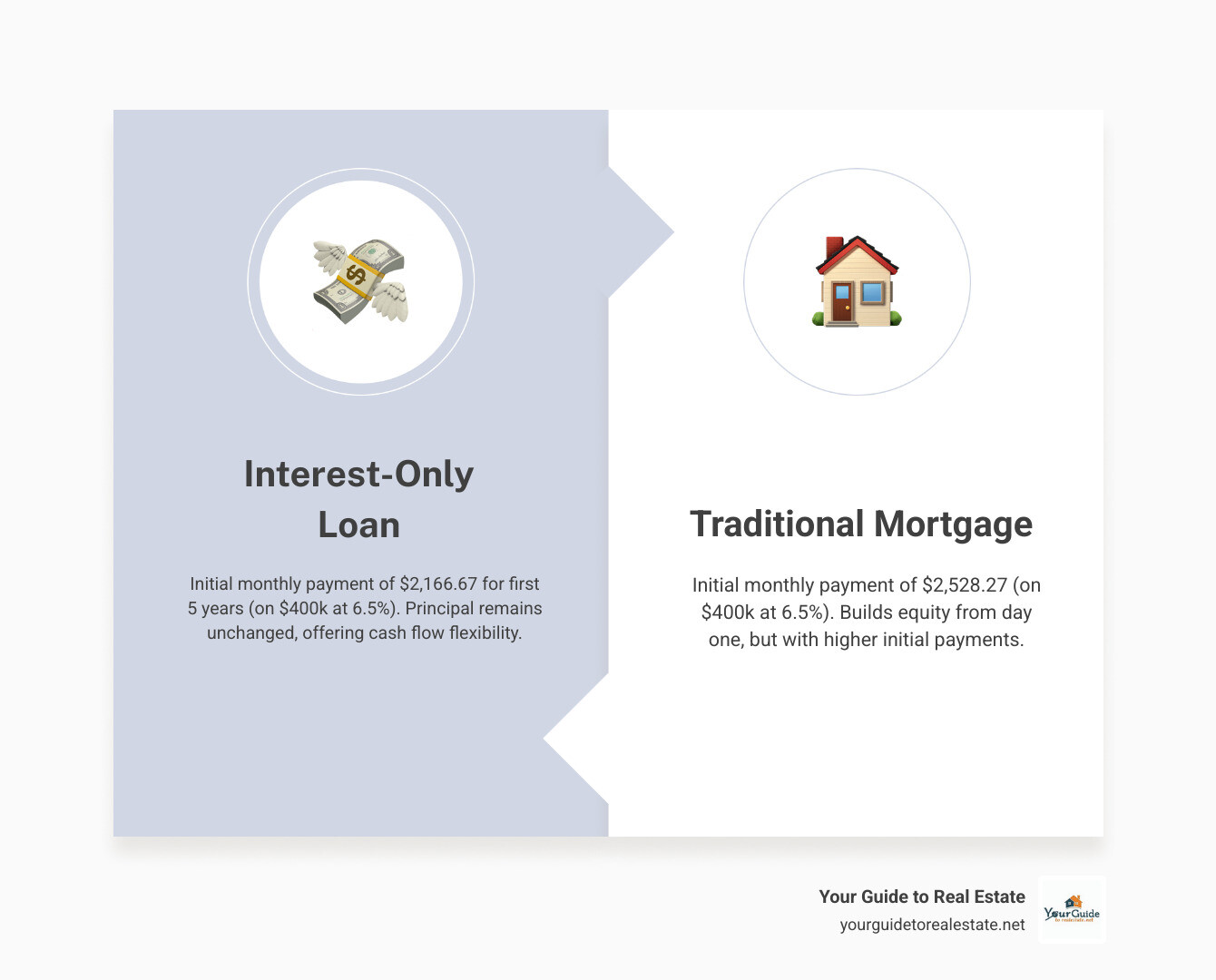
- Example: $400,000 loan at 6.5% = $2,166.67 per month
- Typical Period: 5-10 years of interest-only payments
- After Period: Payments increase to include principal + interest
Interest-only mortgages offer lower initial monthly payments because, for a set period (usually 5-10 years), you only pay interest. The principal balance remains unchanged, which creates cash flow flexibility but means you aren’t building equity through payments.
The appeal is affording a more expensive property or freeing up cash for other investments. However, after the interest-only period ends, your payments will jump significantly as you start paying both principal and interest over the remaining loan term. An interest-only loan calculator helps you understand this trade-off and compare different loan scenarios.
Interest only loan calculator basics:
What is an Interest-Only Mortgage?
An interest-only mortgage is a loan where for an initial period, you only pay the interest. Unlike a traditional mortgage, where each payment includes both principal and interest, your payments don’t reduce the loan balance during this time.
With an interest-only loan, your principal balance stays the same. If you borrow $400,000, you’ll still owe $400,000 after five years of payments. The benefit is that your monthly payments are significantly lower, which improves cash flow. The downside is that you don’t build equity through loan payments; your equity only grows if the property’s value increases. For a deeper look at how different mortgages work, see our Understanding Mortgages: A Beginner’s Guide to Home Loans.
How an Interest-Only Loan Works
During the interest-only period, typically 5 to 10 years, you are only required to pay the interest on your loan. Your principal remains unchanged.
For example, on a $300,000 interest-only mortgage at 6%, you’d pay about $1,500 per month. After seven years, you’d still owe the full $300,000.
After the interest-only period ends, the loan converts, and you must start paying both principal and interest. These post-period payments are much higher because the full principal must be repaid over the shorter remaining loan term. An interest only loan calculator is essential to see what these future payments will be and avoid payment shock. To explore other financing options, see our guide on Mortgage Options Explained.
Key Differences from a Traditional Mortgage
The main difference between these loan types is the speed of equity building.
With traditional principal and interest (P&I) payments, you build equity with every payment by reducing your loan balance. With an interest-only mortgage, your equity accumulation during the initial period depends entirely on property appreciation, as your loan balance doesn’t decrease.
Another key difference is the total interest paid. Because you pay interest on the full loan amount for a longer period with an interest-only mortgage, you will pay significantly more in total interest compared to a traditional loan with the same rate and term.
While interest-only loans offer lower initial payments, they come with higher long-term costs. Understanding this trade-off is crucial. Our guide on How to Compare Mortgages can help you weigh these factors.
How to Use an Interest-Only Loan Calculator
An interest only loan calculator is a financial tool that shows you exactly what you’re signing up for with this type of mortgage. It takes the guesswork out of your monthly payment estimation, giving you a clear picture of your cash flow during the interest-only years.
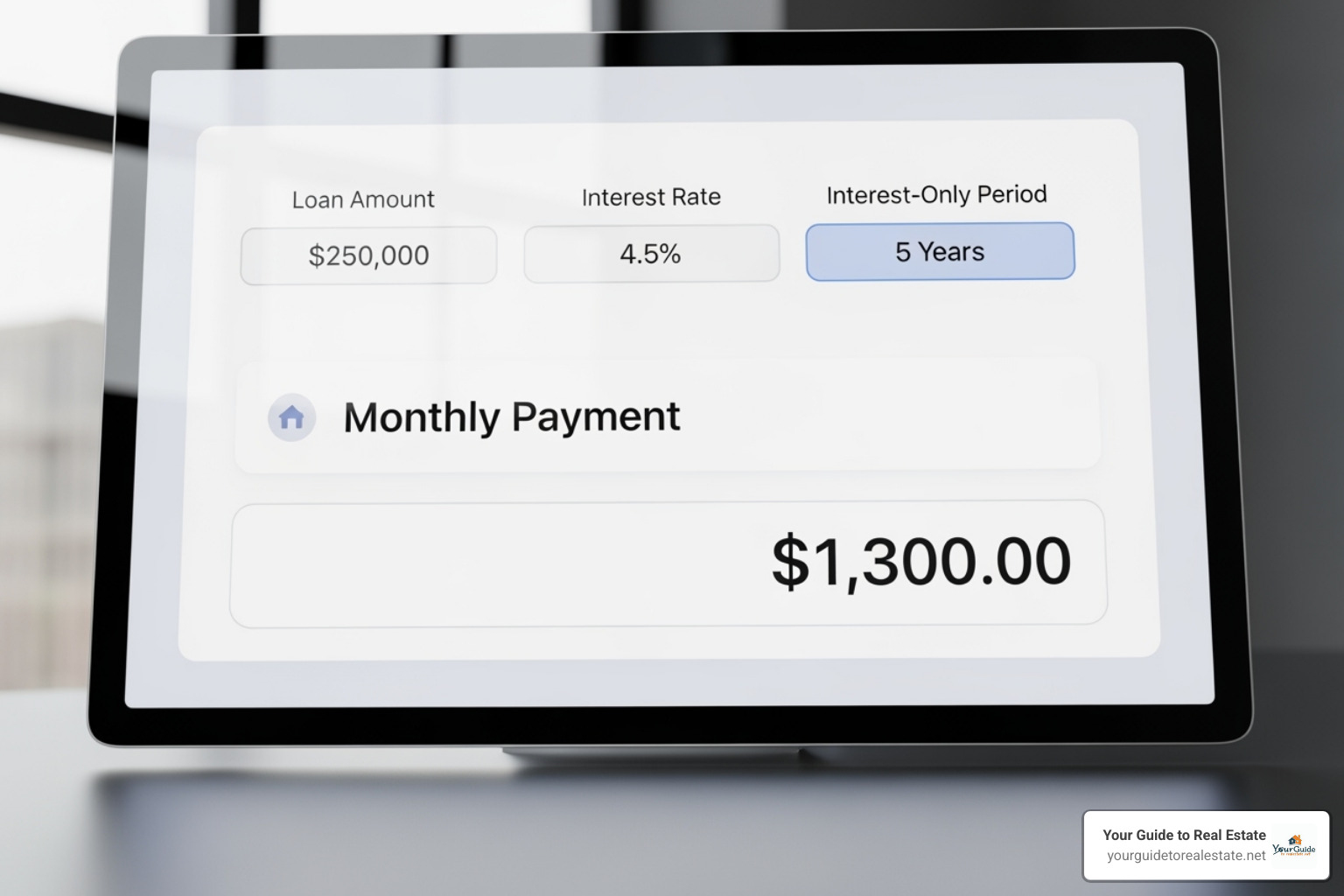
Using this tool helps you answer the question, “Can I afford this?” Knowing your exact monthly commitment is crucial, and the math is surprisingly simple. For more comprehensive calculations, you can explore our general Mortgage Calculator.
The Simple Formula for Interest-Only Payments
The formula for calculating interest-only payments is refreshingly basic.
The formula: (Loan Amount × Interest Rate) ÷ 12 = Your Monthly Payment
Let’s walk through an example. You’re looking at a $400,000 loan with a 6.5% interest rate.
- First, convert the percentage to a decimal: 6.5% becomes 0.065.
- Multiply your loan amount by the interest rate: $400,000 × 0.065 = $26,000 (annual interest).
- Divide by 12 months: $26,000 ÷ 12 = $2,166.67.
Your monthly payment breakdown during the interest-only period is exactly $2,166.67. This payment will increase once the interest-only period ends. For more on how rates affect payments, see our guide on Understanding Mortgage Rates.
What Inputs Does an Interest-Only Loan Calculator Need?
To use an interest only loan calculator, you’ll need a few key pieces of information:
- Loan amount: The total you plan to borrow, not the property’s purchase price.
- Annual interest rate: The actual rate quoted by your lender.
- Interest-only period: How long you’ll make interest-only payments, typically 5 to 10 years.
- Full loan term: The total length of the loan, usually 15, 20, or 30 years. This is needed to calculate payments after the interest-only period.
- Optional extra payments: Many calculators let you model the effect of making additional principal payments during the interest-only period, which can reduce total interest costs.
Weighing the Pros and Cons of Interest-Only Loans
Every mortgage type has trade-offs, and interest-only loans are no exception. While an interest only loan calculator may show appealingly low initial payments, it’s crucial to understand the strings attached.
| Feature | Advantages | Disadvantages |
|---|---|---|
| Initial Payments | Much lower monthly payments, freeing up cash flow. | Payments increase significantly after the interest-only period (payment shock). |
| Cash Flow | Increased liquidity for investments or other expenses. | If freed-up cash isn’t invested wisely, it can be spent without a long-term benefit. |
| Property Purchase | Ability to afford a more expensive property. | May encourage over-leveraging beyond true long-term affordability. |
| Equity Building | Equity grows only through property appreciation during the IO period. | Slower equity accumulation; risk of being “upside-down” if market values fall. |
| Total Cost | Potential for higher returns if freed-up cash is invested successfully. | Higher total interest paid over the life of the loan compared to a traditional mortgage. |
| Risk Exposure | Can be good for short-term ownership or specific investment strategies. | Higher interest rates, exposure to rising rates with ARMs, and stricter eligibility requirements. |
The key is understanding if this financing strategy aligns with your risk tolerance and long-term financial goals.
Primary Benefits of an Interest-Only Mortgage
When used strategically, an interest-only mortgage can be a powerful tool. The most significant benefit is lower initial monthly payments, which creates substantial extra cash flow. For example, on a $400,000 loan at 6.5%, the monthly savings could be over $360 compared to a traditional loan.
This increased cash flow allows investors to diversify or fund other opportunities, and it can help buyers qualify for a more expensive property. Additionally, since the entire payment is interest during the initial period, it may be fully tax-deductible in the U.S. for a primary residence if you itemize deductions (subject to tax laws). For more on this strategy, see our guide on How to Invest in Real Estate.
Potential Drawbacks and Major Risks
The biggest risk is payment shock. When the interest-only period ends, your monthly payment can jump dramatically as you begin paying both principal and interest over a shorter remaining term.
During the interest-only phase, you build no equity through payments. Your equity only grows if your property value appreciates, leaving you vulnerable if the market declines. Interest-only loans also typically have higher interest rates than conventional mortgages to compensate lenders for increased risk.
Fewer lenders offer these loans today, and those that do have stricter requirements, often demanding excellent credit and a large down payment. If you’re navigating today’s rate environment, our High Mortgage Rates Guide can help.
Is an Interest-Only Mortgage Right for You?
Whether an interest-only mortgage is right for you depends on your financial goals, discipline, and investment strategy. It’s a financial tool that can be incredibly useful in the right hands but requires careful planning.

Before using an interest only loan calculator, you must honestly evaluate your financial habits. Success with this loan type requires a concrete plan for managing the extra cash flow and the eventual payment increase. For broader investment guidance, check out our Property Investment resource.
The Ideal Candidate for an Interest-Only Loan
Certain profiles tend to benefit most from interest-only mortgages:
- Real estate investors and flippers: They use the extra cash flow for renovations or acquiring more properties, especially with short-term ownership plans.
- High earners with irregular income: Commissioned salespeople or business owners benefit from lower baseline payments during lean months.
- Those expecting a future windfall: An interest-only loan can act as a bridge until a large bonus, inheritance, or business sale provides funds to pay down the principal.
- DSCR loan borrowers: Investors use interest-only structures to maximize cash flow from rental properties. Our DSCR Loans Complete Guide explains this strategy.
The common thread is a clear exit strategy and the financial sophistication to execute it.
Understanding Payment Shock: What Happens After the IO Period?
Payment shock is the sudden, significant increase in your monthly payment when the interest-only period ends. The loan is recalculated to pay off the full principal balance over the shorter remaining term.
For example, if you have a 30-year loan with a 10-year interest-only period, you must repay the entire principal in the remaining 20 years. This compression of the repayment schedule causes the payment to jump.
Some borrowers plan to refinance before the shock hits, but this is a risky strategy that depends on favorable market conditions, strong credit, and sufficient property value. Relying on a future refinance is not a guaranteed plan. Our Mortgage Refinancing Explained guide can help you prepare.
The key to avoiding a crisis is financial preparedness. Use an interest only loan calculator to see both the initial and post-period payments, and have a concrete plan for handling the increase. Payment shock is only a surprise if you fail to plan for it.
Advanced Considerations and Finding a Calculator
Beyond the basic calculation, factors like tax laws, lender requirements, and market conditions will impact your decision. The basic interest only loan calculator provides a foundation, but these considerations complete the picture.
For those starting their homebuying journey, these details can be complex, which is why our First Time Homebuyer Tips guide can be helpful. It’s also wise to avoid common pitfalls; many people make costly mistakes, as detailed in resources like 5 Rookie Financial Planning Mistakes That Cost You Big-Time (and what to do instead!).
Tax Implications of an Interest-Only Mortgage
Interest-only loans can offer tax advantages, but the rules are nuanced. In the U.S., mortgage interest is typically tax-deductible on a primary residence if you itemize deductions (up to certain limits).
With an interest-only loan, 100% of your payment is interest during the initial period, meaning the entire payment could be deductible. However, this benefit only applies if your total itemized deductions exceed the standard deduction. Tax laws vary by country; for example, Canadian tax laws treat mortgage interest on a primary residence differently.
Given these complexities, it is essential to consult a tax professional to understand how an interest-only mortgage would affect your specific tax situation.
Finding a Reliable Interest-Only Loan Calculator
Not all calculators are created equal. A good interest only loan calculator should have the following features:
- Amortization schedule: Shows both the interest-only payments and the higher payments that follow.
- Extra payment options: Allows you to model the impact of making additional principal payments.
- Post-IO period calculations: Clearly displays how much your payments will increase after the initial period.
- Clear inputs and outputs: An easy-to-understand interface that clarifies your financial picture.
Stick with reputable financial websites for accurate, unbiased tools. You can start with our comprehensive Your Guide to Real Estate Interest Only Loan Calculator, which helps compare different mortgage scenarios. Any calculator is an estimation tool; always confirm the final terms with your lender.
Frequently Asked Questions about Interest-Only Mortgages
Interest-only mortgages can be confusing. Here are answers to the most common questions we hear from clients in Dallas, Oklahoma City, and beyond.
Do interest-only loans have higher interest rates?
Usually, yes. Lenders view these loans as having higher lender risk because the principal balance doesn’t decrease during the initial period. If property values fall, the lender’s exposure remains the same as on day one.
To offset this risk, lenders charge a higher rate, often 0.25% to 0.75% more than for a conventional loan. They also typically have higher credit score requirements (often 700+) and may require larger down payments (20% or more). Always compare to conventional loan rates to understand the full cost.
Can I pay down the principal during the interest-only period?
Yes, and it’s a smart strategy. Most lenders allow optional principal payments. Every extra dollar paid toward the principal reduces the balance that accrues interest, saving you money over the life of the loan.
Making extra payments helps with accelerating equity building beyond just property appreciation. It also reduces the total interest paid and lessens the payment shock when the interest-only period ends. Many interest only loan calculator tools can model the positive impact of these extra payments.
Are interest-only mortgages still available?
Yes, but they are less common than before the 2008 financial crisis. The current lending environment is much stricter, and these loans are typically reserved for financially strong borrowers.
For primary residences, they exist but come with stringent requirements for credit, income, and assets. Lenders prefer borrowers who choose this loan as a financial strategy, not out of necessity.
They are more common for investment properties, where investors use them to maximize cash flow. Lender qualifications are strict, often requiring credit scores above 700, down payments of 20% or more, and significant liquid reserves. It’s important to shop around, as availability and terms vary by lender.
Conclusion
You now have a clearer understanding of how an interest only loan calculator works and whether this type of financing fits your real estate goals. Interest-only mortgages are not for everyone, but for the right person, they can be a powerful tool.

The lower initial payments create financial flexibility, but this benefit comes with risks, including payment shock and slower equity building. These loans demand careful evaluation and a clear plan for when payments inevitably increase.
An interest-only loan is a powerful tool when used correctly. It’s about aligning your mortgage choice with your long-term financial goals, whether that’s building a real estate portfolio or managing an irregular income.
At Your Guide to Real Estate, we believe in empowering you with knowledge to make confident decisions. We’re here to provide a proven framework and stress-free guidance for your real estate journey.
For a complete overview of your financing options, explore our Understanding Mortgages: A Beginner’s Guide to Home Loans. Your future self will thank you.