

Your First Step to Understanding Interest-Only Loans
An interest only mortgage calculator is a financial tool that helps you determine your monthly payments when you only pay the interest portion of your loan, not the principal. Here’s what you need to know:
Key Features:
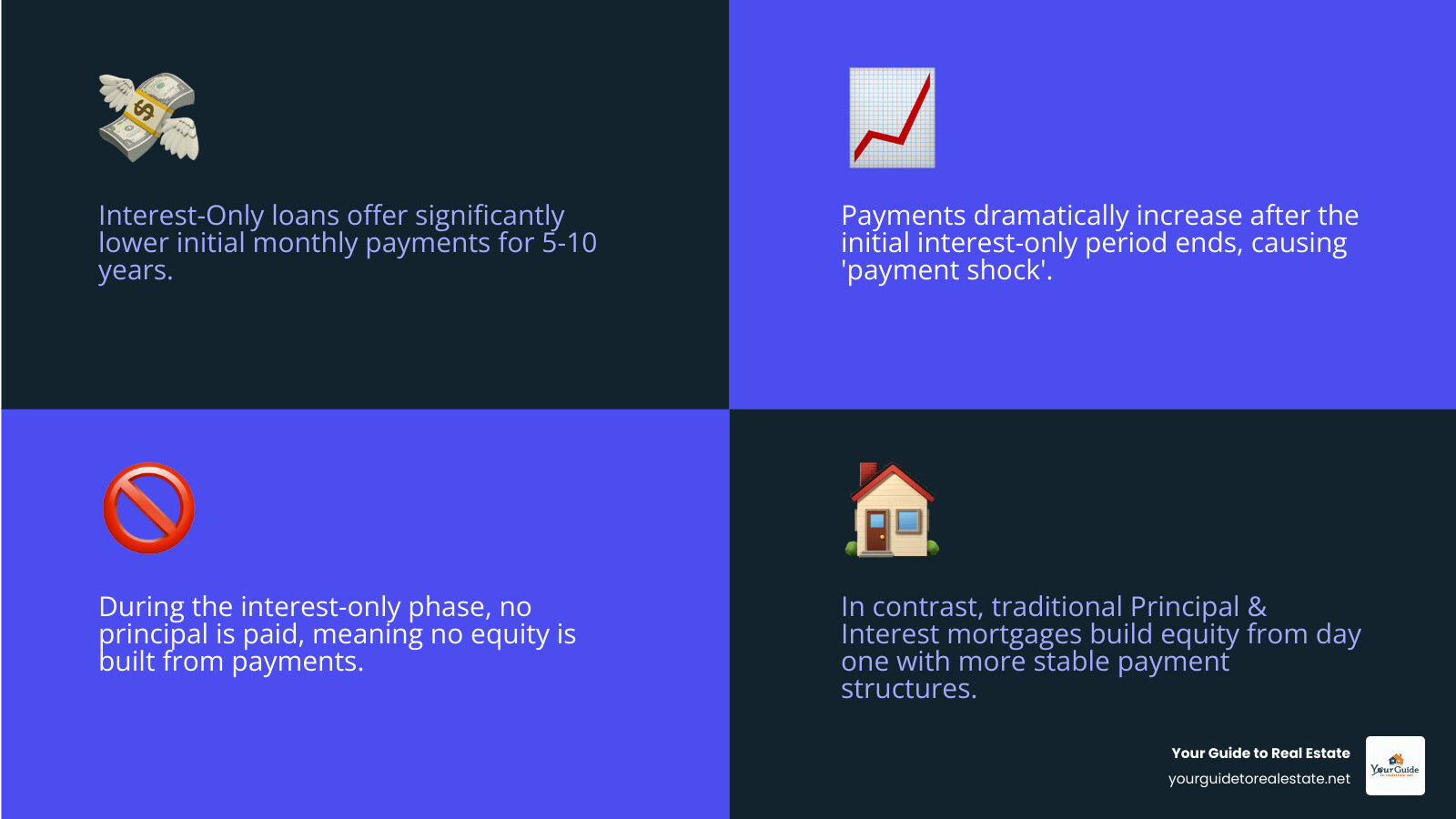
- Lower initial payments – Pay only interest for 5-10 years
- Payment formula – (Interest rate % × Loan amount) ÷ 12
- Payment shock risk – Payments increase significantly after interest-only period ends
- No equity building – Principal balance stays the same during interest-only period
For example, on a $400,000 loan at 6.5% interest, your monthly interest-only payment would be $2,166.67, compared to a traditional mortgage payment that might be over $2,500.
Interest-only mortgages work differently than traditional loans. Instead of paying both principal and interest from day one, you only pay interest for a set period – typically 5 to 10 years. This creates lower monthly payments initially, but comes with significant risks.
The math is straightforward: multiply your loan amount by your annual interest rate, then divide by 12. But the financial implications are far more complex. After your interest-only period ends, your payments will jump dramatically as you begin paying both principal and interest on a shortened timeline.
Who uses these loans? Research shows they’re popular with property investors seeking to maximize tax benefits and people with irregular income like contractors or freelancers. However, they’re much less common in Canada than the US due to different tax laws.
The biggest risk? Payment shock. When your interest-only period ends, you might see your monthly payment increase by $500 to $1,000 or more, depending on your loan size.
* interest only mortgage calculator* terms at a glance:
- i make $70,000 a year how much house can i afford
- why are mortgage rates going up
- down payment assistance
What is an Interest-Only Mortgage? A Head-to-Head Comparison
Think of an interest only mortgage as renting money instead of buying a house. For the first 5-10 years, you’re essentially paying rent on the loan amount without actually owning more of your home each month.
Here’s how it works: during the interest-only period, your monthly payments cover just the interest that accumulates on your loan balance. The principal – that big chunk of money you borrowed – stays exactly the same. It’s like making minimum payments on a credit card that never goes down.

This loan structure creates lower monthly payments upfront, but it comes with a catch – you’re not building equity through your payments. The total cost over the life of your loan will typically be much higher than a traditional mortgage.
If you’re new to mortgages altogether, our Understanding Mortgages: A Beginner’s Guide to Home Loans breaks down all the basics you need to know.
The Anatomy of an Interest-Only Loan
The math behind an interest only mortgage calculator is surprisingly simple. Take your loan amount, multiply by your interest rate, then divide by 12. A $400,000 loan at 6% interest means you’ll pay $2,000 monthly during the interest-only phase.
But here’s where things get interesting – and potentially scary.
During the interest-only period, you’re living in a financial sweet spot with lower payments. Then comes loan recasting. This is when your loan transforms from Dr. Jekyll into Mr. Hyde. Suddenly, you need to pay both principal and interest over the remaining years of your loan.
The result? Payment shock. Your monthly payment might jump from $2,000 to $3,200 or more. It’s like your mortgage hits puberty and grows overnight.
You have several end-of-term options when your interest-only period ends. You can refinance into a new loan, convert to a traditional payment structure, or in some cases, face a balloon payment where the entire remaining balance comes due at once. The balloon option is rare for home mortgages today, but it’s worth understanding your specific loan terms.
If you’re considering changing your current mortgage situation, check out our guide on Mortgage Refinancing Explained for your options.
Interest-Only vs. Principal & Interest (P&I) Mortgages
The difference between these two mortgage types is like comparing a sports car lease to buying a reliable sedan. One gives you flashy benefits upfront, while the other builds long-term value.
With a traditional P&I mortgage, every payment chips away at your loan balance through amortization. You’re steadily building equity while covering interest costs. It’s the tortoise approach – slow, steady, and you own more of your home each month.
Interest-only mortgages flip this script. Your payment composition during the initial period is 100% interest, 0% principal. This creates immediate cash flow benefits but higher long-term costs because you’re paying interest on the full loan amount for longer.
| Feature | Interest-Only (IO) Mortgage | Principal & Interest (P&I) Mortgage |
|---|---|---|
| Initial Monthly Payment | Lower (interest only) | Higher (principal + interest) |
| Equity Growth | Only from market appreciation | Steady growth from payments + appreciation |
| Total Interest Paid | Higher over loan life | Lower over loan life |
| Typical Borrower Profile | Investors, irregular income earners | Traditional homeowners |
The typical borrower profile for interest-only loans includes real estate investors who want to maximize cash flow, people with seasonal or commission-based income, and those expecting significant income increases in the future.
Traditional P&I mortgages work better for most homeowners who want predictable payments and steady equity building. If you’re exploring standard mortgage options, our 30-Year Mortgage Options guide covers the most popular choices.
An interest-only mortgage isn’t necessarily good or bad – it’s a tool that works brilliantly for some situations and terribly for others. The key is understanding exactly what you’re signing up for.
How to Use an Interest Only Mortgage Calculator for Smart Financial Planning
Picture this: you’re sitting at your kitchen table, coffee in hand, wondering if an interest-only loan could work for your situation. The numbers are swirling in your head, but you need concrete answers. That’s exactly when an interest only mortgage calculator becomes your financial compass.

Think of this calculator as your personal financial crystal ball. While it’s built on that simple formula we discussed earlier – (Interest rate × Loan amount) ÷ 12 – a quality calculator does so much more than basic math. It shows you the complete payment journey, from those initial lower payments through the inevitable jump when principal payments kick in.
The beauty of using an interest only mortgage calculator lies in its ability to turn abstract numbers into real-world scenarios. You can test different loan amounts, play with various interest rates, and see exactly how different interest-only periods affect your long-term costs. It’s like having a financial advisor available 24/7 right at your fingertips. You can explore our Interest Only Mortgage Calculator to get started.
A Step-by-Step Guide to Using the Interest Only Mortgage Calculator
Using an interest-only calculator doesn’t require a finance degree – just a few key pieces of information and some patience to explore different scenarios.
Start with your loan amount. This is the total you plan to borrow, so be as accurate as possible. Whether it’s $300,000 or $800,000, this number forms the foundation of every calculation that follows.
Next, input your interest rate. Here’s where things get interesting. Interest rates change constantly, so try running the calculator with a few different rates. Maybe your lender quoted 6.5%, but what if rates drop to 6% or rise to 7%? These small changes can make surprisingly big differences in your monthly payments.
Define your interest-only period carefully. Most loans offer 5, 7, or 10-year interest-only periods. The longer the period, the lower your initial payments – but also the higher your eventual payment shock. It’s a balancing act that depends entirely on your financial situation and future income expectations.
Don’t forget the full loan term. This is typically 30 years total, but the remaining years after your interest-only period ends become crucial. If you have a 10-year interest-only period on a 30-year loan, you’ll be paying principal and interest over just 20 years afterward – which means higher payments.
Finally, analyze those results with fresh eyes. The calculator will show you both your comfortable interest-only payments and the reality of what comes next. This is where many borrowers experience sticker shock, so take your time reviewing these numbers. For more context on the broader loan process, check out our Loan Process for Buying a House guide.
Interpreting the Results from Your Interest Only Mortgage Calculator
Once you hit “calculate,” you’ll see several numbers that tell the complete story of your potential loan. Let’s break down what each one really means for your financial future.
Your initial interest-only payment is probably the most appealing number you’ll see. It represents your lowest possible monthly payment and the extra cash flow you’ll enjoy during the interest-only period. But remember – this is temporary relief, not permanent savings.
The future principal and interest payment deserves your closest attention. This number represents your new reality once the interest-only period ends. The jump can be substantial – sometimes $500 to $1,000 more per month or even higher, depending on your loan size. This is where careful planning becomes essential.
Total interest cost tells a sobering story. Because you’re not paying down principal during the interest-only years, you’ll typically pay significantly more interest over the life of the loan compared to a traditional mortgage. The calculator helps you see exactly how much that convenience costs.
The amortization schedule, when available, provides a month-by-month breakdown of your loan’s progression. It’s fascinating to see how your payments will change over time and how slowly the principal balance decreases once you start paying it down on a shortened timeline.
Extra payment scenarios can be real eye-openers. Many calculators let you explore what happens if you make voluntary principal payments during the interest-only period. Even modest extra payments – say $200 monthly – can dramatically reduce your future payment shock and total interest costs.
Understanding these results helps you make informed decisions about whether an interest-only loan fits your financial strategy. For deeper insights into mortgage rates and how they affect your calculations, explore our Understanding Mortgage Rates resource.
Weighing the Pros and Cons of an Interest-Only Loan
Think of choosing an interest-only mortgage like standing at a financial crossroads. One path offers immediate relief with lower monthly payments, while the other warns of potential pitfalls ahead. It’s not a decision to take lightly, and what works brilliantly for one borrower might become a financial nightmare for another.

Before making this important choice, you need to understand both sides of the equation. Your financial situation, risk tolerance, and long-term goals should all factor into this decision. We always recommend you How to Shop Mortgage thoroughly to explore all your options.
The Upside: Key Advantages
Let’s start with the good news. Interest-only mortgages can be powerful financial tools when used strategically.
The most obvious benefit is lower initial payments. When you’re only covering the interest portion, your monthly mortgage payment drops significantly compared to a traditional loan. For many borrowers, this creates breathing room in their monthly budget that can be life-changing.
This increased cash flow isn’t just about having extra money sitting around. Smart borrowers often deploy these savings strategically. You might invest the difference in higher-return opportunities, pay down credit card debt, or build up your emergency fund. Some people use the extra cash flow to renovate their new home, potentially increasing its value.
Here’s something interesting: an interest-only loan might help you afford a larger home than you could with a traditional mortgage. Since your initial payments are lower, you might qualify for a bigger loan amount. This is particularly valuable in competitive markets where every square foot counts. Speaking of space, did you know that New US homes today are 1000 square feet larger than in 1973? An interest-only loan could be your ticket to that dream home.
For property investors, these loans offer tremendous investment flexibility. The lower payments free up capital for other opportunities, and the interest payments can provide valuable tax benefits. Many investors use this strategy to build their Property Investment portfolio more aggressively.
If you’re self-employed, freelance, or work on commission, an interest only mortgage calculator can show you how these loans help manage irregular income. The predictable, lower payments provide stability during lean months, while you can make extra payments toward principal when business is booming.
The Downside: Major Risks and Disadvantages
Now for the reality check. Interest-only mortgages come with serious risks that have caught many borrowers off guard.
Payment shock is the big one. When your interest-only period ends, your monthly payment can jump by hundreds or even thousands of dollars. Imagine going from a $2,000 monthly payment to $3,200 overnight. If your income hasn’t grown as expected, this increase can be devastating to your budget.
You’ll also face higher total interest costs over the life of the loan. Since you’re not chipping away at the principal during those early years, you’re paying interest on a larger balance for longer. This means more money out of your pocket in the long run.
During the interest-only period, you’re experiencing no forced equity building through your payments. Your loan balance stays exactly the same. The only equity you gain comes from your down payment and any increase in your home’s value. If the market stays flat or declines, you could find yourself with very little equity after several years of payments.
This brings us to market value risk. If property values drop, you might owe more than your home is worth. This situation, called being “underwater” or “upside down,” makes it nearly impossible to sell or refinance when your interest-only period ends.
Some loans carry the risk of negative amortization. This happens when your payment doesn’t even cover the full interest due, causing your loan balance to actually grow larger over time. While less common today, it’s still a possibility with certain adjustable-rate interest-only loans.
Finally, expect stricter qualification requirements. Lenders see these loans as riskier, so they often require higher credit scores, larger down payments, and more cash reserves. The current environment of Why Are Mortgage Rates Going Up? makes understanding these qualification problems even more important.
The bottom line? Interest-only mortgages can be excellent tools for the right borrower in the right situation. But they require careful planning, financial discipline, and a clear exit strategy for when the interest-only period ends.
Ideal Candidates: Who Benefits Most from This Strategy?
Interest-only mortgages aren’t for everyone – and that’s perfectly fine. Think of them as a specialized financial tool, like a high-performance sports car. In the right hands, they can be incredibly powerful. In the wrong hands, well… let’s just say things can get complicated quickly.
The truth is, interest-only mortgages work best for people who have a clear strategy and the financial sophistication to execute it. These aren’t loans for folks hoping to scrape by with lower payments indefinitely. Instead, they’re for borrowers who understand exactly what they’re getting into and have a solid plan for when that interest-only period ends.
Sophisticated investors and property investors often love these loans because they’re all about maximizing cash flow and leverage. Picture this: you buy an investment property, keep your monthly payments low with an interest-only loan, and use that extra cash for renovations or to snag another property. Many investors plan to sell before the principal payments kick in, pocketing the profit and moving on to the next opportunity. It’s a strategy that can work beautifully – if you know what you’re doing and the market cooperates.
High-net-worth individuals use interest-only mortgages for entirely different reasons. When you have substantial assets in stocks, bonds, or business investments earning 8-10% annually, why tie up extra cash in a mortgage at 6%? These borrowers use the interest only mortgage calculator to optimize their cash flow, keeping their money working harder elsewhere while maintaining liquidity for other opportunities.
Then there are those with irregular income patterns – think real estate agents, contractors, freelancers, or anyone whose paycheck varies dramatically from month to month. For them, the predictable, lower interest-only payment provides breathing room during lean periods. They’re often confident that their income will grow substantially over time, making those future higher payments manageable.
Home flippers represent another group that benefits from this strategy. When you’re buying, renovating, and selling within 6-12 months, every dollar counts. Lower monthly payments mean more capital available for renovations and less money tied up in carrying costs. The goal is simple: sell the property and pay off the entire loan before ever reaching the principal-and-interest phase.
Interestingly, some borrowers use interest-only loans simply to afford a larger home than they could with traditional financing. Remember how new US homes today are 1000 square feet larger than in 1973? An interest-only mortgage might bridge the gap between what you can afford now and the home you really want, especially if you’re expecting a promotion, inheritance, or significant income increase.
For real estate investors looking at rental properties, our DSCR Loans Complete Guide offers additional financing strategies worth exploring.
But here’s the key point: all of these strategies require serious financial discipline. You need a rock-solid understanding of your market, a clear exit strategy, and the ability to handle that payment increase when it comes. These loans generally aren’t suitable for first-time homebuyers or anyone operating on a tight budget who couldn’t absorb a significant payment jump.
The most successful interest-only borrowers treat these loans like what they are – sophisticated financial instruments that require careful planning and execution. They’re not looking for a way to avoid payments; they’re strategically timing them to achieve bigger financial goals.
Frequently Asked Questions about the interest only mortgage calculator
When you’re considering an interest-only mortgage, it’s natural to have questions. We hear these same concerns from borrowers all the time, and honestly, they’re exactly the right questions to ask. Let’s walk through the most important ones together, and show you how an interest only mortgage calculator can help you find the answers you need.
What happens when the interest-only period ends?
This is the million-dollar question – literally, depending on your loan size! And it’s where that scary term “payment shock” becomes very real.
Here’s what actually happens: your loan goes through something called loan recasting. Think of it like your mortgage growing up overnight. Instead of just paying interest (the easy part), you now have to pay both interest and start chipping away at that principal balance you’ve been ignoring.
The math can be brutal. Let’s say you had a 30-year mortgage but only paid interest for the first 10 years. Now you’ve got to pay off that entire principal balance in just 20 years. That’s a much shorter timeline, which means much higher monthly payments.
Your options at this crossroads include accepting the higher payments if your income can handle it, refinancing into a new loan (though this depends on current rates and your home’s equity), or selling the property if you’ve built up enough equity. In rare cases with certain loans, you might face a balloon payment where the entire principal becomes due at once – definitely something to avoid if possible.
Some borrowers get lucky and find their income has grown enough to handle the jump. Others… well, let’s just say an interest only mortgage calculator is your best friend for planning ahead and avoiding unpleasant surprises.
Do you build any equity with an interest-only mortgage?
The short answer? No equity from principal payments during the interest-only period. Your monthly payments are literally just covering the interest charges, so that principal balance sits there, unchanged, like a stubborn houseguest who won’t leave.
But don’t panic – you’re not completely stuck. You can still build equity in two ways. First, any down payment equity you made when buying the home counts from day one. Second, if your local housing market is doing well, equity from market appreciation can grow your wealth even while that principal balance stays put.
The catch? If housing values drop or stay flat, you could find yourself in trouble. Some borrowers end up with negative equity, owing more than their home is worth. It’s not a fun place to be, especially when your interest-only period is ending and you need to make decisions about refinancing or selling.
This is why market timing and location matter so much with these loans. You’re essentially betting that your home’s value will rise faster than you’re paying in interest.
Can I switch from an interest-only to a traditional mortgage?
Absolutely! Many borrowers do exactly this, either because their financial situation has changed or because they want the security of building equity through their payments.
You’ve got two main paths. Some lenders offer loan conversion options built right into your original agreement. It’s like having a trapdoor in your contract – you can drop down into a traditional mortgage when you’re ready. Check your loan terms carefully, because not all lenders offer this flexibility.
The more common route is refinancing into a completely new mortgage. This means going through the application process again, which can feel like déjà vu. Your approval depends on your current credit score, income, and how much equity you have in the home. Yes, there will be closing costs, but sometimes it’s worth it for peace of mind.
Before making any moves, it’s smart to explore all your options. Our guide on Mortgage Options Explained can help you understand what’s available. And remember, an interest only mortgage calculator can show you exactly what your payments would look like under different scenarios – it’s like having a crystal ball for your finances.
Conclusion: Plan Your Next Move with Confidence
We’ve covered a lot of ground together, haven’t we? An interest-only mortgage is like a powerful sports car – it can get you where you want to go faster, but you’d better know how to handle it safely. The lower initial payments and increased cash flow can be incredibly appealing, but that looming payment increase when the interest-only period ends? That’s not something you can ignore or hope will work itself out.
Here’s the thing – an interest only mortgage calculator isn’t just some optional tool you might use once and forget about. It’s your financial GPS, helping you steer the twists and turns of this complex loan structure. Without it, you’re essentially driving blindfolded through your financial future.
Think about it this way: would you buy a house without seeing it first? Of course not. So why would you consider an interest-only mortgage without fully understanding what your payments will look like five, seven, or ten years down the road? The calculator shows you the real picture – both the attractive initial payments and the potentially sobering reality of what comes next.
Your financial discipline matters here more than anywhere else. We’ve seen borrowers who used the extra cash flow wisely, investing it or paying down other debts. We’ve also seen those who simply got comfortable with the lower payments and found themselves unprepared when reality hit. Which type of borrower will you be?
The beauty of having all this information at your fingertips is that you can make an informed decision. Maybe you find that the payment jump fits perfectly with your expected salary increase. Or perhaps you realize that a traditional mortgage makes more sense for your situation. Either way, you’re making that choice with your eyes wide open.
At Your Guide to Real Estate, we’re not here to tell you what to do – we’re here to make sure you have everything you need to decide for yourself. Use our resources, play around with different scenarios in the calculator, and really think through your long-term plans. Are you prepared for those higher payments? Do you have a solid strategy for building equity? These aren’t just nice-to-know questions – they’re essential.
Whether you’re a seasoned investor looking to maximize your leverage or someone exploring ways to afford that dream home, understanding every angle of an interest-only mortgage puts you in control. Don’t leave something this important to chance or wishful thinking.
Ready to dive deeper into home financing? Explore our beginner’s guide to home loans for more insights and take that next confident step in your real estate journey.