

Why Understanding the Core Investment Choice Matters
Investing in bonds vs stocks represents the most fundamental decision every investor must make when building wealth. Whether you’re saving for a down payment on your first home or planning for retirement, this choice shapes your entire financial future.
Quick Answer: Stocks vs. Bonds at a Glance
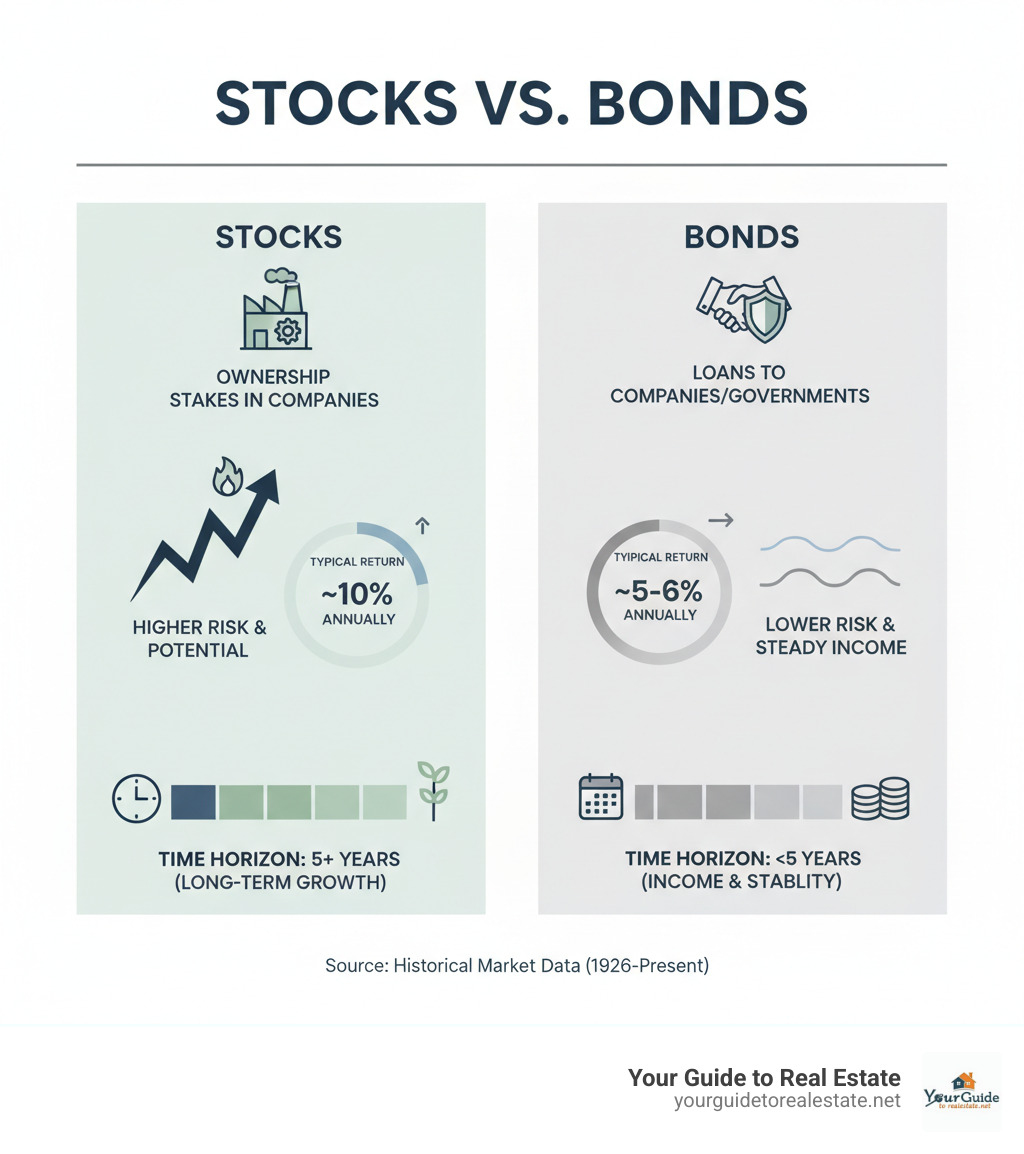
| Stocks | Bonds |
|---|---|
| What they are: Ownership shares in companies | What they are: Loans to companies or governments |
| Returns: Capital gains + dividends | Returns: Fixed interest payments |
| Risk level: Higher volatility | Risk level: Lower, more stable |
| Average return: ~10% annually (since 1926) | Average return: ~5-6% annually (since 1926) |
| Best for: Long-term growth (5+ years) | Best for: Income and stability |
The numbers tell a clear story. Large stocks have returned 10% per year on average since 1926, while long-term government bonds delivered 5-6% returns over the same period. But higher returns come with higher risk – stocks can lose 20-30% in a single year, while bonds typically stay much more stable.
Your choice between these two investment types depends on three key factors:
- Your time horizon – How long until you need the money?
- Your risk tolerance – Can you handle seeing your investments drop 30% without panicking?
- Your financial goals – Are you building wealth or preserving it?
Most successful investors don’t pick just one. A balanced approach using both stocks and bonds – like the popular 60/40 portfolio that earned almost 7% annually over the past decade – often provides the best mix of growth and stability.
Quick investing in bonds vs stocks terms:
The Core Difference: Owning vs. Loaning
Think of investing in bonds vs stocks like the difference between being a business owner versus being a bank. When you understand this simple comparison, everything else about investing becomes much clearer.
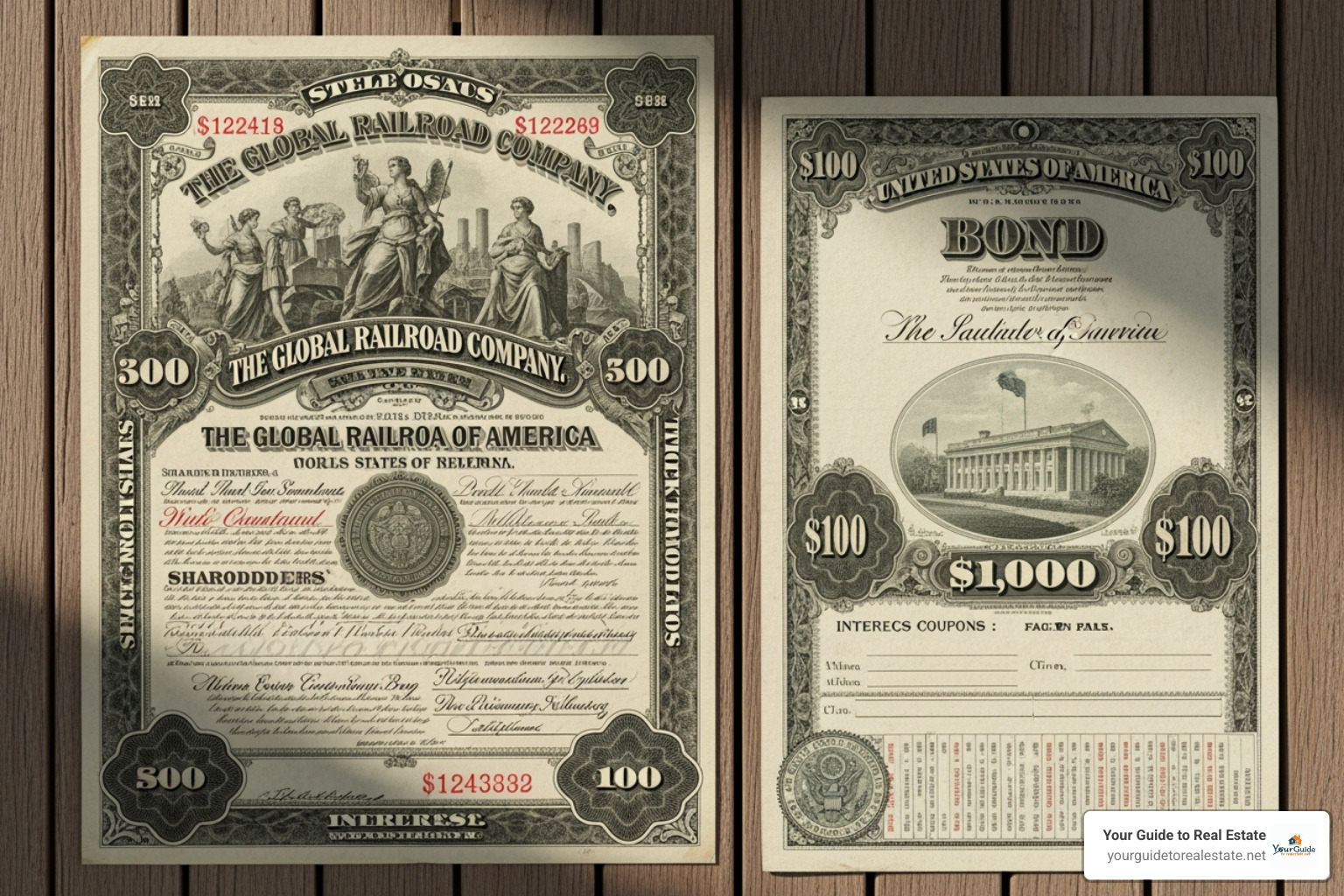
When you buy stock, you’re actually buying a tiny slice of a real company. Congratulations – you’re now a business owner! This makes you what’s called an equity holder, which is just a fancy way of saying you own part of the company’s assets and future profits.
As a stockholder, you get some pretty cool ownership rights. You can vote on important company decisions (like who should be on the board of directors), and you have a say in the company’s future direction. Think of it like being part of a very large partnership – your voice might be small, but it counts.
Bonds work completely differently. When you buy a bond, you’re essentially becoming a lender. You’re loaning your money to a company or government, and they promise to pay you back with interest. You don’t own anything – you’re just a creditor who expects to get paid back.
This means bondholders have lender rights instead of ownership rights. You don’t get to vote on company decisions, and you won’t receive any ownership benefits. But you do get something stockholders don’t: a legal promise to be paid back, with interest, on a specific schedule.
This fundamental difference in capital structure – whether you’re an owner or a lender – shapes everything about how these investments work and how much money you might make.
How Stocks Generate Returns
Stocks can make you money in two main ways, and both tie directly back to that ownership concept we just discussed.
Capital appreciation is the big one. When the company you own a piece of does well, other investors want to buy shares too. This drives up the stock price. If you bought shares at $50 and they’re now worth $75, you’ve made $25 per share through appreciation. The key here is company performance – when businesses grow their profits, expand into new markets, or simply become more valuable, share price growth typically follows.
Dividends are the second way stocks pay you. Some companies share their profits directly with owners by sending out dividend checks. It’s like getting a bonus just for being an owner. These payments can provide steady income while you wait for the stock price to appreciate.
The beauty of stock returns is that they’re tied to real business success. When companies innovate, grow, and thrive, stockholders benefit directly. For a deeper understanding of how this all works, check out our guide on Understanding the Stock Market: Terminology and Concepts.
How Bonds Generate Returns
Bond returns are much more straightforward – and that’s exactly the point. As a lender, you want predictability.
Interest payments are your main source of income from bonds. When you buy a bond, you’re promised a specific coupon rate – let’s say 4% per year. If you invested $1,000, you’ll receive $40 every year until the bond matures, usually paid in two $20 installments every six months. This fixed income approach means you know exactly what you’ll earn and when you’ll earn it.
At the maturity date, you get your original investment back through principal repayment. If you bought that $1,000 bond, you’ll receive your full $1,000 back when it expires, regardless of what happened to interest rates or the company’s stock price in the meantime.
This predictable structure is why bonds appeal to investors who want steady income and capital preservation. Unlike stocks, where returns depend on company performance and market sentiment, bonds come with fixed interest rates that promise a certain return.
The trade-off is simple: you get more certainty but typically lower long-term returns compared to stocks. It’s the price of that predictability and safety.
The Core of Investing in Bonds vs Stocks: Risk, Volatility, and Performance
When you’re deciding between investing in bonds vs stocks, understanding how these investments behave during different market conditions is absolutely crucial. Think of it like choosing between a steady bike ride and a roller coaster – both can get you where you want to go, but the experience along the way is dramatically different.

The key difference lies in their risk profiles and return potential. Stocks offer the chance for higher returns but come with much more dramatic ups and downs. Bonds provide steadier income but typically grow your money more slowly. Understanding this trade-off helps you match your investments to your comfort level and financial goals.
Market fluctuations affect each investment type differently too. Economic conditions, interest rate changes, and investor sentiment can send stocks soaring one day and crashing the next. Bonds, while generally more stable, face their own challenges – particularly when interest rates start moving or when there’s credit risk involved.
Historical Performance: A Long-Term View
The numbers tell a compelling story about long-term growth potential. Since 1926, stocks have delivered an average return of about 10% per year, while bonds have provided 5-6% annual returns over the same period. That might not sound like a huge difference, but thanks to compounding, it adds up to dramatically different outcomes over time.
The S&P 500 has been the gold standard for measuring stock performance, while the Bloomberg Barclays U.S. Aggregate Bond Index tracks how bonds have performed. According to CNN Money, this performance gap reflects the fundamental trade-off between risk and reward.
Here’s what makes this interesting: stocks don’t just beat bonds by a little bit over long periods – they often beat them by a lot. But that extra return comes with a price. While bonds might have a bad year here and there, stocks can lose 20%, 30%, or even more in a single year. The 2008 financial crisis reminded everyone that stock investments can be a wild ride.
The key insight? Time horizon matters enormously. If you’re investing for decades, those higher average returns from stocks can really add up. But if you need your money in a few years, those short-term drops in stock prices become much more concerning.
How Market Conditions Affect Stocks vs. Bonds
One of the most fascinating aspects of investing in bonds vs stocks is how they often move in opposite directions. This inverse relationship can actually work in your favor if you understand it.
When the economy is humming along nicely, companies tend to make more money, and stock prices usually rise. Investors feel confident and are willing to take on more risk. During these times, bonds might seem boring by comparison, and their prices often stay flat or even decline as investors chase higher returns elsewhere.
But when economic uncertainty hits, something interesting happens. Investors suddenly want safety over growth, and they flock to bonds – especially government bonds. This flight to safety can actually push bond prices up just when stock prices are falling.
Federal Reserve policy plays a huge role in this dance. When the Fed cuts interest rates to stimulate the economy, it’s often because stocks are struggling. But those same rate cuts can boost bond prices. When the Fed raises rates to cool down an overheated economy, existing bonds with lower rates become less attractive.
Inflation adds another layer of complexity. Rising prices hurt both stocks and bonds, but in different ways. Stocks might struggle initially as companies face higher costs, but they can eventually adjust prices. Bonds get hit harder because their fixed payments become worth less in real terms.
Market sentiment can amplify all these effects. Fear and greed drive investors to make dramatic moves, creating the volatility that makes some people love investing and others lose sleep over it. Understanding these cycles helps you make better decisions about when to stay the course and when to consider rebalancing your investments.
Strategizing Your Portfolio with Stocks and Bonds
Smart investing in bonds vs stocks isn’t really about picking sides – it’s about creating a winning team. Think of it like building a house: you wouldn’t use only hammers or only screwdrivers. You need the right mix of tools for the job, and the same goes for your investment portfolio.
The secret sauce here is asset allocation – fancy words for “how much of each investment type you own.” Your perfect mix depends on three key things: how much risk makes you comfortable, when you’ll need the money, and what you’re trying to achieve with your investments.
The Power of Diversification
Here’s something that might surprise you: bonds and stocks often move in opposite directions. When stocks are having a rough day, bonds might be doing just fine. When the economy is booming and stocks are soaring, bonds might take a breather. This opposite behavior is exactly why smart investors love diversification.
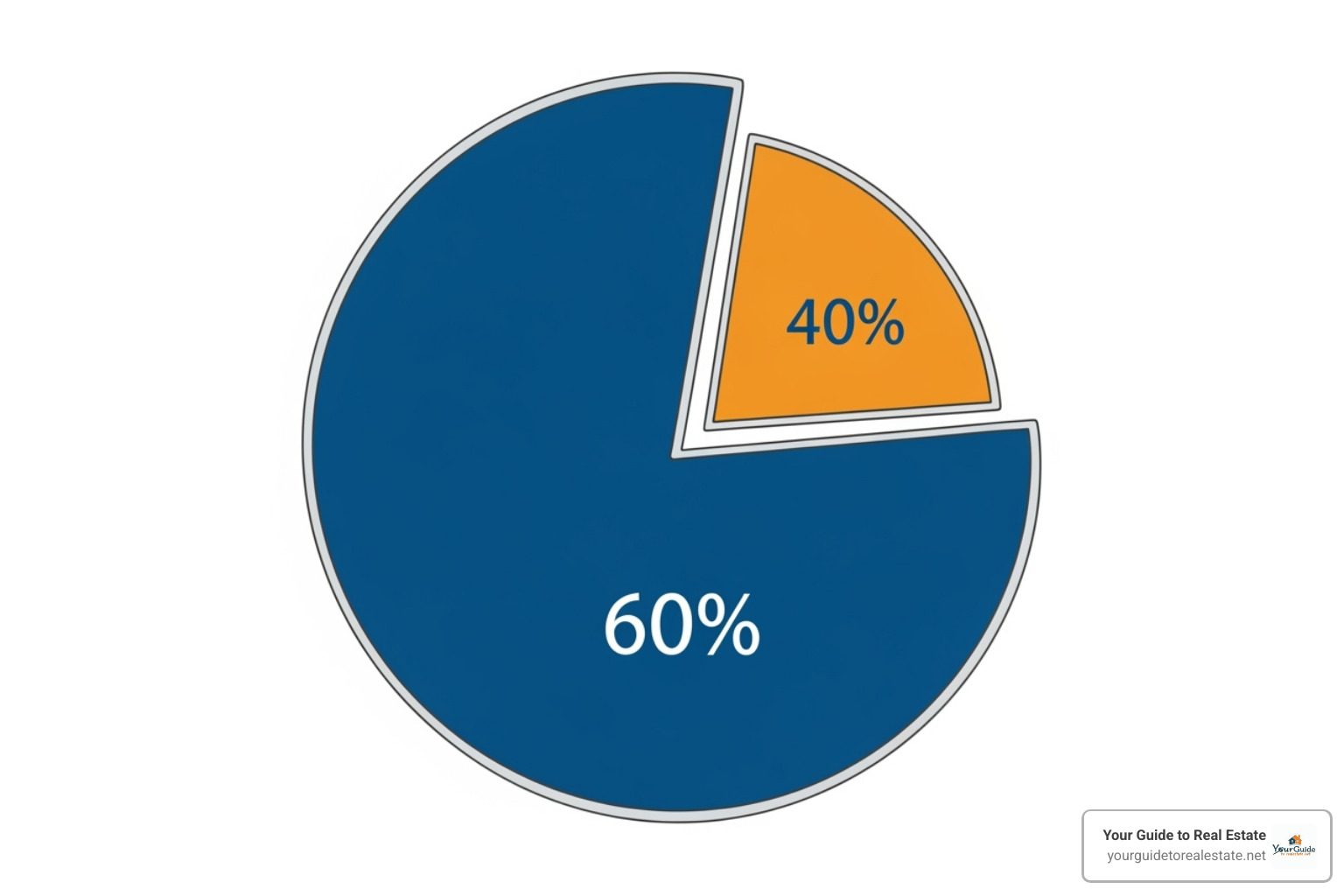
The classic example everyone talks about is the 60/40 portfolio – 60% stocks for growth and 40% bonds for stability. This simple mix has earned almost 7% in annual returns over the past decade through September 2024. That’s enough to potentially double your money every decade, which isn’t too shabby for a “boring” balanced approach.
Think of it this way: stocks are like the gas pedal in your car, giving you the power to accelerate toward your financial goals. Bonds are like the brakes and steering wheel, helping you stay in control when the road gets bumpy. You need both to get where you’re going safely.
The beauty of this approach is portfolio stability. Instead of your investments swinging wildly up and down with every market mood swing, you get smoother, more predictable growth. You’re essentially hedging your bets, balancing growth potential with safety.
Key Factors in Investing in Bonds vs Stocks for Young Professionals
If you’re in your 20s or 30s, you’ve got something older investors would pay big money for: time. And time changes everything when it comes to investing in bonds vs stocks.
Your longer time horizon is like having a superpower. Got 30 or 40 years until retirement? You can ride out multiple market crashes and still come out ahead. As research shows, over long periods, the stock market’s ups and downs tend to smooth out, and those higher average returns really add up.
Here’s where it gets exciting: compounding growth. When you start investing early, your money doesn’t just grow – the growth starts growing too. It’s like planting a tree. The earlier you plant it, the bigger it gets, and eventually it’s producing fruit that falls and grows into more trees. The power of starting early with investing works the same way.
Young professionals also typically have higher risk capacity. Not necessarily because they want more risk, but because they have more time to recover if things go wrong. If the market drops 30% when you’re 25, you’ve got decades to make it back. If it drops 30% when you’re 65, that’s a much bigger problem.
This often means younger investors can lean more heavily toward stocks for that higher growth potential. But here’s the thing – even with all that time on your side, you still need to sleep well at night. If market drops give you panic attacks, a slightly more conservative mix might be better for your peace of mind.
Want to crunch some numbers and see what might work for your situation? Check out our Dave Ramsey Investment Calculator: Plan Your Financial Future to help map out your strategy.
There’s no one-size-fits-all answer. The best portfolio is the one that matches your goals, timeline, and comfort level – and that you can stick with through good times and bad.
A Deeper Dive into Stocks and Bonds
Now that we’ve covered the basics of investing in bonds vs stocks, let’s roll up our sleeves and explore the nitty-gritty details. Understanding the different types available, their specific advantages and drawbacks, and how Uncle Sam treats each one can make the difference between a good investment strategy and a great one.
| Feature | Stocks | Bonds |
|---|---|---|
| Ownership | Partial ownership in a company | Lending money to a company or government |
| Return Type | Capital appreciation, Dividends | Fixed interest payments (coupon), Principal repayment |
| Risk Level | Higher volatility, potential for significant losses | Generally lower volatility, but still have risks (interest rate, credit) |
| Priority in Bankruptcy | Lowest claim on assets | Higher claim on assets than stockholders |
| Voting Rights | Common stockholders typically have voting rights | No voting rights |
This comparison table tells the story at a glance, but there’s so much more beneath the surface. Think of stocks and bonds like two different tools in your financial toolbox – each designed for specific jobs, with various models available depending on what you’re trying to accomplish.
Types, Pros, and Cons of Stocks
The stock market isn’t just one giant bucket of investments. It’s more like a diverse marketplace with different flavors to suit different tastes and goals.
Common stock is what most people picture when they think about owning shares. You get a piece of the company and usually voting rights on important decisions. It’s like being part of a really big club where your voice matters (even if it’s a tiny voice among millions).
Preferred stock sits somewhere between stocks and bonds – it’s the hybrid vehicle of the investment world. You typically give up voting rights, but you get fixed dividends and first dibs on payouts before common stockholders. Think of it as the VIP section of stock ownership.
Growth stocks come from companies expected to expand faster than average. These companies often plow their profits right back into the business instead of paying dividends, betting that future growth will reward patient investors with bigger gains down the road.
Value stocks are the bargain hunters’ dream – shares that appear underpriced compared to what the company is actually worth. It’s like finding a designer jacket at a thrift store; you’re betting the market hasn’t recognized the true value yet.
Dividend stocks represent mature, stable companies that regularly share their profits with shareholders. These are the reliable friends of the investment world, consistently putting money in your pocket. For a deeper dive into this strategy, check out 5 Stars Stocks: Your Guide to Dividend and Income Stocks.
The advantages of stock investing are compelling. Historically, stocks have delivered higher long-term returns than bonds, offering significant capital appreciation potential. Many stocks provide dividend income that can cushion market drops or compound your returns through reinvestment. Plus, stocks are typically highly liquid – you can buy and sell them easily during market hours.
But stocks aren’t without their challenges. Higher volatility means your portfolio value can swing dramatically in short periods. There’s no guaranteed return – you could potentially lose your entire investment if things go badly. And if a company fails completely, your shares can become worthless pieces of paper (or digital entries, these days).
Types, Pros, and Cons of Bonds
The bond universe is equally diverse, with options ranging from rock-solid government securities to higher-risk corporate offerings.
Government bonds – like U.S. Treasury bonds, notes, and bills – are backed by the full faith and credit of the government. They’re considered among the safest investments available, though that safety comes with typically lower returns.
Corporate bonds let you lend money directly to companies. The interest rate and risk level depend on how creditworthy the company is. A bond from Apple will offer different terms than one from a struggling startup.
Municipal bonds are issued by state and local governments. Their big selling point? The interest is often exempt from federal taxes, and sometimes state and local taxes too. For high earners, this tax advantage can be substantial.
High-yield bonds (sometimes called junk bonds) come from companies with shakier credit ratings. They offer higher interest rates to compensate for the increased risk that the company might not be able to pay you back.
Convertible bonds offer a unique twist – under certain conditions, you can convert them into company stock. It’s like having an option to switch teams if the stock starts performing better than the bond.
Zero-coupon bonds don’t pay regular interest. Instead, you buy them at a discount and receive the full face value at maturity. The difference between what you paid and what you receive is your return.
The benefits of bond investing center around stability and predictability. Bonds typically show lower volatility than stocks, making them easier on the nerves. They provide predictable income through regular interest payments, which is perfect for retirees or anyone needing steady cash flow. If you hold a bond to maturity, you’ll get your principal back (assuming no default). In bankruptcy situations, bondholders get paid before stockholders, giving you a higher claim on company assets.
However, bonds have their limitations. They’ve historically provided lower long-term returns compared to stocks. Interest rate risk means bond prices fall when rates rise – it’s like being stuck with a 3% loan when everyone else is offering 5%. Inflation risk can erode the purchasing power of your fixed interest payments over time. And there’s always credit risk – the possibility that the issuer can’t make payments or repay your principal.
Tax Implications of Investing in Bonds vs Stocks
Nobody likes talking taxes, but understanding how the IRS treats your investments can significantly impact your actual returns. The tax treatment of investing in bonds vs stocks varies considerably and should influence your strategy.
Stock taxation depends on how long you hold your investments. Sell stocks you’ve owned for less than a year, and profits are taxed at your regular income tax rate. But hold them for more than a year, and you qualify for long-term capital gains rates, which are typically much lower. This creates a powerful incentive to be patient with your stock investments.
Dividends from stocks usually face taxation as ordinary income. However, qualified dividends from U.S. corporations or qualifying foreign companies may qualify for the lower capital gains tax rates, making dividend-paying stocks even more attractive.
Bond taxation is generally straightforward – interest payments are taxed as ordinary income. But there are some notable exceptions that can save you serious money.
Municipal bonds offer a significant tax advantage because their interest is typically exempt from federal income tax. If you buy municipal bonds issued by your home state or city, you might avoid state and local taxes too. For investors in high tax brackets, this can make municipal bonds very attractive despite their typically lower interest rates.
Treasury bonds split the difference – you’ll pay federal income tax on the interest, but you’re exempt from state and local income taxes.
Understanding these tax implications isn’t just academic – it can dramatically affect your net returns and should play a key role in how you structure your portfolio. A bond paying 4% might actually be better than a stock dividend paying 5% if you’re in a high tax bracket and the bond interest is tax-exempt.
Frequently Asked Questions about Investing in Bonds vs Stocks
Is it better to invest in bonds or stocks?
This is probably the most common question new investors ask, and honestly, it’s like asking whether a hammer or a screwdriver is better. The answer depends entirely on what you’re trying to build.
For long-term wealth building, especially if you have 5 or more years before you need the money, stocks generally take the crown. Think about it this way – if you’re a young professional just starting your career, you have decades until retirement. That’s plenty of time to ride out the market’s ups and downs while benefiting from stocks’ superior growth potential.
For capital preservation and steady income, bonds are often your best friend. Maybe you’re saving for a house down payment in two years, or you’re nearing retirement and can’t afford to see your nest egg drop 30% in a bad market year. Bonds provide that stability and predictable income that can help you sleep better at night.
But here’s the thing – most successful investors don’t choose sides in this investing in bonds vs stocks debate. Instead, they create a balanced portfolio that combines both. This approach gives you the growth potential of stocks with the stability cushion of bonds.
Your personal mix depends on your financial goals, risk tolerance, and time horizon. A 25-year-old might feel comfortable with 80% stocks and 20% bonds, while someone closer to retirement might prefer a 40/60 split.
Which is riskier, a stock or a bond?
Stocks are definitely the riskier choice, but let’s break down what that actually means for your money.
Stock volatility is the main culprit here. Stock prices can swing dramatically based on company news, market sentiment, or economic conditions. During the 2008 financial crisis, some stocks lost 50% or more of their value in just a few months. As a shareholder, you’re essentially last in line if a company goes belly up – bondholders and creditors get paid first, and you might get nothing.
Bonds have their own risks, though they’re generally much milder. The biggest threat is interest rate risk – when rates go up, your existing bonds become less attractive and their value drops. There’s also credit risk, which is the chance that the bond issuer can’t make their payments. You’re essentially lending money, so there’s always a small chance you won’t get it back.
Don’t forget about inflation risk with bonds either. If you’re earning 3% on a bond but inflation is running at 4%, you’re actually losing purchasing power each year.
Here’s the silver lining for bondholders: if a company files for bankruptcy, bondholders have priority over stockholders when it comes to getting their money back. It’s not a guarantee, but it’s better than being last in line.
How do I start investing in stocks and bonds?
Getting started with investing in bonds vs stocks is easier than most people think, and you don’t need thousands of dollars to begin.
Opening a brokerage account is your first step. Most online brokers today offer user-friendly platforms where you can buy individual stocks, bonds, and funds with just a few clicks. Many have eliminated trading fees entirely, making it even more accessible for beginners.
Mutual funds and ETFs are often the smartest starting point for new investors. Instead of trying to pick individual stocks or bonds, you can buy a fund that holds hundreds or thousands of them. This gives you instant diversification without needing to research every single investment.
For individual bonds, you have options too. Your brokerage account will let you buy corporate and municipal bonds, while Treasury Direct allows you to purchase government bonds directly from Uncle Sam, often with lower fees.
The key is determining your allocation – what percentage goes to stocks versus bonds. A common rule of thumb is to subtract your age from 100, and that’s your stock percentage. So a 30-year-old might go with 70% stocks and 30% bonds.
Start small and be consistent. Many platforms now offer fractional shares, meaning you can invest in expensive stocks with just a few dollars. The magic happens through regular contributions over time – even $50 a month can grow into substantial wealth thanks to compound growth.
If you’re thinking about diving deeper into the financial world professionally, our guide Is Finance a Good Career Path? Exploring Your Options explores the exciting opportunities available in this field.
Conclusion
You’ve just taken a deep dive into investing in bonds vs stocks, and hopefully, the path forward feels clearer now. The truth is, this isn’t really about picking sides – it’s about understanding how these two investment types can work together to help you reach your financial dreams.
Stocks offer the exciting potential for long-term growth and the thrill of owning a piece of companies you believe in. Yes, they come with more ups and downs, but for those patient enough to ride out the waves, history shows they’ve rewarded investors handsomely. Bonds, meanwhile, are your portfolio’s steady friend – providing predictable income and helping you sleep better at night when markets get choppy.
For most people, especially young professionals just starting their wealth-building journey, the magic happens when you combine both. A balanced portfolio gives you the growth potential from stocks while the stability from bonds keeps you grounded during market storms. Think of it like building a house – stocks are your foundation for growth, while bonds are the insurance that keeps everything stable.
Your ideal mix will change as your life evolves. Maybe you start aggressive with more stocks in your twenties, then gradually shift toward bonds as retirement approaches. The key is starting early, staying consistent, and letting time do the heavy lifting through compound growth.
Whether you’re dreaming of buying your first home, planning for retirement, or simply building financial security, understanding these investment basics puts you miles ahead of most people. And speaking of homes, if real estate is part of your long-term financial picture, our guide on Understanding Mortgages: A Beginner’s Guide to Home Loans can help you steer that exciting journey too.
At Your Guide to Real Estate, we believe that smart investing – whether in stocks, bonds, or property – is one of the most powerful tools for creating the life you want. Take what you’ve learned here, start small if you need to, but most importantly, start. Your future self will thank you for taking this first step toward long-term financial success.