

Why Finance Remains One of America’s Most Attractive Career Paths
Is finance a good career path? The short answer is yes, but it depends on your personality, goals, and tolerance for high-pressure environments. Finance offers some of the highest-paying jobs in America, with excellent growth prospects and diverse specializations.
Quick Answer Summary:
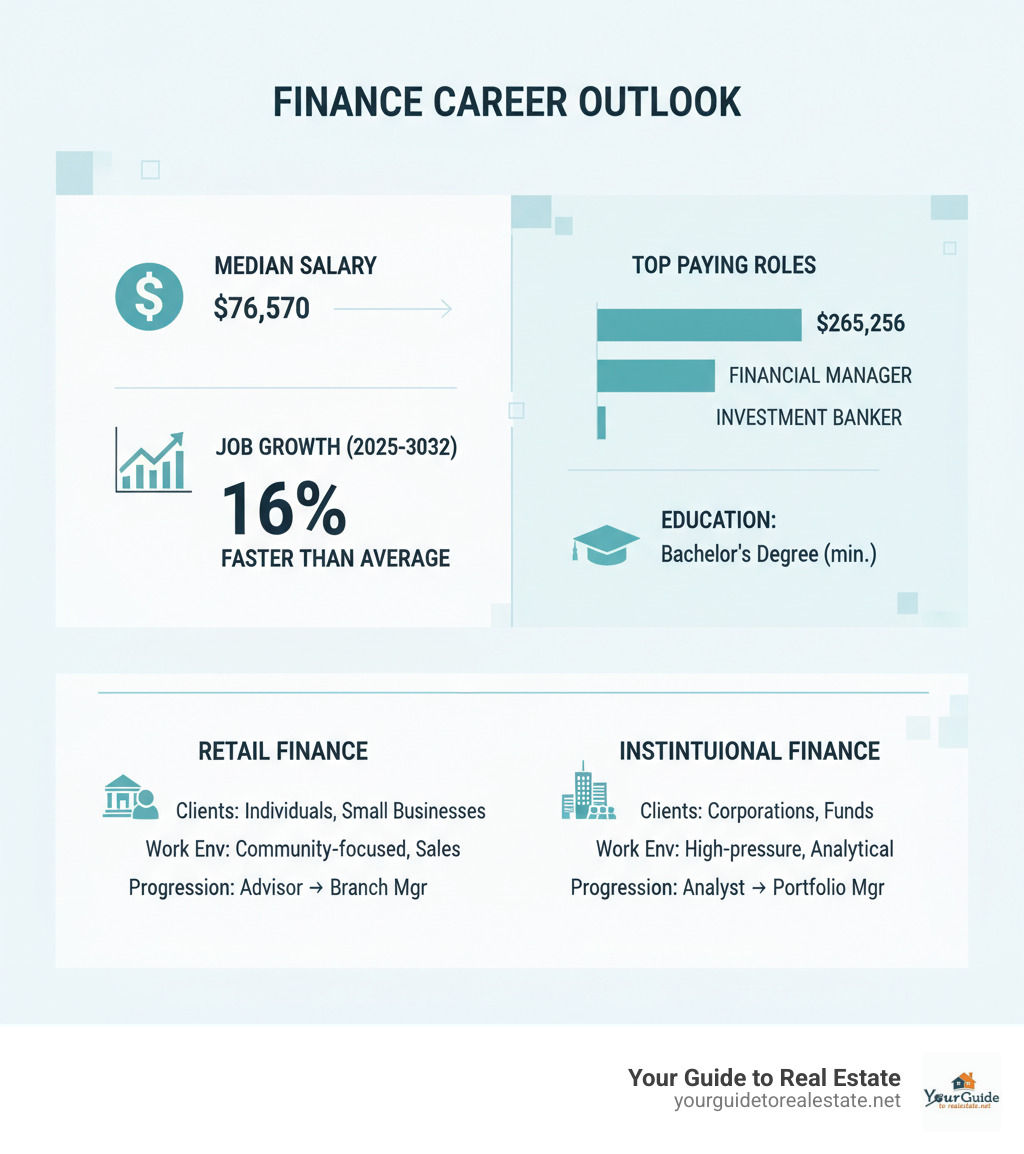
- Median salary: $76,570 (significantly higher than $45,760 average for all jobs)
- Job growth: 16% expected growth through 2032 (much faster than average)
- Top-paying roles: Financial managers ($134,180), Investment bankers ($265,256)
- Best for: Detail-oriented problem-solvers who thrive under pressure
- Challenges: Long hours, high stress, intense competition
If you’ve ever searched “Is Finance a Good Career Path?” online, you’ve probably been overwhelmed by generic advice. Most articles miss the crucial point: what will this industry look like in 10-20 years?
The finance industry has experienced unprecedented growth since the 1980s. The finance wage premium jumped from 5-10% in 1978 to over 70% by 2018. That’s not just good – that’s extraordinary.
But here’s what makes finance particularly interesting for our readers: finance skills are essential in real estate. Whether you’re buying your first home, investing in rental properties, or working as a real estate professional, understanding finance gives you a massive advantage.
The finance world offers two main paths: retail finance (working with individuals and small businesses) and institutional finance (serving large corporations and investment funds). Both have distinct advantages, career trajectories, and lifestyle implications.
However, finance isn’t for everyone. The high rewards come with significant costs: brutal hours, intense stress, and fierce competition. Some roles demand 60-80 hour work weeks, especially early in your career.
Know your is finance a good career path terms:
The Pros and Cons: A Realistic Look at a Finance Career

Let’s be honest: is finance a good career path gets asked so often because the answer isn’t simple. Finance careers come with incredible highs and some pretty tough lows. Think of it like asking if roller coasters are fun – it depends entirely on whether you love the thrill or prefer keeping your feet on solid ground.
The Allure: High Compensation and Dynamic Opportunities
Here’s what gets everyone excited about finance: the money is real. We’re talking about salaries that make your friends in other fields do a double-take. According to the Bureau of Labor Statistics, business and financial occupations had a median wage of $76,570 in 2021. Compare that to the $45,760 median for all jobs, and you can see why people get interested.
But those are just the starting numbers. Financial managers earn a median of $134,180, while investment bankers can pull in around $265,256 – and that’s before bonuses kick in. Even entry-level financial analysts start around $83,660. The numbers speak for themselves.
What makes these salaries even more impressive is that they’ve been growing faster than almost any other field. The finance wage premium jumped from a modest 5-10% in 1978 to over 70% by 2018. That’s not just inflation – that’s real growth in earning power.
Beyond the paycheck, finance offers something many careers can’t: intellectual stimulation that actually matters. You’re solving complex puzzles, analyzing market trends, and making decisions that create real impact. One day you might be helping a family buy their first home, the next you could be structuring a deal that creates hundreds of jobs.
The career growth opportunities are equally impressive. The BLS projects 963,500 job openings annually through 2033. Financial analyst positions are expected to grow by 12%, while personal financial advisor roles could expand by nearly 30%.
Here’s something we love about finance skills: they translate beautifully to real estate. Understanding cash flow analysis, market valuation, and risk assessment makes you incredibly effective whether you’re learning how to invest in real estate or helping clients steer complex transactions.
The Reality: Stress, Work-Life Balance, and Ethical Problems
Now for the part that makes people pause: finance can be really demanding. Those high salaries often come with 60-80 hour work weeks, especially when you’re starting out. Investment banking is notorious for this – some professionals joke that they see their office more than their apartment.
The stress isn’t just about long hours. Market volatility can turn a normal day into chaos in minutes. When the markets are crashing, you can’t just clock out at 5 PM. Your clients need you, your deals need attention, and your stress levels hit the roof.
Then there’s the responsibility factor. In finance, you’re often managing other people’s life savings, retirement funds, or business futures. That family counting on you to help them understand their mortgage options? That’s real pressure. The weight of making the right recommendation when someone’s financial future hangs in the balance can be overwhelming.
Ethical challenges pop up more than you’d expect. As a financial professional, you have a fiduciary duty to put your clients’ interests first. But what happens when your firm’s incentives don’t align perfectly with what’s best for your client? These situations require careful navigation and strong moral compass.
The regulatory environment adds another layer of complexity. Compliance requirements are extensive and constantly changing. One small mistake in documentation or procedure can have serious consequences for both you and your clients.
Understanding these challenges is crucial, whether you’re considering a finance career or working with financial products. When we help people with understanding mortgages and home loans, we always emphasize the importance of working with ethical professionals who prioritize your interests over their commissions.
The Verdict: Is finance a good career path for your personality?
The answer to “is finance a good career path” depends entirely on who you are as a person. Are you someone who gets energized by pressure, or does stress keep you up at night? Do you thrive in competitive environments, or do you prefer collaborative teamwork?
Detail-oriented people often love finance because precision matters. A decimal point in the wrong place can mean thousands of dollars. If you’re the type who double-checks restaurant bills and notices when your bank statement is off by a few cents, you might have the right mindset.
Some finance roles are highly analytical – think risk management or quantitative analysis. You’ll spend your days building models and crunching numbers. Other positions are client-facing, like personal financial advising or sales roles. If you love helping people solve problems and explaining complex concepts in simple terms, client-facing roles might be perfect.
The key is honest self-assessment. Can you handle the pressure of managing someone’s retirement savings? Are you comfortable with the fact that your income might fluctuate based on market performance? Do your personal values align with the sometimes aggressive nature of financial markets?
Consider your long-term goals too. If you want financial security, intellectual challenge, and diverse career options, and you’re prepared for demanding hours and high-stakes decisions, finance could be an excellent fit. But if work-life balance is non-negotiable, you’ll need to be very selective about which finance roles you pursue.
The beautiful thing about finance skills is their versatility. Whether you end up staying in traditional finance or transitioning to real estate, entrepreneurship, or consulting, the analytical and strategic thinking skills you develop will serve you well throughout your career.
Decoding the Finance World: Career Paths and Specializations

Think of the finance world like a massive shopping mall with dozens of different stores. Each “store” serves different customers and offers unique experiences. When you’re wondering is finance a good career path, understanding these different areas becomes crucial because your choice will shape everything from your daily routine to your long-term earning potential.
The beauty of finance lies in its diversity. You’re not limited to the stereotypical Wall Street investment banker (though that’s certainly an option). There are paths for people who love working with families, others who thrive on complex corporate deals, and even those who want to blend finance with real estate investing.
Retail vs. Institutional Finance: Who Do You Serve?
The first major fork in the road involves choosing your audience. This decision affects everything from your work schedule to how you get paid.
Retail finance means working directly with regular people like you and me. Picture yourself sitting across from a young couple buying their first home, or helping a retiree plan their golden years. These professionals build long-term relationships with individuals, families, and small business owners who need guidance on everything from retirement planning to investment strategies.
The work style here feels more personal and relationship-driven. You might find yourself explaining complex financial concepts in simple terms, celebrating when a client reaches their savings goal, or providing reassurance during market downturns. Many retail finance professionals enjoy significant flexibility, with opportunities for remote work or even starting their own practice.
Institutional finance, on the other hand, operates in a completely different universe. Here, you’re serving massive entities like Fortune 500 companies, government agencies, or pension funds managing billions of dollars. Instead of helping someone save for their child’s college fund, you might be structuring a $500 million corporate acquisition or managing investment portfolios worth more than some countries’ GDP.
The environment tends to be more analytical and team-focused. You’ll likely work in gleaming office towers in major financial centers, collaborating with brilliant colleagues on complex transactions that make headlines. The pace is often intense, but so are the financial rewards.
Here’s how these paths compare:
| Feature | Retail Finance | Institutional Finance |
|---|---|---|
| Clients | Individuals, families, small businesses | Corporations, governments, pension funds, hedge funds |
| Work Style | Direct client interaction, relationship-focused, often more independent | Analytical, team-based, complex transactions, hierarchical |
| Flexibility | More location flexibility, potential for remote work | Less remote work, typically office-based in financial hubs |
| Compensation | Commissions, fees, salary; potential for entrepreneurship income | Salary + significant bonuses, often performance-driven |
| Key Designation | CFP (Certified Financial Planner) | CFA (Chartered Financial Analyst) |
Finding Your Niche: Popular Finance Specializations
Once you’ve chosen your audience, it’s time to pick your specialty. The finance world offers something for almost every personality type and interest.
Investment banking remains the most glamorous (and demanding) option. These professionals advise companies on major deals like mergers and acquisitions, help them raise capital, and structure complex financial transactions. Yes, the hours are brutal, but the compensation can be extraordinary.
Corporate finance professionals work inside companies, managing everything from budgeting to strategic planning. They’re the financial backbone of businesses, making sure companies have the money they need to grow while managing risks. It’s less flashy than investment banking but often offers better work-life balance.
Personal financial advisors represent the heart of retail finance. They help individuals and families achieve their financial dreams, whether that’s buying a home, funding education, or enjoying a comfortable retirement. The projected growth rate of nearly 30% through 2024 shows how much demand exists for this role.
Financial analysts are the detectives of finance, digging deep into company financials and market trends to make investment recommendations. With job growth projected at more than 12% through 2024, it’s a stable and growing field that appeals to analytically-minded individuals.
Asset management involves managing investment portfolios for clients, balancing the eternal challenge of maximizing returns while controlling risk. Risk management professionals focus specifically on identifying and mitigating financial dangers that could harm their organizations.
Here’s where things get interesting for our readers: real estate finance represents a fascinating intersection of two powerful wealth-building industries. These professionals might structure financing for major property developments, manage real estate investment trusts, or help investors understand Real Estate Financing options.
We’ve seen how valuable finance skills are in real estate. Whether you’re making smart decisions about Property Investment or simply want to understand your options better, financial literacy gives you a massive advantage in real estate transactions.
Fintech represents the exciting frontier where finance meets technology. These innovators are creating everything from mobile payment apps to blockchain solutions, reshaping how we think about money itself.
The key is finding the specialization that matches your personality, interests, and lifestyle goals. Some people thrive in the high-pressure, high-reward world of investment banking. Others find deep satisfaction in helping families achieve financial security. Both paths can lead to rewarding careers – it’s just a matter of choosing the right fit for you.
Your Blueprint for Success: Skills, Education, and Qualifications

Building a successful finance career is like constructing a house – you need a solid foundation, the right materials, and ongoing maintenance. When you’re wondering is finance a good career path for you, understanding the skills and qualifications needed is crucial for making an informed decision.
The good news? You don’t need to be a math genius or have a trust fund to succeed in finance. But you do need the right combination of technical skills, people skills, and credentials to stand out in this competitive field.
Building Your Foundation: Essential Hard and Soft Skills
Think of finance skills as having two sides of the same coin. On one side, you have the technical abilities that help you crunch numbers and analyze data. On the other side, you have the people skills that help you communicate your findings and build relationships.
Your technical toolkit starts with strong analytical skills – the ability to look at complex data and spot patterns that others might miss. This isn’t just about being good with numbers; it’s about understanding what those numbers are telling you about a company, market, or investment opportunity.
Financial modeling is another must-have skill. You’ll spend countless hours in Excel building models that predict everything from company valuations to market trends. If you enjoy creating detailed spreadsheets and forecasting scenarios, you’re already on the right track.
Quantitative ability goes hand-in-hand with your analytical skills. You need a solid grasp of mathematics and statistics to understand risk, evaluate investments, and make sense of market behavior. This includes mastering budgeting and risk analysis – skills that help you allocate resources wisely and spot potential problems before they become disasters.
But here’s where many people get it wrong: they think finance is all about numbers. The truth is, your soft skills are just as important as your technical abilities.
Communication skills top the list because you need to explain complex financial concepts to people who might not share your background. Whether you’re presenting to senior executives or helping a family plan for retirement, clarity is king.
Attention to detail can make or break your career in finance. A single decimal point error in a financial model could cost millions. The pressure to be precise is real, and it’s constant.
Problem-solving and critical thinking abilities set the best finance professionals apart. Markets are unpredictable, regulations change, and clients have unique needs. Your ability to think creatively and strategically will determine how far you go.
Don’t underestimate the importance of ethical judgment. With great financial responsibility comes the need for unwavering integrity. The industry has seen too many scandals caused by professionals who cut ethical corners.
Finally, resilience and listening skills are essential for surviving the high-pressure environment and building strong client relationships. Just like successful professionals in real estate need diverse skills (as outlined in Real Estate Agent Skills), finance professionals must balance analytical prowess with exceptional interpersonal abilities.
Educational Pathways and Professional Certifications
The path into finance typically starts with your education, but there’s more flexibility than you might think. Most entry-level positions require a bachelor’s degree in finance, economics, or accounting, but the field welcomes diverse academic backgrounds.
Many successful finance professionals started with degrees in mathematics, engineering, or even liberal arts. What matters most is demonstrating strong quantitative skills and genuine interest in financial markets. We’ve seen geology majors successfully transition into finance by starting as sales assistants and earning their licenses.
For those with bigger ambitions, especially in institutional finance, an MBA often becomes essential. Top-tier investment banks and hedge funds heavily recruit from prestigious MBA programs. The advanced coursework provides comprehensive business strategy knowledge alongside sophisticated financial concepts.
Professional certifications are where you really differentiate yourself and show commitment to excellence. The CFA Charter (Chartered Financial Analyst) stands as the gold standard for investment professionals. It’s incredibly rigorous – pass rates hover around 45% for Level I, 40% for Level II, and 55% for Level III. But earning your CFA opens doors to the highest levels of institutional finance.
If you’re drawn to helping individuals and families, the CFP (Certified Financial Planner) designation is your ticket to credibility. With a pass rate around 63%, it’s challenging but achievable. CFP professionals focus on comprehensive financial planning, retirement strategies, and wealth management.
The CPA license remains valuable beyond accounting, especially for corporate finance roles requiring deep understanding of financial reporting. Other specialized certifications include the FRM (Financial Risk Manager) for risk management, CAIA (Chartered Alternative Investment Analyst) for alternative investments, and various others depending on your chosen specialization.
Here’s the reality about finance education: lifelong learning isn’t optional. Markets evolve, regulations change, and new technologies emerge constantly. The professionals who thrive are those who commit to continuous education and adaptation throughout their careers.
Whether you’re evaluating is finance a good career path for yourself or already committed to the journey, success comes from combining solid technical foundations with strong interpersonal skills and relevant credentials. It’s an investment in yourself that can pay dividends for decades to come.
The Future of Finance: Is finance a good career path for tomorrow?

Looking ahead, the question is finance a good career path becomes even more interesting. The financial world is changing faster than ever, and understanding these shifts is crucial for making smart career decisions.
Think about it this way: if you’re considering a finance career today, you’ll likely be working for the next 30-40 years. What will that world look like? The answer involves both exciting opportunities and real challenges that anyone entering finance needs to understand.
How Technology and AI are Reshaping the Industry
Let’s be honest – robots are coming for some finance jobs. But before you panic, here’s the real story: technology is changing finance, not destroying it.
The routine stuff is definitely going away. Basic data entry, simple financial reports, and even some trading activities are increasingly handled by AI systems. These machines can crunch numbers 24/7 without coffee breaks or sick days. But here’s what they can’t do: understand the human side of money.
AI-powered analytics are actually making finance professionals more powerful. Imagine having a super-smart assistant that can analyze thousands of data points in seconds, spot patterns you’d never see, and flag potential risks before they become problems. That’s what modern AI tools are doing for finance professionals.
The fintech revolution has created entirely new career paths. Companies are building innovative solutions for everything from digital payments to blockchain applications. These aren’t just tech jobs – they’re finance jobs that happen to use cutting-edge technology.
According to research, AI is expected to contribute up to $15.7 trillion to the global economy by 2030. The World Economic Forum suggests AI will likely create more finance jobs than it eliminates, especially roles requiring complex decision-making and human interaction.
This shift is creating new roles in data science and compliance. Finance professionals who can work alongside AI, interpret its outputs, and use technology strategically will be in high demand. It’s similar to what we’re seeing in real estate, where How AI and Automation Are Changing the Real Estate Workforce in 2025 shows how professionals are adapting rather than being replaced.
Macro-Economic Trends and Long-Term Career Prospects
The bigger economic picture tells us a lot about finance’s future. The good news? Finance jobs are still growing steadily. The BLS industry outlook projects 963,500 openings annually from 2023 to 2033. Financial managers are expected to grow by 16% until 2032, while financial analysts should see 8% growth by 2030.
But let’s talk about the elephant in the room: the golden age of finance (1980-2020) might be over. During those decades, falling interest rates made everything easier – deals flowed, assets appreciated, and finance professionals rode a massive wave of growth.
The impact of interest rates going forward could be different. Rising rates make deals harder, reduce asset valuations, and generally create a tougher environment for some finance roles. This doesn’t mean finance is doomed, but it might mean the extraordinary growth we saw in past decades won’t repeat.
Demographic shifts are also worth watching. Many developed countries face aging populations and declining birth rates. Fewer people means fewer consumers and smaller markets over time. China’s population is already shrinking, and birth rates are falling across the developed world.
There’s also growing regulatory scrutiny. After decades of deregulation, governments are taking a harder look at big deals and financial practices. This could make some traditional finance activities more challenging.
Despite these headwinds, global market expansion continues creating opportunities, especially in emerging markets. And here’s an interesting twist: some experts believe “real assets” like real estate, infrastructure, and commodities might outperform traditional financial assets in inflationary environments.
This connects perfectly to our expertise at Your Guide to Real Estate. We’re constantly monitoring Top 7 Real Estate Trends Shaping 2025 and Beyond because financial professionals who understand real assets could have a significant advantage in the coming decades.
The bottom line? Finance will remain a solid career choice, but it may not offer the same extraordinary relative growth as the past 40 years. The finance wage premium might stabilize at a lower (but still attractive) level. Success will increasingly depend on adaptability, continuous learning, and focusing on areas that combine human judgment with technological tools.
Frequently Asked Questions about Finance Careers
What is the highest-paying job in finance?
When people wonder is finance a good career path, compensation is often their first concern. And honestly, the numbers are impressive.
Investment bankers typically earn the most, with average salaries around $265,256 before bonuses. But here’s the kicker – those bonuses can easily double or triple your total pay. We’re talking about compensation that can reach well into the six figures, even early in your career.
Hedge fund managers and private equity associates also command top dollar, especially when performance bonuses kick in. These roles can be life-changing financially, but they’re also incredibly demanding.
Don’t overlook quantitative analysts (or “quants” as they’re called). These math wizards who build complex financial models earn around $126,655 on average. Financial managers aren’t far behind at $156,100 median pay according to 2023 BLS data.
That location matters tremendously. A financial manager in New York will likely out-earn someone in Oklahoma City, but the cost of living tells a different story. The key is finding the right balance for your lifestyle.
How difficult is it to get an entry-level finance job?
Let’s be honest – breaking into finance can be tough, especially if you’re aiming for those prestigious investment banking roles.
The competition is fierce. Top firms want candidates with stellar academic records, relevant finance internships, and rock-solid analytical skills. Networking is absolutely crucial – many positions are filled through connections before they’re even posted publicly.
You’ll also need to prepare for rigorous technical interviews. Expect questions about financial modeling, valuation methods, and market analysis. It’s not just about knowing the theory – you need to think on your feet.
But here’s some good news: finance is much broader than just Wall Street. While landing that stereotypical “finance bro” investment banking job might be challenging, plenty of other doors are open. Corporate finance, financial analysis, and wealth management roles are often more accessible.
The key is demonstrating genuine interest and aptitude. Show that you understand concepts like accounts receivable and other business fundamentals. Employers want to see that you’re serious about the field, not just chasing big paychecks.
Is a degree in finance worth it?
Absolutely. A finance degree is one of the best investments you can make in your future.
The numbers speak for themselves. Finance majors earn an average of $101,038 right out of college – that’s significantly higher than most other fields. But it’s not just about the starting salary; it’s about the trajectory.
A finance degree opens doors across multiple industries. You’re not locked into traditional banking. You could work in corporate finance, investment management, real estate, or even start your own business. The analytical and strategic thinking skills you develop are incredibly valuable.
From our perspective in real estate, we see how finance knowledge gives professionals a huge advantage. Understanding market analysis, risk assessment, and investment principles makes you a much more effective real estate professional or investor.
The degree provides a solid foundation that you can build on throughout your career. Whether you pursue additional certifications like the CFA or CFP, or branch into specialized areas, that undergraduate finance education gives you the framework you need.
While other degrees like economics or mathematics can also lead to finance careers, a dedicated finance program offers the most direct path. You’ll graduate with both theoretical knowledge and practical skills that employers immediately recognize and value.
Conclusion: Is a Finance Career the Right Move for You?
After diving deep into finance – from the high earning potential and diverse career paths to the demanding hours and intense pressure – you might be wondering where you fit in. The question is finance a good career path doesn’t have a one-size-fits-all answer, but hopefully our exploration has given you the insights you need to make an informed decision.
Finance offers something rare in today’s job market: a combination of intellectual challenge, financial security, and genuine impact. Whether you’re helping a family plan for retirement, structuring a billion-dollar merger, or analyzing market trends that shape entire industries, finance professionals play a crucial role in how our economy functions.
But let’s be honest – it’s not for everyone. The industry rewards those who can handle pressure, work long hours when needed, and maintain their ethical compass when the stakes are high. If you’re someone who thrives on solving complex problems, enjoys working with numbers, and can communicate clearly with both colleagues and clients, finance could be an excellent fit.
The skills you develop in finance are incredibly valuable and transferable. Understanding financial markets, risk management, and strategic planning opens doors not just within traditional finance roles, but across many industries. These skills are particularly valuable in real estate, where financial literacy can make the difference between a good investment and a great one.
Final Thoughts: Is finance a good career path for your long-term goals?
Looking ahead, finance remains a solid career choice with strong growth prospects. While the industry is evolving with technology and changing regulations, these shifts are creating new opportunities rather than eliminating careers entirely. The professionals who succeed will be those who adapt, continue learning, and accept new tools and methods.
The financial security that comes with a finance career is significant. Beyond the impressive starting salaries, finance offers clear paths for advancement and the potential for substantial earnings growth throughout your career. Many finance professionals also find that their skills naturally lead to entrepreneurship opportunities, whether starting their own advisory practice or launching a fintech startup.
Your exit opportunities are also excellent. The analytical thinking, strategic planning, and business acumen you develop in finance are highly sought after in other industries. We’ve seen finance professionals successfully transition into real estate development, corporate leadership roles, and even completely different fields.
At Your Guide to Real Estate, we understand that major career decisions require the same careful analysis we bring to real estate investments. Just as we help clients steer complex property transactions with our proven framework and stress-free guidance, we encourage you to approach your career choice methodically.
Talk to professionals currently working in finance. Seek out internships or entry-level positions to test the waters. Consider how finance aligns with your personal values and long-term goals. And remember, understanding finance will benefit you regardless of your career path – whether you’re evaluating Understanding Mortgages: A Beginner’s Guide to Home Loans or making any major financial decision.
The finance industry, with its diverse specializations and ongoing evolution, continues to offer rewarding careers for those who are prepared for its demands. If you’ve made it this far in our guide, you clearly have the curiosity and analytical mindset that finance values. The question now is whether you’re ready to take the next step.