
Why This Mortgage Rate Drop is Creating New Opportunities for Homebuyers
When mortgage rates drop significantly, it creates ripple effects throughout the housing market that can save you thousands of dollars. Recent data shows that mortgage rates have fallen more than half a percent and are at their lowest level since February 2023, with 30-year fixed rates dropping to an average of 6.13%.
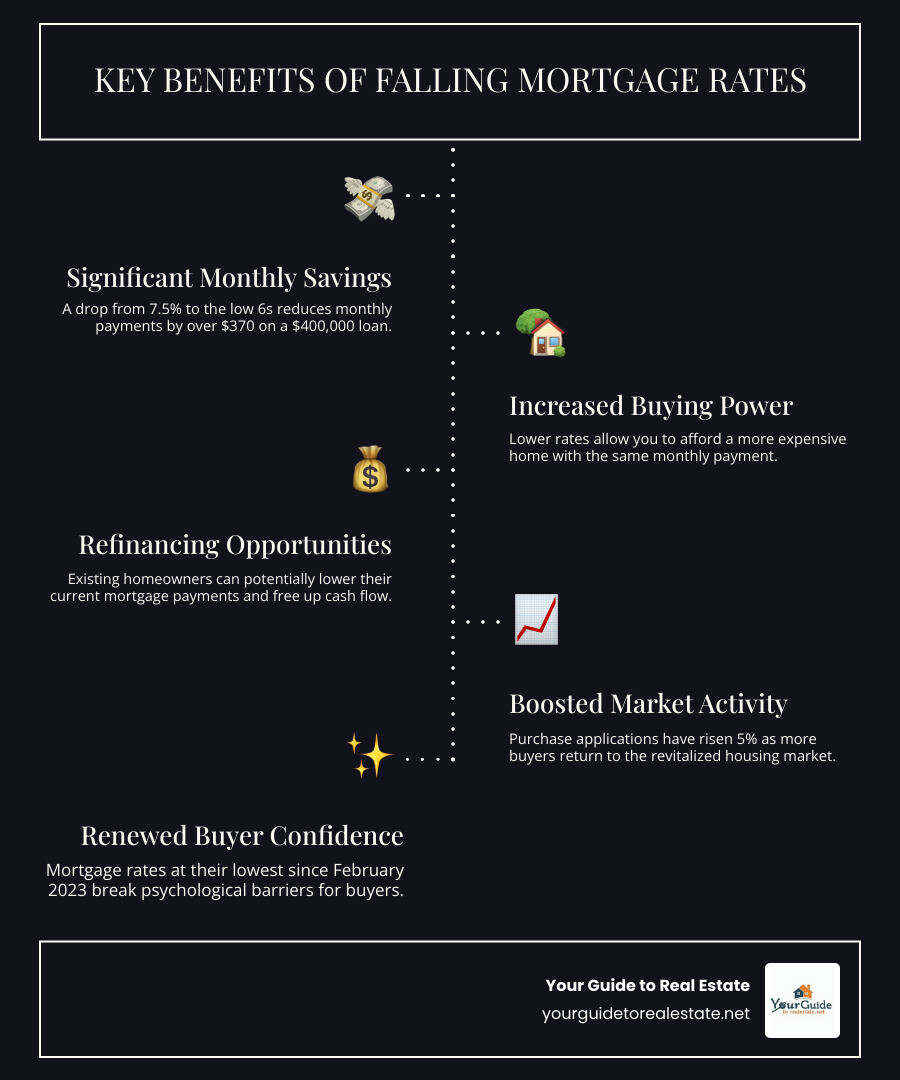
Key impacts of falling mortgage rates:
- Monthly savings: A drop from 7.5% to the low 6s reduces monthly payments by over $370 on a $400,000 loan
- Increased buying power: Lower rates mean you can afford a more expensive home with the same monthly payment
- Refinancing opportunities: Existing homeowners can potentially lower their current mortgage payments
- Market activity boost: Purchase applications have risen 5% as buyers return to the market
- Psychological barrier broken: Rates starting with a “3” handle create renewed buyer confidence
The Bank of Canada’s recent rate cut to 2.50% has triggered this downward trend, with economists predicting further cuts through 2025. As one mortgage expert noted, “Going from 7.5% just a few months ago to the low 6s has a big impact on your bottom line.”
This rate environment represents the most significant opportunity for both buyers and current homeowners in nearly two years. However, understanding how to evaluate and act on these changes requires looking beyond the headline numbers.
Mortgage rates drop terms simplified:
Why the Recent Mortgage Rates Drop is Happening Now
If you’re wondering why we’re suddenly seeing this mortgage rates drop, you’re not alone. It’s actually the result of several moving parts working together – think of it like dominoes falling in sequence. Central banks make policy decisions based on what they see happening in the economy, and right now, they’re seeing signals that tell them it’s time to make borrowing cheaper.
The Role of Central Banks
The Bank of Canada holds the keys to interest rates in our country. When they adjust their policy rate, everything else follows suit – including mortgage rates.
Here’s what happened recently: The Bank of Canada cut their benchmark rate from 2.75% to 2.50% in September 2025. This wasn’t a spur-of-the-moment decision. They’d been watching the economy slow down and realized they needed to give it a boost.
When the Bank of Canada cuts rates, it’s like turning down the cost of borrowing money. Banks can get money cheaper, so they can offer cheaper loans and mortgages to you. It’s their way of encouraging people to spend and invest when the economy needs some help.
The central bank’s job is tricky – they need to keep inflation under control while also making sure people have jobs and the economy keeps growing. Right now, they decided the economy needed more support than inflation needed more fighting.
Key Economic Factors at Play
Several economic warning signs convinced the Bank of Canada that a mortgage rates drop was necessary. Let’s break down what they were seeing:
Economic growth hit a rough patch. Canada’s economy actually shrank by 0.2% in the second quarter of 2025, according to GDP contraction data. That was the third month in a row of decline – definitely not the direction anyone wants to see.
Job losses started piling up. The August labour market report showed Canada lost 66,000 jobs in just one month. The unemployment rate jumped from 6.9% to 7.1%. When people lose jobs, they spend less money, which slows down the whole economy.
Consumer spending cooled off. People became more cautious with their wallets, which showed up in weaker retail sales numbers. When consumers pull back, businesses feel it, and the economy needs a nudge to get moving again.
Bond yields dropped. This is where things get technical, but it matters for your mortgage. The 10-year government bond yields fell as investors got nervous about the economy. Since fixed mortgage rates follow bond yields pretty closely, this helped push mortgage rates down even before the central bank acted.
Inflation became less of a worry. While inflation was still a bit above the Bank of Canada’s 2% target, it wasn’t racing higher anymore. At 1.9% in August, it was actually sitting right where they want it. This gave them room to focus on helping the economy instead of fighting price increases.
All these factors together painted a picture of an economy that needed help more than it needed higher interest rates. That’s why we’re seeing this mortgage rates drop – it’s the central bank’s way of giving the economy the boost it needs to get back on track.
How Falling Rates Impact Homebuyers and Homeowners
When mortgage rates drop, it’s like getting an unexpected bonus that puts real money back in your pocket. Whether you’re dreaming of buying your first home or you’re already a homeowner wondering if you should refinance, these rate changes create opportunities that can transform your financial picture.

Understanding the Impact of a Mortgage Rates Drop on Your Wallet
The beauty of falling rates isn’t just in the headlines – it’s in how they change what you can actually afford and what you’ll pay each month. Let’s break down exactly what this means for your wallet.
Your purchasing power gets a major boost when rates fall. Think of it this way: if you were pre-approved for a certain loan amount at 7.5%, that same monthly payment budget now qualifies you for a more expensive home when rates drop to the low 6s. It’s like getting a raise without changing jobs.
The monthly savings are equally impressive. On a $400,000 loan, dropping from 7.5% to around 6% saves you over $370 every month. Even smaller drops make a difference – going from 7.79% to 7.22% still puts $125 back in your pocket each month. You can see exactly how different rates affect your specific situation using our Mortgage Calculator.
There’s also a psychological shift that happens when rates start dropping. As mortgage expert Penelope Graham from Ratehub.ca explains, “having a three handle on mortgage rates is an important psychological hurdle for buyers.” Many potential buyers have been waiting on the sidelines, and seeing rates fall can feel like getting permission to jump back into the market.
For current homeowners, a mortgage rates drop opens the door to refinancing opportunities. If you locked in a mortgage above 7% in recent years, refinancing could significantly reduce your monthly burden or help you access your home’s equity. Our Mortgage Refinancing Explained guide walks you through the process and helps you determine if it makes sense for your situation.
Fixed vs. Variable Mortgages: Who Benefits Most?
Not all mortgages respond to rate drops in the same way, and understanding these differences can help you make smarter decisions about your financing.
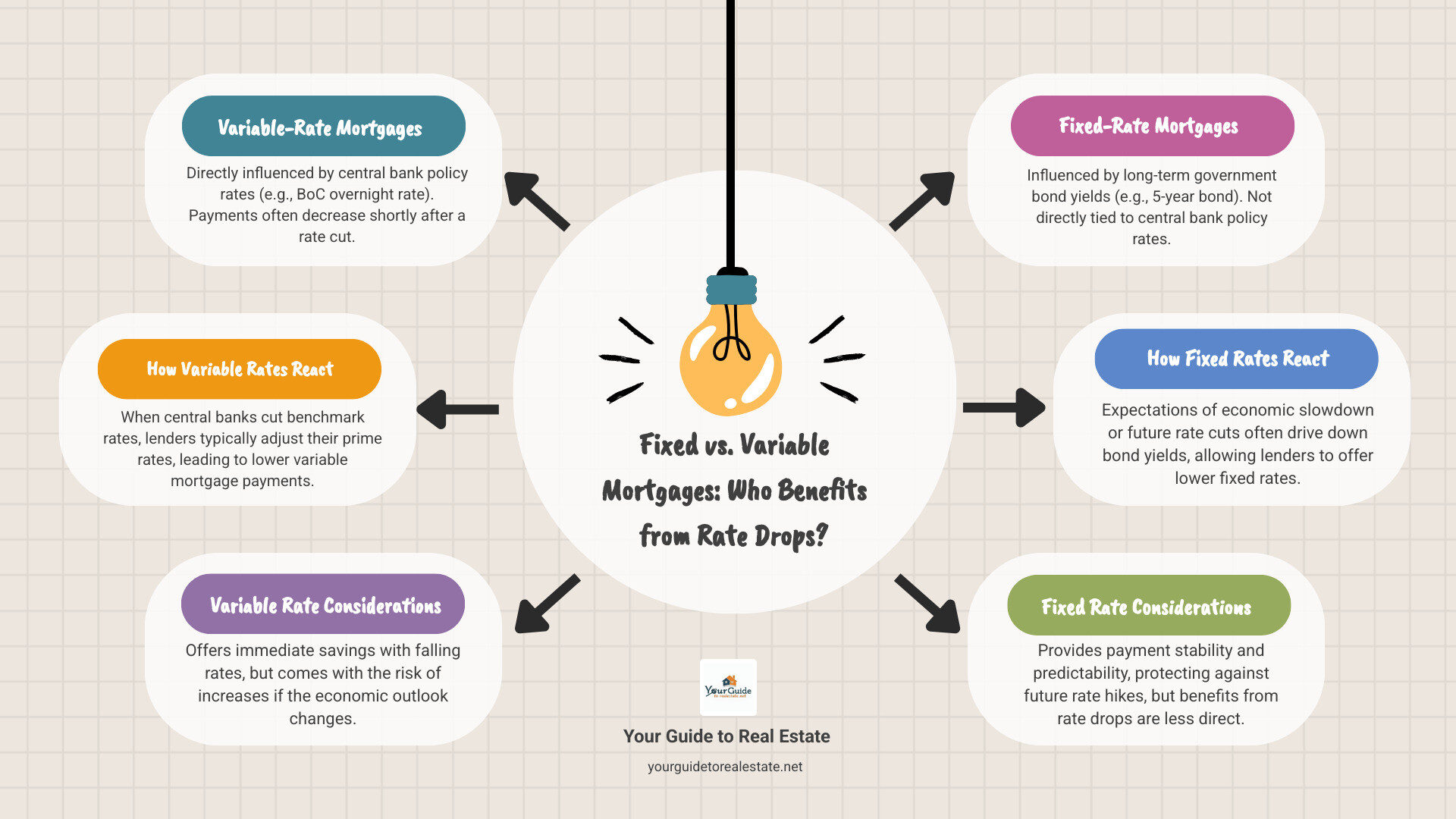
Variable-rate mortgage holders see immediate benefits when central banks cut rates. These mortgages are directly tied to the prime rate, which moves in lockstep with the Bank of Canada’s policy rate. When the BoC cut rates to 2.50% in September 2025, most bank prime rates dropped to 4.70%. If you have a variable-rate mortgage, your interest rate – and often your monthly payment – adjusts quickly to reflect these changes.
Fixed-rate mortgages work differently but can still benefit from falling rates. These rates are influenced by the bond market rather than central bank policy directly. When investors expect economic slowdowns or future rate cuts, they buy more government bonds, which pushes yields down and allows lenders to offer better fixed rates. Recent data shows 5-year fixed rates averaging around 3.97%, while 30-year fixed rates in the U.S. have dropped to 6.13% – their lowest level in three years.
The question of who benefits most depends on your situation and comfort level. Variable-rate borrowers are already seeing relief in their monthly payments, and they’ll benefit from any additional rate cuts. New borrowers considering variable rates might save money if rates continue falling, but they need to be comfortable with the possibility of increases if economic conditions change.
Fixed-rate borrowers get the gift of predictability along with today’s improved rates. If you value knowing exactly what you’ll pay each month and want to lock in current lower rates, this could be your moment. The choice often comes down to your risk tolerance and how you sleep at night when markets get volatile.
For a deeper dive into how these different rate types work, check out our guide on Understanding Mortgage Rates. The most important thing is choosing the option that aligns with your financial goals and comfort level.
Your Action Plan: How to Take Advantage of Lower Rates
When mortgage rates drop, it’s like finding a golden ticket in your mailbox. This isn’t just good financial news – it’s your cue to take action. Whether you’re dreaming of buying your first home or looking to save money on your current mortgage, now’s the time to move strategically.

Strategic Moves to Make When Mortgage Rates Drop
Think of this mortgage rates drop as a limited-time opportunity. Here’s your step-by-step roadmap to make the most of it:
Start by shopping around for the best deal. Don’t just walk into your current bank and accept whatever they offer. Different lenders can have surprisingly different rates, even on the same day. Online lenders, credit unions, and local banks all compete for your business, which means better deals for you. Our How to Compare Mortgages guide walks you through exactly how to evaluate different offers side by side.
Check your credit score before you do anything else. Lenders save their best rates for borrowers with excellent credit – typically scores in the high 700s or above. Pull your credit report and look for any errors that might be dragging down your score. If you find mistakes, dispute them immediately. Paying down credit card balances can also give your score a quick boost.
Get pre-approved if you’re buying a home. This step is absolutely crucial in today’s market. Pre-approval shows sellers you’re serious and gives you a clear picture of what you can actually afford. It also speeds up the buying process when you find the right home, which can make all the difference in competitive situations.
Consider locking in your rate once you find a good one. Mortgage rates can change daily, sometimes even multiple times per day. While rates are trending down right now, market conditions can shift quickly. If you find a rate that works for your budget, lock it in to protect yourself from any sudden increases.
Evaluate whether refinancing makes sense for your situation. If you’re currently paying a mortgage rate above 7% – and millions of homeowners are – refinancing could save you hundreds of dollars every month. Just remember to factor in closing costs and consider how long you plan to stay in your home. The savings need to outweigh the costs for refinancing to make financial sense.
Expert Advice for Navigating the Market
Mortgage professionals are seeing increased activity as rates fall, and their insights can help you steer this opportunity more effectively.
Don’t automatically dismiss adjustable-rate mortgages (ARMs). While fixed rates offer predictability, ARMs often start with lower rates than fixed loans. If you’re not planning to stay in your home for decades, an ARM might save you significant money in the early years. Just make sure you understand how and when your rate could adjust.
Consider working with a mortgage broker. A good broker can compare offers from multiple lenders and help you find the best deal for your specific situation. This is especially valuable if you’re a first-time buyer or have unique financial circumstances. They can often access rates and programs you might not find on your own.
Stay informed but don’t get paralyzed by analysis. Yes, it’s smart to understand market trends, but don’t fall into the trap of waiting for the “perfect” rate. Markets change constantly, and the great rate you see today might be gone tomorrow. If you find terms that work for your budget and goals, move forward with confidence.
Be smart about cash-out refinancing. If you’re considering tapping into your home’s equity to pay off high-interest debt, make sure you have a solid plan for managing your finances going forward. The last thing you want is to clear your credit cards only to run them back up again. Mortgage rates drop events like this one create opportunities, but they require discipline to maximize the benefits.
This favorable rate environment won’t last forever. Economic conditions change, and with them, interest rates. The key is to act thoughtfully but decisively when you find an opportunity that aligns with your financial goals.
The Future Outlook for Mortgage Rates and the Housing Market
Looking ahead, it’s natural to wonder if this mortgage rates drop is just a temporary blip or the start of a longer trend. The good news? Most economists are optimistic that we’ll continue seeing favorable rates, though the path forward comes with some interesting twists and turns.
What Economists Predict for 2025-2027
When major banks and financial institutions start making predictions, it’s worth paying attention. The consensus among Canada’s biggest economic forecasters is remarkably aligned: more rate cuts are coming.
The Bank of Canada’s expected journey looks quite promising for borrowers. TD Economics expects the BoC to trim its policy rate down to 2.25% by the end of 2025, with rates staying around that sweet spot through 2027 as the economy works through its current sluggish period. They’re not alone in this thinking.
Both National Bank and Scotiabank are singing the same tune, forecasting that 2.25% target by year’s end. RBC adds an interesting wrinkle to their forecast, expecting rates to hit 2.25% in 2025, then nudge up slightly to 2.50% in 2026 as the economy finds its footing again.
For our American readers, the outlook remains cautiously optimistic. Experts polled by Bankrate in April 2025 predicted 30-year mortgage rates would settle around 6.41% by year’s end. While that’s still higher than the rock-bottom rates we saw a few years ago, it represents a meaningful mortgage rates drop from the peaks we experienced.
The wild cards in this forecast are recession and stagflation risks. A recession, while nobody wants one, would likely speed up rate cuts as central banks work overtime to jumpstart the economy. On the flip side, stagflation – that nasty combination of high inflation and weak growth – could complicate things if ongoing trade tensions keep pushing prices higher while the economy struggles. Our guide on Will Mortgage Rates Go Down? explores these scenarios in more detail.
Market-based forecasts suggest the BoC rate will hold steady at 2.50% into early 2026, dip to 2.25%, then creep back up to 2.50% by late 2026. It’s like watching a slow-motion economic dance, with each move carefully calculated.
Broader Implications for the Economy
This mortgage rates drop isn’t happening in a vacuum – it’s creating ripple effects that touch every corner of the economy, and understanding these can help you make smarter decisions about your real estate future.
The housing market is already waking up from its recent slumber. As mortgage experts have noted, when interest rates drop, it often sparks a surge in home-buying among people who’ve been waiting on the sidelines. We’re seeing this play out in real time, with mortgage applications climbing and buyers dusting off those saved property listings that once felt out of reach. The news that mortgage rates drop to lowest levels since February 2023 has been like a starting gun for many hesitant buyers.
Your purchasing power gets a boost when rates fall, and this creates more activity in markets from coast to coast. More buyers mean more competition, but it also means more inventory movement and potentially more choices as sellers who were hesitant to list their homes start seeing opportunity in the renewed market energy.
Consumer confidence plays a fascinating role here. While some uncertainty around economic policies has kept people cautious, a mortgage rates drop acts like a confidence booster shot. When your biggest monthly expense – your mortgage payment – becomes more manageable, it frees up money for everything from home improvements to family vacations. This extra spending power helps fuel economic recovery across multiple sectors.
Business investment and job creation also get a lift from lower borrowing costs. The economic slowdown that prompted these rate cuts hit business confidence hard, with many companies pulling back on expansion plans and hiring. But cheaper money changes the equation. Companies that were on the fence about expanding, upgrading equipment, or adding staff suddenly find these investments more attractive.
This creates a positive feedback loop: lower rates encourage business investment, which creates jobs, which puts money in people’s pockets, which supports housing demand. It’s economic recovery in action, and it’s why central banks use interest rates as their primary tool for steering the economy.
The current environment represents more than just a mortgage rates drop – it’s a strategic economic reset designed to breathe life back into growth. For real estate, this means we’re likely looking at a more vibrant market ahead, with opportunities for both buyers and sellers who understand how to steer these changing conditions.
Frequently Asked Questions about Falling Mortgage Rates
Let’s address the most common questions we hear from homebuyers and homeowners when they see a mortgage rates drop. These answers will help you make smart decisions during this favorable market window.
How much do mortgage rates need to drop to make a difference?
You might be surprised to learn that even a small mortgage rates drop can create meaningful savings. The numbers tell a compelling story.
When rates move from 7.5% down to the low 6s on a $400,000 loan, your monthly payment drops by over $370. That’s real money – over $4,400 back in your pocket every year! Even a smaller shift from 7.79% to 7.22% still saves you $125 monthly on that same loan amount.
These savings directly boost your purchasing power. What seemed unaffordable at higher rates suddenly becomes manageable. That extra $370 per month could be the difference between stretching your budget and comfortably affording your dream home. Or it might free up money for other financial goals like building an emergency fund or saving for your kids’ education.
The affordability increase works both ways too. Lower rates mean you can qualify for a larger loan amount with the same monthly payment, potentially opening up neighborhoods that were previously out of reach.
Should I wait for rates to drop even further before buying a house?
This is the question that keeps many potential buyers awake at night, and honestly, there’s no perfect answer. Market volatility makes timing the absolute bottom nearly impossible.
Here’s what we’ve learned from years of helping clients steer these decisions: waiting for the perfect moment often means missing good opportunities. As one expert noted, rates “could turn on a dime if China continues to sell bonds, and then rates could head back up.”
Consider these key factors when making your decision. Rate lock options protect you from increases while your loan processes, so if you find a rate that works for your budget, securing it makes sense. Housing inventory presents another consideration – as rates drop, more buyers return to the market, creating additional competition that could drive home prices higher.
Most importantly, focus on your personal financial situation. The best time to buy is when you’re financially ready with stable income, healthy savings, and good credit. Your home purchase should align with your long-term goals, not just current interest rate trends.
Our advice? If you find a rate that fits comfortably in your budget and you’re otherwise ready to buy, don’t let the fear of missing slightly lower rates keep you on the sidelines indefinitely.
How are fixed and variable mortgage rates determined?
Understanding how lenders set your rate helps you make better mortgage decisions and know what to expect when economic conditions change.
Fixed rates follow the bond market, specifically long-term government bond yields like the 5-year government bond for a 5-year fixed mortgage. When investors expect economic slowdowns or future rate cuts, they buy government bonds as safe investments. This increased demand drives up bond prices and pushes down yields, allowing lenders to offer lower fixed mortgage rates.
Variable rates work differently. They’re directly tied to your lender’s bank prime rate, which closely follows the central bank’s policy rate. When the Bank of Canada or Federal Reserve announces a rate change, commercial banks typically adjust their prime rates within days, and your variable rate moves with it.
Both rate types respond to the same economic forces – inflation, unemployment, and economic growth – but through different channels. Fixed rates reflect long-term economic expectations through the bond market, while variable rates immediately reflect central bank policy decisions.
This explains why variable-rate holders feel the impact of a mortgage rates drop almost immediately when central banks cut rates, while fixed-rate borrowers benefit when bond markets anticipate future economic conditions.
Conclusion
The recent mortgage rates drop has opened doors that many thought were locked tight. We’ve watched rates fall from over 7.5% to the low 6s, creating real savings of $370 monthly on a $400,000 loan. That’s not just a number on paper—it’s money that can transform your financial future.
Throughout this journey, we’ve explored how central bank decisions respond to economic signals like GDP contraction and rising unemployment. These aren’t abstract concepts; they’re the forces that directly impact whether you can afford that dream home or finally refinance your existing mortgage at a better rate.
The difference between fixed and variable mortgages becomes clearer when rates are moving. Variable-rate holders have already felt the immediate benefit as prime rates dropped to 4.70%. Meanwhile, those considering fixed rates can now lock in stability at levels we haven’t seen since February 2023.
Your action plan doesn’t have to be complicated. Compare lenders because rates vary significantly between them. Check your credit score because it’s your ticket to the best rates. Get pre-approved to show sellers you’re serious. And if you’re an existing homeowner with a rate above 7%, evaluate refinancing—millions of homeowners are in your exact situation.
The economic forecasts through 2025-2027 suggest this isn’t just a temporary blip. TD Economics, National Bank, and RBC all predict the Bank of Canada will continue cutting rates to 2.25% by late 2025. That means more opportunities ahead.
But here’s the thing about timing: waiting for the absolute perfect moment often means missing good moments. The market is already responding with increased purchase applications and renewed buyer confidence. Housing inventory could tighten as more buyers return, potentially offsetting your interest savings with higher home prices.
At Your Guide to Real Estate, we believe in taking action when the fundamentals align with your personal situation. This mortgage rates drop represents exactly that kind of alignment—economic conditions creating genuine opportunity for those ready to act.
Whether you’re buying your first home or optimizing your current mortgage, the tools and knowledge are at your fingertips. Our comprehensive guide, Understanding Mortgages: A Beginner’s Guide to Home Loans, can walk you through every detail with the same stress-free guidance that’s helped thousands of others steer their real estate journey successfully.
The window is open. The question isn’t whether opportunities exist—it’s whether you’re ready to walk through that door.