

Why This Mortgage Rate Drop Matters for Your Home Purchase
Mortgage rates plunge has become the headline grabbing attention across the housing market, and for good reason. The 30-year fixed-rate mortgage recently dropped to 6.35%, marking the largest weekly decline in over a year and reaching its lowest point since October 2024.
Key impacts of the current mortgage rate drop:
- Monthly savings: A drop from 7.5% to low 6% rates saves over $370 monthly on a $400,000 loan
- Increased buying power: Your purchasing power is now the best it’s been in almost two years
- Application surge: Mortgage applications jumped 11% in one week following the rate decline
- Refinancing boom: Nearly half of all mortgage applications are now refinances
- Market momentum: Purchase applications reached their highest year-over-year growth in over four years
This dramatic shift stems from weakening job market data and growing expectations that the Federal Reserve will cut interest rates in September. The economy added just 22,000 jobs in August – far below the 150,000 monthly average considered healthy.
The timing couldn’t be better for potential homebuyers. As Sam Khater, Freddie Mac’s chief economist, notes: “Mortgage rates are headed in the right direction and homebuyers have noticed.”
But understanding why rates dropped so quickly – and whether this trend will continue – is crucial for making smart decisions in today’s market.
Relevant articles related to * mortgage rates plunge*:
Why the Sudden Plunge? Key Economic Drivers Explained
When mortgage rates drop this dramatically, it’s never just one thing causing the shift. Think of it like dominoes falling – one economic event triggers another, creating a chain reaction that ultimately lands at your doorstep as lower monthly payments.
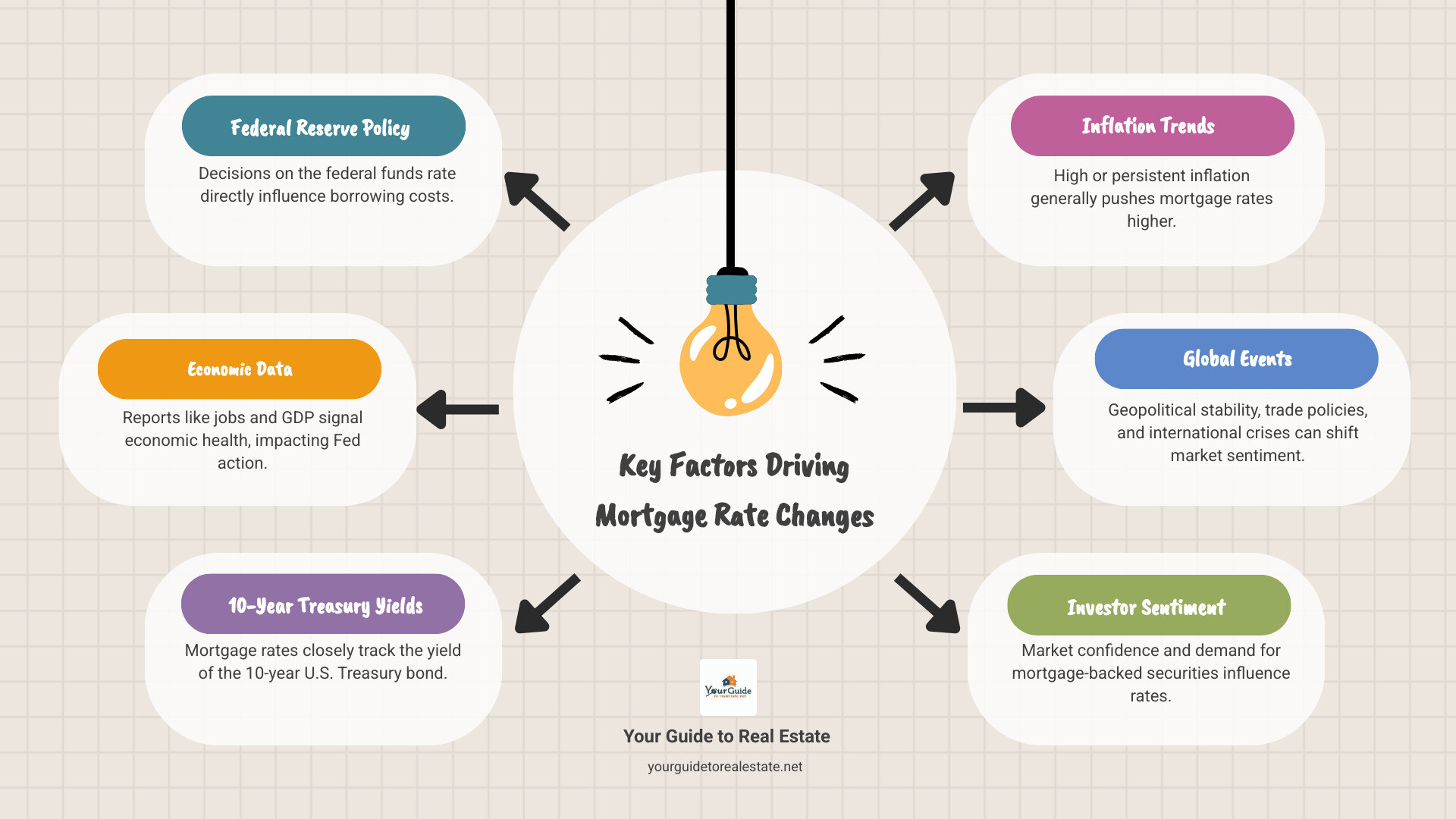
The recent mortgage rates plunge stems from several interconnected forces working together. The job market is showing clear signs of weakness, inflation trends are shifting, and investors are betting big on what the Federal Reserve will do next. Meanwhile, Treasury yields are falling and global economic uncertainty is making everyone a bit more cautious.
Let’s break down what’s really happening behind the scenes.
The Fed’s Next Move
The Federal Reserve doesn’t directly control mortgage rates, but their decisions ripple through the entire housing market. Right now, investors are playing a high-stakes guessing game about the Fed’s next move – and they’re betting on rate cuts.
Here’s the interesting part: before the recent weak jobs report, investors thought there was less than a 50% chance of a rate cut. After seeing those disappointing numbers, the odds flipped completely. Market anticipation now points to an almost certain interest rate cut when the Fed meets on September 17th.
This shift in expectations is a major driver behind the mortgage rates plunge. When investors believe the Fed will cut rates, they start buying bonds, which pushes mortgage rates down even before any official announcement.
The Fed is walking a tightrope between controlling inflation and supporting economic growth. Recent comments from central bank officials suggest they’re increasingly concerned about economic slowdown, which historically leads to lower interest rates across the board.
How a Weak Jobs Report Affects Rates
The connection between job growth and mortgage rates might seem puzzling at first, but it’s actually quite straightforward. When fewer people are working, the economy slows down, and that typically means lower interest rates.
The recent jobs data tells a concerning story. Job growth data showed the economy added just 22,000 jobs in August – far below the 150,000 monthly average that economists consider healthy. Even worse, previous months were revised downward by a total of 258,000 jobs.
The unemployment rate crept up from 4.2% to 4.3%, and the three-month average for job creation hit its slowest pace since summer 2010 (excluding pandemic years). These numbers sent a clear signal to financial markets: the economy might be cooling faster than expected.
When investors see economic slowdown signals like these, they often move money into safer investments like government bonds. This increased demand for bonds drives their prices up and yields down – and since mortgage rates closely follow bond yields, your borrowing costs drop too.
The downward revisions to previous months’ job numbers were particularly telling. When the government has to significantly lower its initial estimates, it suggests the economic picture is weaker than officials first thought. This kind of data gives the Federal Reserve more room to cut rates without worrying about overheating the economy.
It’s worth noting that similar trends are happening globally. Canada lost 66,000 jobs in August, pushing their unemployment rate to 7.1%. These international patterns reinforce the narrative that economic growth is slowing, which supports the case for lower interest rates.
For more context on how these economic factors might shape the housing market going forward, check out our housing market forecast.
The bottom line? Weakening job market conditions create a domino effect that often leads to lower mortgage rates. While job losses are never good news for the broader economy, they can create opportunities for homebuyers and those looking to refinance.
The Impact of the Mortgage Rates Plunge on the Housing Market
When mortgage rates plunge like they have recently, the ripple effects spread through the entire housing market like good news traveling through a small town. This isn’t just numbers on a financial website – it’s real change that affects real people looking to buy homes or improve their current mortgage situation.

The market response has been swift and dramatic. Mortgage applications jumped 11% in just one week following the rate drop, with purchase applications reaching their highest year-over-year growth in over four years. It’s clear that buyers who had been waiting on the sidelines are now ready to make their move.
A Window of Opportunity for Homebuyers
For months, potential homebuyers have felt like they were window shopping at an expensive store – looking but not buying. The recent mortgage rates plunge has changed that dynamic completely, opening doors that seemed firmly shut just weeks ago.
Your purchasing power has significantly increased. When rates dropped from the recent highs of 7.5% down to the low 6% range, the monthly payment on a $400,000 loan decreased by over $370. That’s real money that stays in your pocket every month – enough to cover groceries, utilities, or build your emergency fund.
This improved affordability means you can either afford a more expensive home with the same monthly budget, or enjoy substantially lower monthly payments on the home you were already considering. Our mortgage payment calculator online can show you exactly how these rate changes affect your specific situation.
The impact is especially meaningful for first-time buyers who may have felt priced out of the market. Many are finding they can now qualify for homes they thought were beyond their reach. If you’re in this group, our first-time homebuyer tips can help you steer this opportunity.
Buyers who stepped away from the market during the high-rate period are returning with renewed confidence. The combination of lower rates and relatively stable home prices (the median sale price was $397,000 as of early August, up only 2% from the previous year) has created a more balanced affordability picture.
Why Homeowners Are Rushing to Refinance
Current homeowners aren’t missing out on this opportunity either. The mortgage rates plunge has triggered what can only be described as a refinancing boom, with applications spiking dramatically across the country.
Refinance applications jumped 23% in a single week and now make up nearly half of all mortgage activity. This surge tells us that homeowners recognize a good deal when they see one. Those who secured mortgages earlier in the year at higher rates are now finding themselves in an excellent position to save money.
The math is compelling. Compared to the October peak rate of 7.79%, current rates offer monthly savings of about $125 on a $400,000 mortgage. Over the life of a 30-year loan, that translates to tens of thousands of dollars in interest savings.
Homeowners with jumbo loans are particularly motivated to refinance, as even small rate reductions on larger loan amounts can result in substantial monthly and lifetime savings. The process of refinancing has also become more streamlined, making it easier for homeowners to take advantage of these lower rates.
For those considering this option, our comprehensive guide on mortgage refinancing explained walks you through everything you need to know about the process.
The current environment represents a sweet spot for the housing market. While there’s always the possibility that rates could drop further if the economy weakens significantly, the current mortgage rates plunge is providing genuine relief and opportunity without the negative backdrop of a deep recession. This timing allows both buyers and current homeowners to benefit from improved affordability while the broader economy remains relatively stable.
A Closer Look at the Numbers: Current vs. Historical Rates
Numbers tell stories, and the recent mortgage rates plunge has written quite a dramatic one. To truly understand what this means for your home-buying or refinancing plans, let’s dive into where rates stand today and how they compare to both recent history and the broader mortgage landscape.
The Significance of the Recent Mortgage Rates Plunge
Think of mortgage rates like a fever thermometer for the housing market – and right now, that temperature is dropping fast. According to Freddie Mac’s Primary Mortgage Market Survey, the average interest rate for a 30-year fixed-rate mortgage dropped to 6.35%, down from 6.5% just one week earlier. That might sound like a small change, but in mortgage terms, it’s huge.
This represents the largest weekly drop in the past year and brings rates to their lowest level since last October. But the story gets even more interesting when you look at the other mortgage products.
The 15-year fixed-rate mortgage has followed suit, averaging around 5.93% to 5.97% in recent reports. If you’re someone who likes to pay off debt quickly, this shorter-term option is looking more attractive than it has in months.
Adjustable-rate mortgages (ARMs) have seen perhaps the most dramatic shift. The average rate for five-year ARMs plummeted by a whopping 26 basis points in just one week, settling around 5.77%. This drop has been so significant that ARM applications jumped 25% in a single week, reaching a three-year high as buyers rush to lock in these lower initial rates.
Even jumbo loans – those larger mortgages for expensive homes – aren’t being left out of this rate relief party. Jumbo 30-year mortgage rates have dropped to an average of 6.77%, making luxury home purchases more accessible.
Here’s what makes this mortgage rates plunge so remarkable: we’ve gone from a peak of 7.08% in May to the low 6s today. That’s a drop of nearly a full percentage point, which translates to real money in your pocket every month. For context on how these changes affect your specific situation, check out our guide on understanding mortgage rates.
Historical Context: How Today’s Rates Compare
To really appreciate where we are, let’s take a trip down mortgage memory lane. It’s been quite a wild ride over the past few years.
Just recently, rates felt punishingly high. The 30-year fixed-rate mortgage hit 7.37% last spring, and reached a historic 23-year peak of 8.01% in October 2023. If you were house hunting during those months, you probably felt like the market was working against you. Rates had been stubbornly above 6.5% for most of the last year, making homeownership feel out of reach for many families.
But let’s rewind a bit further to put things in perspective. During the pandemic era, we experienced some truly extraordinary lows. The 30-year fixed-rate mortgage hit a record weekly low of 2.65% on January 7, 2021. The 15-year mortgage went even lower, reaching 2.1% in July 2021. Those were once-in-a-lifetime rates driven by unprecedented economic circumstances and aggressive action by the Federal Reserve.
Of course, what goes down can also go up – and sometimes way up. The all-time record high for the 30-year fixed-rate mortgage was 8.89% back in December 1994. But that’s nothing compared to the 15-year mortgage, which reached an eye-watering 18.63% in September 1981. Imagine trying to buy a home with rates like that!

So where does today’s mortgage rates plunge leave us? We’re sitting in what many would call a “sweet spot” – not at the historic lows of the pandemic era, but significantly better than the recent peaks that had many buyers sitting on the sidelines. Today’s rates around 6.35% represent a meaningful opportunity for both new buyers and homeowners looking to refinance.
This historical perspective shows us that mortgage rates are always changing, influenced by countless economic factors. The current mortgage rates plunge offers a window of opportunity that smart buyers and homeowners are already taking advantage of.
What’s Next? Future Outlook and Expert Advice
The million-dollar question everyone’s asking is simple: will this mortgage rates plunge keep rolling, or are we just catching our breath before rates climb again? If predicting mortgage rates was easy, we’d all be rich and retired by now! But while we can’t see the future, we can look at the economic tea leaves and expert predictions to make smarter decisions.
Will the mortgage rates plunge continue?
Here’s the honest truth: mortgage rates are like a teenager’s mood – they can change quickly and without much warning. The recent mortgage rates plunge has been encouraging, with rates dropping for five straight weeks. Most experts expect this downward trend to continue through the end of the year, but the path won’t always be smooth.
What the experts are saying: Fannie Mae predicts the 30-year fixed mortgage rate will settle around 6.5% in the second quarter of 2025, dropping further to 6.3% by the fourth quarter. The Mortgage Bankers Association is slightly less optimistic, forecasting 6.8% in Q2 2025 and 6.5% by Q4 2025. While these declines may happen slowly, they still represent meaningful savings compared to recent peaks.
The case for further drops looks pretty strong if current trends continue. A persistently weak job market combined with cooling inflation could push the Federal Reserve to cut rates more aggressively. This would likely mean even better mortgage rates ahead.
But here’s what could spoil the party: If inflation decides to be stubborn and stick around longer than expected, or if the economy suddenly shows unexpected strength, the Fed might pump the brakes on rate cuts. Global events – think trade wars, geopolitical tensions, or other economic surprises – can also throw a wrench in the works.
There’s also a sobering reality to consider. While a significant mortgage rates plunge sounds great, it might only happen if we slide into a deeper recession. Lower rates would be nice, but they’d come with job losses and potentially falling home values – not exactly the ideal scenario for most buyers.
Canadian context: Our neighbors to the north are facing similar decisions. The Bank of Canada’s policy rate sits at 2.75%, with their next decision coming September 17th. Canada’s unemployment jumped to 7.1% with 66,000 jobs lost, creating pressure for rate cuts. National Bank expects their rates to drop to 2.25% by end of 2025, while TD Economics predicts a gradual cut to 2.25% by mid-2025. These parallel trends often influence our own market dynamics.
For deeper insights into what these trends might mean long-term, check out our Real Estate Market Projections for 2025: Key Numbers to Watch.
Advice for Navigating the Current Market
So what should you actually do in this environment? Whether you’re house hunting in Dallas, considering a purchase in Oklahoma City, or anywhere else across the country, here’s your game plan:
Stay informed without going crazy. Yes, keep an eye on job reports and inflation data – they’re the best predictors of where rates are headed. But don’t refresh the news every hour or make snap decisions based on daily headlines. That’s a recipe for stress and poor choices.
Shop around like your savings depend on it – because they do! The current mortgage rates plunge has lenders competing harder for your business. Don’t just call your current bank and call it done. Get quotes from multiple lenders and compare not just rates, but fees and terms too. Our guide on how to compare mortgages will walk you through exactly what to look for.
Think carefully about locking in your rate. If you’re close to closing on a home, locking in your current rate might make sense. It protects you from potential increases, even if rates drop a bit more. The decision should match your comfort level with risk – some people sleep better knowing their rate is locked, while others prefer to float and potentially benefit from further drops.
Weigh fixed versus adjustable rates carefully. ARMs have seen some of the biggest drops recently, making those initial payments very tempting. But remember, adjustable rates can – and likely will – go up after the initial fixed period. If you’re planning to stay in your home long-term, a fixed-rate mortgage usually offers better peace of mind.
Don’t go it alone. This market is too important and too complex to steer without help. Work with experienced professionals who understand both the national trends and your local market conditions. A good real estate agent and mortgage professional can provide personalized advice that generic online articles simply can’t match. Our How to Choose the Right Real Estate Agent: A Complete Buyer’s Guide can help you find the right partner for your journey.
The current mortgage rates plunge represents a real opportunity – possibly the best we’ve seen in months. Whether you’re buying your first home, moving up, or looking to refinance, the window is open right now. The question isn’t whether you should act, but how quickly you can get your ducks in a row to take advantage of these improved conditions.
Perfect timing is a myth. But good timing? That’s something you can actually achieve with the right information and professional guidance.
Conclusion
The recent mortgage rates plunge represents far more than just another economic news story – it’s a genuine game-changer that’s opening doors for countless Americans who’ve been waiting on the sidelines. Think of it as the housing market finally catching its breath after a marathon of high rates and tight affordability.
We’ve walked through the perfect storm of factors that created this opportunity: a weakening job market that caught economists off guard, growing Federal Reserve expectations for rate cuts, and the complex interplay of Treasury yields responding to global uncertainty. These forces didn’t just nudge rates down – they created the largest weekly drop in over a year, bringing 30-year fixed rates to their lowest point since last October.
The numbers tell an encouraging story. Purchasing power has increased significantly, with monthly savings of over $370 on a typical $400,000 loan compared to peak rates. Mortgage applications jumped 11% in a single week, and refinance activity nearly doubled, showing that both buyers and homeowners are seizing this moment.
But here’s what matters most: this isn’t just about statistics. It’s about real families finally being able to afford that first home, existing homeowners cutting hundreds from their monthly payments, and communities seeing renewed activity in their housing markets.
The future remains uncertain, as it always does with interest rates. Economic data will continue driving volatility, and expert forecasts vary on whether we’ll see further declines. What we do know is that windows of opportunity like this don’t stay open indefinitely.
At Your Guide to Real Estate, we understand that navigating these market shifts can feel overwhelming. That’s exactly why we provide stress-free guidance and a proven framework to help you make confident decisions. Whether you’re ready to buy your first home, considering an upgrade, or exploring refinancing options, the key is acting with good information and trusted support.
This mortgage rates plunge has created a moment worth seizing. The question isn’t whether rates will continue falling – it’s whether you’re prepared to take advantage of the opportunity that’s here right now.
For a deeper dive into home loans and to strengthen your real estate knowledge, explore our Understanding Mortgages: A Beginner’s Guide to Home Loans. Your journey to homeownership or better mortgage terms starts with understanding your options.