How Tariffs Are Shaking Up Mortgage Rates in 2025
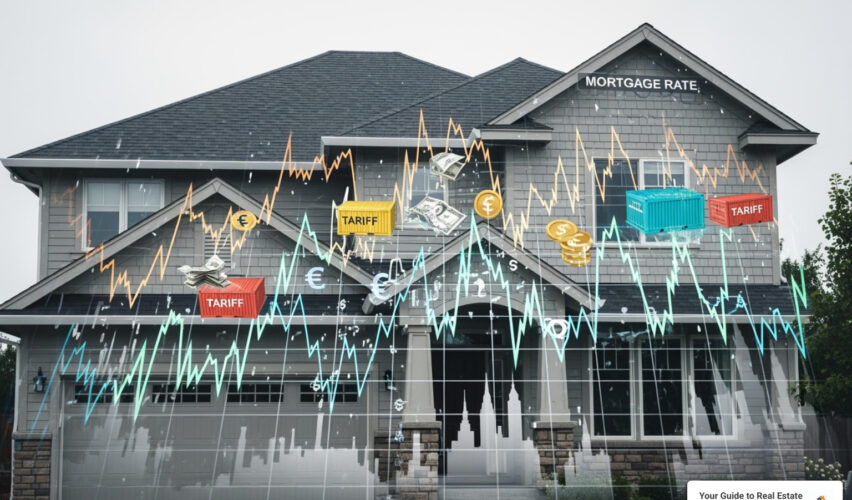
Mortgage rates tariffs are creating unprecedented volatility in the housing market, directly impacting what you’ll pay for your home loan. When governments impose tariffs on imported goods, they trigger a chain reaction that flows through financial markets and ultimately affects the interest rate on your mortgage.
Here’s what you need to know about mortgage rates and tariffs:
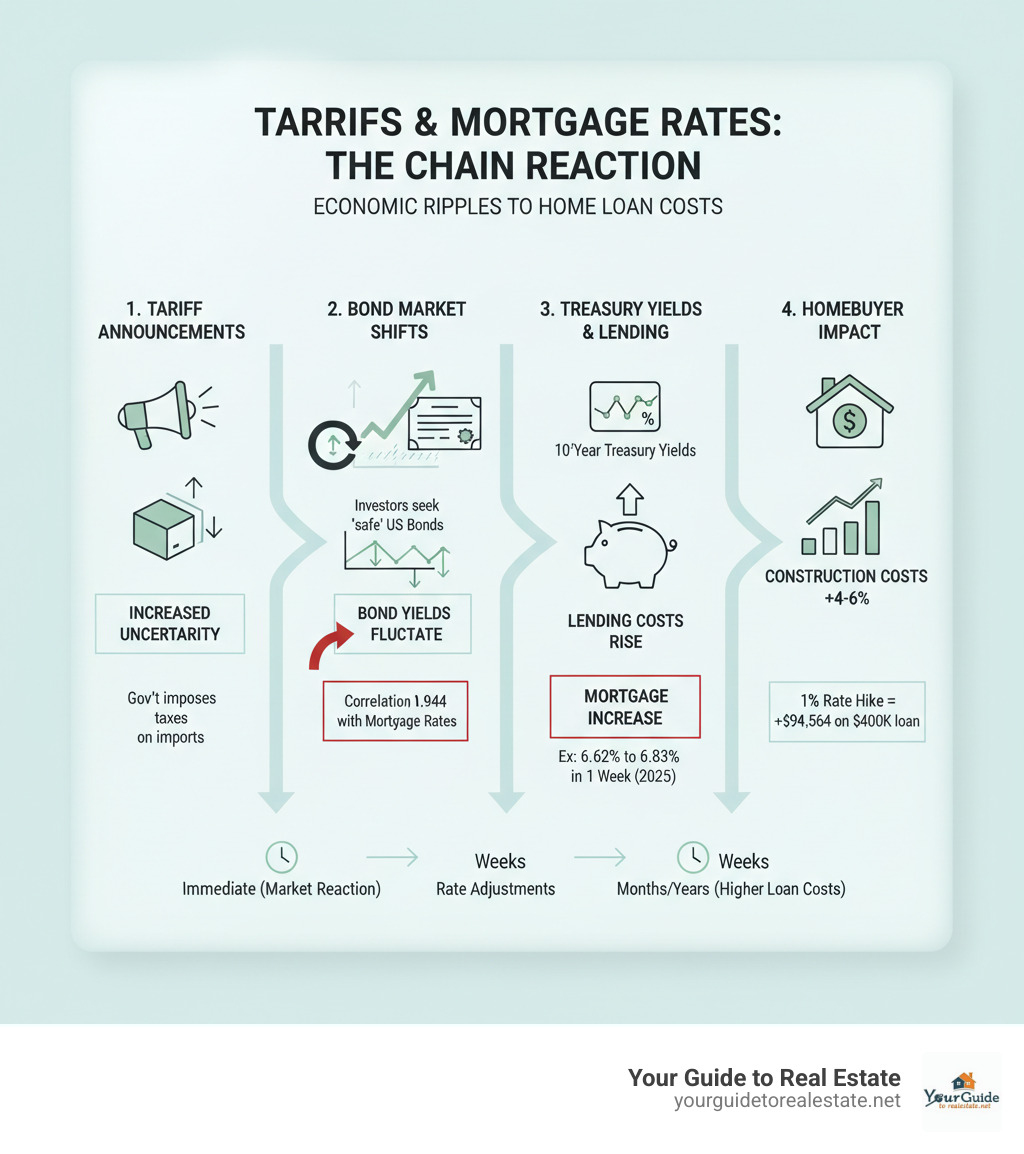
- Tariffs create economic uncertainty → Investors seek safer investments like government bonds
- Bond yields fluctuate → Mortgage rates follow these movements closely (correlation of .944)
- Current impact: 30-year mortgage rates jumped from 6.62% to 6.83% in one week following recent tariff announcements
- Construction costs rise: Existing tariffs already increase new-home building costs by 4-6%
- Your wallet feels it: A 1% rate increase adds roughly $94,564 to a typical 30-year mortgage
The connection isn’t obvious at first glance. After all, tariffs are taxes on imported goods – what do they have to do with your mortgage?
The answer lies in market psychology and economics. When President Trump announced sweeping tariffs in 2025, including a blanket 10% tariff on all imports and additional taxes on 60 other countries, the stock market experienced its worst week since the 2020 pandemic crash. This uncertainty sent investors scrambling for safer assets, causing wild swings in Treasury yields – the benchmark that mortgage rates track.
As one mortgage professional put it: “We could see 10% mortgage rates with what’s going on here.”
For homebuyers, this means navigating a market where your interest rate can change dramatically based on trade policy announcements. The Tax Foundation estimates these tariffs will raise taxes by $1.2 trillion, with an average household paying about $830 more per year.
Mortgage rates tariffs basics:
The Link Between Tariffs, Treasury Yields, and Your Mortgage
Let’s be honest – when economists start talking about Treasury yields and bond markets, most of us want to tune out. But here’s the thing: understanding this connection could save you thousands on your mortgage. The relationship between government tariffs, 10-year Treasury yield, and your mortgage rate isn’t just academic theory – it’s the reason your dream home might cost more next month than it does today.
Think of U.S. Treasury bonds as the financial world’s comfort food. When investors get nervous about the economy, they flock to these government-backed investments like we reach for our favorite blanket during a storm. This flight to safety can initially push Treasury yields down as demand increases.
But here’s where tariffs complicate things. While investors might seek safety in bonds, tariffs also spark inflation fears. When everything from lumber to electronics costs more due to import taxes, investors worry about their money losing purchasing power. They start demanding higher returns to compensate, which drives Treasury yields back up.
This tug-of-war creates the kind of market volatility that makes mortgage lenders nervous. And when lenders get nervous, rates go up.
The bond market reaction happens fast. On April 9th this year, the 10-year Treasury yield jumped over 50 basis points (that’s 0.5%) in a single day, hitting 4.5%. The immediate culprit of this spike was investor concerns over President Trump’s “Liberation Day” tariffs. That’s how quickly trade policy can hit your wallet.
For a deeper understanding of how these forces shape your borrowing costs, check out our guide on Understanding Mortgage Rates.
How Tariffs Create Market Uncertainty
Tariffs sound simple enough – they’re just taxes on stuff we import from other countries. But their ripple effects through the economy are anything but simple.
President Trump’s recent blanket tariffs – a 10% tax on all imported goods plus additional taxes on specific country tariffs targeting 60 nations – sent shockwaves through Wall Street. The stock market reaction was swift and brutal. Last week saw the worst week for U.S. stocks since the 2020 pandemic crash.
The numbers tell the story of widespread investor anxiety: the Dow plunged 2,000 points in a single Friday, the S&P 500 dropped 6%, and the Nasdaq fell nearly 6%. When markets move this dramatically, it’s not just about stock prices – it’s about fundamental uncertainty over where the economy is heading.
The Tax Foundation estimates these tariffs will cause economic output reduction of 0.4% while raising taxes by $1.2 trillion. That translates to about $830 more in taxes for the average household this year. When businesses face higher costs for raw materials and components, they pass those costs along to consumers. Other countries often retaliate with their own tariffs, creating a cycle that makes everyone poorer.
This uncertainty doesn’t stay confined to trade policy. It spreads through every corner of the economy, affecting everything from job security to consumer spending – and yes, the cost of borrowing money for your home.
Why Treasury Yields Matter for Mortgages
Here’s where the rubber meets the road for homebuyers. The historical correlation between the 10-year Treasury yield and 30-year mortgage rates is remarkable: a statistical correlation .944. In plain English, they move together almost perfectly.
Why such a tight relationship? Mortgage lenders use the 10-year Treasury as their mortgage rate benchmark. It’s like the foundation they build your rate on top of. The Treasury yield reflects what investors think will happen with inflation and economic growth over the next decade – exactly the timeframe that matters for a 30-year mortgage.
Traditionally, mortgage rates run about 1.7 to 2 percentage points higher than the 10-year Treasury yield. This difference covers the lender’s costs, profit, and the extra risks that come with home loans. But lately, this spread widening has stretched to 3 percentage points or more. That means even when Treasury yields hold steady, your mortgage rate can still climb.
When mortgage rates tariffs create market turmoil and inflation worries, Treasury yields spike upward. Your mortgage rate follows right behind. Understanding this connection helps you time your home purchase or refinance better.
For more insights into what drives these rate changes, take a look at our article on Why Are Mortgage Rates Going Up?. The more you understand these market forces, the better equipped you’ll be to steer them successfully.
How Trump’s Tariffs Are Affecting Mortgage Rates and the Housing Market
When we talk about mortgage rates tariffs, we’re really talking about how trade policies are changing what it costs to buy or build a home in America. The effects are hitting homebuyers, builders, and entire communities from coast to coast, and understanding these changes can help you make smarter decisions about your real estate future.
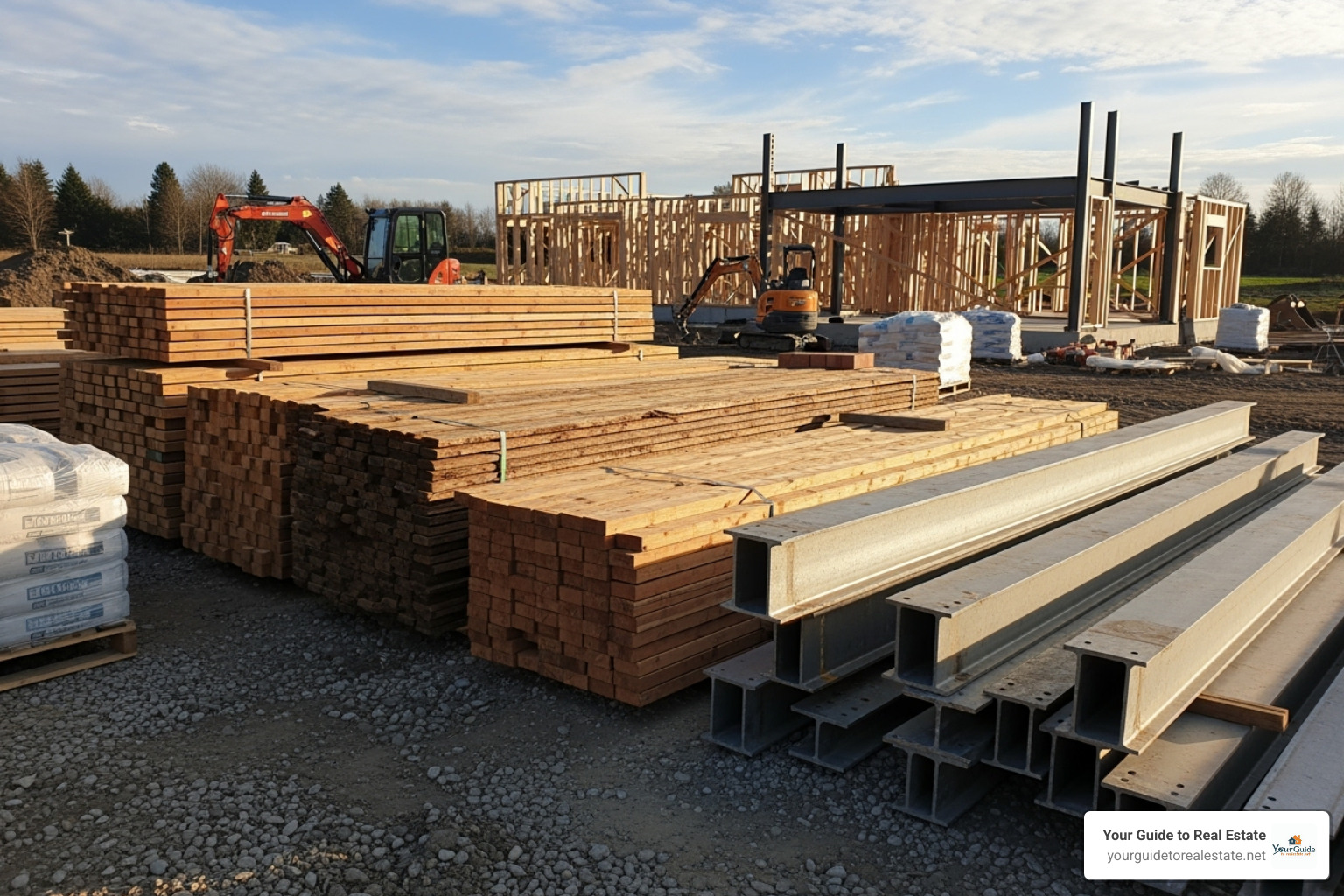
Think about what goes into building a house: steel for the frame, aluminum for windows, lumber for structure, and countless other materials. Many of these components are imported, and tariffs make them more expensive. We’re already seeing existing tariffs push new-home construction costs up by 4% to 6%. That might not sound like much, but on a $400,000 home, it means an extra $16,000 to $24,000 in building costs.
This creates a domino effect. Builders either absorb these costs (reducing their profits) or pass them on to buyers (making homes less affordable). Either way, fewer homes get built, and the ones that do cost more. It’s a challenge that affects everyone looking to buy, whether you’re shopping for your first home or your forever home. Our guide on How Much Does It Cost to Build a House? breaks down these costs in detail.
Immediate Impact of Tariffs on Mortgage Rates
The story of how mortgage rates tariffs played out in recent weeks reads like a financial thriller with unexpected twists. When major tariff announcements hit the news, something interesting happened: mortgage rates actually dropped at first.
On April 3rd, just one day after a significant tariff announcement, the 30-year fixed-rate mortgage was 6.64% – a tiny decrease from the week before. This happened because worried investors rushed to buy U.S. Treasury bonds, seeking safety in uncertain times. When bond demand goes up, yields go down, and mortgage rates follow.
But this relief didn’t last long. Economic reality set in quickly. By the week ending April 17th, the average 30-year fixed mortgage rate had jumped to 6.83%, up from 6.62% just one week earlier. This was the biggest one-week rate increase in nearly a year, according to the Federal Home Loan Mortgage Corporation.
The lesson here? While tariffs might briefly create a “flight to safety” that temporarily lowers rates, the bigger picture of inflation fears and economic uncertainty usually wins out. This volatility makes timing crucial for homebuyers – what seems like a good rate today might look very different next week.
Housing Market Response to Volatility
Despite rising rates, the housing market has surprised many experts with its resilience. We’ve seen some fascinating – and sometimes contradictory – trends emerge.
Mortgage applications surged as buyers tried to lock in rates before they climbed higher. The Mortgage Bankers Association (MBA) reported that applications jumped 20% from the prior week, reaching the highest level since September 2024.
This increase becomes even more interesting when you compare it to last year. At this time in 2024, rates had hit 7.1%, and purchase demand was 13% lower than today’s levels. This suggests there’s strong underlying demand in the market, possibly driven by more homes becoming available.
Inventory is finally improving. March saw a 10% annual increase in new listings, with active listings up roughly 28% year over year. After years of tight inventory, this gives buyers more choices – though it also means more competition among sellers.
However, the story isn’t all positive. Pending sales fell 5.2% from last March in the nation’s largest metropolitan areas. While more homes are listed, higher rates and affordability challenges are still making it harder for buyers to actually close deals. For a complete picture of these market dynamics, check out our U.S. Housing Market Update 2025: Prices, Inventory, and Buyer Behavior.
Broader Economic Effects of Mortgage Rates & Tariffs
The broader impact of mortgage rates tariffs extends far beyond individual mortgage payments. We’re seeing effects that touch every aspect of homeownership and the overall economy.
Construction costs are climbing due to tariffs on building materials. The 4% to 6% increase in new-home construction costs might seem modest, but it adds up quickly. This makes new homes more expensive and contributes to the overall affordability crisis many Americans face.
Household budgets are getting squeezed from multiple directions. The Tax Foundation estimates that recent tariffs will reduce economic output by 0.4% and raise taxes by $1.2 trillion. This translates to an average tax increase of about $830 per U.S. household this year – money that could otherwise go toward a down payment or monthly mortgage payments.
The affordability numbers are sobering. Roughly 70% of U.S. households – about 94 million families – cannot afford a $400,000 home. The national median existing home price was $398,400 in February, up 3.8% from last year. Prospective homebuyers now need an annual household income of nearly $117,000 to afford a typical home in the U.S.
Even for more modest homes, the requirements are steep. For a $200,000 home at a 6.5% mortgage rate, the minimum required income is $61,487. This puts homeownership out of reach for many working families.
The math on rate increases is particularly painful. A 1% increase in the Annual Percentage Yield (APY) on a mortgage adds $94,564 to the total cost of a typical 30-year mortgage – a 10.5% increase. This can turn an affordable monthly payment into an impossible one, pushing homeownership further out of reach for many families.
These challenges can feel overwhelming, but understanding them is the first step toward navigating them successfully. At Your Guide to Real Estate, we believe that with the right information and proven strategies, everyone can find their path to successful homeownership, even in challenging market conditions. For more insights on current market projections, explore our Real Estate Market Projections for 2025: Key Numbers to Watch.
Expert Forecasts and Official Statements
When the market gets turbulent, we naturally look to the experts and those in power for guidance. The discussions around mortgage rates tariffs are no exception, with economists offering varied predictions and political figures weighing in on interest rate policy.

The uncertainty surrounding tariffs and their economic impact has prompted a wide range of responses from financial experts and policymakers. While some see potential for dramatic rate increases, others predict more measured changes based on historical patterns and Federal Reserve policy.
What Economists Predict for Future Mortgage Rates & Tariffs
The economic community largely agrees that tariffs create significant uncertainty, but their predictions for mortgage rates vary dramatically. Laurence Kotlikoff, a professor of economics at Boston University, paints perhaps the starkest picture. He believes the uncertainty and recession risk could push mortgage rates as high as 10%. This sobering prediction stems from the inflationary pressures tariffs create and the heightened risk investors perceive in an unstable market.
However, other economists take a more nuanced view. The Mortgage Bankers Association (MBA) economists Mike Fratantoni and Joel Kan noted in their March forecast on MBA’s website that “slower growth and heightened uncertainty are likely to drag on housing market activity.” They observed how mortgage rates had already declined from over 7% in January to as low as 6.5% in February, marking the “lowest levels of 2025” at that time.
The key factor driving these predictions is inflation. Tariffs naturally push prices higher by increasing the cost of imported goods. If inflation climbs too aggressively, the Federal Reserve might need to raise interest rates to cool the economy. This would create a domino effect, pushing mortgage rates even higher.
What makes tariff-induced inflation particularly challenging is that it can create slower economic growth alongside rising prices – a difficult combination that’s harder for policymakers to address than typical inflation patterns.
What President Trump Has Said
President Trump has been remarkably vocal about connecting his tariff policies to interest rate expectations. He consistently frames tariffs as beneficial for the U.S. economy and argues they should be paired with lower interest rates to maintain affordability for American consumers.
His Truth Social posts reveal a clear pattern of thinking. On February 12th, he wrote: “Interest Rates should be lowered, something which would go hand in hand with upcoming Tariffs!!!” This direct connection between trade policy and monetary policy shows how he views these economic tools as working together.
As market volatility increased following tariff announcements, his calls for Federal Reserve action became more urgent. On April 7th, he specifically addressed mortgage costs, stating that “the slow moving Fed should cut rates”. Three days earlier, he had posted: “This would be a perfect time for Fed Chairman Jerome Powell to cut Interest Rates. He is always ‘late,’ but he could now change his image, and quickly.”
His frustration with Fed policy became even more apparent when he concluded with a direct appeal: “Cut interest rates, Jerome, and stop playing politics!” These statements reflect his belief that the Federal Reserve should actively support his economic policies through lower borrowing costs.
Advice for Homebuyers in a Volatile Market
Navigating today’s real estate landscape with fluctuating mortgage rates tariffs and economic uncertainty can feel overwhelming. Think of it like trying to hit a moving target while riding a roller coaster – challenging, but not impossible with the right strategy.
The most important thing is staying flexible and informed. Economic news, especially trade policy announcements and inflation reports, can trigger sudden rate changes. Following these developments helps you anticipate potential shifts rather than being caught off guard.
Don’t let market noise paralyze your decision-making. If you’re seriously considering buying a home, especially in competitive markets like Dallas or Oklahoma City, waiting indefinitely for “perfect” conditions rarely pays off. Some experts suggest current rates might be the lowest we see for quite some time if predictions of future increases prove accurate.
Rate locks become crucial in volatile times. If you find a rate you’re comfortable with and you’re close to making an offer, strongly consider locking it in. This protects you from sudden spikes caused by unexpected tariff announcements or other economic surprises.
Understanding your loan’s total cost matters more than ever. Don’t focus solely on monthly payments. A 1% increase in Annual Percentage Yield can add over $94,000 to a typical 30-year mortgage’s total cost. Use our Mortgage Calculator to grasp the long-term financial implications of different rate scenarios.
Local market research remains essential. While national trends influence everything, real estate stays fundamentally local. A strong regional economy might buffer some national volatility, making your local market more stable than headlines suggest.
Existing homeowners shouldn’t overlook refinancing opportunities. If you purchased in the last year or two at a higher rate, watch for significant rate dips. Even temporary drops could present chances to refinance and reduce monthly payments.
Professional guidance becomes invaluable during uncertain times. Our team at Your Guide to Real Estate specializes in providing stress-free guidance through market complexities. We help assess your mortgage situation, understand your options, and develop strategies custom to current conditions. For comprehensive preparation, explore our First-Time Homebuyers Toolkit: Everything You Need to Know Before You Buy.
The key is staying informed without becoming paralyzed by information overload. Focus on what you can control – your financial preparation, market research, and working with trusted advisors who understand both national trends and local conditions. For additional strategies on securing favorable terms, check out our guide on How to Shop Mortgage.
Frequently Asked Questions about Mortgage Rates and Tariffs
We get it – the whole mortgage rates tariffs situation can feel like trying to solve a puzzle while someone keeps changing the pieces. Let’s clear up some of the most common questions we hear from homebuyers who are trying to make sense of it all.
Do tariffs always make mortgage rates go up?
Here’s where things get interesting – and a bit counterintuitive. Tariffs don’t always push mortgage rates up, at least not immediately. The relationship is more like a complicated dance than a straight march upward.
When tariffs are first announced, they create what economists call “economic uncertainty.” Think of it as the market getting spooked. Initially, this uncertainty can actually cause mortgage rates to dip slightly. Why? Because nervous investors often rush to buy safer investments like U.S. Treasury bonds. When more people want to buy these bonds, the yields (or returns) on them go down, and since mortgage rates follow Treasury yields so closely, your mortgage rate can actually drop temporarily.
We saw exactly this happen recently. Right after a major tariff announcement, the 30-year fixed rate briefly dipped to 6.64%. But here’s the catch – this relief usually doesn’t last long.
The real trouble starts when inflation fears kick in. Tariffs make imported goods more expensive, which can drive up prices across the economy. When investors worry about inflation eating away at their returns, they demand higher yields on bonds to compensate. This pushes Treasury yields up, and mortgage rates follow right along.
So while rates might dip initially before rising, the overall tendency is for tariffs to contribute to higher mortgage rates over time. It’s like a roller coaster that starts with a small dip before the big climb.
How much does a 1% rate increase really cost?
This question always makes people do a double-take when they see the real numbers. A 1% increase in your mortgage rate isn’t just a small bump – it’s a financial earthquake that ripples through your entire 30-year loan.
Let’s break it down with real numbers. Based on the average home purchase loan amount of $388,716 in 2024, a 1% increase in your Annual Percentage Yield (APY) would add $94,564 to the total cost of your 30-year mortgage. That’s not a typo – nearly $95,000 more over the life of your loan.
To put that in perspective, it represents a 10.5% increase in the total amount you’ll pay for your home. This is why even seemingly small fluctuations in mortgage rates tariffs can have such a profound impact on your long-term financial picture.
It’s not just about your monthly payment going up by a hundred dollars or so. It’s about paying an additional $95,000 over three decades. That’s a new car, a child’s college education, or a substantial retirement nest egg – all going to interest instead of staying in your pocket.
What is the best way to track mortgage rates?
Staying on top of mortgage rate movements doesn’t require a finance degree, but it does help to know where to look. The key is monitoring the right indicators and getting advice from people who understand how all the pieces fit together.
Start with the 10-year U.S. Treasury yield – this is your crystal ball for mortgage rate movements. .944 correlation we mentioned? It means when the 10-year Treasury yield moves, mortgage rates are usually right behind it. You can find real-time Treasury yield information on financial news websites and dedicated bond market trackers.
Follow the weekly reports from trusted sources like Freddie Mac and the Mortgage Bankers Association (MBA). Freddie Mac’s Primary Mortgage Market Survey comes out every Thursday and gives you the national average rates for different types of mortgages. The MBA releases weekly data on mortgage applications too, which can tell you whether other buyers are rushing to lock in rates or waiting on the sidelines.
But here’s the most important part: consult with a mortgage professional who can translate all this information into advice that actually applies to your situation. National averages are helpful, but your specific rate will depend on your credit score, down payment, loan type, and dozens of other factors.
At Your Guide to Real Estate, we help our clients understand not just what’s happening with rates today, but how broader economic factors like mortgage rates tariffs might affect their unique circumstances. We can help you time your purchase, understand when to lock in a rate, and steer all the decisions that come with buying a home in a volatile market.
The bottom line? Stay informed, but don’t try to time the market perfectly. Sometimes the best rate is the one you can get today when you’re ready to buy.
Conclusion
Understanding the relationship between mortgage rates tariffs and the housing market isn’t just about economic theory – it’s about your financial future and homeownership dreams. We’ve walked through how a trade policy announcement in Washington can ripple through Treasury markets and land squarely on your mortgage application within days.
The story we’ve told here is one of interconnected markets and real consequences. When President Trump announces tariffs, bond investors get nervous. When they get nervous, Treasury yields jump around like popcorn in a hot pan. And when those yields move, your mortgage rate follows along with that remarkable .944 correlation we discussed.
The numbers tell a compelling story. A 1% rate increase doesn’t just mean a slightly higher monthly payment – it means paying an extra $94,564 over the life of your loan. That’s a new car, a college education, or years of comfortable retirement savings. These aren’t abstract market movements; they’re real dollars that affect real families.
We’ve seen how construction costs rise with tariffs, making new homes more expensive. We’ve watched mortgage applications surge as buyers try to lock in rates before they climb higher. And we’ve heard from economists predicting everything from continued volatility to potential 10% mortgage rates.
But here’s what we want you to remember: markets are unpredictable, but knowledge is power. You don’t need to become an economics expert to steer these waters successfully. You need reliable information, sound advice, and a clear plan.
At Your Guide to Real Estate, we’ve built our reputation on helping people like you make sense of complex markets. Whether tariffs are pushing rates up or economic uncertainty is creating opportunities, we’re here to provide that proven framework and stress-free guidance you need. The housing market has weathered countless economic storms, and with the right support, you can too.
Your homeownership journey doesn’t have to wait for perfect market conditions – because those rarely exist. What matters is having the tools and knowledge to make informed decisions, regardless of what’s happening with trade policies or Treasury yields.
Ready to take the next step? Start building your foundation with our comprehensive guide: Understanding Mortgages: A Beginner’s Guide to Home Loans. Your dream home is waiting, and we’re here to help you reach it.