

Lower Your Monthly Payments Without Refinancing
A mortgage recast calculator is a financial tool that helps you determine how much you can save by making a lump-sum payment toward your mortgage principal. This calculator shows your new monthly payment and total interest savings after your lender re-amortizes your loan.
Key Information About Mortgage Recast Calculators:
- Purpose: Calculate new monthly payments after a large principal payment
- Required inputs: Current loan balance, interest rate, remaining term, lump-sum amount
- Main benefit: Lower monthly payments without changing your interest rate or loan term
- Cost: Typically $250-$500 in processing fees vs. thousands in refinancing costs
- Process time: 2-5 business days vs. 30-45 days for refinancing
Mortgage recasting, also known as reamortization, works by applying your lump-sum payment directly to your principal balance. Your lender then recalculates your monthly payments based on the lower remaining balance while keeping your original interest rate and payoff date unchanged.
This strategy can be especially valuable when you receive an inheritance, work bonus, or proceeds from selling an asset. Unlike refinancing, recasting doesn’t require a credit check, income verification, or appraisal – making it a simpler way to reduce your monthly housing costs.
However, not all loans qualify for recasting. Government-backed loans like FHA, VA, and USDA mortgages typically don’t allow this option, and some lenders have minimum payment requirements ranging from $5,000 to $10,000.
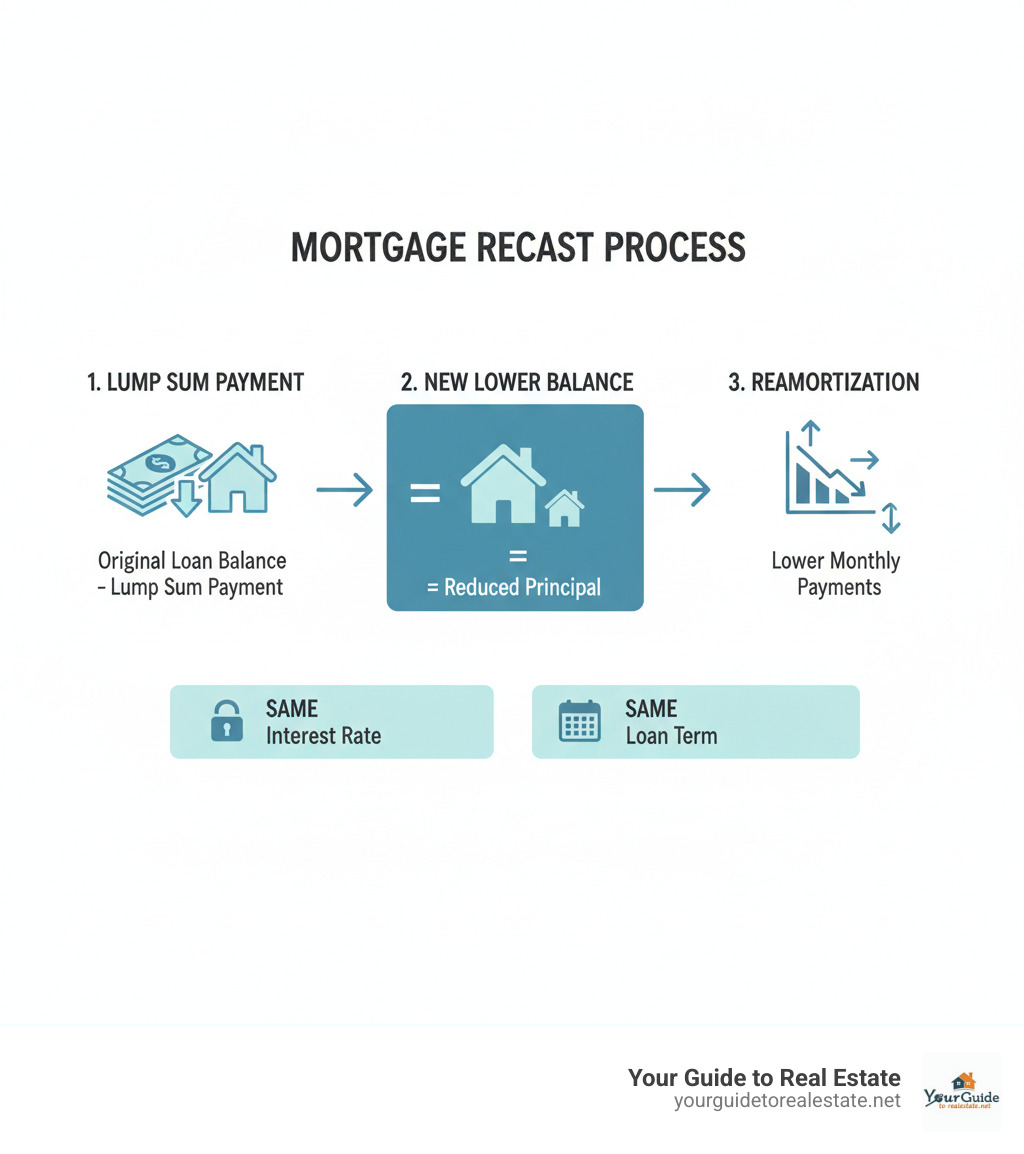
Mortgage recast calculator vocab explained:
How to Use a Mortgage Recast Calculator to See Your Savings
![IMAGE of a mortgage recast calculator interface showing input fields]
Picture this: you’ve just received a nice bonus at work or maybe an inheritance, and you’re wondering how much it could actually help with your mortgage payments. That’s exactly where a mortgage recast calculator becomes your best friend! This handy tool takes the guesswork out of deciding whether to make a large principal payment on your home loan.
When you use a mortgage recast calculator, you’ll find three key benefits that can transform your financial picture. First, you’ll see exactly how much your monthly payment reduction will be – and trust us, those savings can be substantial. Second, you’ll uncover the interest savings over your loan’s lifetime, which often reaches into the thousands. Finally, you’ll get a clear view of how your amortization schedule changes, showing you the real impact on your financial future.
Think of this calculator as your personal financial planning tool that gives you the power to make informed decisions about your mortgage. It’s like having a crystal ball that shows you exactly what your payments will look like after making that lump-sum payment. For a deeper dive into how mortgages work in general, our Understanding Mortgages: A Beginner’s Guide to Home Loans is a great place to start.
Step 1: Gather Your Current Loan Information
Before you can work any magic with a mortgage recast calculator, you’ll need to gather some basic information about your current mortgage. Don’t worry – this isn’t as complicated as it sounds! Think of it like collecting ingredients before cooking your favorite meal.
The most important piece you’ll need is your current principal balance. This is simply how much you still owe on your mortgage right now. You can find this number on your latest mortgage statement or by logging into your lender’s online portal. Next, you’ll need your annual interest rate – the percentage your lender charges you for borrowing the money.
You’ll also want to know your remaining loan term, which tells you how many years and months are left until your mortgage is completely paid off. This matters because recasting keeps your original payoff date unchanged. Finally, grab your current monthly payment for principal and interest only. This doesn’t include escrow payments for taxes and insurance – just the amount that goes toward paying down your loan.
Understanding what principal means in your loan payments is crucial for grasping how recasting works. The Consumer Financial Protection Bureau explains this concept clearly in their guide about the difference between principal and interest payments.
Step 2: Determine Your Lump-Sum Principal Payment
Here’s where things get exciting! The heart of mortgage recasting is making a significant lump-sum principal payment that triggers lower monthly payments going forward. This payment becomes the catalyst for reducing your future financial burden.
So where might this lump sum come from? We’ve seen homeowners use money from various sources with great success. An inheritance from a loved one can provide a meaningful opportunity to reduce debt. Many people strategically apply their annual bonus from work directly to their mortgage principal. Others use proceeds from the sale of an asset like a second property, vehicle, or investment. Some homeowners simply use accumulated savings they’ve set aside specifically for this purpose.
Most lenders require a minimum payment to initiate a recast, typically ranging from $5,000 to $10,000. This isn’t just an extra payment – it’s a strategic financial move that formally reduces your outstanding loan balance and resets your entire payment schedule. To better understand how mortgage payments work in general, check out our Mortgage Payment Calculator – Complete Guide.
Step 3: Input Your Data into the Mortgage Recast Calculator
Now comes the fun part – putting your mortgage recast calculator to work! Using an online tool is typically straightforward, but the results can be truly eye-opening. You’ll find input fields designed to capture all the information you’ve gathered.
Entering your variables is usually as simple as filling in a few boxes. You’ll input your current principal balance, annual interest rate, current monthly payment, your planned lump-sum amount, and remaining loan term. Most calculators are designed to be user-friendly, so don’t worry if you’re not a math whiz.
Many calculators also allow for simulating different scenarios, which can be incredibly valuable. You might want to see what happens if you put down $20,000 versus $30,000, or compare the impact of different lump-sum amounts. This flexibility helps you find the sweet spot that works best for your financial situation.
Key inputs for a mortgage recast calculator include your current loan balance before the payment, your existing interest rate, your current principal and interest payment, the lump sum you’re considering, and how much time remains on your original mortgage term.
Step 4: Analyze Your New Payment and Total Savings
This is the moment you’ve been waiting for! After you input your information, the mortgage recast calculator reveals the financial impact of your lump-sum payment. The results often surprise homeowners with just how significant the benefits can be.
Your new monthly payment will be the first thing that catches your attention. We’ve seen examples where a $50,000 lump-sum payment on a $200,000 mortgage drops monthly payments by hundreds of dollars. Imagine having that extra breathing room in your monthly budget!
The total interest savings over your loan’s lifetime can be equally impressive. Even though recasting doesn’t change your interest rate, you’ll pay interest on a much smaller principal balance for the rest of your loan term. This often translates to thousands or even tens of thousands of dollars in savings. One scenario we analyzed showed total interest savings of over $16,000!
Comparing before and after scenarios helps you visualize the real impact on your cash flow. That lower monthly payment directly improves your household’s financial flexibility, freeing up money for savings, investments, or other financial goals. The calculator typically shows your original payment and total interest side-by-side with the recast figures, making the benefits crystal clear.
Your amortization schedule changes in a positive way too. While your loan term stays the same, the re-amortization creates a new payment schedule based on your reduced principal balance. This means more of each future payment goes toward principal rather than interest, helping you build equity faster than you would have otherwise.
Recasting vs. Refinancing: Which Path Is Right for You?
Picture yourself standing at a fork in the road, with two promising paths stretching ahead. One sign points toward “Recast” while the other beckons you toward “Refinance.” Both routes promise to improve your mortgage situation, but they’ll take you on completely different journeys to get there.

Here’s the fundamental difference that changes everything: recasting works with your existing loan, while refinancing replaces it entirely with a brand new one. It’s like the difference between renovating your current home versus selling it and buying a different house altogether.
This core distinction ripples through every aspect of the process. Recasting keeps your original interest rate and loan term while simply recalculating your payments based on a lower principal balance. Refinancing, on the other hand, opens the door to changing your interest rate, loan term, and even accessing your home’s equity – but it comes with the full weight of a new loan application.
Understanding when each option makes sense can save you thousands of dollars and countless hours of paperwork. For a deeper dive into the refinancing process, our Mortgage Refinancing Explained guide covers all the details.
| Feature | Mortgage Recasting | Mortgage Refinancing |
|---|---|---|
| Cost | Low processing fees, typically a few hundred dollars ($250-$500). | Significant closing costs, usually 2-6% of the loan amount. According to the Federal Reserve Board, consumers normally spend around 3 to 6 percent of their outstanding mortgage balance on refinancing. |
| Process Time | Quick, typically 2-5 business days. | Longer, usually 30-45 days. |
| Interest Rate | Remains the same as your original loan. | Can change, potentially lower or higher depending on market rates. |
| Loan Term | Remains the same as your original loan. | Can change, often shortened to 15 or 20 years, or extended. |
| Credit Check | Generally not required, as it’s not a new loan. | Required, as it’s a new loan application. |
| Income Verify. | Generally not required. | Required. |
| Appraisal | Generally not required. | Often required. |
| Eligibility | Typically for conventional loans; government-backed (FHA, VA, USDA) and some jumbo loans usually not eligible. | Widely available for many loan types, including FHA, VA, USDA, and conventional. |
| Lump Sum Req. | Requires a significant lump-sum payment towards principal ($5,000-$10,000 minimum). | Does not require a lump-sum payment (though you can pay down principal at closing). |
| Primary Goal | Lower monthly payments and save interest without changing original loan terms or rate. | Secure a lower interest rate, change loan terms, or access home equity. |
When to Recast Your Mortgage
Think of recasting as the “if it ain’t broke, don’t fix it” approach to mortgage management. You’re essentially saying, “I like my current loan terms, but I’d love to pay less each month.”
The sweet spot for recasting happens when you’re sitting pretty with a low interest rate that you locked in during better times. Maybe you secured a 3% rate a few years back, and today’s rates are hovering around 6% or 7%. Why would you trade that golden rate for something higher?
Rising or stable interest rate environments make recasting particularly attractive. When rates are climbing or holding steady, your existing rate becomes more valuable by the day. A mortgage recast calculator can show you exactly how much you’ll save by keeping that rate while lowering your payments.
The simplicity factor can’t be overstated either. Recasting feels like ordering takeout compared to cooking a five-course meal from scratch. No credit checks, no income verification, no appraisal appointments – just a straightforward process that typically wraps up in less than a week.
Avoiding closing costs is another major win. While refinancing can cost you thousands in closing costs, recasting typically runs just a few hundred dollars in processing fees. That’s money that stays in your pocket instead of going to lenders and title companies.
If your main goal is simply lowering your monthly payment after receiving a windfall like an inheritance, work bonus, or proceeds from selling another property, recasting hits the bullseye. You get immediate monthly relief without the complexity of restructuring your entire loan.
When to Refinance Your Mortgage
Refinancing shines when you want to fundamentally change your mortgage landscape, not just adjust the monthly payment. It’s the power tool in your financial toolkit when market conditions shift in your favor or your goals evolve.
The most compelling reason to refinance is when you can secure a significantly lower interest rate. If rates have dropped substantially since you got your original loan, the long-term savings can be massive – often tens of thousands of dollars over the life of the loan.
Many homeowners use refinancing to shorten their loan term, typically moving from a 30-year to a 15-year mortgage. Yes, your monthly payments might increase, but you’ll own your home outright much sooner and save an incredible amount on total interest.
Cash-out refinancing opens up another powerful possibility – tapping into your home’s equity for major expenses like renovations, education costs, or debt consolidation. Our Cash-Out Refinancing Explained guide walks you through this option in detail.
Sometimes life changes require loan changes too. Maybe you started with an adjustable-rate mortgage but now crave the stability of a fixed rate. Or perhaps your credit score has improved dramatically since you first bought your home, positioning you for much better terms.
The key is having a strong credit score and stable income to qualify for the best refinancing terms. If your financial profile has strengthened over the years, refinancing can be your reward for that improved creditworthiness.
The Mortgage Recasting Process: Requirements, Fees, and Steps
Now that you’ve run the numbers with a mortgage recast calculator and finded the potential savings, it’s time to turn those calculations into reality. The good news? The actual process is refreshingly straightforward – no mountains of paperwork, no lengthy approval periods, and no anxious waiting by the phone for underwriter decisions.
Think of mortgage recasting as the express lane of mortgage modifications. While refinancing feels like renovating your entire kitchen, recasting is more like swapping out a single appliance – quick, efficient, and surprisingly affordable.
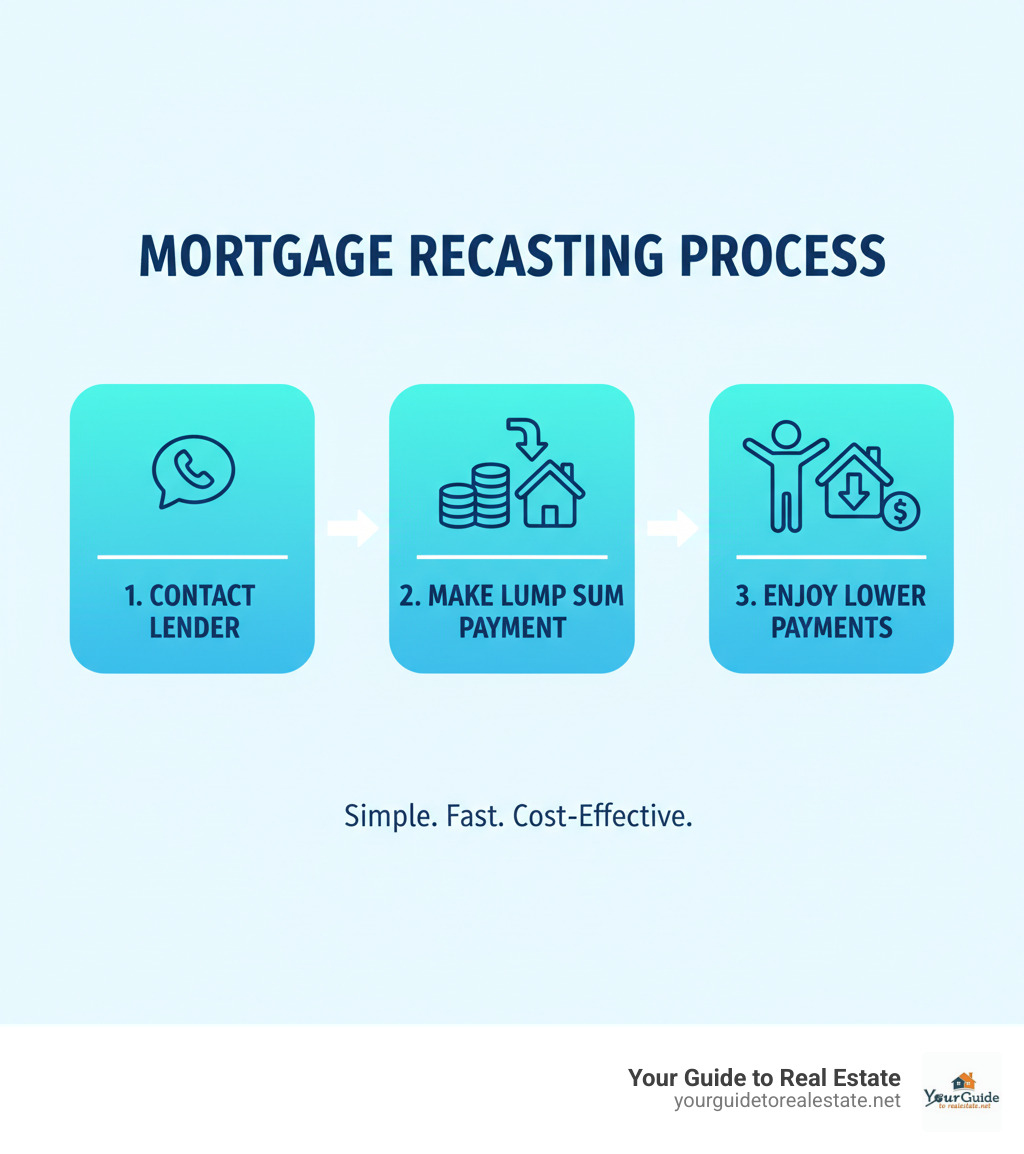
Step 5: Initiating the Recast with Your Lender
Your first move is contacting your loan servicer – and here’s where many homeowners get confused. Your loan servicer might not be the same company that originally gave you the mortgage. Banks often sell mortgages to other companies, so the folks collecting your monthly payments are the ones with the power to process your recast.
When you make that initial call, you’ll want to confirm eligibility right away. Not all loans play nice with recasting. Conventional loans are usually perfect candidates, but government-backed loans like FHA, VA, and USDA typically don’t allow this option. Some jumbo loan restrictions also apply, so it’s worth asking specifically about your loan type.
Your servicer will explain their specific lender policies and walk you through their requirements. Most will ask for a written request to get the ball rolling – this creates a paper trail and ensures everyone’s on the same page about your intentions.
If you’re curious about why certain loan types have restrictions, our guide on FHA Loan Requirements explains how government-backed loans operate differently from conventional mortgages.
Understanding the Requirements and Fees
Here’s where recasting really shines compared to refinancing. The requirements are minimal, and the fees won’t make your wallet weep.
Your lender will require a minimum lump-sum payment to make recasting worthwhile – usually somewhere between $5,000 and $10,000. This isn’t pocket change, but it’s the catalyst that triggers your lower monthly payments. The exact minimum varies by lender, so ask about their specific threshold.
The processing fees are beautifully simple – typically ranging from $250 to $500. Compare that to refinancing costs that can run into thousands of dollars, and you’ll appreciate this straightforward approach. This fee covers the administrative work of re-amortizing your loan and updating your payment schedule.
What you won’t need is equally important. There’s no appraisal needed because you’re not getting a new loan – you’re simply modifying your existing one. Your home’s current value doesn’t matter for this process. Similarly, there’s no credit check or income verification required. Your financial situation today isn’t under scrutiny because you’re not asking for new credit.
The entire process typically wraps up in just 2-5 business days once you submit your lump-sum payment. It’s remarkably fast compared to the lengthy timeline of other mortgage processes. To understand how this compares to other mortgage procedures, check out our comprehensive Loan Process for Buying a House guide.
This simplicity and speed make recasting an attractive option for homeowners who want immediate results without the complexity of a full refinance.
Frequently Asked Questions about Mortgage Recasting
We get it – mortgage recasting is one of those financial strategies that sounds almost too good to be true. That’s why we love answering your questions! At Your Guide to Real Estate, we believe that understanding your options completely is the key to making confident financial decisions. Let’s explore the most common questions homeowners ask about using a mortgage recast calculator and the recasting process itself.
Does recasting a mortgage shorten the loan term?
Here’s where things get interesting, and honestly, a bit counterintuitive. No, recasting a mortgage does not shorten your loan term. Your original payoff date stays exactly the same, which often surprises people.
Think of it this way: when you recast your mortgage, you’re essentially giving your loan a makeover, not a complete change. You make that big lump-sum payment toward your principal, and your lender takes this new, lower balance and re-amortizes it over your remaining loan term. They’re basically saying, “Okay, you now owe less money, but we’re still spreading those payments over the same time period.”
The magic happens in your monthly payment, not your payoff timeline. Instead of paying off your home faster, you’re freeing up cash flow each month. It’s like choosing to carry a lighter backpack on the same hiking trail – you’re still covering the same distance, but the journey becomes much more comfortable.
This focus on payment reduction rather than loan acceleration is what makes recasting perfect for homeowners who want breathing room in their monthly budget while keeping their current interest rate and loan structure intact.
How many times can you recast a mortgage?
The short answer is that most lenders don’t put a hard limit on how many times you can recast your mortgage. Lender-specific policies vary quite a bit, though, so this isn’t a one-size-fits-all situation.
Some mortgage servicers are perfectly happy to let you recast whenever you have the funds and meet their minimum requirements. Others might have potential restrictions on frequency – perhaps allowing only one recast per year or requiring a waiting period between recasts.
The key is to check with your servicer before you start planning multiple recasts. They’ll give you the straight scoop on their specific rules. After all, if you’re fortunate enough to receive multiple windfalls or bonuses, you want to know exactly how you can use them to your advantage!
Will recasting my mortgage affect my credit score?
This is one of our favorite questions because the answer is so reassuring. No, recasting will not have a direct negative impact on your credit score. In fact, it might even help it!
Here’s why: recasting doesn’t involve a new credit inquiry because you’re not applying for a new loan. You’re simply modifying your existing one. No credit check, no income verification, no financial scrutiny – just a straightforward adjustment to your current mortgage.
But here’s the bonus: that reduced loan balance you’ll have after your lump-sum payment can actually work in your favor. When credit agencies look at your debt-to-income ratio and overall debt load, they’ll see that lower mortgage balance. This can have a positive effect on your credit utilization and overall financial profile.
So not only are you lowering your monthly payments, but you’re also potentially strengthening your credit standing. It’s one of those rare financial moves where you get multiple benefits with virtually no downside!
Conclusion: Take Control of Your Mortgage Payments
You’ve made it to the finish line! We’ve walked through everything from understanding what a mortgage recast calculator can do for you to actually initiating the process with your lender. Think of this journey as building your financial toolkit – and now you have a powerful new tool that many homeowners don’t even know exists.
The beauty of mortgage recasting lies in its simplicity and effectiveness. When you use a mortgage recast calculator, you’re not just playing with numbers – you’re mapping out a path to improved cash flow that puts real money back in your pocket each month. We’ve seen homeowners save hundreds of dollars monthly, which adds up to thousands over the years.
The significant interest savings aspect often surprises people the most. By reducing your principal balance early, you’re essentially shrinking the mountain of interest you’ll pay over your loan’s lifetime. It’s like taking a shortcut that saves you both time and money, without actually shortening your loan term.
What makes recasting especially attractive is its simple and cost-effective process. No credit checks, no income verification, no appraisals – just a straightforward administrative adjustment that typically costs a few hundred dollars instead of thousands. Compare that to refinancing, and the choice becomes crystal clear in many situations.
Perhaps most importantly, recasting preserves your existing interest rate. If you locked in a great rate years ago, you get to keep that advantage while still enjoying lower monthly payments. It’s like having your cake and eating it too!
At Your Guide to Real Estate, we believe knowledge is power, especially when it comes to homeownership decisions. Taking control of your mortgage payments isn’t just about saving money – it’s about creating financial breathing room that can transform your entire budget and peace of mind.
Whether you decide to move forward with recasting or explore other options, you’re now equipped with the knowledge to make an informed choice. For a deeper dive into mortgage fundamentals, don’t miss our comprehensive Understanding Mortgages: A Beginner’s Guide to Home Loans – it’s the perfect next step in your real estate education journey.