
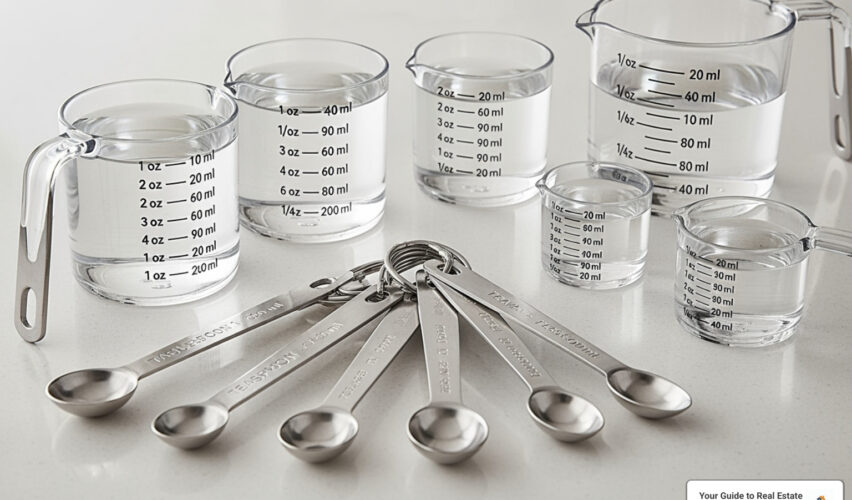
Why Knowing How Many mLs in an Ounce Matters
How many mLs in an ounce is a question that comes up more often than you might think—whether you’re following a recipe, measuring paint for a home renovation project, or calculating liquid volumes for property maintenance tasks.
Quick Answer:
- 1 US fluid ounce = 29.5735 milliliters (ml)
- 1 Imperial fluid ounce = 28.4131 ml (used in the UK)
- Common approximation: 1 fl oz ≈ 30 ml (fine for most everyday uses)
Here’s the simple truth: fluid ounces and milliliters measure volume, not weight. The US uses fluid ounces while most of the world uses the metric system with milliliters. This difference can cause confusion when you’re working with measurements—especially if you’re dealing with international suppliers, following recipes from different countries, or converting specifications for home improvement projects.
The conversion is straightforward once you know the basic formula. Multiply fluid ounces by 29.5735 to get milliliters. Or divide milliliters by 29.5735 to get fluid ounces.
This guide will walk you through everything you need to know about converting between these two units. You’ll learn the exact conversion rates, when to use precise numbers versus approximations, and the important difference between US and Imperial measurements. We’ll also provide a quick reference chart for the most common conversions you’ll encounter.
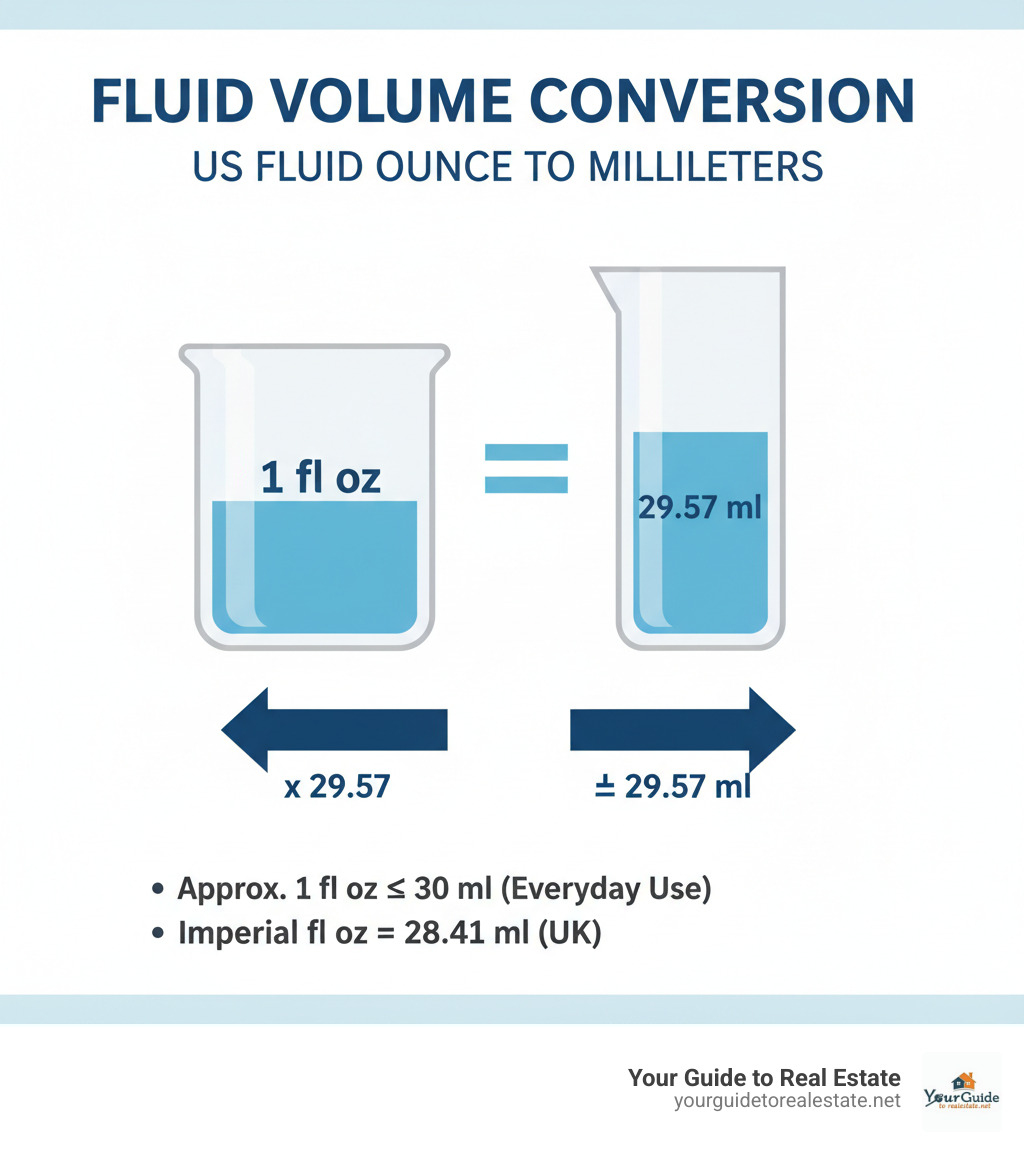
Key how many mls in an ounce vocabulary:
Understanding the Basic Units: Fluid Ounce vs. Milliliter
Before we dive deeper into how many mls in an ounce, let’s get clear on what these units actually mean. Both fluid ounces and milliliters measure volume—the amount of space a liquid takes up. But they come from completely different measurement systems, which is where things get interesting.
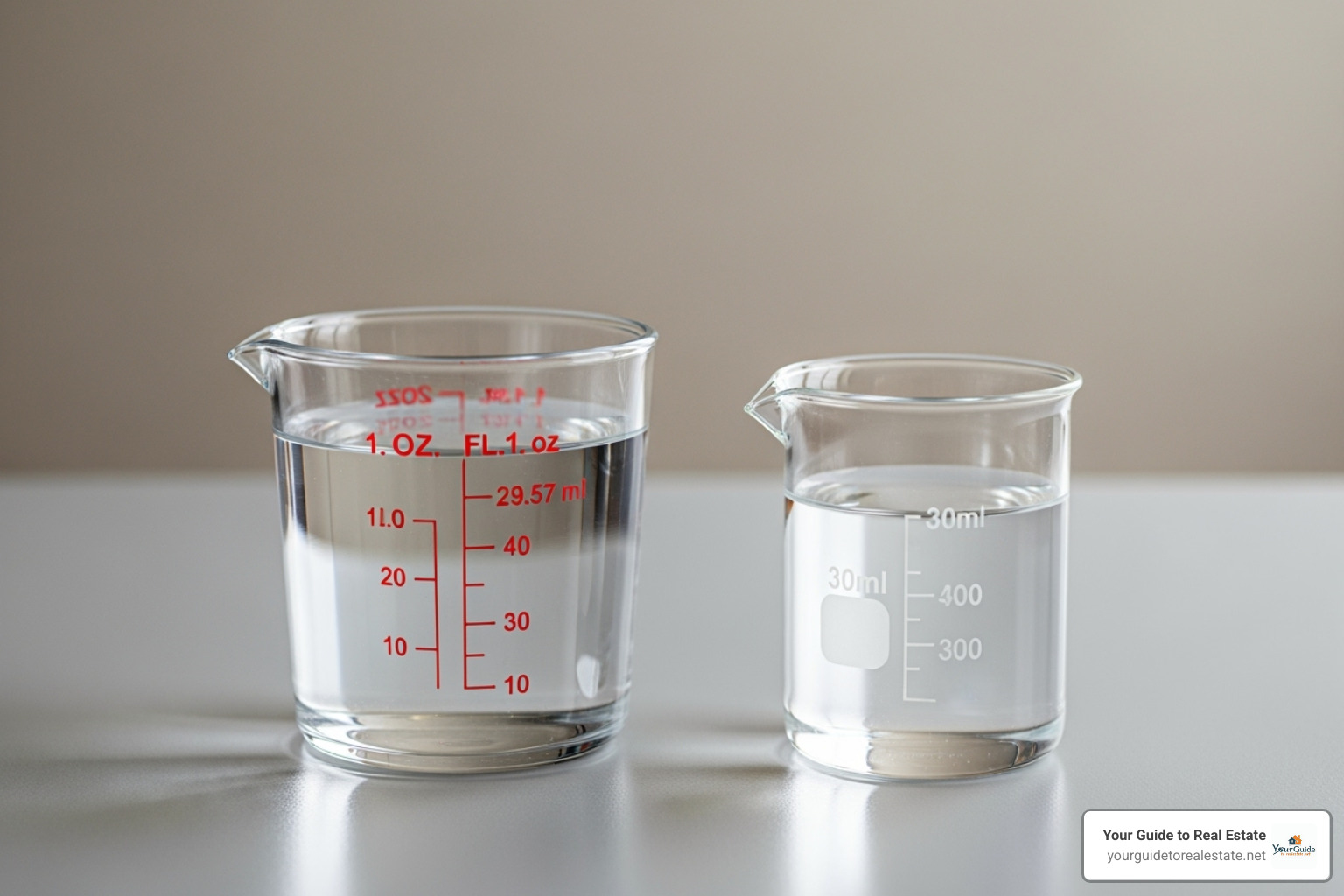
A fluid ounce (fl oz) is how we measure liquids in the United States and a few other countries. You’ll see it everywhere—on juice bottles, in cooking recipes, and even when you’re measuring cleaning products for home maintenance. It’s part of the US customary units system, which Americans use for everyday measurements.
Now here’s where it gets a bit tricky. There’s actually more than one type of fluid ounce. The US fluid ounce is slightly different from the Imperial fluid ounce used in the United Kingdom. The Imperial system was the measurement system used throughout the British Empire, and while most countries have switched to metric, you’ll still encounter Imperial measurements in some places. We’ll explore exactly how these differ in a later section.
On the flip side, a milliliter (ml or mL) belongs to the metric system—the decimal-based measurement system used by most of the world. The metric system makes conversions easy because everything is based on multiples of ten. A milliliter is one-thousandth of a liter, which is the base unit of volume in metric measurements. When you’re working with international suppliers, reading European recipes, or dealing with scientific measurements, you’ll be using milliliters.
Fluid Ounce (Volume) vs. Ounce (Weight)
Here’s something that confuses a lot of people: not all ounces are created equal. A fluid ounce measures volume (how much space something takes up), while a regular ounce measures weight (how heavy something is). Understanding this difference can save you from some serious measurement mistakes.
Think about it this way. A fluid ounce of water takes up a certain amount of space in your measuring cup. A fluid ounce of honey also takes up that same amount of space. But honey is denser than water, so that fluid ounce of honey actually weighs more than the fluid ounce of water. Same volume, different weight.
This matters a lot when you’re working with recipes or mixing products for home projects. Liquid ingredients like water, milk, oil, juice, or paint thinner are measured in fluid ounces (or milliliters). These are always volume measurements.
Dry ingredients like flour, sugar, or powdered cleaners are typically measured by weight in ounces or grams. This is especially important in baking, where precision matters. A cup of flour can weigh anywhere from 4 to 5 ounces depending on how you scoop it, which is why serious bakers prefer weighing ingredients.
You’ve probably heard of the avoirdupois ounce—that’s just the fancy name for the standard weight ounce we use for everyday items. It’s what your kitchen scale uses, and it’s what the post office uses to weigh your packages. It has nothing to do with fluid ounces.
And just to make things even more interesting, precious metals like gold use yet another type of ounce called a troy ounce. If you’re curious about that, check out our guide on how many grams in an ounce of gold.
The takeaway? When you see “ounce,” always ask yourself: are we talking about how much space it takes up, or how heavy it is?
What is a Milliliter (ml)?
The milliliter is your go-to metric unit of volume for measuring liquids. As we mentioned, it’s one-thousandth of a liter. To give you some perspective, a liter is just a bit more than a quart—about 33.8 US fluid ounces. So a milliliter is quite small, which makes it perfect when you need precision.
Here’s a cool fact that makes the metric system so practical: a milliliter is exactly the same as one cubic centimeter (cc). Picture a tiny cube where each side is one centimeter long. The space inside that cube equals one milliliter. This is why doctors and nurses often use “cc” and “ml” interchangeably when measuring medications. If your prescription says 5 cc, that means 5 ml.
This equivalence to cubic centimeter makes the metric system incredibly logical and easy to work with once you get the hang of it.
You’ll find milliliters used in so many places. In science and cooking, they’re the standard for liquid measurements. Medical dosages rely on milliliters because even tiny measurement errors can matter. International recipes almost always list liquids in milliliters. And when you’re buying beverages, cosmetics, or household products from around the world, the volume will be marked in milliliters.
For anyone working with international suppliers on property renovations or following recipes from different countries, understanding milliliters is essential. If you want to learn more about milliliter conversions and how this unit relates to others, this resource about the milliliter unit has all the details.
The Exact Answer to How Many mLs in an Ounce
Let’s cut straight to the heart of the matter: how many mLs in an ounce? If you’re working with US fluid ounces (which most Americans are), here’s the exact answer:
1 US fluid ounce = 29.5735296875 milliliters (ml)
That’s the precise number, though for most everyday situations, you’ll see this rounded to 29.57 ml or 29.6 ml—and honestly, that’s perfectly fine for most purposes.

This conversion factor is the key to switching between these two measurement systems. Once you know it, you can create two simple formulas that work for any amount.
The simple multiplication formula takes you from fluid ounces to milliliters: multiply the number of fluid ounces by 29.5735. So if you have 5 fluid ounces and need to know the milliliters, you’d calculate 5 × 29.5735 = 147.87 ml.
Going the other direction uses the simple division formula: divide milliliters by 29.5735 to get fluid ounces. Have 100 ml and need to know the fluid ounces? Just divide 100 ÷ 29.5735 = 3.38 fl oz.
The real question becomes: when should you use precise numbers versus approximate ones? It’s all about context. If you’re measuring medication for a child, calculating chemical concentrations for a pool, or working with any scientific or medical application, you absolutely need that precise conversion factor. In these situations, even tiny rounding errors can compound into significant problems.
But if you’re following a recipe for Sunday dinner, mixing a cleaning solution for your floors, or estimating how much paint thinner you need for a small touch-up project, using 30 ml as a quick approximation for 1 fluid ounce will serve you just fine. The small difference won’t make or break your results, and it makes the mental math so much easier.
How to Convert Fluid Ounces to Milliliters
Converting from fluid ounces to milliliters is refreshingly straightforward once you know the conversion factor. Since we’re focusing on US measurements here (which is what most American recipes and products use), we’ll stick with the US fluid ounce.
Here’s your go-to formula: ml = fl oz × 29.5735
Let’s walk through this with a real-world example. Say you’re looking at a recipe that calls for 12 fluid ounces of chicken broth, but your measuring cup only shows milliliters. No problem.
Start with your 12 fluid ounces and multiply by the conversion factor: 12 × 29.5735 = 354.882 ml. Round that to 354.88 ml, and you’re good to go. This is actually about the size of a standard soda can—a measurement you probably encounter all the time without thinking about it.
Now, here’s where practical life gets easier. For everyday cooking and household tasks, most people use the common approximation of 1 fl oz ≈ 30 ml. This simple rounding makes quick estimates a breeze. Need to know roughly how many milliliters are in 8 fluid ounces? Just think 8 × 30 = 240 ml. Done.
But knowing when approximations are appropriate versus when they’re not is crucial. For cooking and baking at home, that 30 ml approximation works beautifully. Your casserole won’t know the difference between 236 ml and 240 ml of milk. Same goes for general household measurements—whether you’re mixing a cleaning solution or diluting paint for a home project, being off by a few milliliters won’t cause problems.
However, approximations have no place in medicine. When you’re measuring liquid medication, especially for children, you need exact amounts. The same goes for scientific experiments where precision determines whether your results are valid, and for any legal or commercial specifications where exact measurements are required by law or contract. In these situations, always use the precise conversion factor of 29.5735.
How to Convert Milliliters to Fluid Ounces
Going from milliliters to fluid ounces is just as simple as going the other direction—you’re just flipping the math. This conversion comes in handy when you’re looking at imported products, following international recipes, or working with specifications that use metric measurements.
The formula you’ll use is: fl oz = ml ÷ 29.5735
Let’s try a practical example. You’ve got a 250 ml bottle of olive oil from an Italian market, and you want to know how many fluid ounces that is for a recipe written in US measurements.
Take your 250 milliliters and divide by 29.5735: 250 ÷ 29.5735 = 8.4535 fluid ounces. You can round that to 8.45 fl oz for most purposes. You’ll see this 250 ml size frequently on imported beverages, cosmetics, and specialty food products.
There’s another way to think about this conversion that some people find more intuitive. The inverse conversion factor tells you how many fluid ounces are in one milliliter: 1 ml ≈ 0.0338 fl oz. If you prefer multiplying to dividing, you can use this factor instead. For that same 250 ml bottle, multiply 250 × 0.0338 = 8.45 fl oz. Same result, different path.
Whether you’re figuring out how many mLs in an ounce or working backward from milliliters to ounces, having both formulas in your toolkit means you can tackle any conversion that comes your way. Choose whichever method feels more natural to you—they’ll both get you to the right answer.
US vs. Imperial Fluid Ounces: A Crucial Difference
Here’s where things get interesting—and potentially confusing. When someone asks how many mls in an ounce, the answer actually depends on which fluid ounce they’re talking about. Not all fluid ounces are created equal, and this distinction has caused more than a few kitchen mishaps over the years.
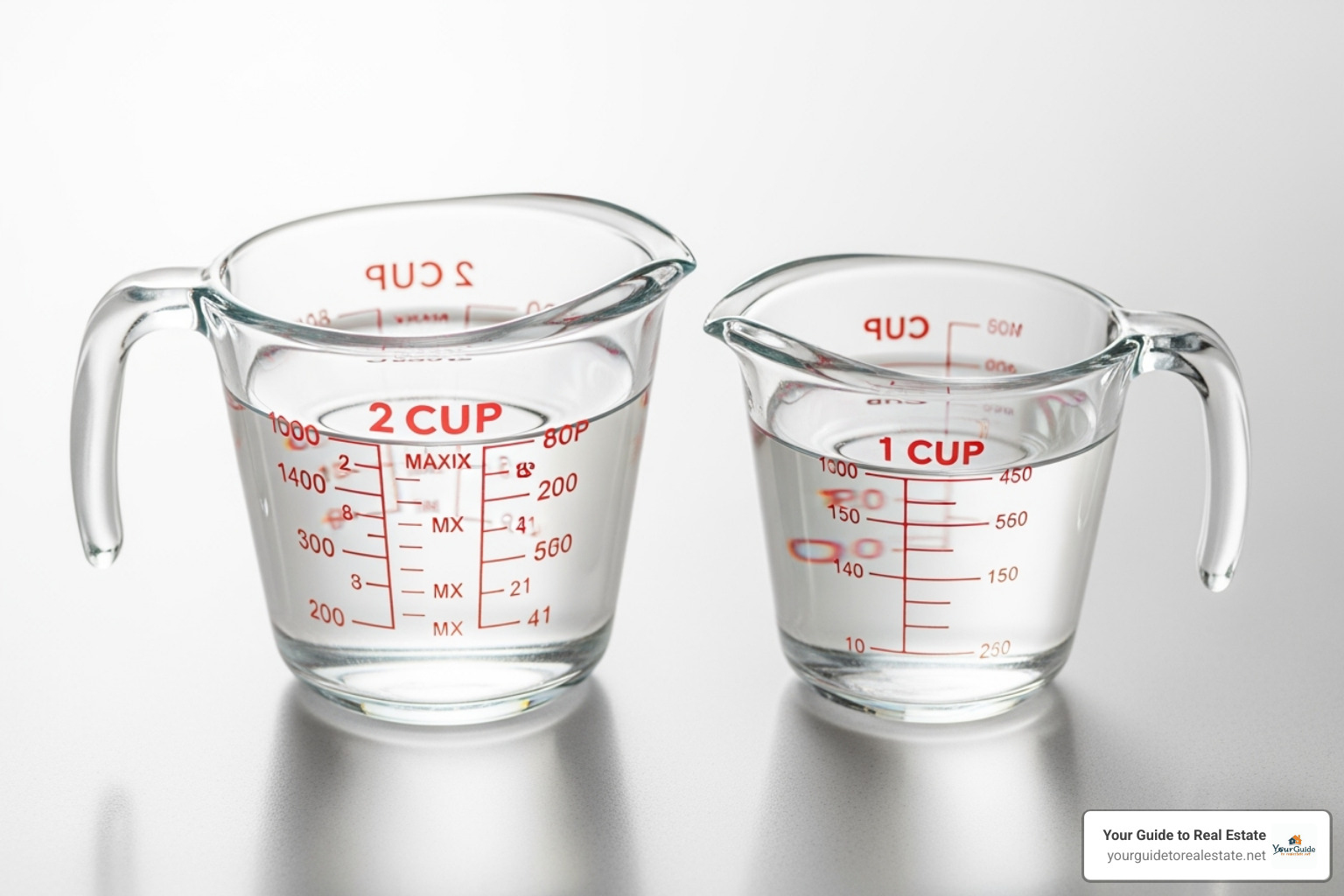
The US fluid ounce converts to 29.5735 ml, while the UK Imperial fluid ounce equals 28.4131 ml. That’s a difference of about 1.16 ml per ounce, which works out to roughly 4% variation between the two systems.
At first glance, 4% might not sound like much. But think about what happens when you’re following a recipe that calls for 16 fluid ounces of liquid. If you’re using US measurements when the recipe intended Imperial, you’ll end up with nearly 19 ml more liquid than intended. For delicate recipes like custards, bread dough, or cocktails where ratios matter, this difference can throw off your entire result.
This matters especially when you’re working with international recipes. That charming British scone recipe you found online? It’s probably using Imperial fluid ounces. The American pancake recipe from a US food blog? Those are US fluid ounces. Getting this wrong can mean the difference between perfect texture and a disappointing outcome.
The reason for this split goes back to the early 1800s. The historical context traces to 1824, when Britain standardized its measurements with the Weights and Measures Act, creating what we now call the Imperial system. But the United States had already been independent for decades and continued using measurements based on older English standards. Both countries essentially went their separate ways, and we’ve been living with slightly different “ounces” ever since.
This isn’t just a theoretical concern for home bakers. Over the years, these measurement differences have caused real problems in commercial settings, from beverage production to pharmaceutical manufacturing. When you’re dealing with large-scale production, that 4% difference multiplies quickly.
So what’s the takeaway? Always check where your recipe or product specifications originated. If you’re working with anything from the UK, Canada (which uses a mix of systems), Australia, or other Commonwealth countries, you’re likely dealing with Imperial measurements. US sources will use US customary units. When in doubt, look for recipes that list measurements in grams and milliliters—the metric system eliminates all this confusion entirely.
Ounce to Milliliter Quick Reference and Everyday Examples
When you’re in the middle of a project or recipe, the last thing you want is to stop and do complex math. That’s why we’ve put together this handy conversion chart for the most common measurements you’ll encounter. Think of it as your quick-reference cheat sheet for how many mLs in an ounce conversions.
| US Fluid Ounces (fl oz) | Milliliters (ml) (approx.) |
|---|---|
| 1 fl oz | 29.57 ml |
| 2 fl oz | 59.15 ml |
| 3 fl oz | 88.72 ml |
| 4 fl oz | 118.29 ml |
| 5 fl oz | 147.87 ml |
| 6 fl oz | 177.44 ml |
| 7 fl oz | 207.01 ml |
| 8 fl oz | 236.59 ml |
| 10 fl oz | 295.74 ml |
| 12 fl oz | 354.88 ml |
| 16 fl oz | 473.18 ml |
| 20 fl oz | 591.47 ml |
| 24 fl oz | 709.76 ml |
| 32 fl oz | 946.35 ml |
This chart covers the volumes you’ll run into most often, from small recipe measurements to larger quantities for household projects. But let’s make these numbers even more meaningful by looking at how they show up in your daily life.
In cooking and baking, these conversions become second nature once you start using them. That vintage recipe from your grandmother might call for 4 fluid ounces of cream, and you’ll know that’s about 118 milliliters. International recipes are even more likely to use metric measurements, so understanding this conversion opens up a whole world of culinary possibilities. Whether you’re making a French sauce that calls for 60 ml of wine or an American chili that needs 8 fl oz of broth, you’ve got it covered.
When it comes to medicine dosages, precision isn’t just helpful—it’s essential. While most liquid medications in the US now come with milliliter markings, you might encounter older medicine cups marked in fluid ounces, or you might be traveling with medication. A typical dose of children’s cough syrup might be 5 ml, which is just under a fifth of a fluid ounce. Never approximate when it comes to medication; always measure exactly as prescribed.
Parents dealing with baby bottles will find this conversion especially useful. Formula instructions might come in milliliters while your bottle is marked in ounces, or vice versa. A 4-ounce feeding is approximately 118 ml, and a 6-ounce bottle holds about 177 ml. Getting these measurements right ensures your little one gets the nutrition they need.
Take a look at beverage cans and bottles next time you’re at the store. That standard soda can in the US holds 12 fluid ounces, which converts to about 355 ml. Meanwhile, European soft drinks often come in 330 ml cans. The difference is small but noticeable if you’re comparing serving sizes across different markets.
For those who enjoy cocktail measurements, understanding these conversions can lift your home bartending game. A standard shot is 1.5 fluid ounces, which equals approximately 44 ml. Many professional recipes use milliliters for precision, so knowing that a half-ounce jigger holds about 15 ml helps you follow recipes accurately and create consistently delicious drinks.
Even in property maintenance tasks around your home, these conversions matter. Mixing a concentrated deck cleaner might require 16 fluid ounces per gallon of water—that’s about 473 ml if your measuring container uses metric markings. Diluting landscaping chemicals, measuring paint additives, or preparing cleaning solutions all become simpler when you can confidently convert between measurement systems.
Understanding these everyday applications makes the conversion from fluid ounces to milliliters more than just a math problem. It becomes a practical skill that helps you steer everything from weekend cooking projects to maintaining your property with confidence.
Frequently Asked Questions about Ounce to Milliliter Conversions
We’ve covered a lot of ground, but some questions pop up more often than others when people are trying to figure out how many mLs in an ounce. Let’s address the most common ones to clear up any lingering confusion.
Is 30ml the same as 1 fluid ounce?
Not quite, but it’s close enough for most everyday situations! Here’s the honest truth: 30 ml is not exactly the same as 1 fluid ounce, but it’s a very handy approximation that makes life easier.
1 US fluid ounce is precisely 29.5735 ml. This means that 30 ml is actually slightly more than 1 US fluid ounce—about 1.014 fluid ounces, to be exact. The difference is less than half a milliliter, which is tiny.
So when is this approximation acceptable? If you’re mixing a cocktail, following a casual recipe, or just need a quick estimate for a home project, rounding to 30 ml works beautifully. The small difference won’t affect your margarita or your homemade salad dressing. It’s the kind of shortcut that makes mental math a breeze without sacrificing quality.
However, there are times when you should stick with the precise number. When administering medication, conducting scientific experiments, or working with precise industrial formulas, always use the exact conversion of 29.5735 ml per fluid ounce. In these contexts, even small discrepancies can have significant consequences, so accuracy isn’t optional—it’s essential.
How many mls are in 8 US fluid ounces?
This is one of the most practical conversions to memorize because 8 fluid ounces shows up everywhere in daily life. To find out how many mLs are in 8 US fluid ounces, we simply multiply by our conversion factor:
8 fl oz × 29.5735 ml/fl oz = 236.588 ml
So 8 US fluid ounces equals approximately 236.59 ml. Round it to 237 ml if you prefer—close enough for most purposes!
Why is this measurement so important? Because 8 fluid ounces is exactly 1 US cup, one of the most common measurements in American cooking. When a recipe calls for “1 cup” of milk or broth, you now know that translates to about 237 ml. This is also the typical size of a standard glass of water. If you’ve heard the popular health advice to drink “8 glasses of water a day” (which would total 64 ounces), understanding that each glass is roughly 237 ml helps you track your hydration whether you’re thinking in ounces or milliliters.
How do I know if a recipe means fluid ounces or weight ounces?
This question comes up all the time, and for good reason—getting this wrong can really throw off your cooking! The trick is to look at what you’re measuring and pay attention to the context clues.
When you see an ingredient that’s a liquid—things like water, milk, oil, broth, juice, or vanilla extract—the recipe almost certainly means fluid ounces (fl oz), which measure volume. On the other hand, when you’re dealing with dry ingredients like flour, sugar, chocolate chips, nuts, or spices, the recipe typically means weight ounces (oz), unless it specifically says “fluid ounces” or gives you a volume measurement like “cups” or “tablespoons.”
The recipe’s origin also gives you helpful hints. American recipes tend to use fluid ounces for liquids and weight ounces (or cups) for dry ingredients. Meanwhile, recipes from the UK or metric countries usually skip the ounce confusion altogether by using milliliters for liquids and grams for dry ingredients.
Look for clues in how the measurement is written. If you see “fl oz” or “fluid oz,” you know it’s definitely measuring volume. If it just says “oz,” it’s usually referring to weight, especially for solid ingredients.
Here’s a practical example: if a recipe calls for “8 oz milk,” it means 8 fluid ounces of milk by volume. But if it asks for “8 oz flour,” it means 8 ounces of flour by weight. In fact, serious bakers often prefer measuring flour by weight because a “cup” of flour can vary wildly depending on how you scoop it. If you’re curious about weight conversions for other materials, you might find it interesting to explore how many grams in an ounce of gold, which uses yet another type of ounce—the troy ounce.
By paying attention to whether you’re working with liquids or solids and checking for those context clues, you’ll confidently know which type of ounce the recipe means. Your cooking (and your stress levels) will thank you!
Conclusion: Master Your Measurements with Confidence
You’ve made it through liquid measurements, and honestly, it’s not as complicated as it might have seemed at first. Understanding how many mLs in an ounce is one of those practical skills that quietly makes life easier in so many ways—from whipping up a new recipe to tackling home maintenance projects with confidence.
Let’s recap what matters most: 1 US fluid ounce equals 29.5735 milliliters. That’s your precise conversion factor, the one to reach for when accuracy truly counts. And for those everyday moments when you just need a quick estimate? The 1 fl oz ≈ 30 ml approximation works beautifully and keeps mental math simple.
Here’s something we can’t stress enough: remember the distinction between US and Imperial fluid ounces. That 29.57 ml versus 28.41 ml difference might seem minor, but it can genuinely affect your results, especially when you’re following a recipe from across the pond or working with international product specifications. Knowing which system you’re working with saves you from those head-scratching moments when things don’t turn out quite right.
The real beauty of mastering these conversions is how often they come in handy. You’re not just measuring ingredients anymore—you’re confidently reading product labels, accurately mixing cleaning solutions for your property, understanding beverage sizes when traveling, and even double-checking medication dosages. In our increasingly connected world where metric and imperial systems bump into each other constantly, having this knowledge in your back pocket is genuinely valuable.
At Your Guide to Real Estate, we know that success comes from understanding the details, whether that’s navigating property values, market trends, or yes, even the measurement conversions that matter for your home projects. These seemingly small pieces of knowledge add up to bigger confidence and better outcomes in everything you do.
Ready to dive deeper into managing your property and making smart real estate decisions? For more expert tips on managing your property, explore our resources for real estate agents. We’re here to help you succeed, one informed decision at a time.