
Why Real Estate Agent Selection Can Make or Break Your Home Purchase
Real estate agent selection is one of the most important decisions you’ll make when buying or selling a home. According to the National Association of Realtors, 80% of sellers pick the first agent they meet with, while two-thirds of first-time buyers contact only one agent before moving forward. This approach can cost you thousands of dollars and months of stress.
Quick Answer for Real Estate Agent Selection:
- Interview at least 3 agents (recommended by Real Estate Council of Ontario)
- Verify licensing through your provincial real estate council
- Check recent sales in your target neighborhood and price range
- Ask for references from their last 3-5 clients
- Avoid dual agency situations where one agent represents both buyer and seller
- Compare commission rates (typically 3-7% of sale price, but negotiable)
The stakes are high. Buying or selling a home is one of the most financially significant transactions most Canadians will ever make. The wrong agent can mean overpaying for a home, underselling your property, or getting stuck in a deal that falls through.
But here’s the good news: the right agent makes everything easier. They know the local market, handle complex paperwork, negotiate on your behalf, and guide you through potential pitfalls.
The key is knowing how to separate the great agents from the mediocre ones. This guide will show you exactly how to do that, step by step.
Real estate agent selection terms made easy:
– best buyer’s agent
– find buyer’s agent
Understanding the Role and Types of Real Estate Professionals
Think of choosing a real estate professional like picking a surgeon. You wouldn’t just grab the first name from the phone book, right? The same logic applies to real estate agent selection – understanding what different professionals actually do can save you thousands of dollars and countless headaches.
In Canada, every real estate professional must jump through some serious hoops before they can help you buy or sell. They need a provincial license, must complete specialized courses, pass rigorous exams, and undergo criminal background checks. It’s not exactly a weekend hobby.
But here’s where it gets interesting – not all licensed professionals offer the same level of service or expertise.
Real estate agents are basically your personal advocates in what can feel like a pretty overwhelming process. When you’re buying, they’ll hunt down properties that match your wishlist, arrange showings (even on short notice), decode market trends so you know if that asking price is realistic, and negotiate like their commission depends on it (because it does).
For sellers, agents become your marketing team, pricing expert, and negotiation warrior all rolled into one. They’ll analyze what similar homes sold for, get your property in front of the right buyers through MLS and other channels, host open houses, and handle the back-and-forth with potential buyers.
The relationship runs deeper than just “find me a house” though. Agents have something called fiduciary duty – a fancy legal term meaning they’re required by law to put your interests first. They must keep your secrets, give you honest advice (even when it’s not what you want to hear), and tell you about any conflicts of interest.
Real Estate Agent, Realtor®, Broker—What’s the Difference?
Here’s where things get a bit confusing. People throw around these titles like they’re interchangeable, but they’re actually quite different.
A real estate agent is your basic licensed professional. They’ve met all the provincial requirements and can legally help you buy or sell property. Think of this as the foundation level – they have the skills and legal authority to do the job.
A REALTOR® is an agent with extra credentials. That little ® symbol isn’t just for show – it’s a trademarked term that means the agent belongs to the Canadian Real Estate Association (CREA). These professionals have completed additional ethics training and agree to follow a stricter code of conduct beyond basic licensing requirements.
A real estate broker has leveled up even further. They’ve completed additional coursework and gained more experience, which allows them to open their own brokerage and supervise other agents. Every agent, regardless of their other credentials, must work under a licensed broker’s supervision.
| Title | Licensing Required | Additional Requirements | Can Supervise Agents |
|---|---|---|---|
| Real Estate Agent | Provincial license | None | No |
| REALTOR® | Provincial license | CREA membership, ethics training | Depends on broker status |
| Real Estate Broker | Improved provincial license | Additional coursework, experience | Yes |
Why does this matter for your real estate agent selection? While REALTOR® membership isn’t mandatory, it often signals an agent’s commitment to professional standards and ongoing education. It’s like choosing between a mechanic who just fixes cars and one who’s also certified by the manufacturer – both can do the job, but one has gone the extra mile.
The key takeaway? Don’t get too hung up on titles alone. Focus on finding someone with the right experience, local knowledge, and communication style for your specific needs.
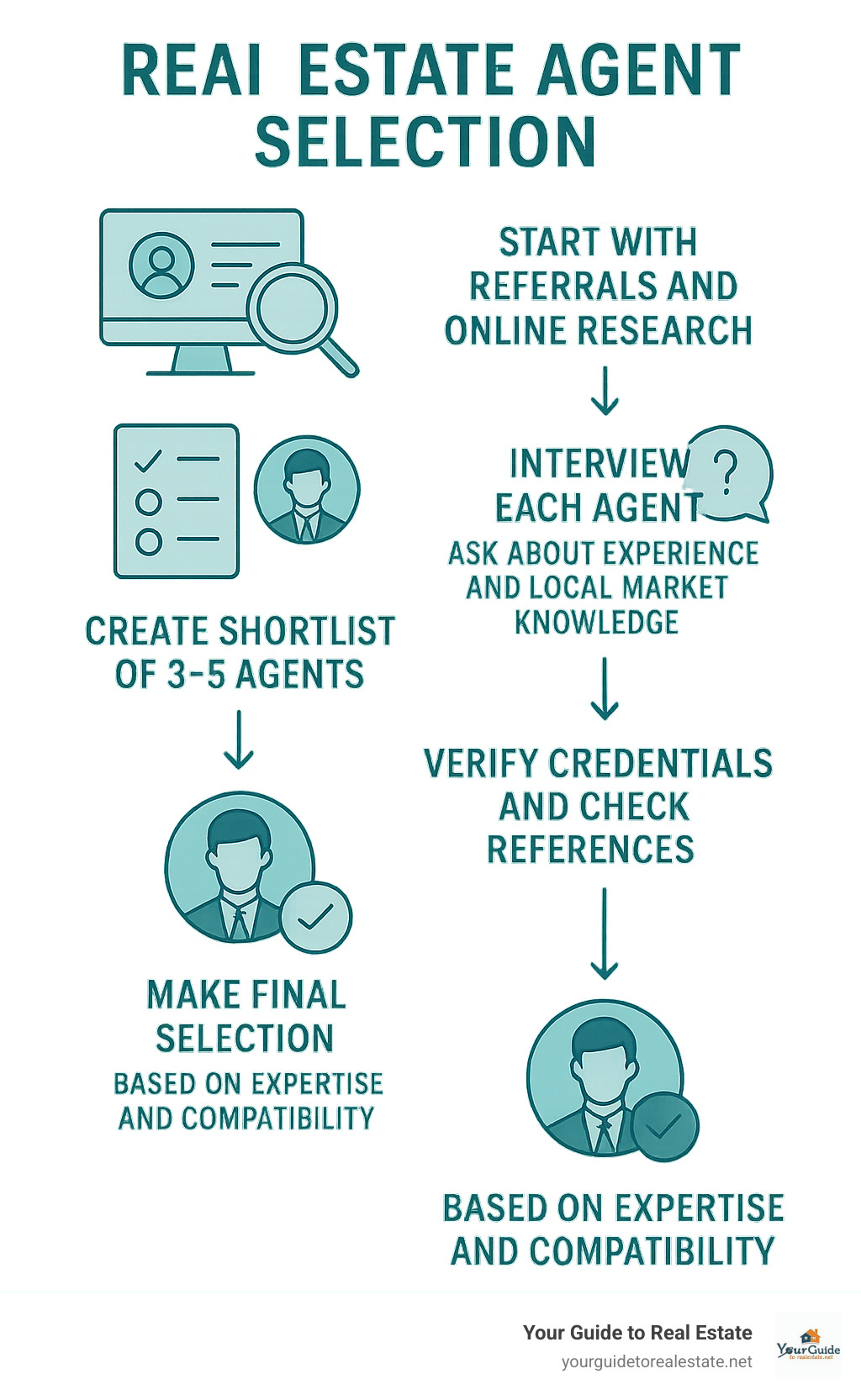
Real Estate Agent Selection Process: Step-By-Step
Finding the right real estate agent doesn’t happen overnight. Real estate agent selection is a process that deserves your full attention, not a quick decision made under pressure. Think of it like hiring someone for an important job – because that’s exactly what you’re doing.
We recommend giving yourself 2-3 weeks to do this properly. Yes, it might seem like a lot of time when you’re eager to start house hunting or get your home on the market. But this upfront investment pays huge dividends later.
Here’s how your timeline should unfold: Week 1 is all about casting a wide net and building your shortlist through referrals and research. Week 2 gets more focused – you’ll conduct interviews and check references with your top candidates. By Week 3, you’ll have all the information you need to make a confident decision and sign agreements.
The agents who rush you through this process? That’s actually your first red flag. The best agents understand that real estate agent selection takes time, and they respect clients who do their homework.
Step 1 – Start Your Search & Build a Shortlist
The absolute best place to start your search is with people you trust. Ask friends, family members, and colleagues who’ve recently bought or sold homes in your area about their experiences. But don’t just ask if they liked their agent – dig deeper.
What specific results did the agent deliver? How did they handle challenges? Would they use this agent again? These details matter more than a simple “yeah, they were great.”
Walking your target neighborhood is another smart move that many buyers skip. Those “For Sale” and “Sold” signs tell a story. When you see the same agent’s name on multiple signs in the same area, it usually means they have deep local connections and a strong marketing presence.
Online databases can be incredibly helpful too. Tools like Find Buyers Agent let you filter agents by experience, specialization, and client reviews. Many franchise websites show you recent sales volume and years of experience right upfront.
Don’t overlook open house networking either. Attending open houses gives you a chance to see agents in their natural habitat. How do they present the property? Do they seem genuinely knowledgeable about the neighborhood, or are they just reading from a script? Are they helpful without being pushy?
Social media research reveals a lot about an agent’s professionalism and market engagement. Are they actively posting about local market trends? Do they showcase recent sales? Their online presence often reflects their marketing skills and dedication to the business.
Your goal here is simple: compile a shortlist of 3-5 agents for formal interviews. More than five becomes overwhelming and hard to manage. Fewer than three doesn’t give you enough comparison points to make a confident choice.

Step 2 – Interview for Fit and Expertise (Real Estate Agent Selection in Action)
This is where real estate agent selection gets real. You’re essentially conducting job interviews, and you should approach them with the same seriousness. After all, you’re hiring someone to handle what’s likely your largest financial transaction.
Start with experience and track record questions. How long have they been selling real estate full-time? This matters because part-time agents often lack the availability and market knowledge you need. How many homes did they sell in the past 12 months? What’s their average days on market compared to the local average?
Industry research suggests looking for agents with at least 3-5 years of full-time experience and a minimum of 10 transactions per year. Agents with fewer deals under their belt may struggle when complex situations arise.
Local market knowledge separates the pros from the pretenders. How long have they lived or worked in your target area? Can they explain current market trends in your specific neighborhoods? Do they understand which schools, amenities, and transportation options add real value?
The best agents don’t just know the numbers – they understand the why behind market movements and can explain it in simple terms.
Communication and availability can make or break your experience. What’s their preferred method of communication? How quickly do they typically respond to calls and emails? Do they work with a team, or will you work directly with them?
Here’s a simple test: if an agent takes more than four hours to respond during the interview process without explanation, consider it a preview of future communication problems.
For sellers, marketing strategy questions are crucial. How will they price your home? What’s their marketing plan beyond just putting it on MLS? How much do they typically spend on advertising per listing? Can they show you examples of their recent marketing materials?
The agents who can walk you through a detailed, customized marketing plan are usually the ones who get results. For more detailed guidance on these conversations, check out How to Select the Best Real Estate Agent.
Step 3 – Compare Data & Trust Your Gut (Final Real Estate Agent Selection)
After all those interviews, it’s decision time. The final phase of real estate agent selection involves both your head and your heart. Create a simple comparison to organize your thoughts.
Look at the hard numbers first: years of experience, recent sales in your area, average days on market, and list-to-sale price ratio. Agents with a list-to-sale price ratio of 95% or higher typically have strong pricing and negotiation skills.
But don’t ignore the softer factors – communication style, local market knowledge, marketing sophistication, and that all-important personal rapport. You’ll be working closely with this person for weeks or months, so compatibility matters.
The best agents ask as many questions as they answer. They want to understand your needs, timeline, and concerns because they know that’s how they deliver the best results. If an agent seems more interested in getting your signature than understanding your situation, keep looking.
Sometimes the agent with the most impressive statistics isn’t the right fit for your personality or situation. As one industry veteran put it, “Your gut feeling often plays a significant role in making the right choice.” Trust that instinct – it’s usually pointing you in the right direction.
Due Diligence: Credentials, Compatibility & Red Flags
You’re getting close to making your final real estate agent selection, but don’t rush to sign on the dotted line just yet. A little detective work now can save you from major headaches later.
Think of this step like checking references before hiring a babysitter. You wouldn’t trust your kids to someone without verifying their background, right? The same logic applies when you’re trusting someone with your biggest financial transaction.
Verify Licensing & Designations
Every real estate agent in Canada must hold a valid provincial license – no exceptions. But here’s the thing: not all agents are created equal when it comes to credentials and ongoing education.
Start by checking your provincial real estate council’s online database. You’re looking for more than just a valid license. Check for disciplinary actions or complaints that might signal problems. Look at when their license was issued – brand new agents aren’t necessarily bad, but they lack the experience to handle complex situations that might arise.
For Ontario residents, the Real Estate Council of Ontario search tool makes this verification quick and easy. Other provinces have similar online tools that let you search by agent name or license number.
Professional designations tell you an agent has gone beyond basic licensing requirements. ABR® (Accredited Buyer’s Representative) means specialized training in buyer representation. CRS® (Certified Residential Specialist) indicates advanced training in residential sales. SRES® (Seniors Real Estate Specialist) shows expertise in serving clients 50 and older.
Here’s an interesting fact: Scientific research on credential impact shows that agents with professional designations often earn significantly more than those without. CRS designation holders earn nearly three times more than non-designees. This suggests higher client satisfaction and more repeat business – exactly what you want in your real estate agent selection.
Don’t forget to verify they carry liability insurance. Professional agents should have errors and omissions coverage to protect both themselves and their clients.
Spotting Red Flags Before You Sign
Your gut instinct is powerful, but knowing specific warning signs makes your real estate agent selection even stronger. Here are the red flags that should make you pause:
Overpricing promises are a classic trap. Some agents will suggest listing prices way above market value just to win your business. They figure they’ll pressure you to drop the price later. A good agent will provide realistic pricing based on recent comparable sales, not pie-in-the-sky numbers.
Watch out for dual agency pressure. This happens when one agent represents both buyer and seller in the same transaction. While legal in many provinces, it creates obvious conflicts of interest. How can someone negotiate the best price for you when they’re also trying to get the best price for the other side? Avoid agents who push dual agency or do it frequently.
“Post-and-pray” marketing is another red flag. These agents list your property on MLS and then wait for magic to happen. Ask for specific marketing plans. Good agents have strategies that go well beyond basic MLS listing – professional photography, social media campaigns, email marketing to their network, and more.
Be suspicious of long lock-in contracts. Standard listing agreements typically run 3-6 months. Agents pushing longer terms without good reason might be trying to trap you in a relationship that isn’t working.
Poor response times during the courtship phase spell trouble. If an agent takes forever to return calls or emails when they’re trying to win your business, imagine how slow they’ll be once you’ve signed with them.
Finally, watch for mispricing tactics and communication lags that seem to follow a pattern. Professional agents respond promptly and price properties based on data, not wishful thinking.
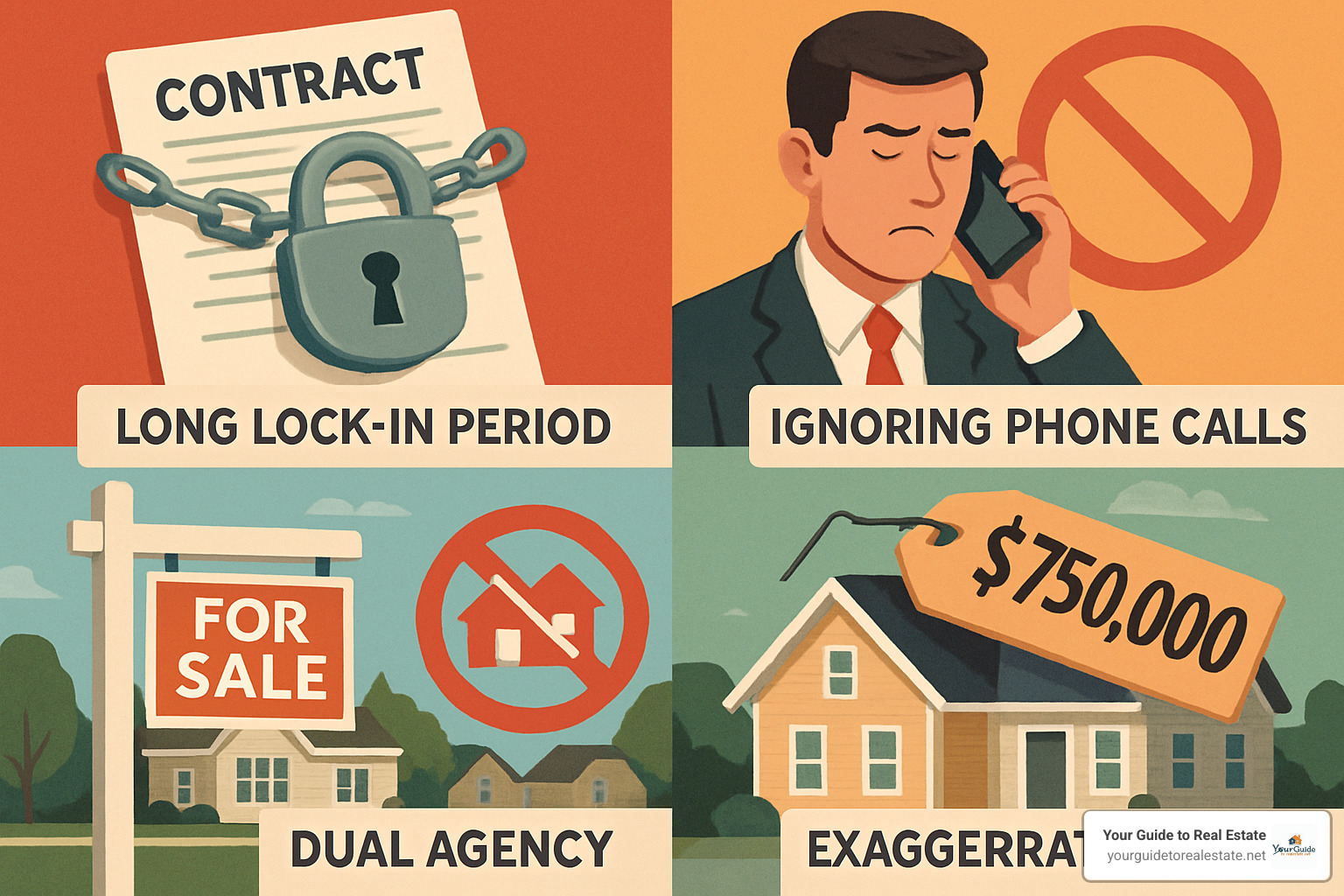
You have the right to include termination clauses in your agreement. Don’t let anyone pressure you into contracts without reasonable exit options. The best agents are confident enough in their service to offer fair cancellation terms.
Commissions, Dual Agency & Marketing Strategy
Let’s talk money and strategy – two topics that can make or break your real estate agent selection. Understanding these financial realities upfront helps you make smarter decisions and avoid costly surprises later.
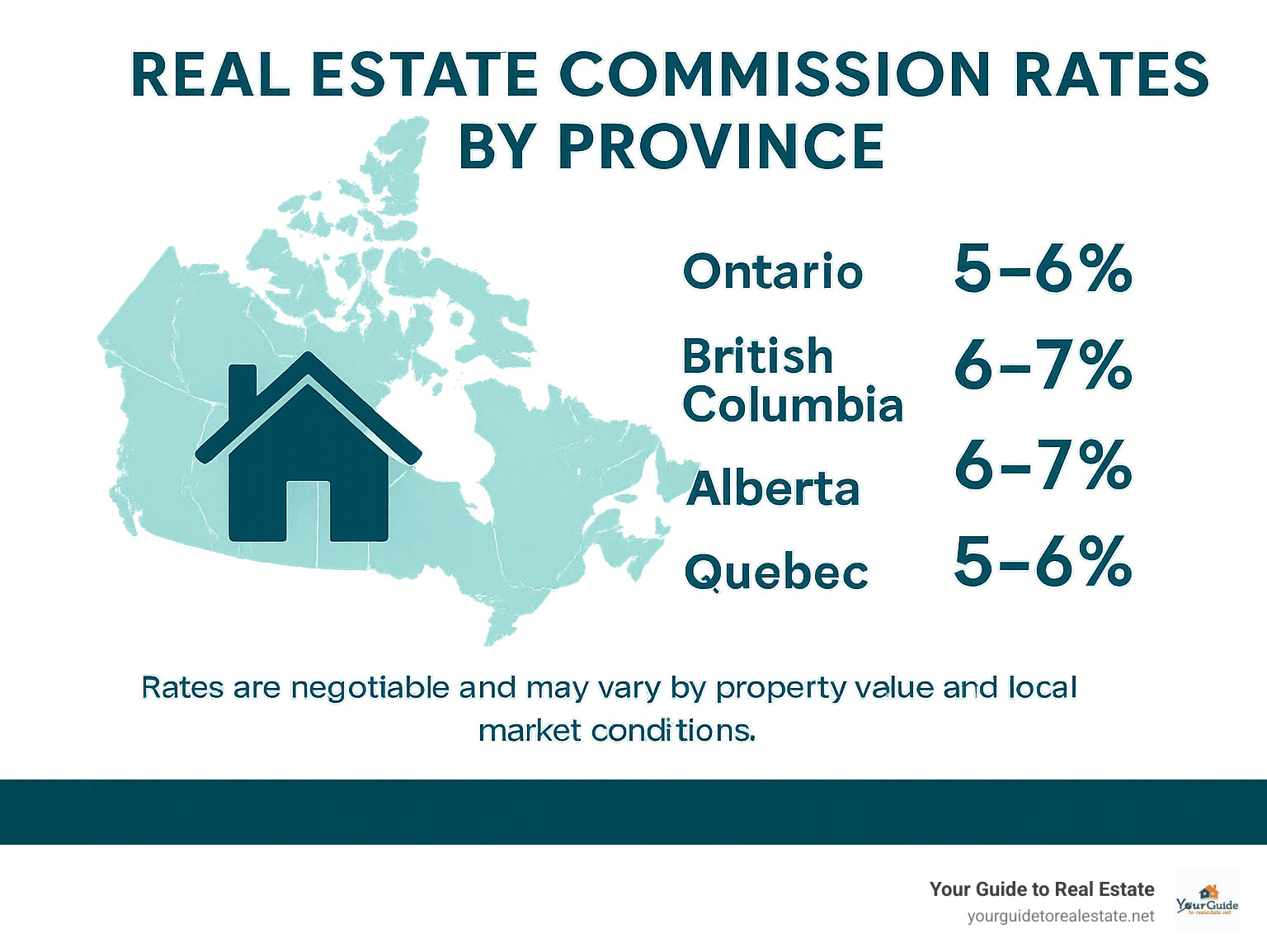
Real estate commissions in Canada typically range from 3% to 7% of your home’s final sale price. That means on a $600,000 home, you’re looking at anywhere from $18,000 to $42,000 in total commissions. This fee is usually split between the buyer’s and seller’s agents.
Here’s something important to remember: commission rates are negotiable. But here’s the catch – be cautious of agents who immediately slash their rates to win your business. As one industry veteran put it, “Agents who immediately offer discounted commissions may not fight effectively for your money.” You want someone who values their service enough to charge appropriately, then delivers results that justify every penny.
Evaluating an Agent’s Marketing Blueprint
A sophisticated marketing strategy separates the great agents from the “post-and-pray” crowd. When evaluating agents, ask to see their complete marketing blueprint – not just a vague promise to “get your home out there.”
The digital side should include professional photography and virtual tours, comprehensive MLS listings that syndicate to major real estate websites, active social media promotion across multiple platforms, and targeted email marketing to their client database.
Traditional marketing still matters too. Look for agents who invest in professional signage and brochures, strategic print advertising in local publications, well-organized open houses (both public and broker-only), and direct mail campaigns to neighborhood residents.
Advanced strategies set top agents apart from the rest. This includes drone photography for unique properties, engaging video tours and walkthroughs, staging consultation and coordination, and professional floor plans with dedicated property websites.
Don’t be afraid to ask about their marketing budget per listing. Agents who can’t give you concrete dollar figures probably aren’t investing enough in promotion. The best agents view marketing as an investment, not an expense.
For deeper insights on effective marketing approaches, check out these online and offline strategies that successful agents use.
Money Questions to Ask Up Front
Don’t dance around the financial details during your real estate agent selection process. The best agents appreciate clients who ask direct questions about costs and expectations.
Start with commission structure: What’s their rate, and is there room for negotiation? Are there additional fees for photography, marketing, or administrative costs? What happens to the commission if your sale falls through? In markets where they’re legal, do they offer buyer rebates?
Contract terms matter just as much as commission rates. What are the cancellation terms if you’re unsatisfied with their service? How long is the listing period, and can you terminate early if needed?
For sellers, you typically pay both your agent’s commission and the buyer’s agent commission. For buyers, your agent’s commission is usually paid by the seller, though this landscape is evolving in some markets.
If you’re selling, our guide on How to Choose a Selling Real Estate Agent dives deeper into seller-specific considerations.
Frequently Asked Questions about Real Estate Agent Selection
How many agents should I interview? The Real Estate Council of Ontario recommends interviewing at least three agents. This gives you solid comparison points without overwhelming yourself. More than five interviews often leads to analysis paralysis – trust us, you’ll know a great fit when you meet one.
Can I change agents mid-transaction? Absolutely, but it depends on your agreement terms. Look for contracts with reasonable cancellation clauses during your real estate agent selection process. Some agents even offer satisfaction guarantees, allowing you to terminate the relationship if you’re unhappy with their service.
What’s a fair commission in my market? Commission rates vary by region and property type. In most Canadian markets, total commissions range from 5-7% of the sale price, split between buyer’s and seller’s agents. However, everything is negotiable, especially for higher-value properties or if you’re a repeat client. The key is finding an agent who delivers value that justifies their fee.
Conclusion
Choosing the right agent isn’t just about today’s transaction—your real estate agent selection decision will echo through your financial future. The gap between working with an average agent and an exceptional one often translates to tens of thousands of dollars and dramatically different stress levels.
Think about it this way: you’re not just hiring someone to open up doors and handle paperwork. You’re bringing on a professional who will guide you through one of life’s biggest financial decisions. The right agent becomes your advocate, your market expert, and sometimes even your voice of reason when emotions run high.
The best agents don’t just earn their commission—they save you money. They know which inspection issues are deal-breakers versus negotiating points. They spot overpriced listings before you fall in love with the wrong house. They have relationships with mortgage brokers, home inspectors, and contractors that can make your transaction smoother.
Remember the roadmap we’ve outlined: start with a solid shortlist built through referrals and research, then interview at least three candidates with thoughtful questions. Verify their credentials through your provincial real estate council, and don’t skip checking references from recent clients.
Compare the numbers that matter—their list-to-sale price ratios, average days on market, and recent transaction volume in your area. But also trust your gut about communication style and personal compatibility. You’ll be working closely with this person for weeks or months.
Watch for red flags like agents who promise unrealistic prices, push dual agency arrangements, or can’t explain their marketing strategy beyond “I’ll put it on MLS.” These warning signs often predict bigger problems down the road.
Don’t let commission be your only deciding factor. The agent who offers the biggest discount upfront might not fight hardest for your money when it counts. Focus on finding someone with the experience, local knowledge, and marketing sophistication to deliver results.
The agent selection process takes time—usually 2-3 weeks if you do it right. That might feel like a lot when you’re eager to start house hunting or get your home on the market. But this upfront investment pays dividends in smoother transactions and better outcomes.
For deeper insights into making this crucial decision, explore our comprehensive resource: How to Choose the Right Real Estate Agent: A Complete Buyer’s Guide.
Your future self will thank you for taking this decision seriously. At YourGuideToRealEstate.net, we’ve seen how the right agent transforms what could be a stressful experience into an exciting journey toward your goals. Whether you’re a first-time buyer or a seasoned investor, the right professional partnership makes all the difference.
Take your time. Ask the tough questions. Trust the process. The perfect agent for your situation is out there—and now you know exactly how to find them.