

Why Real Estate Financing Matters for Every Property Transaction
Real estate financing is the process of obtaining funds to purchase, invest in, or develop property. Whether you’re buying your first home, expanding your investment portfolio, or starting a real estate business, understanding your financing options is crucial for making informed decisions and securing the best terms possible.
Key Real Estate Financing Options:
- Traditional mortgages – Conventional loans from banks and credit unions
- Government-backed loans – FHA, VA, and USDA programs with lower down payments
- Alternative financing – Seller financing, lease-to-own, and private lending
- Asset-based options – Home equity loans, HELOCs, and cash-out refinancing
- Investment strategies – Hard money loans, crowdfunding, and self-directed IRAs
The numbers tell the story: 78% of homebuyers rely on financing to purchase their properties, with most choosing 30-year fixed-rate mortgages. This isn’t just about getting a loan – it’s about accessing opportunities that would otherwise be out of reach.
Real estate financing serves three critical purposes:
Enables homeownership for families who can’t pay cash upfront. Instead of waiting years to save $300,000, you might put down $60,000 and finance the rest.
Builds wealth through leverage. You can control a $400,000 property with just $80,000 down, potentially earning returns on the full property value while only investing 20%.
Creates investment opportunities for those looking to grow their portfolios. With the U.S. real estate finance market reaching $18.8 trillion in 2022, and projected to hit $27.2 trillion by 2027, the opportunities are vast.
The financing landscape includes traditional lenders like banks and credit unions, government-sponsored enterprises like Fannie Mae (which provided $178 billion in funding in the first half of 2025), and alternative sources like private lenders and crowdfunding platforms.
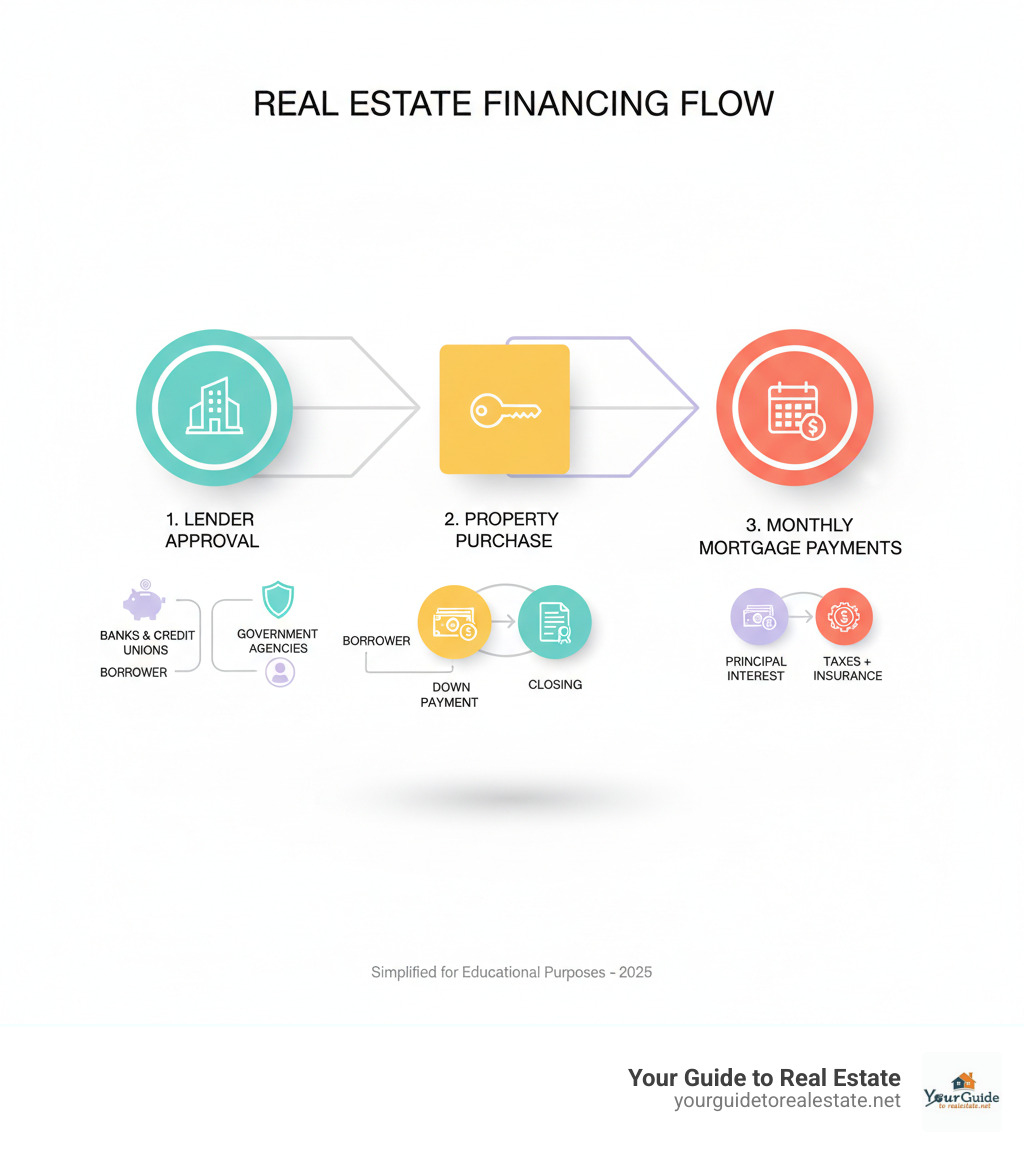
Essential real estate financing terms:
The Foundations of Real Estate Financing
Think of real estate financing as the foundation of your dream home – without it, most of us would still be saving pennies in a jar, hoping to buy a house sometime around retirement. The good news? There’s an entire system designed to help you get those keys in your hand much sooner.
Understanding the Basics of Real Estate Financing
Real estate financing is essentially the art of using other people’s money to buy property – and doing it legally! At its heart, it’s about securing funds to purchase residential or commercial property when you don’t have enough cash sitting in your checking account.
The most traditional approach involves lending against the cash flow generated by a property. Picture this: you buy a rental property, and the monthly rent from your tenants helps pay back the loan. It’s like having your property work a day job to pay its own mortgage.
Banks are the heavyweight champions of real estate lending. Take JPMorgan Chase, for example – they offer commercial property loans starting at $500,000 and are major players in both residential and commercial lending. These financial giants have deep pockets and strict standards.
Credit unions offer a more personal touch. As member-owned cooperatives, they often provide competitive rates with the kind of service where loan officers actually remember your name. It’s like getting a mortgage from your friendly neighborhood banker.
Mortgage companies are the specialists of the bunch. They live and breathe mortgages, focusing solely on originating and servicing these loans. They know every trick in the book because, well, mortgages are their book.
Here’s where it gets interesting: most lenders don’t keep your mortgage forever. They often sell it to the secondary mortgage market, which frees up their capital to help the next family buy their dream home. This constant flow of funds keeps the real estate financing market humming along smoothly. For a deeper dive into your options, check out our guide on mortgage options.
The Role of Fannie Mae and Freddie Mac
Meet the dynamic duo of housing finance: Fannie Mae and Freddie Mac. Don’t let their folksy names fool you – these Government-Sponsored Enterprises (GSEs) are the backbone of American homeownership.
These aren’t your typical lenders. Instead of handing you money directly, they work behind the scenes purchasing mortgages from banks and credit unions. Think of them as the middlemen who keep the mortgage money flowing.
Here’s how their magic works: they buy mortgages from lenders, bundle them into something called mortgage-backed securities (MBS), and sell these to investors. This creates a beautiful cycle – lenders get their money back quickly and can make new loans, while investors get a steady return.
The numbers are staggering. Fannie Mae alone provided $178 billion in funding during the first half of 2025, helping 668,000 households buy, refinance, or rent homes. With $4.3 trillion in total assets as of June 2025, they’re not just big players – they’re the entire playing field.
This system promotes market stability by ensuring mortgage funds are available even when the economy gets bumpy. Without Fannie Mae and Freddie Mac, getting a mortgage would be much harder and more expensive. You can learn more about their impact at Fannie Mae’s role in the housing market.
Residential vs. Commercial Real Estate Financing
Financing a cozy family home versus a busy office building? It’s like comparing a bicycle to a motorcycle – both get you where you’re going, but the ride is completely different.

Residential financing focuses on you as a person. Lenders want to know about your credit score (the average for approved mortgages is 753), your job stability, and whether you can handle the monthly payments. It’s personal and straightforward.
Commercial financing is all about business. The borrower type shifts from individuals to entities like LLCs or corporations. Lenders care more about the property’s income potential and your business experience than your personal credit score.
Loan terms tell a different story too. Your home mortgage might stretch 30 years with predictable monthly payments. Commercial loans typically run 5 to 15 years and often end with a balloon payment – meaning you’ll need to refinance or sell when the term ends.
Down payments reflect the risk level. You might buy a home with as little as 3% down through an FHA loan, but commercial properties typically require 20% to 40% down. Lenders see commercial deals as riskier ventures.
Interest rates follow suit – residential rates stay lower and steadier thanks to government backing, while commercial rates run higher and can be more unpredictable.
The risk assessment process differs dramatically. For your home, it’s about your debt-to-income ratio and credit history. For commercial properties, lenders dive deep into cash flow projections, tenant lease agreements, and market analysis.
Finally, property use shapes everything. Residential properties house families, while commercial properties generate business income through offices, retail spaces, or large apartment complexes. JPMorgan Chase has committed $22 billion to affordable housing, showing how significant these larger residential investments can be.
Understanding these differences helps whether you’re buying your first home or considering that office building downtown.
Traditional Mortgage Loans: Your Path to Homeownership
When most people dream about buying a home, they’re really thinking about real estate financing through traditional mortgage loans. These tried-and-true financing methods have helped millions of families achieve homeownership, and there’s a good reason they’re so popular.
The numbers speak for themselves: 87% of homebuyers had to finance their home purchase in 2021. You’re definitely not alone if you need a loan to make your homeownership dreams come true. In fact, most buyers – about 78% – chose the classic 30-year, fixed-rate conventional loan. It’s like the vanilla ice cream of mortgages: simple, reliable, and satisfying.
Conventional and Government-Backed Loans
When you sit down with a lender (and trust me, that conversation is less scary than it sounds), you’ll find two main paths for your real estate financing: conventional loans and government-backed options.
Conventional loans are the workhorses of the mortgage world. These aren’t insured or guaranteed by any government agency – they’re just good old-fashioned loans between you and your lender. Think of them as the “regular” option that most people with decent credit and steady income can access.
Most conventional loans are conforming loans, which means they meet the specific criteria set by Fannie Mae and Freddie Mac. These government-sponsored enterprises basically say, “If your loan looks like this, we’ll buy it from your lender.” This keeps money flowing through the system and helps keep rates competitive.
But what if you need to borrow more than the conforming loan limits allow? That’s where jumbo loans come in. These are for amounts that exceed the standard limits, and they typically come with stricter requirements. It’s like shopping in the premium section – you’ll need stronger financials to qualify.
Government-backed loans open doors for many people who might not qualify for conventional financing. These loans are insured or guaranteed by U.S. government agencies, making lenders more willing to work with borrowers who have unique circumstances.
FHA loans are incredibly popular, especially among first-time homebuyers. Insured by the Federal Housing Administration, these loans often require just 3.5% down and are more forgiving of lower credit scores. If you’re curious about whether you qualify, check out our detailed guide on FHA Loan Requirements.
VA loans are one of the best-kept secrets in real estate financing – if you’re eligible. Available to service members, veterans, and their spouses, these loans often require no down payment and offer competitive rates. It’s a well-deserved benefit for those who’ve served our country.
USDA loans might surprise you. Backed by the U.S. Department of Agriculture, these loans help low-to-moderate-income families buy homes in eligible rural areas, often with no down payment required. You don’t need to be a farmer – you just need to want to live outside the city.
If this is your first rodeo, don’t worry. We’ve created comprehensive First-Time Homebuyer Tips to help you steer these waters with confidence.
Fixed-Rate vs. Adjustable-Rate Mortgages (ARMs)
Once you’ve chosen your loan type, you’ll face another important decision: do you want your interest rate to stay the same forever, or are you comfortable with some uncertainty in exchange for potential savings?
Fixed-rate mortgages are exactly what they sound like – the interest rate stays locked in place for your entire loan term. Whether interest rates soar or plummet over the next 30 years, your rate won’t budge. This means your principal and interest payments remain completely predictable month after month.
Most homebuyers love this stability. There’s something comforting about knowing exactly what your housing payment will be, whether you’re budgeting for next month or next decade. When rates are low, locking in that rate for decades feels like winning the lottery. The popularity speaks for itself – 78% of buyers choose the 30-year fixed-rate option. For more insights on this popular choice, explore our guide to 30-Year Mortgage Options.
Adjustable-rate mortgages (ARMs) take a different approach. Your rate starts fixed for an initial period – maybe 3, 5, 7, or 10 years – then adjusts periodically based on market conditions. It’s like getting a teaser rate that can change over time.
The appeal? ARMs often start with lower initial rates than fixed-rate mortgages. If you’re planning to move or refinance before the adjustment period kicks in, you could save thousands in interest. But there’s a trade-off: if rates rise, your payments could increase significantly.
Fortunately, most ARMs include rate caps that limit how much your rate can jump during each adjustment period and over the life of the loan. It’s like having guardrails on a mountain road – they won’t prevent all bumps, but they’ll keep you from going over a cliff.
| Feature | Fixed-Rate Mortgage | Adjustable-Rate Mortgage (ARM) |
|---|---|---|
| Rate Stability | Stays the same for entire loan term | Fixed initially, then adjusts periodically |
| Initial Rate | Typically higher than ARM starting rates | Often lower than fixed-rate mortgages |
| Long-Term Risk | Low – payments stay predictable | Higher – potential for rate increases |
Fixed-rate mortgages work best for long-term homeowners who value budget certainty. ARMs might appeal to those planning shorter-term ownership or those confident they can handle potential payment increases.
The choice ultimately depends on your financial situation, risk tolerance, and how long you plan to keep the loan. Both options have helped millions of families achieve homeownership – the key is choosing the one that fits your unique circumstances.
Alternative & Flexible Financing Strategies
Sometimes the traditional mortgage path isn’t the right fit for your situation. Maybe you’re an investor looking to move quickly on a property, or perhaps your financial circumstances don’t align with conventional lending requirements. That’s where real estate financing gets creative and interesting.
The beauty of alternative financing is that it opens doors that might otherwise stay closed. According to industry data, creative financing involves using non-traditional methods to fund property purchases and investments, helping investors overcome financial obstacles and expand their portfolios in ways that traditional banks simply can’t accommodate.
For Buyers and Investors
Let’s talk about some financing options that think outside the traditional lending box. These strategies can be game-changers when you need flexibility or speed.
Seller financing is like cutting out the middleman entirely. Instead of getting a loan from a bank, the property seller becomes your lender. You negotiate the interest rate, payment schedule, and terms directly with them. This can be a beautiful arrangement – buyers often get more flexible terms and avoid hefty bank fees, while sellers might earn better returns than they’d get from other investments. Plus, it can speed up the entire transaction since you’re not waiting for bank approvals.
Lease-to-own agreements offer a unique path to homeownership. Think of it as a test drive for buying a house. You rent the property for an agreed period, with part of your monthly rent going toward the eventual purchase price. This gives you time to improve your credit score, save for a larger down payment, or simply decide if you truly love the property before committing to buy it.
Hard money loans are the sprint runners of real estate financing. These short-term loans from private lenders typically fund within days rather than weeks, making them perfect for investors who need to move fast on opportunities. Yes, they come with higher interest rates – usually between 10-15% – and shorter repayment periods of 6-18 months, but they’re based more on the property’s value than your credit score. They’re particularly popular for fix-and-flip projects where speed matters more than long-term affordability.
Don’t overlook family loans either. Sometimes the best lender is sitting at your dinner table. Family members can offer incredibly flexible terms, competitive rates, and a level of understanding that no bank can match. Just make sure to document everything properly to avoid future family drama.
These creative approaches can open up opportunities that traditional financing might miss. Our comprehensive guide on how to invest in property strategy explores many of these options in greater detail.
Leveraging Your Existing Assets
If you already own property, congratulations – you’re sitting on a potential goldmine for your next real estate financing adventure. Your home’s equity can be the key to funding new investments or major life goals.
Home equity loans let you borrow a lump sum against your home’s value, typically with fixed interest rates and predictable monthly payments. It’s like getting a second mortgage, but you receive all the money upfront. This works well when you know exactly how much you need for a specific project.
Home Equity Lines of Credit (HELOCs) offer more flexibility. Think of it as a credit card secured by your home’s equity. You can draw money as needed up to your approved limit, and you only pay interest on what you actually use. This is perfect for ongoing projects or when you’re not sure exactly how much funding you’ll need.
Cash-out refinancing replaces your current mortgage with a larger one, giving you the difference in cash. If your home is worth $300,000 and you owe $150,000, you might refinance for $200,000 and pocket $50,000. This strategy can be particularly attractive when interest rates are low. Our detailed guide on cash out refinancing explained walks you through this process step by step.
Here’s something many people don’t know: your self-directed IRA can be a powerful real estate investing tool. This allows you to use retirement funds to purchase investment properties, potentially offering tax advantages while diversifying your portfolio. The IRS has strict rules about this, so you’ll need to work with a qualified custodian, but it can be an excellent way to build wealth for retirement.
Partnerships and crowdfunding have revolutionized how people access real estate financing. You don’t need to have all the money yourself anymore. Partnerships let you team up with other investors to tackle larger deals, sharing both the risks and rewards. Real estate crowdfunding platforms connect you with other small investors to fund bigger projects that would be impossible to handle alone.
The world of alternative financing proves that there’s rarely just one way to fund a real estate deal. For investors ready to explore these innovative approaches, our page on creative financing strategies for investors offers even more detailed strategies and insights.
The Mortgage Process: From Application to Closing
Alright, you’ve explored your options, you know what kind of property you’re looking for, and you’re ready to make a move. Now comes the practical part: navigating the mortgage process itself. While it might seem daunting, we’re here to guide you through each key step, from getting your ducks in a row to finally receiving the keys to your new property.
Step 1: Qualifying and Getting Pre-Approved
This is where your financial story begins to unfold for a lender. They want to see that you’re a reliable borrower who can comfortably make their mortgage payments.
Here’s what lenders typically look at:
- Credit Score: Your credit score is a numerical representation of your creditworthiness. Lenders use this metric to evaluate your risk. As Experian notes, the average credit score for approved mortgage loans in the United States is 753, highlighting the importance of a strong credit history. We always advise our clients to check their credit reports and scores well in advance.
- Debt-to-Income (DTI) Ratio: This ratio compares your monthly debt payments to your monthly gross income. Lenders prefer a lower DTI ratio, as it indicates less financial strain. The Consumer Financial Protection Bureau typically recommends a maximum DTI ratio of 43% for mortgage approval. Keeping your debts in check can significantly improve your chances!
- Down Payment: The amount of money you’re putting down upfront. A larger down payment often leads to more favorable financing terms and can help you avoid Private Mortgage Insurance (PMI). The average down payment for a home purchase in the United States is 12%, according to the National Association of Realtors.
- Income Stability: Lenders want to ensure you have the financial capacity to make consistent mortgage payments. They’ll look at your employment history and income sources. The U.S. Census Bureau reports the median household income in the United States as $67,521, providing a benchmark for income stability assessments.
It’s important to understand the difference between prequalification and pre-approval:
- Prequalification: This is an initial estimate of how much you might be able to borrow, based on a quick review of your finances. It’s a good starting point, but not a guarantee.
- Pre-approval: This is a much more thorough process where the lender verifies your financial information (income, assets, credit). It results in a conditional commitment to lend you a specific amount, giving you a strong advantage when making an offer on a home.
Getting pre-approved early in the process is a game-changer. It tells sellers you’re a serious buyer and can help you set realistic expectations for your home search. For a detailed walkthrough, explore our guide on the loan process for buying a house.
Step 2: Application, Underwriting, and Appraisal
Once you’ve found your dream home and had an offer accepted, it’s time for the formal loan application.
- Submitting the Application: You’ll complete a full mortgage loan application, providing extensive documentation. This typically includes:
- W-2 forms and pay stubs to verify income.
- Federal tax returns (often for the past two years).
- Recent bank statements and investment account statements to verify assets.
- Information on any other debts you have.
- The Underwriting Decision: This is where the lender’s underwriter carefully reviews all your financial documents and the property details. They’re making sure the loan meets all the lender’s requirements and internal guidelines. This is a crucial step where your creditworthiness and the property’s value are scrutinized.
- Property Appraisal: As part of the underwriting process, the lender will order an appraisal of the property. An independent appraiser will assess the home’s value to ensure it’s worth the loan amount. This evaluation helps determine the loan-to-value (LTV) ratio, a critical metric in loan approval decisions. Zillow reported the average home value in the United States to be approximately $357,000 in 2022, providing a general market context for appraisers.
Step 3: Final Approval and Closing Day
The finish line is in sight!
- Final Approval (“Clear to Close”): Once the underwriter is satisfied with all documentation and the appraisal, your loan receives final approval. This is often referred to as getting “clear to close” – a phrase that brings immense relief to homebuyers!
- Closing Disclosure Review: A few days before closing, you’ll receive a Closing Disclosure (CD), which details all the final terms of your loan, including interest rate, monthly payments, and all closing costs. It’s crucial to review this document carefully and compare it to your initial Loan Estimate.
- Closing Day Process: This is the big day! You, your real estate agent, and potentially your attorney will meet with the title company representative (and sometimes the lender’s representative) to sign a mountain of paperwork. This includes the promissory note (your promise to repay the loan), the mortgage or deed of trust (which gives the lender a lien on the property), and various other legal documents. You’ll also pay any remaining closing costs and your down payment. Finally, once all documents are signed and funds are transferred, the deed is recorded, and you officially become the proud owner of your new home. Understanding the nuances of this final stage, especially the role of escrow, can be helpful. We have a guide on understanding escrow process that can shed more light on this.
Frequently Asked Questions about Real Estate Financing
We get it – real estate financing can feel overwhelming, especially when you’re navigating it for the first time. Over the years, we’ve heard the same questions pop up again and again from our clients. Let’s tackle the most common ones together, so you can move forward with confidence.
What is the difference between a mortgage broker and a direct lender?
This question comes up all the time, and it’s a smart one to ask! Understanding who you’re working with can make a huge difference in your experience and your wallet.
When you work with a direct lender, you’re going straight to the source. These are banks, credit unions, or mortgage companies that use their own money to fund your loan. Think of it like buying directly from the manufacturer – you’re dealing with the people who actually make the decisions and write the checks. The process can be more straightforward since there’s no middleman involved.
A mortgage broker, on the other hand, is like having a personal shopping assistant for loans. They don’t lend money themselves, but they have relationships with multiple lenders and can shop around on your behalf. They’ll compare rates, terms, and programs from different sources to find what works best for your situation.
Both options have their perks. Direct lenders might offer faster processing and fewer hands touching your file, while brokers can potentially find you better rates by casting a wider net. The key is shopping around and comparing what each can offer you. Our guide on how to compare mortgages walks you through exactly how to evaluate your options effectively.
What is Private Mortgage Insurance (PMI)?
Ah, PMI – those three little letters that can add a chunk to your monthly payment! Let’s break down what it actually does and why it exists.
Private Mortgage Insurance is essentially a safety net for your lender, not for you. When you put down less than 20% on a conventional loan, the lender sees your loan as riskier. PMI protects them if you can’t make your payments and they have to foreclose.
Here’s the thing – while PMI protects the lender, it does allow you to buy a home sooner rather than waiting years to save up that full 20% down payment. Without PMI, many people would be stuck renting much longer.
The good news is that PMI isn’t forever. Once you’ve built up enough equity in your home – typically when you owe 78% or less of the home’s original value – the PMI automatically comes off. You can also request removal once you hit 20% equity, though you might need a new appraisal to prove your home’s current value.
Want to dive deeper into how PMI works and when you can get rid of it? Check out our comprehensive guide on understanding private mortgage insurance.
Can I get financing for a home that needs significant repairs?
Absolutely! This is one of our favorite questions because it opens up so many opportunities for buyers. Just because a house needs work doesn’t mean you can’t get real estate financing for it.
The FHA 203(k) loan is your best friend here. This government-backed program lets you roll the purchase price and renovation costs into one single mortgage. Instead of buying the house, then scrambling to find money for repairs, you get it all handled upfront.
There are two flavors of the 203(k) loan. The Streamline 203(k) covers smaller projects up to $35,000 – think new flooring, kitchen updates, or bathroom renovations. The Standard 203(k) is for bigger jobs that might include structural work, additions, or major systems replacements.
The appraisal process is pretty clever with these loans. The appraiser looks at what the home will be worth after the improvements are completed, not just its current condition. This means you can finance based on the home’s future value, which often works in your favor.
These renovation loans can be a game-changer, especially in competitive markets where move-in-ready homes get snapped up quickly. You might find yourself with less competition and more negotiating power when looking at fixer-uppers.
Conclusion: Your Path to Property Ownership
What a journey we’ve taken together through real estate financing! From understanding how traditional lenders work to exploring creative strategies that can open doors you never knew existed, you now have a comprehensive roadmap for navigating property transactions with confidence.
The beauty of real estate financing lies in its diversity. Whether you’re drawn to the predictability of a 30-year fixed-rate mortgage, intrigued by the flexibility of seller financing, or considering leveraging your existing home’s equity for your next investment, there’s likely a financing solution that fits your unique situation and goals.
Remember those key numbers we discussed? With 78% of homebuyers relying on financing and the U.S. real estate finance market projected to reach $27.2 trillion by 2027, you’re joining a massive community of people who understand that financing isn’t just about getting a loan – it’s about accessing opportunities that can transform your financial future.
The path from your first pre-approval to holding those keys on closing day might seem long, but each step brings you closer to achieving something truly meaningful. Whether that’s providing a stable home for your family, building wealth through property appreciation, or creating passive income through rental investments, real estate financing is the bridge that makes it all possible.
At Your Guide to Real Estate, we believe that knowledge truly is power. The more you understand about financing options, market dynamics, and the mortgage process itself, the better equipped you’ll be to make decisions that align with your long-term goals. We’re here to provide that proven framework and stress-free guidance every step of the way.
Ready to turn your real estate dreams into reality? Start with the fundamentals by exploring our comprehensive guide: Understanding Mortgages: A Beginner’s Guide to Home Loans. Your journey to property ownership begins with that first step, and we’re excited to be part of your success story!