

What Are Retained Earnings and Why They Matter
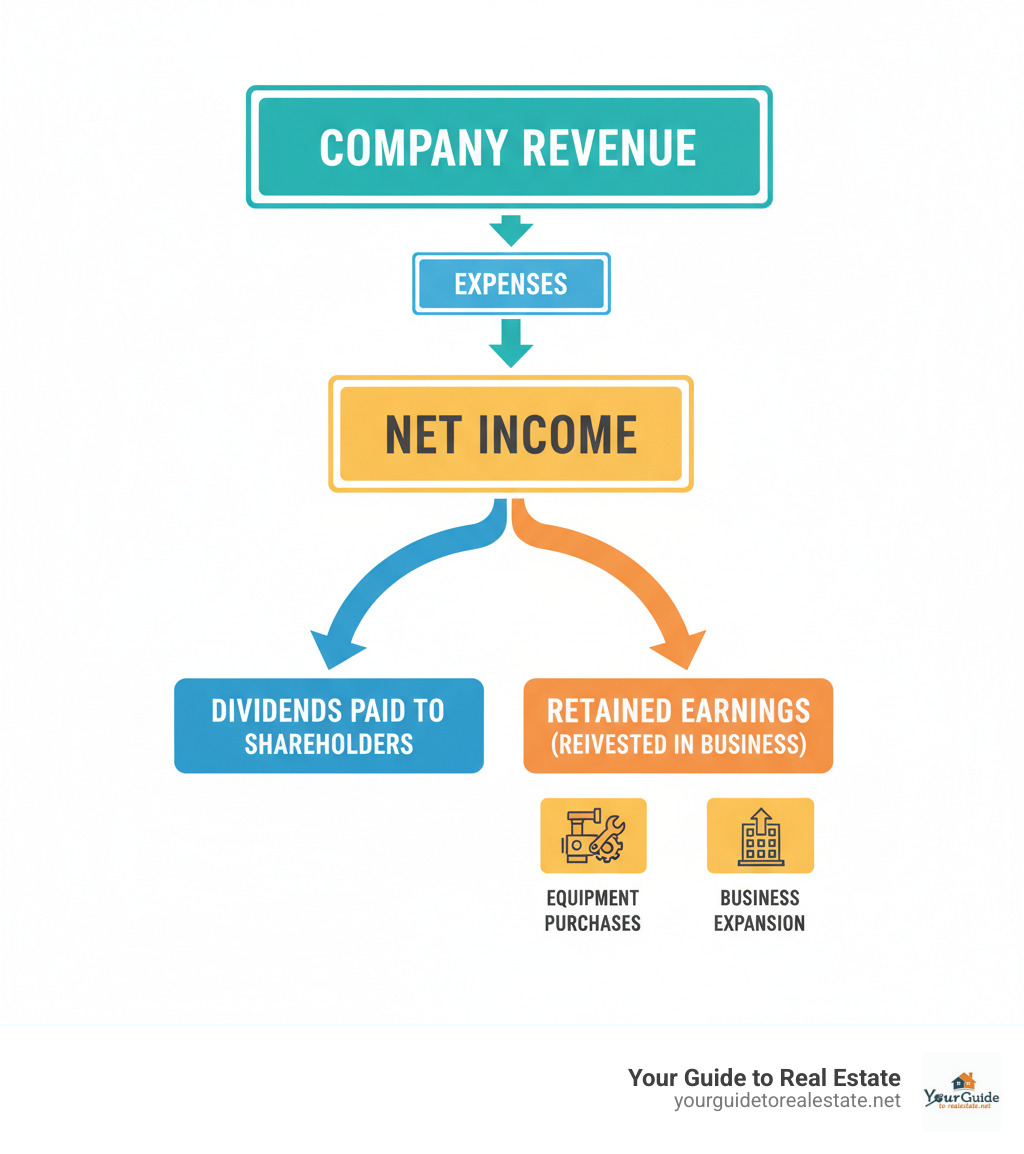
A retained earnings statement shows how much profit a company has kept and reinvested in the business instead of paying it all out to shareholders as dividends.
Quick Answer: What is a Retained Earnings Statement?
- Definition: A financial statement showing accumulated profits kept by a company
- Purpose: Tracks how much money is available for reinvestment and growth
- Formula: Beginning Retained Earnings + Net Income – Dividends = Ending Retained Earnings
- Location: Found in the shareholders’ equity section of the balance sheet
- Key Insight: Shows management’s strategy for using company profits
Think of retained earnings like a business savings account. Just as you might save part of your paycheck for future purchases instead of spending it all, companies save part of their profits for future investments, expansion, or unexpected expenses.
Retained earnings represent the cumulative net income that a company has earned since it started operations, minus any dividends paid to shareholders. This isn’t cash sitting in a bank account – it’s money that has been reinvested back into the business through equipment purchases, hiring, research and development, or other growth activities.
For real estate companies, retained earnings might fund new property acquisitions, office expansions, technology upgrades, or marketing campaigns to attract more clients. A growing retained earnings balance typically signals that a company is profitable and confident about future opportunities.
The retained earnings statement serves as a bridge between the income statement (which shows current period profits) and the balance sheet (which shows the company’s financial position at a point in time). Banks often look for at least two years of positive retained earnings when considering loan applications, making this statement crucial for companies seeking financing.
Common retained earnings statement vocab:
The Anatomy of a Retained Earnings Statement
Think of a retained earnings statement as the financial story of how your company’s savings account grew or shrank over the year. It’s a simple but powerful document that shows exactly what happened to all those profits you worked so hard to earn.
This statement is one of the four main financial reports every business needs, sitting right alongside your balance sheet, income statement, and cash flow statement. You might hear accountants call it by different names – the statement of retained earnings, statement of shareholders’ equity, or statement of owners’ equity – but they’re all talking about the same thing.
What makes this statement special is how it connects the dots between your other financial reports. It takes the profit from your income statement and shows how that money flows into the equity section of your balance sheet. It’s like a bridge that explains the journey of your company’s accumulated wealth.
For real estate professionals, this connection is crucial. When we’re helping clients understand property investments or business valuations, the retained earnings statement tells us whether a company is growing its financial foundation or depleting it. It reveals management’s strategy – are they reinvesting for growth or returning profits to owners?
The Retained Earnings Formula and Calculation
The beauty of retained earnings lies in its straightforward calculation. The formula is refreshingly simple, yet it captures everything you need to know about how your company’s accumulated profits changed:
Ending Retained Earnings = Beginning Retained Earnings + Net Income – Dividends Paid
Let’s break this down into bite-sized pieces that actually make sense.
Beginning retained earnings is where you started the year. It’s all the profits your company has saved up from day one, minus any dividends you’ve paid out over the years. If you’re just starting out, this number is zero – everyone starts somewhere!
Net income comes straight from your income statement. This is your company’s profit (or loss) for the current period. When you make money, it boosts your retained earnings. When you lose money, it chips away at that accumulated wealth. Every dollar of revenue, every expense, every depreciation charge – they all flow through net income and ultimately impact your retained earnings.
Dividends are the profits you choose to share with owners or shareholders. These come in two flavors, and both affect your retained earnings differently:
Cash dividends are exactly what they sound like – real money leaving your business account and going into shareholders’ pockets. This directly reduces both your cash and your retained earnings.
Stock dividends are trickier. Instead of cash, you’re giving shareholders more shares of stock. While no money leaves the company, you’re still moving some retained earnings into other equity accounts. The total equity stays the same, but retained earnings go down.
Here’s how this works in the real world. Let’s say “Sunshine Realty Partners” started the year with $125,000 in retained earnings. They had a fantastic year, earning $35,000 in net income from successful property sales and management fees. To reward their investors, they paid out $15,000 in cash dividends.
Using our formula:
- Beginning Retained Earnings: $125,000
- Add Net Income: $35,000
- Subtract Dividends: $15,000
- Ending Retained Earnings: $145,000
Sunshine Realty grew their retained earnings by $20,000, showing they’re building financial strength while still rewarding their investors. That’s the kind of balanced approach that creates long-term value.
How to Prepare a Simple Retained Earnings Statement
Creating a retained earnings statement doesn’t require an accounting degree – just attention to detail and a systematic approach. Here’s how to build one step by step:
Start with a proper heading that includes three key pieces of information: your company’s full legal name, the title “Statement of Retained Earnings,” and the specific time period you’re covering. For example: “Sunshine Realty Partners, LLC – Statement of Retained Earnings – For the Year Ended December 31, 2024.”
Begin with your starting point by listing the retained earnings balance from the end of the previous period. You’ll find this number on last year’s balance sheet. This becomes your foundation – the accumulated profits you’re building upon.
Add your current period’s performance by including the net income (or subtracting the net loss) from this period’s income statement. This is where your hard work during the year shows up in the retained earnings story.
Subtract any dividends paid during the period, whether they were cash payments to shareholders or stock dividends that reallocated equity. Every dollar distributed is a dollar that can’t be reinvested in growth.
Calculate your ending balance by doing the math: starting balance plus net income minus dividends equals your new retained earnings total. This number will appear on your current balance sheet.
Here’s what a clean, professional statement looks like:
Sunshine Realty Partners, LLC
Statement of Retained Earnings
For the Year Ended December 31, 2024
Retained Earnings, January 1, 2024 . . . . . . . . . . . . . . . . . . . . . . . . . . . . . . . . . . . . . . . . . . . . . . . . . . . . . . . . . . . . . . . . . . . . . . . . $125,000
Add: Net Income for the Year . . . . . . . . . . . . . . . . . . . . . . . . . . . . . . . . . . . . . . . . . . . . . . . . . . . . . . . . . . . . . . . . . . . . . . . . . . . . . . $35,000
Less: Dividends Paid . . . . . . . . . . . . . . . . . . . . . . . . . . . . . . . . . . . . . . . . . . . . . . . . . . . . . . . . . . . . . . . . . . . . . . . . . . . . . . . . . . . . . . ($15,000)
Retained Earnings, December 31, 2024 . . . . . . . . . . . . . . . . . . . . . . . . . . . . . . . . . . . . . . . . . . . . . . . . . . . . . . . . . . . . . . . . . . . $145,000

This statement tells a complete story in just four lines. It shows where the company started, how it performed, what it paid out, and where it ended up. For investors, lenders, and business owners, this simple document provides crucial insights into the company’s financial health and management’s strategic decisions.
Why Retained Earnings Matter for Business Growth
Retained earnings are so much more than just numbers on a financial report; they’re a powerful peek into a company’s future plans and its ability to grow all on its own. For us here at Your Guide to Real Estate, really understanding these funds is key to making smart property investments and expanding our reach in the market.
When a company consistently earns profits and keeps a good portion of them, it’s a big sign of financial health. It shows that the folks running the company are confident about what’s ahead! These funds act like a flexible savings account for the business. They can be used for all sorts of projects without having to borrow more money (which means no extra debt!) or bring in new owners (which keeps control with the current team). Think of it as a company’s own ready-to-go capital for growth.

Common Uses of Retained Earnings
The wonderful thing about retained earnings is how many different ways a company can use them. Businesses, especially those in the real estate world, can put these funds to work to help them achieve their big goals:
First and foremost, companies use these funds for reinvesting in the business. This is often the most important use! For a real estate company like ours, this could mean buying brand new properties, giving existing ones a fresh makeover, or investing in the latest property management software to serve clients better.
Retained earnings can also fuel Research & Development (R&D). While you might not think of R&D right away for real estate, it could involve creating innovative building methods, exploring eco-friendly materials, or even using AI tools to better understand market trends. These efforts give a company a real edge!
Another common use is buying new assets. This could be anything from new office equipment and vehicles to much larger purchases, like buying big plots of land or commercial buildings for future development. These are big investments that help a company grow its physical footprint and capabilities.
Specifically for real estate, retained earnings are perfect for direct property investment. This means funding new real estate purchases, big development projects, or growing a portfolio of rental properties. It’s all about expanding the company’s core business.
Sometimes, a smart move is paying off company debt. Reducing what the company owes makes its financial picture much stronger. It also means less money goes towards interest payments and makes the company look more reliable to banks and lenders. This is a big plus when seeking new real estate financing!
Of course, retained earnings are key for funding expansion. This might involve opening new offices in different cities (like Dallas or Oklahoma City for us!), moving into new parts of the market (like going from residential to commercial properties), or hiring more skilled people to support growth.
Finally, companies might use retained earnings for share buybacks. This is when a company buys its own stock back from the market. It can help increase the earnings per share for the remaining stock and give value back to the shareholders who stick around.
The Impact of Dividends on Growth Strategy
Deciding whether to pay out profits as dividends or keep them as retained earnings is a tricky balancing act for any company, especially for those aiming for long-term growth.
When it comes to dividend decisions and shareholder distributions, companies have to weigh pleasing their shareholders with immediate cash payments (dividends) against the need to hold onto those profits to grow the business in the future. Companies focused on growth, like Apple Inc. was for many years, might choose to pay very small dividends or none at all. This allows them to put all their money back into the company. For example, between 1995 and 2012, Apple kept 100% of its earnings, pouring them into new product development, which really powered their huge growth. Even now, Apple still holds onto a lot of its earnings, even though they started paying dividends in 2012.
This leads to a clear reinvestment trade-off: every dollar paid out as a dividend is a dollar that can’t be put back into the business for growth. Company leaders have to believe they can earn a good return on investment by keeping those funds. If there aren’t many profitable ways to grow, then giving those earnings back to shareholders as dividends might actually be the smarter choice.
To understand a company’s reinvestment plans, we often look at the Retention Ratio (also called the Plowback Ratio). This helpful number shows how much profit a company is holding onto. Here’s how it’s figured out:
Retention Ratio = (Net Income – Dividends) / Net Income
Let’s say a company earns $169,400 in net income and pays out $16,000 in dividends. Its retention ratio would be ($169,400 – $16,000) / $169,400 = 90.6%. This means the company is keeping and reinvesting a big chunk of its profits. A high retention ratio usually tells us a company is focused on growing bigger, while a lower ratio might mean it’s a more established company or one that prefers to give more cash back to its owners.
The choice between paying out dividends and keeping earnings directly shapes a company’s financial path and how well it can fund its future projects without needing outside help. It’s a vital part of strategic planning, and understanding a company’s retained earnings statement helps us see that strategy in action.
How to Analyze Retained Earnings
Understanding how to analyze retained earnings is like learning to read the financial story of a business. It’s not just about that final number on the balance sheet – it’s about understanding what that number tells us about the company’s past decisions and future potential.
When we look at retained earnings, we’re essentially examining a company’s financial health over time. Think of it as checking the vital signs of a business. A strong, growing retained earnings balance often signals that management is making smart decisions about reinvesting profits for future growth.

The real power in analyzing retained earnings comes from trend analysis. Looking at just one year’s numbers is like trying to understand a movie from a single frame. You need to see how retained earnings have changed over several years to get the full picture of where the company is heading.
What Stakeholders Look For
Different people care about retained earnings for different reasons, and understanding these perspectives helps us see why this financial statement matters so much.
Investors focus on value creation when they examine retained earnings. They want to know if the company is using those reinvested profits wisely. Are those retained dollars generating more wealth for shareholders over time?
Take Apple as an example – between September 2021 and September 2024, for every dollar of net earnings they kept in the business, they managed to create about $5.42 of market value. That’s impressive efficiency! This kind of track record makes investors confident that their money is in good hands, whether they’re looking at tech stocks or considering property investment opportunities.
Banks and creditors have a different focus – they’re looking at retained earnings as a measure of financial stability and borrowing capacity. Here’s what gets their attention: they typically want to see at least two years of positive retained earnings before they’ll consider significant loans. This shows them that a company can consistently generate profits and build equity.
The math here is pretty straightforward but powerful. Banks generally lend about three to four times what a company has in equity. So if your business has built up $400,000 in retained earnings, you could potentially qualify for $1.2 to $1.6 million in additional borrowing capacity. For real estate businesses, this can be the difference between slow, cautious growth and being able to move quickly on promising opportunities. Strong retained earnings make securing real estate financing much easier.
Business owners use retained earnings to make strategic decisions about their company’s future. These numbers help them understand how much internal capital they have available for expansion, whether they can afford to pay off debt early, or if there’s room to increase dividend payments to shareholders.
Interpreting Positive and Negative Balances
The balance in retained earnings tells a story about a company’s financial journey, but like any good story, context matters.
Positive retained earnings are generally what you want to see. They indicate that a company has been profitable over time and has been smart about keeping some of those profits in the business rather than spending everything. This creates a foundation for financial strength and future growth opportunities.
But here’s where it gets interesting – negative retained earnings (also called an accumulated deficit) aren’t always a disaster. Yes, they mean that a company’s cumulative losses exceed its total profits, or that it has paid out more in dividends than it has earned over its lifetime. This can be a red flag, especially for newer or struggling companies.
However, even successful companies sometimes show negative retained earnings. Apple, for instance, had an accumulated deficit of $19.1 billion at the end of their 2024 fiscal year. Before you panic about Apple’s financial health, this happened because they chose to return massive amounts of capital to shareholders through dividends and share buybacks. They were so profitable that they could afford to pay out more than their cumulative earnings while still maintaining strong cash flows.
The key is understanding why the balance is negative. Is it because the company is losing money consistently? That’s concerning. Or is it because a profitable company is returning value to shareholders? That might actually be a sign of financial strength.
Trend analysis becomes crucial here. Looking at retained earnings over five years gives you a much clearer picture than any single year’s number. You want to see the direction the company is moving, not just where it stands today.
There’s an old rule of thumb that suggests the ideal ratio of retained earnings to total assets should be around 100%, but honestly, that’s rarely realistic. What’s considered “good” depends heavily on the industry, how mature the company is, and what its growth strategy looks like. A rapidly growing startup might have lower retained earnings because it’s reinvesting everything into expansion. A stable, mature company might have higher retained earnings but fewer exciting growth opportunities ahead.
The most important question isn’t just how much a company has retained, but how well they’re using those retained earnings to generate returns. After all, the goal isn’t just to accumulate money – it’s to use that money to create even more value over time.
Frequently Asked Questions about the Retained Earnings Statement
It’s common to have questions about financial statements, and the retained earnings statement often sparks a few. Let’s clear up some of the most frequent queries with straightforward answers.
What is the difference between retained earnings and net income?
This is a common point of confusion for many, but the distinction is actually quite simple once you get the hang of it!
-
Net Income: Think of net income as a snapshot of a company’s financial performance over a short, specific period – like a single quarter or an entire year. It’s the “bottom line” on the income statement, showing how much profit a company made after all revenues are in and all expenses (including taxes!) are paid for that particular period. It’s like your paycheck for one month or your annual salary after taxes.
-
Retained Earnings: Now, imagine your total savings account. Retained earnings are the cumulative total of all the net income a company has ever made since it started, minus any money it has paid out to shareholders as dividends over all those years. It’s an accumulated balance, building up over time. If net income is your monthly paycheck, retained earnings are your total savings built up over your whole working life, after you’ve paid your bills and maybe treated yourself to something nice.
So, the key takeaway is this: Net income measures profit for one period, while retained earnings are the total accumulated profit kept by the business over its entire history (after paying dividends). Net income from the current period directly adds to the retained earnings balance.
Are retained earnings the same as cash?
This is a really important one to understand, and the answer is a firm no, retained earnings are not the same as cash. It’s a crucial distinction!
-
Retained Earnings: This is an equity account on the balance sheet. It represents the portion of the owners’ stake in the company that has been built up from past profits which were reinvested back into the business. When a company decides to “retain” earnings, it doesn’t mean the money just sits in a special bank account called “retained earnings.” Instead, that capital is typically used to purchase tangible assets like new property, equipment, or inventory. It might also be used to pay down company debt or fund daily operations and growth initiatives. These are all uses of cash, but the retained earnings figure itself is an accounting entry, not a liquid asset.
-
Cash: On the other hand, cash is a very specific type of asset – it’s money that’s readily available for immediate use. While a company certainly uses its cash to fund the activities that its retained earnings represent, the actual retained earnings balance doesn’t tell you how much cash a company has in its bank account. A company could have a very high retained earnings balance, showing years of profitability and reinvestment, but still have a low amount of actual cash if it has invested heavily in non-cash assets or has a lot of money tied up in accounts receivable. Therefore, retained earnings are not a measure of liquidity.
Can a profitable company have negative retained earnings?
You might be surprised, but yes, a company that is currently profitable can indeed have negative retained earnings! This negative balance is often called an accumulated deficit. Here’s why this can happen:
-
Large Historical Losses: Retained earnings are cumulative. If a company went through a rough patch in its early years or faced a significant economic downturn, it might have accumulated substantial losses. Even if the company has been profitable for several recent years, those past losses could be so large that they haven’t been fully offset by the subsequent profits. The negative balance from those early losses can linger on the balance sheet.
-
Excessive Dividends or Share Buybacks: Sometimes, especially with mature, highly successful companies, management might make a strategic decision to return a lot of capital to shareholders. This means paying out more in dividends or buying back more of its own stock than it has generated in its current or historical profits. For example, a tech giant like Apple has sometimes shown an accumulated deficit. This isn’t because they aren’t making money – quite the opposite! It often reflects a deliberate strategy to give a significant amount of money back to its shareholders, even if it technically reduces the retained earnings balance on paper.
While a negative retained earnings balance can be a red flag, especially for newer or smaller businesses, it’s crucial to look at the full picture. For a consistently profitable company, it might simply reflect a very aggressive approach to shareholder returns rather than a lack of operational success. However, for most businesses, especially those seeking loans or new investments, a consistently positive retained earnings statement is generally a much stronger indicator of financial health and stability.
Conclusion
Think of the retained earnings statement as your company’s financial autobiography – it tells the complete story of how profits have been managed over time. For those of us navigating business and investment, this document reveals far more than just numbers on a page.
Throughout this guide, we’ve uncovered how retained earnings represent the accumulated profits that smart companies reinvest rather than simply hand out to shareholders. This isn’t just accounting jargon – it’s the fuel that powers sustainable growth. Whether you’re eyeing property acquisitions or planning business expansion, understanding how these earnings flow from your income statement to your balance sheet gives you real insight into a company’s financial DNA.
The beauty of retained earnings lies in their versatility. They can fund research and development, help acquire new assets, pay down troublesome debt, or fuel that expansion you’ve been dreaming about. For real estate professionals, these earnings often translate directly into new property investments and market opportunities.
What makes this statement truly powerful is how different people read it. Investors look for value creation potential, while banks want to see at least two years of positive earnings before they’ll seriously consider your loan application. As a business owner, you’ll use this information to make those crucial decisions about growth versus distributions.
A positive balance typically signals financial strength, but don’t panic if you see negative numbers – context matters enormously. Even profitable companies can show accumulated deficits if they’ve been generous with shareholder returns or overcame early struggles.
The retained earnings statement serves as both a vital sign of financial health and a strategic planning tool. It helps you understand not just where a company has been, but where it’s likely headed. By mastering these concepts, you’re better equipped to evaluate investment opportunities and make informed decisions about property ventures.
For deeper insights into real estate valuation and market analysis strategies, explore more of our resources at Your Guide to Real Estate. Understanding financial statements like this one is just another tool in your toolkit for real estate success.