

Why Social Security Transparency Matters More Than Ever
Social security transparency initiatives are changing how Americans access and understand their benefits through groundbreaking reforms at the Social Security Administration (SSA). These changes affect millions of current and future beneficiaries who need clear, reliable information about their financial security.
Key Social Security Transparency Initiatives:
- Open Government Initiative – Public access to agency data, crowdsourcing platforms, and citizen participation tools
- Weekly Operational Reports – Real-time updates on wait times, challenges, and agency decisions published online and via YouTube
- Improved Identity Verification – New security measures requiring ‘my Social Security’ accounts or in-person visits to combat fraud
- Open Data Programs – Public datasets and performance metrics available through Data.gov since 2009
- Strategic Partnerships – Collaborations with healthcare providers and government agencies to improve service delivery
The SSA’s Acting Commissioner recently emphasized that “good government must serve the People, and this begins with being transparent in how its government makes decisions and operates as good stewards of the resources entrusted to it.“
These transparency efforts aim to increase public trust while protecting benefits from sophisticated identity theft schemes that use personal information readily available on the dark web. The changes particularly impact individuals applying for new benefits or updating direct deposit information.
For real estate investors and homebuyers, understanding Social Security transparency is crucial for long-term financial planning. Your future benefits directly affect your ability to qualify for mortgages and plan retirement income streams.
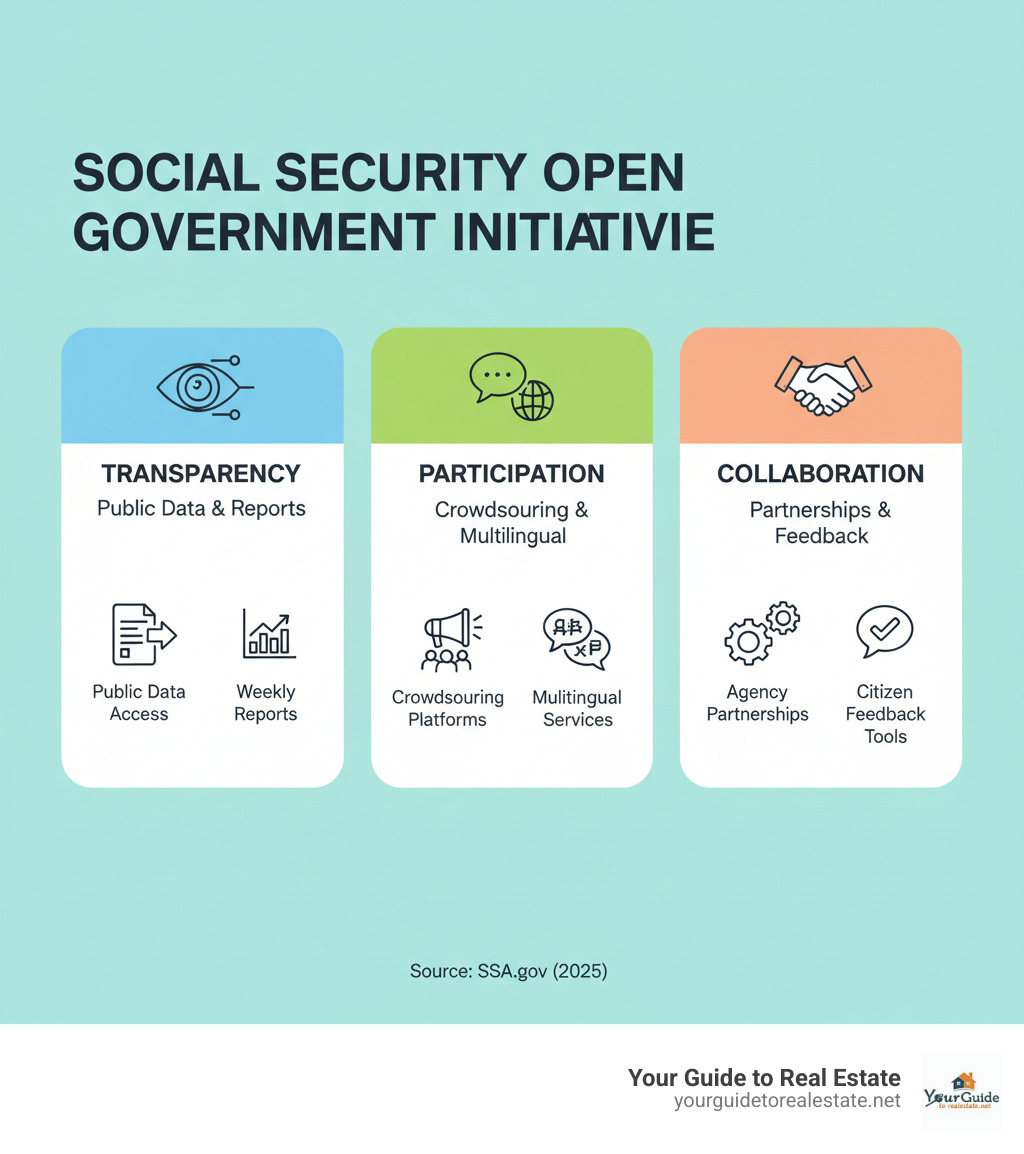
Social security transparency initiatives terms to learn:
1. The Open Government Initiative: A Framework for Public Trust
The Social Security Administration didn’t just wake up one day and decide to be more transparent. Their social security transparency initiatives are built on a solid foundation called the Open Government Initiative – a thoughtful framework that puts public trust front and center.
Think of it like this: imagine if your bank suddenly started showing you exactly how they handle your money, invited you to suggest improvements, and actually listened to your feedback. That’s essentially what the SSA is doing through their Open Government Portal.
The initiative rests on three simple but powerful ideas: transparency, participation, and collaboration. Instead of operating behind closed doors, the SSA now proactively shares datasets about how they’re organized and managed. They’ve also made information more digestible through press releases, public service announcements, and webinars that actually make sense.
But here’s where it gets interesting – they’re not just talking at us anymore. The SSA has expanded online services in both English and Spanish, improved their feedback tools, and even set up crowdsourcing platforms where regular folks can submit ideas. It’s like having a voice in how your own benefits are managed.
For detailed information about their comprehensive approach, check out The SSA’s comprehensive Open Government Plan.
Core Goals of social security transparency initiatives
The SSA’s transparency efforts aren’t happening in a vacuum. They’re part of a much bigger federal push toward openness and accountability that affects how all government agencies operate.
The real game-changer came with the Foundations for Evidence-Based Policymaking Act of 2018 (Evidence Act). This legislation basically told federal agencies: “Show your work.” It established new requirements for data governance, management, and public engagement that push agencies toward making decisions based on actual evidence rather than guesswork.
You can see this commitment in action through the SSA’s increased openness in their communications. Their press releases now cover everything from policy changes to benefit adjustments. Public service announcements help spread crucial information through various media channels. And those educational webinars? They’re designed to help you understand complex topics without needing a law degree.
The goal isn’t just to make information available – it’s to actively communicate with the public in ways that actually help. That’s a refreshing change from the old days of government bureaucracy.
Fostering Participation and Collaboration
Here’s where things get really exciting. The SSA has moved beyond just sharing information – they’re actively asking for your input and ideas.

Through public crowdsourcing efforts, the SSA uses platforms like Ideascale to gather diverse perspectives from real people dealing with real Social Security issues. It’s like having a digital town hall where your voice actually matters in policy development.
The agency has also invested in improved feedback tools that make it easier to share your thoughts and concerns. Their multi-language online services ensure that language barriers don’t prevent people from participating in the conversation.
This collaborative approach bridges the gap between government and citizens in a meaningful way. Instead of feeling like Social Security is something that happens to you, these initiatives help it feel like something you can actually influence and understand.
For anyone planning their financial future – whether that’s buying a home or preparing for retirement – this transparency makes it easier to make informed decisions about your benefits and long-term security.
2. Data Hubs and Public Reports: Following the Numbers
The Social Security Administration has acceptd a powerful truth: transparency starts with sharing real numbers. Gone are the days when we had to wonder what was happening behind closed doors at the SSA. Today, we can actually peek inside and see how our most important safety net program operates day-to-day.
Think of it like finally getting to see your favorite restaurant’s kitchen – suddenly everything makes more sense! The SSA now publishes weekly operational reports that show us exactly what challenges they’re facing and how they’re tackling them. These aren’t boring government documents hidden away somewhere. You can find them right on their website, and they even share updates through SSA’s YouTube channel.
What’s really exciting is that we can now see customer service metrics in real-time. Wait times, processing delays, agency decisions – it’s all there. The SSA has committed to being more honest about these challenges rather than pretending everything runs perfectly. This means we can better plan our visits and understand why certain processes might take longer than expected.
The agency has also joined the broader Open Data movement, making datasets available through platforms like Data.gov since 2009. These social security transparency initiatives give researchers, journalists, and curious citizens the tools to analyze trends and understand how the system really works.

Accessing Operational Data and Performance Metrics
The Open Data at SSA portal serves as your gateway to understanding how the agency really operates. It’s like having a backstage pass to government operations – you can explore public data listings, learn about Freedom of Information Act (FOIA) requests, and dive deep into performance reports.
This transparency helps us understand everything from benefit calculations to agency management decisions. Just like understanding a company’s financial health requires looking at detailed reports (similar to how More info about How to Calculate Retained Earnings helps investors), grasping SSA operations means digging into their data.
The agency follows an “open by default” philosophy, guided by federal guidelines that encourage civic engagement while protecting our privacy. This means they proactively share information rather than waiting for us to ask for it. Whether you’re planning your retirement, helping elderly parents steer the system, or just curious about how your tax dollars are being used, these resources provide unprecedented insight.
Understanding Internal Restructuring and Efficiency Efforts
The SSA isn’t just transparent about its services – it’s also honest about the tough internal changes happening right now. The agency is working to streamline operations, which includes some significant workforce changes. They’re reducing staff from about 57,000 to 50,000 employees through voluntary departures and reassignments.
Here’s what’s happening: nearly 2,500 employees were offered voluntary separation packages, while over 2,200 others are being moved into direct customer service roles. The goal is putting more people on the front lines where they can help us directly.
The SSA is also partnering with the General Services Administration (GSA) to optimize their office space. This means identifying underused buildings and potentially consolidating operations for better efficiency. While these changes aim to save taxpayer money through cost avoidance, they’ve raised concerns about potential field office closures and longer wait times, especially in rural communities.
The agency acknowledges these challenges head-on. Rather than sugar-coating the situation, they’re committed to providing honest updates about customer service issues and wait times. This transparency helps us understand what to expect and shows they’re taking accountability for the changes ahead.
3. ‘my Social Security’ Accounts: Empowering Beneficiaries and Fighting Fraud
Your Social Security benefits deserve the strongest protection possible. That’s exactly what the SSA is working to provide through improved security measures in their ‘my Social Security’ online accounts. These digital portals have become your first line of defense against increasingly sophisticated fraud attempts that could steal your hard-earned benefits.

The reality is sobering: criminals are using personal information found on the dark web to steal benefits from unsuspecting Americans. Your name, Social Security number, and other personal details might already be floating around in these digital criminal marketplaces. The SSA’s response? Stricter identity verification requirements that make it much harder for fraudsters to succeed.
When you need to apply for cash benefits or change your direct deposit information, you’ll now face improved security measures. You can either authenticate through your secure ‘my Social Security’ account online or verify your identity in person at a local field office. While this might seem like an extra step, it’s actually your shield against benefit theft. You can get started with Secure access to your Social Security statement to see how straightforward the process really is.
The best part? If you’re not applying for cash benefits or changing your direct deposit, you don’t need to take any action at all. These social security transparency initiatives are specifically targeted at the most vulnerable points where fraud typically occurs.
New Identity Verification and Its Impact
Let’s break down what these changes mean for you in practical terms. The old system relied on knowledge-based authentication – those questions about your previous addresses or loan amounts. Unfortunately, criminals found ways around these questions using information from data breaches and dark web purchases.
The new approach is much more secure. You’ll need to use one of two verification methods, and here’s how they compare:
| Feature | Online Verification via ‘my Social Security’ | In-Person Verification at a Field Office |
|---|---|---|
| Convenience | Most convenient, accessible 24/7 | Requires travel and appointments |
| Speed | Often instant | Can involve longer processing times |
| Documentation | Digital identity proofing | Requires physical documentation |
| Who it impacts | New applicants, those changing direct deposit | New applicants, those changing direct deposit |
| Best for | Tech-savvy individuals, remote users | Individuals without online access, complex cases |
The online route through your ‘my Social Security’ account offers convenience and speed. You can complete the verification process from your couch at midnight if that works better for your schedule. The digital identity proofing technology is sophisticated enough to confirm you are who you say you are without requiring a trip anywhere.
If you prefer face-to-face interaction or don’t have reliable internet access, the in-person option at field offices remains available. You’ll need to bring proper identification and any necessary documentation, but you’ll have the peace of mind that comes from talking directly with SSA staff.
Parents applying for benefits for children under 18 have a slightly different process. Your child doesn’t need to appear in person, but you’ll need to provide your own identification and proof of your relationship to the child. It’s designed to be family-friendly while maintaining security.
Addressing Accessibility for Vulnerable Populations
We understand that not everyone finds these new requirements easy to steer. Rural communities, elderly individuals without internet access, and people with disabilities may face real challenges with improved verification procedures. The SSA recognizes these concerns and is working hard to ensure no one gets left behind.
The agency maintains its commitment to serving all Americans, regardless of their comfort level with technology or their geographic location. While they encourage online verification for its convenience and speed, the in-person option isn’t going anywhere. Field offices continue to provide full verification services for anyone who needs them.
For people in rural areas where the nearest Social Security office might be hours away, the SSA is exploring additional support options. They’re also working to ensure that individuals with disabilities have appropriate accommodations throughout the verification process.
The goal isn’t to make accessing benefits harder – it’s to make stealing them nearly impossible. These social security transparency initiatives represent a careful balance between protecting your benefits from criminals and maintaining access for legitimate beneficiaries. The SSA continues to refine these processes based on public feedback and real-world experience, always keeping accessibility at the forefront of their planning.
4. Strategic Partnerships: Improving Services Through Collaboration
The Social Security Administration doesn’t work alone – and that’s actually great news for all of us. When it comes to social security transparency initiatives and making services better, the SSA has finded that teamwork makes the dream work. They’ve been building partnerships with healthcare providers, other government agencies, and organizations that bring fresh ideas and better technology to the table.
These collaborations aren’t just feel-good handshakes. They’re designed to cut through red tape, speed up processes, and make life easier for people who depend on Social Security benefits. Think of it like renovating a house – sometimes you need to bring in specialists who know plumbing, electrical work, and carpentry to get the job done right.
The SSA’s partnership approach shows they understand that working together creates better outcomes than going it alone. This is especially important when you’re dealing with millions of Americans who need timely, accurate service.
Enhancing Disability Claims with Health IT
One area where these partnerships really shine is in disability claims processing. If you’ve ever waited for medical records to be transferred between doctors, you know how painfully slow paper-based systems can be. The SSA figured this out too and decided to do something about it.
Their partnership with Kaiser Permanente has been a game-changer. Instead of waiting weeks for paper files to arrive by mail, medical records now zip electronically from Kaiser’s systems directly to the SSA. This means faster decisions for people who are already dealing with serious health challenges.
The SSA has also teamed up with the Department of Defense (DoD) to create a similar program for military personnel and veterans. When someone who served our country needs disability benefits, their military medical records can be transmitted electronically too. This collaboration is particularly valuable for people on the Compassionate Allowance List – those with conditions so severe that their claims should be fast-tracked.
These electronic medical record partnerships represent a major shift from the old days of faxed forms and lost paperwork. It’s the kind of efficiency improvement that makes a real difference in people’s lives when they need help most.
Aligning with Broader Financial Concepts
Managing a massive organization like the SSA requires the same kind of financial discipline that successful companies use. Understanding how large entities manage funds can be complex, similar to understanding a company’s financial health through its Statement of Retained Earnings.
The SSA’s strategic partnerships are really about government efficiency and being smart with taxpayer resources. When they collaborate with healthcare providers to speed up claims processing, they’re not just helping individuals – they’re also reducing administrative costs and making the whole system run more smoothly.
These efficiency efforts reflect a commitment to long-term sustainability. Just like a well-managed company reinvests its profits wisely, the SSA is investing in partnerships and technology that will keep Social Security strong for future generations. It’s about making every dollar count while delivering better service to the people who need it.
5. The SSA’s Public Communications: Your Source for Social Security Transparency Initiatives
Think about the last time you tried to get information from a government agency. Frustrating, right? Well, the Social Security Administration is working hard to change that experience. They understand that having information available isn’t enough – they need to actively reach out and connect with us in ways that actually make sense.
The SSA’s Press Office acts like the agency’s main communication hub, constantly pushing out press releases, policy updates, and important announcements. But here’s what’s really impressive: they’re not stuck in the past with just traditional media. The SSA hosts webinars where real people can ask real questions about everything from retirement planning to disability benefits. It’s like having a direct line to the experts without the usual government runaround.
You’ll find the SSA actively engaging on social media platforms like Facebook, X (Twitter), and LinkedIn. They share updates, answer questions, and actually seem to care about connecting with their community. If you want to stay in the loop without constantly checking their website, you can easily Subscribe to the Press Office for direct email updates straight to your inbox.
How the SSA Keeps the Public Informed
The SSA takes a smart, multi-layered approach to keeping us informed. Press releases flow regularly, covering everything from policy changes to service updates. These aren’t just meant for reporters – they’re written for everyday Americans who need to understand what’s happening with their benefits.
One area where the SSA really shines is combating scams. They regularly launch public awareness campaigns warning people about imposter scams and teaching us how to protect our personal information. This isn’t just helpful – it’s essential when you consider how sophisticated these fraudsters have become.
The agency also uses their YouTube channel for weekly operational reports and publishes detailed agency decisions on their website. This means you can choose how you want to get your information – whether you prefer watching videos, reading detailed reports, or getting quick social media updates. It’s refreshing to see a government agency that recognizes people have different preferences for consuming information.
The Future of social security transparency initiatives
The SSA’s commitment to social security transparency initiatives isn’t a one-and-done project – it’s an ongoing evolution. We can expect continued improvements in digital modernization and more sophisticated ways for citizens to provide feedback. The goal is creating what they call a “citizen feedback loop” where public input actually shapes future policy decisions.
This approach reminds us of how transparency works in real estate. When buyers and sellers have access to clear market data and honest communication, everyone makes better decisions. The same principle applies to government – when agencies like the SSA accept openness, it empowers all of us to better understand and steer the system.
The SSA recognizes that evolving technology will continue to create new opportunities for transparency and engagement. As they modernize their digital platforms and refine their communication strategies, we should see even more responsive and accessible services. It’s encouraging to see a government agency that’s willing to adapt and improve based on what we, the people they serve, actually need.
Frequently Asked Questions about Social Security Transparency
We know navigating social security transparency initiatives can feel overwhelming, so let’s tackle the most common questions we hear from people just like you. These changes affect millions of Americans, and understanding them is crucial for your financial planning – whether you’re thinking about retirement or major investments like buying a home.
Why is the SSA implementing stricter identity verification?
The simple answer? Fraudsters have gotten scary good at stealing benefits. Personal information that was once private is now readily available on the dark web, making it easier than ever for criminals to impersonate you and steal your Social Security benefits.
The old system of asking security questions like “What street did you live on in 2015?” just doesn’t cut it anymore. Scammers can easily find this information online and use it to redirect your benefits to their own bank accounts. By requiring either a secure ‘my Social Security’ account or an in-person visit, the SSA is putting up stronger walls to protect your financial future.
Think of it like upgrading from a basic door lock to a high-tech security system. It might be a bit more work upfront, but it’s worth it to keep your benefits safe from thieves who could drain years of your hard-earned Social Security payments.
How can I give feedback or participate in SSA policy-making?
Here’s something many people don’t realize: the SSA actually wants to hear from you! Through their Open Government Initiative, they’ve created several ways for regular citizens to influence how Social Security operates.
The easiest way is through their Ideascale platform, where you can submit suggestions and vote on ideas from other Americans. It’s like a suggestion box that actually gets read and considered when making policy decisions.
You can also use the official feedback tools on the SSA’s website or engage with them on social media. They’re active on Facebook, X (formerly Twitter), and LinkedIn, where they regularly respond to questions and concerns. Many people find social media to be the fastest way to get answers to specific questions.
The goal is creating a citizen feedback loop where your real-world experiences help shape future policies. After all, who better to tell them what’s working (or not working) than the people actually using these services?
Will these changes lead to office closures or longer wait times?
This is probably the question we hear most often, and it’s completely understandable why people are worried. The SSA is indeed making significant changes to optimize their operations, including reducing their workforce from about 57,000 to 50,000 employees and working with the General Services Administration to identify underused office spaces.
The agency acknowledges these concerns head-on. They know that workforce reductions and office consolidations could potentially impact service delivery, especially for people in rural areas or those who rely heavily on in-person services.
But here’s what they’re doing about it: The SSA has committed to increasing transparency about customer service challenges, including publishing detailed information about wait times for both their 800 number and field offices. They’re also working to provide multiple service channels, so you’re not stuck with just one option if your local office closes.
The bottom line? Yes, some changes are coming, but the SSA is being more open than ever about potential challenges and is actively working to minimize disruptions. They understand that for many Americans, Social Security isn’t just a government program – it’s a lifeline that affects everything from daily expenses to major financial decisions like homeownership.
Conclusion
The Social Security Administration’s commitment to social security transparency initiatives represents something truly meaningful – a government agency that’s finally opening its doors and inviting us all inside. These aren’t just policy changes happening in some distant bureaucratic office; they’re real improvements that affect your daily life, your family’s security, and your future financial planning.
Think about what we’ve covered together. The SSA is now sharing weekly reports about their challenges and successes, making their data freely available online, and even posting updates on YouTube. They’ve created secure online portals to protect your benefits from sophisticated fraud schemes, while still ensuring that everyone – including those without internet access – can get the help they need.
These efforts go far beyond simple government reform. They’re about empowering you with the knowledge and tools to make informed decisions about your financial future. When you understand how your Social Security benefits work, when you can access your earnings history instantly, and when you know exactly what to expect – that’s when you can truly plan ahead with confidence.
Here at Your Guide to Real Estate, we see this connection every day. Understanding your benefits is a key step in long-term financial planning – the same foundation that helps you qualify for mortgages, plan for retirement, and make smart property investments. Your Social Security statement isn’t just a government document; it’s a crucial piece of your financial puzzle that affects everything from your debt-to-income ratio to your retirement timeline.
The beauty of these transparency efforts is that they make complex financial planning more accessible. Just like we help simplify the real estate process for our clients, the SSA is working to explain Social Security. By leveraging these resources and staying informed about ongoing changes, you’re building the financial clarity that opens doors to homeownership and other major life goals.
We encourage you to dive into these valuable resources, create your secure online account, and take an active role in understanding your benefits. When you’re ready to turn that financial confidence into real estate success, learn more about modern real estate solutions and find how a solid financial foundation can support all your property dreams.