

Understanding the Foundation of Financial Health
A statement of retained earnings shows how much profit a company has kept and reinvested in its business after paying dividends to shareholders. This financial document reveals the accumulated earnings that form the backbone of a company’s growth potential and financial stability.
Quick Answer for Statement of Retained Earnings:
- What it is: A financial statement showing changes in retained earnings over a specific period
- Formula: Beginning Retained Earnings + Net Income – Dividends = Ending Retained Earnings
- Purpose: Tracks how much profit stays in the business vs. gets paid to shareholders
- Location: Part of shareholders’ equity on the balance sheet
- Key insight: Shows management’s reinvestment strategy and company’s financial strength
Think of retained earnings like the roots of a tree. Just as roots anchor the tree, absorb nutrients, and fuel growth, retained earnings form the foundation that supports a company’s future expansion and weathering of financial storms.
Banks typically lend three to four times what a company has in equity – and retained earnings make up a major portion of that equity. This makes the statement crucial for understanding not just past performance, but future borrowing capacity and investment potential.
For real estate investors and anyone analyzing companies, this statement connects the dots between the income statement (how much profit was made) and the balance sheet (where that profit ended up). It answers a critical question: Is this company reinvesting in growth or returning cash to shareholders?
Statement of retained earnings glossary:
The Core Components and Formula for Retained Earnings
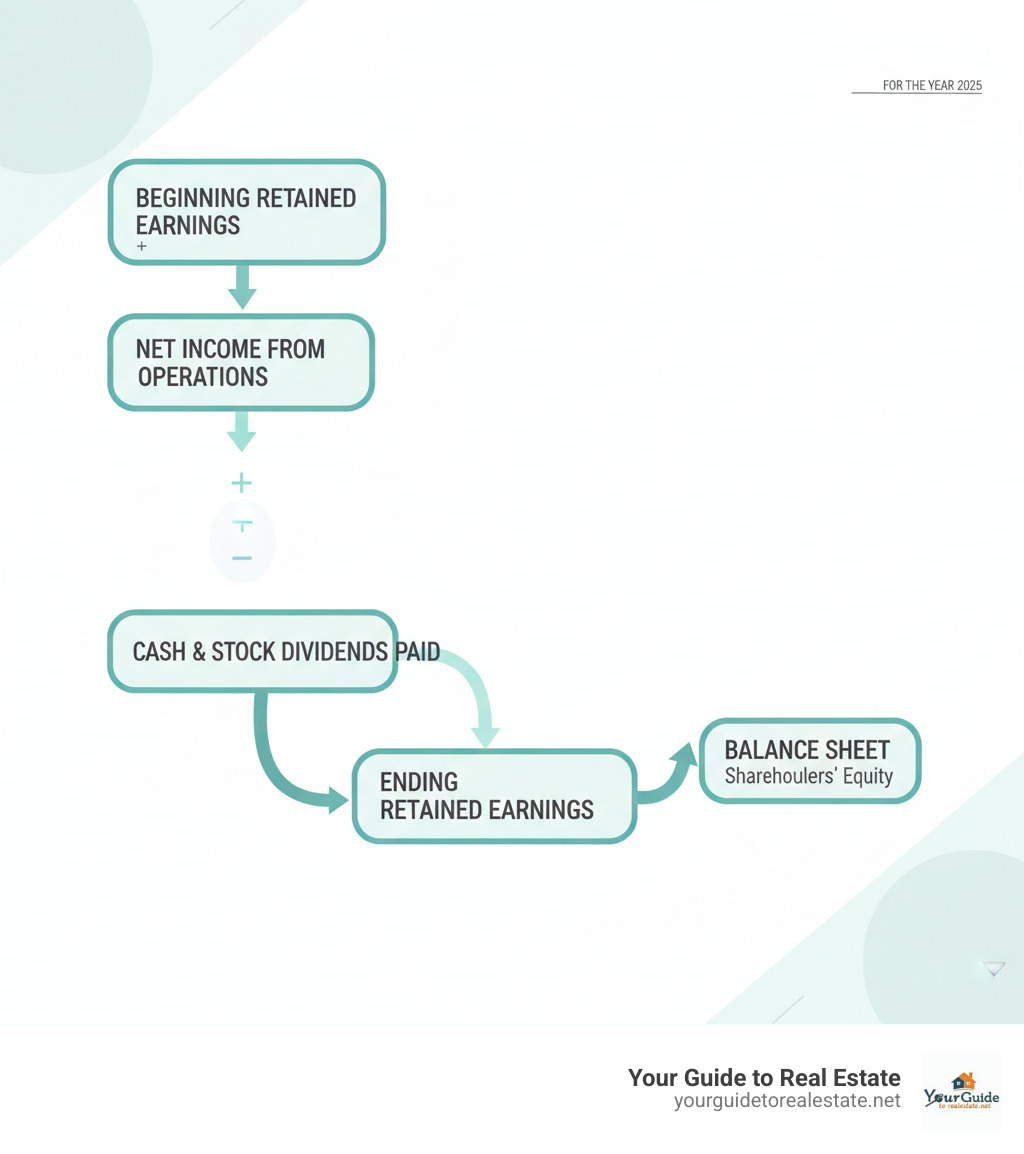
At its heart, the statement of retained earnings is a simple yet powerful reconciliation tool. It takes the retained earnings balance from the beginning of an accounting period, factors in the net income or loss generated during that period, and then subtracts any dividends paid out to shareholders. The result is the ending retained earnings balance, which then carries over to the balance sheet.
Let’s look at a classic example to illustrate this. Imagine a company, let’s call it “Winnie’s Web Design, LLC.”
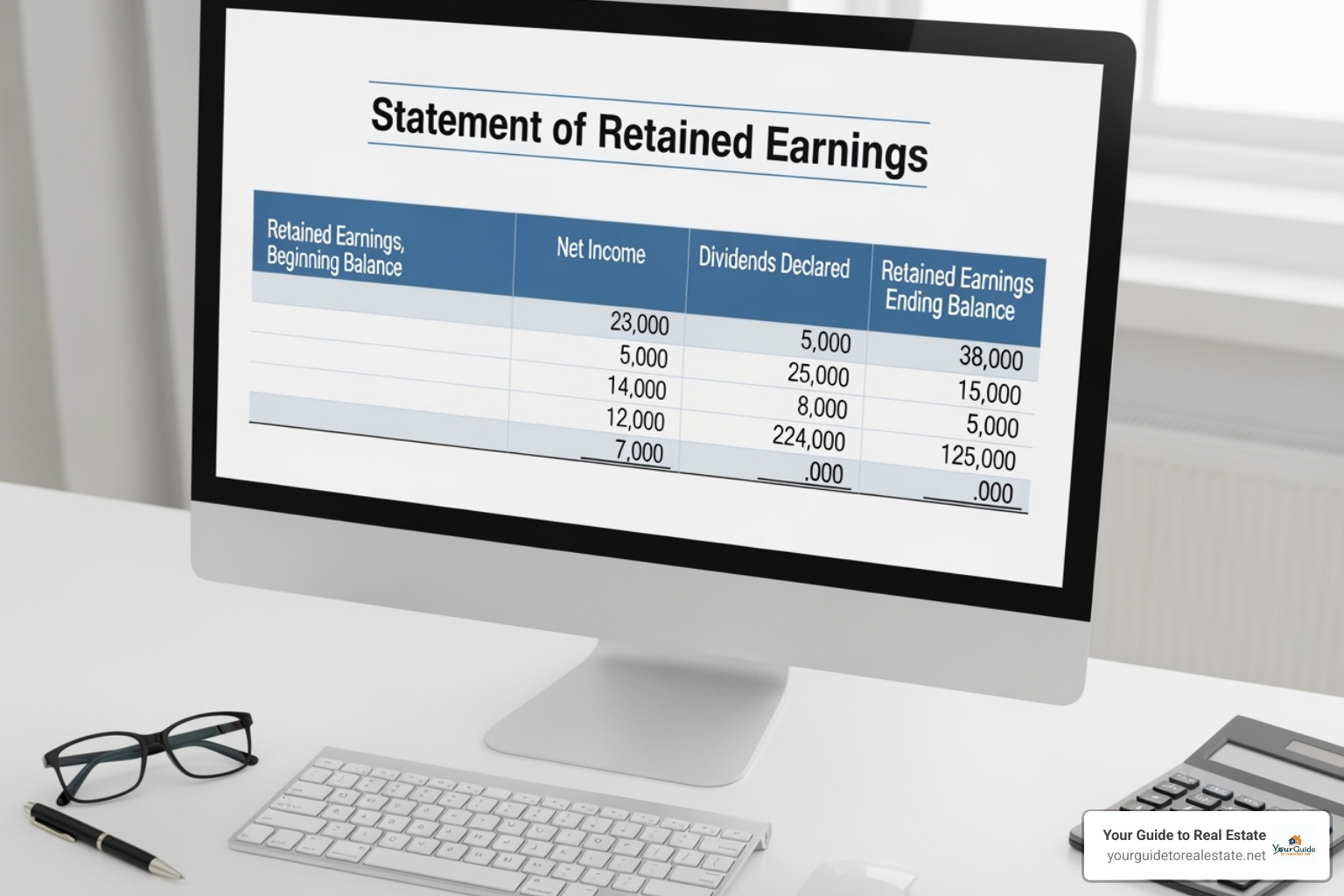
For the year ended December 31, 2020, Winnie’s Web Design, LLC’s statement of retained earnings would look something like this:
- Retained earnings at December 31, 2019 (Beginning Balance): $95,000
- Net income for the year ended December 31, 2020: $45,000
- Dividends paid to shareholders: ($15,000)
- Retained earnings at December 31, 2020 (Ending Balance): $125,000
This simple example shows us how the pieces fit together. The company started with $95,000 in accumulated profits, added $45,000 from its successful year, and then distributed $15,000 to its owners, leaving $125,000 to reinvest or keep for future needs.
Another common example found in our research illustrates this clearly: if a company has a $100,000 beginning balance, earns $50,000 in net income, and pays $20,000 in cash dividends, its ending retained earnings balance would be $130,000. It’s a straightforward calculation that offers deep insights.
The Official Formula for Calculating Retained Earnings
The formal calculation for retained earnings is:
Ending Retained Earnings = Beginning Retained Earnings + Net Income (or – Net Loss) – Cash Dividends – Stock Dividends
Let’s break down each component:
- Beginning Retained Earnings: This is the accumulated retained earnings from all prior periods, carried over from the previous period’s balance sheet. It’s the starting point for our calculation.
- Net Income (or Net Loss): This figure comes directly from the income statement for the current accounting period. It represents the company’s profit or loss after all expenses and taxes have been accounted for. A net income increases retained earnings, while a net loss decreases them.
- Cash Dividends: These are distributions of cash paid out to shareholders. Once declared, the company owes these funds to shareholders, and they reduce both the company’s cash and its retained earnings.
- Stock Dividends: Less common than cash dividends, stock dividends involve distributing additional shares of the company’s stock to existing shareholders. While they don’t involve a cash outflow, they still reallocate a portion of retained earnings to other equity accounts (like common stock and additional paid-in capital), reducing the retained earnings balance and decreasing the value of stocks per share.
Sometimes, you might also see prior period adjustments in the statement. These are corrections for errors made in previous accounting periods, improper accounting methods, or poor estimates. These adjustments can either increase or decrease the beginning retained earnings balance before the current period’s net income and dividends are factored in. Accuracy and consistency in reporting are crucial here, as any discrepancies can mislead stakeholders.
How Net Income Impacts Retained Earnings
Net income is the lifeblood of a company’s financial health, and it has a direct and profound impact on retained earnings. Simply put:
- When a company generates net income (a profit): This profit is added to the beginning retained earnings balance. The more profitable a company is, the more it can retain, leading to a higher ending retained earnings balance. This signifies growth and the ability to reinvest in the business.
- When a company incurs a net loss: This loss is subtracted from the beginning retained earnings balance. Consistent losses will deplete retained earnings and can even lead to a negative balance, known as an accumulated deficit.
The impact of net income is cumulative. Over many periods, consistent profitability allows a company to build a substantial base of retained earnings, which can then be used for various strategic purposes. This accumulation is a key indicator of a company’s long-term success and financial resilience.
How Dividends Impact Retained Earnings
Dividends represent the portion of a company’s profits that are distributed to its shareholders. They are a direct reduction to retained earnings. This is where the company decides how much of its hard-earned profits to keep and how much to give back to its investors.
- Cash Dividends: These are the most common type of dividend. When a company declares and pays cash dividends, it reduces both its cash assets and its retained earnings. This is a straightforward outflow of funds from the company to its owners.
- Stock Dividends: Instead of cash, shareholders receive additional shares of the company’s stock. While this doesn’t reduce the company’s cash, it does transfer an amount from retained earnings to other equity accounts, such as common stock and additional paid-in capital. The total shareholder equity remains the same, but the composition changes, and the value per share typically decreases due to more shares outstanding.
The decision to pay dividends versus retaining earnings is a strategic one, influenced by a company’s growth opportunities, cash flow, and shareholder expectations. For companies, especially those in the real estate sector, understanding this balance is vital when considering future investments, property acquisitions, or development projects.
To explore how these financial decisions tie into broader funding strategies, you might find our insights on Real Estate Financing particularly helpful. It highlights how a company’s internal financial strength, including its retained earnings, directly impacts its ability to secure external funding for real estate ventures.
Analyzing and Interpreting the Statement of Retained Earnings
Reading a statement of retained earnings is like looking at a company’s financial diary – it tells you the story of how management treats the money they’ve earned. This simple document reveals whether a company is focused on growth, committed to rewarding shareholders, or struggling to stay afloat.
Investors love digging into this statement because it shows them exactly what management does with profits. Picture two companies: a hot tech startup might keep every penny of profit to fund new products and hire more developers. Meanwhile, a steady utility company might pay out most of its earnings as dividends since they don’t need massive reinvestment. Both strategies can be smart – it just depends on what you’re looking for as an investor.
Lenders take a completely different approach when analyzing retained earnings. Banks and other financial institutions see retained earnings as a key part of a company’s equity – and that directly affects how much they’re willing to lend. Here’s a powerful statistic that might surprise you: banks typically lend three to four times what a company has in equity. Since retained earnings make up a major chunk of that equity, a strong retained earnings balance can dramatically boost a company’s borrowing power.
Think about it this way – if your real estate development company has built up $500,000 in retained earnings over the years, that solid financial foundation could help you secure loans of $1.5 to $2 million for your next project. That’s the kind of leverage that can transform a small operation into a major player.
For anyone serious about understanding how retained earnings fit into the bigger financial picture, our comprehensive Guide to Retained Earnings breaks down everything you need to know.
What Does Negative Retained Earnings Mean?
Negative retained earnings – also called an accumulated deficit – happens when a company’s total losses and dividend payments exceed all the profits it’s ever made. It’s like having a negative bank account balance, but for the company’s entire financial history.
The most common culprit is simply losing money year after year. When expenses consistently outpace revenue, those losses pile up and create an accumulated deficit. This is a red flag that signals serious operational problems or an unsustainable business model.
Sometimes high dividend payouts cause the problem. Imagine a company that earned $100,000 total over five years but paid out $120,000 in dividends. The math doesn’t work – they’re literally giving away money they never earned. While shareholders might enjoy those fat dividend checks, this practice can cripple the company’s financial strength.
Age matters a lot when interpreting negative retained earnings. Startup companies often show accumulated deficits because they’re burning cash to grow rapidly. A three-year-old software company with negative retained earnings might be perfectly healthy if they’re investing heavily in product development and customer acquisition.
But when an established company – say, a 20-year-old manufacturing firm – shows negative retained earnings, that’s usually a sign of potential financial weakness. It suggests years of poor performance or questionable management decisions about profit distribution.
Calculating the Retention Ratio
The retention ratio (sometimes called the plowback ratio) tells you exactly what percentage of profits a company keeps versus what it pays out to shareholders. It’s calculated with this simple formula: (Net Income – Dividends) / Net Income.
This ratio reveals a company’s true strategy. Let’s say a major technology company earns $1 million and pays $250,000 in dividends. Their retention ratio would be 75%, meaning they’re keeping three-quarters of their profits to reinvest in growth.
Apple provides a fascinating real-world example. From 1995 to 2012, Apple paid zero dividends – giving them a 100% retention ratio. Every dollar of profit went back into developing products like the iPhone and iPad. Even after they started paying dividends in 2012, Apple typically maintains a retention ratio of 70-75%, still keeping most profits for innovation and expansion.
Industry context makes all the difference. A rapidly growing real estate development company might retain 90% of earnings to fund new projects, while a mature property management firm might only retain 40% since they don’t need massive reinvestment. Neither approach is wrong – they just reflect different business realities and growth opportunities.
The key is consistency and alignment with what the company says it’s trying to accomplish. Wild swings in retention ratios often signal confused management rather than clear strategic thinking.
Connecting the Dots: Retained Earnings and Other Financial Statements
If you’ve ever felt like financial statements are a jumbled puzzle, don’t worry! The statement of retained earnings is actually a fantastic piece that helps connect everything, making the whole picture clear. Think of it as the friendly messenger between two very important financial documents.
This interconnectedness is super important for anyone trying to understand a company’s full financial story. The statement of retained earnings acts like a crucial link, showing how a company’s performance over a period (what we see on the income statement) ties into its financial position at a specific moment (what we find on the balance sheet).
Imagine your company’s financial journey unfolding. First, you have the Income Statement, which proudly shows off how much profit (or loss) you made this year. Then, this profit takes a little trip over to the statement of retained earnings. This is where we decide what to do with that hard-earned cash – keep it for growth or share it with owners. Finally, the leftover amount, your accumulated savings, lands safely on the Balance Sheet, showing how strong your company’s financial position is right now.

It’s a continuous loop that tells a comprehensive story of how a company generates and uses its profits, helping you see the bigger picture of its financial health.
Where Are Retained Earnings Reported on a Balance Sheet?
When you peek at a company’s Balance Sheet, you’ll find retained earnings nestled comfortably within the Shareholder’s Equity section. Think of Shareholder’s Equity as the owners’ slice of the company pie – what’s left after all debts are paid. It’s made up of things like the money investors first put in (like Common Stock), any extra money they paid for shares (Additional Paid-in Capital), and, importantly, all the profits the company has held onto over time.
It’s super important to remember this one thing: while retained earnings come from profits, they aren’t a big pile of cash sitting in a vault! Instead, those profits have likely been reinvested. Maybe they bought new equipment, paid down debt, or funded exciting new projects. For anyone in real estate, understanding how robust these retained earnings are can really change how you look at a company’s Real Estate Valuation. A company with a healthy chunk of retained earnings often means a stronger financial foundation, which can be a real plus when you’re thinking about its value and ability to invest in new properties.
What Is the Difference Between Retained Earnings and Net Income?
It’s easy to mix up retained earnings and net income, but they’re like two different chapters in the same book. Net income is your company’s profit for just one specific period – like how much you earned last month or last year. It’s a snapshot of recent success, what we call a “flow” of money.
On the other hand, retained earnings is the grand total of all the profits your company has ever kept since it started, after paying out any dividends along the way. It’s a cumulative number, like a running tally of your business’s savings account over its entire lifetime. So, a company might have a fantastic net income this year but still have modest retained earnings if it’s always paid out big dividends. Or, it could have a so-so year but boast huge retained earnings from decades of smart financial choices. Knowing the difference helps you see the full story!
Can the Income Statement and Statement of Retained Earnings Be Combined?
Sometimes, especially for smaller businesses or for internal reports, you might see the information from the statement of retained earnings tucked into another financial report. It’s like combining two short stories into one slightly longer one to save space!
For instance, the details about retained earnings might pop up as an extra note on the Income Statement or be part of the Shareholder’s Equity section on the Balance Sheet. There’s also something called a Statement of Comprehensive Income or a Statement of Changes in Equity which can bring everything together. While accounting rules (like GAAP) often suggest separate reports for clarity, combining them can make things simpler for small businesses. But for investors and lenders, having clear, separate statements usually makes it much easier to understand a company’s financial health at a glance.
Frequently Asked Questions about Retained Earnings
Let’s be honest – financial statements can feel overwhelming at first glance. But once you understand the basics, the statement of retained earnings becomes one of the most revealing windows into a company’s financial soul. Here are the questions we hear most often, answered in plain English.
Are retained earnings the same as cash?
This is probably the biggest misconception we encounter, and the answer is a resounding no. Retained earnings and cash are completely different animals.
Think of retained earnings as a historical scorecard of all the profits your company has earned and decided to keep over the years. But here’s the key point: those profits didn’t just sit in a vault collecting dust. The company likely used that money to buy equipment, expand operations, acquire real estate, pay down debt, or fund new projects.
So while a company might show $500,000 in retained earnings on its balance sheet, it might only have $50,000 in actual cash. Where did the other $450,000 go? It transformed into other valuable assets or was used to strengthen the business in other ways.
Retained earnings live in the equity section of the balance sheet, not the assets section. They represent the owners’ claim on the company’s value, not a pile of money waiting to be spent.
What is the relationship between retained earnings and shareholder equity?
Here’s where things get interesting. Retained earnings are actually a major piece of the shareholder equity puzzle – often the biggest piece for successful, established companies.
Shareholder equity represents the total ownership value in a company. It’s what would theoretically be left for the owners if the company sold all its assets and paid off all its debts. This equity comes from two main sources: money that shareholders invested directly (by buying stock) and profits that the company generated and kept (retained earnings).
For many mature, profitable companies, retained earnings make up the lion’s share of total equity. This makes sense when you think about it – a company that’s been profitable for decades can accumulate far more wealth through successful operations than it originally raised from investors.
This relationship is crucial for real estate investors and anyone analyzing companies. Strong retained earnings mean strong equity, which translates to better borrowing power and financial flexibility.
Why are high retained earnings important for a company?
High retained earnings are like having a well-stocked emergency fund and investment account rolled into one. They signal financial strength that goes beyond just current profitability.
Historical success is the first thing high retained earnings tell us. A company doesn’t accumulate substantial retained earnings overnight – it takes years of consistently earning more than it spends. This track record matters enormously to lenders, investors, and business partners.
But retained earnings aren’t just about the past. They provide fuel for future growth without the strings attached to borrowing money or selling more stock. Want to expand into new markets? Acquire that perfect piece of real estate? Fund a major research project? High retained earnings give companies the freedom to say yes to opportunities without waiting for loan approvals or diluting ownership.
Financial resilience might be the most valuable benefit of all. When economic storms hit, companies with substantial retained earnings can weather the downturn, while competitors might struggle to survive. They can continue investing in growth when others are cutting back, often emerging stronger when conditions improve.
Finally, statistic we mentioned earlier: banks typically lend three to four times a company’s equity. Since retained earnings often represent a huge portion of that equity, they directly impact how much a company can borrow for expansion, real estate acquisitions, or other strategic moves.
The sweet spot isn’t always “more is better,” though. Sometimes companies with extremely high retained earnings face questions about whether they should be sharing more of that wealth with shareholders through dividends. But generally speaking, substantial retained earnings are a sign of a company that’s built to last and grow.
Conclusion: Using Financial Statements for Smarter Investments
So, we’ve journeyed through the ins and outs of the statement of retained earnings, and hopefully, you now see it for what it truly is: far more than just a dry accounting report. It’s a living, breathing story of a company’s financial choices, its ambitions, and its wisdom. Here at Your Guide to Real Estate, we believe understanding this statement isn’t just helpful; it’s absolutely vital.
Why? Because it paints a clear picture of a company’s financial health. It tells us if a business is diligently reinvesting its profits back into itself for growth, or if it’s choosing to distribute those earnings to shareholders. This strategy—reinvestment versus distribution—is a huge clue to its future potential, especially when you’re thinking about real estate investment decisions. A company that consistently retains earnings often has the financial muscle to expand, develop new properties, or weather economic shifts.
By really digging into a company’s statement of retained earnings, you’re not just looking at numbers; you’re gaining insight into its long-term viability and strategic direction. Whether you’re a budding real estate investor, a seasoned pro, or a business owner planning to grow, a solid grasp of financial statements like this one empowers you. It helps you make smarter, more informed decisions, giving you that stress-free guidance our proven framework offers. It’s about building a more secure financial future for yourself.
Ready to put these financial insights into action for your real estate ventures? Let’s take the next step together. Learn more about Valuation and Market Analysis in Real Estate to truly sharpen your investment strategy.