

What Stock Brokers Really Earn: Understanding the Income Potential
The stock broker salary landscape is complex and highly variable, with earnings ranging from around $47,000 to over $425,000 annually depending on experience, location, and performance. Understanding these compensation structures is crucial for anyone considering this career path.
Quick Answer: Stock Broker Salary Ranges (2024)
- Average Base Salary: $64,413 – $145,347
- Total Compensation: $174,000 – $325,000+ (including bonuses and commissions)
- Entry-Level: $46,000 – $54,000
- Experienced (20+ years): $99,000 – $102,000+ base salary
- Wall Street Premium: Starting around $134,000, top earners near $300,000
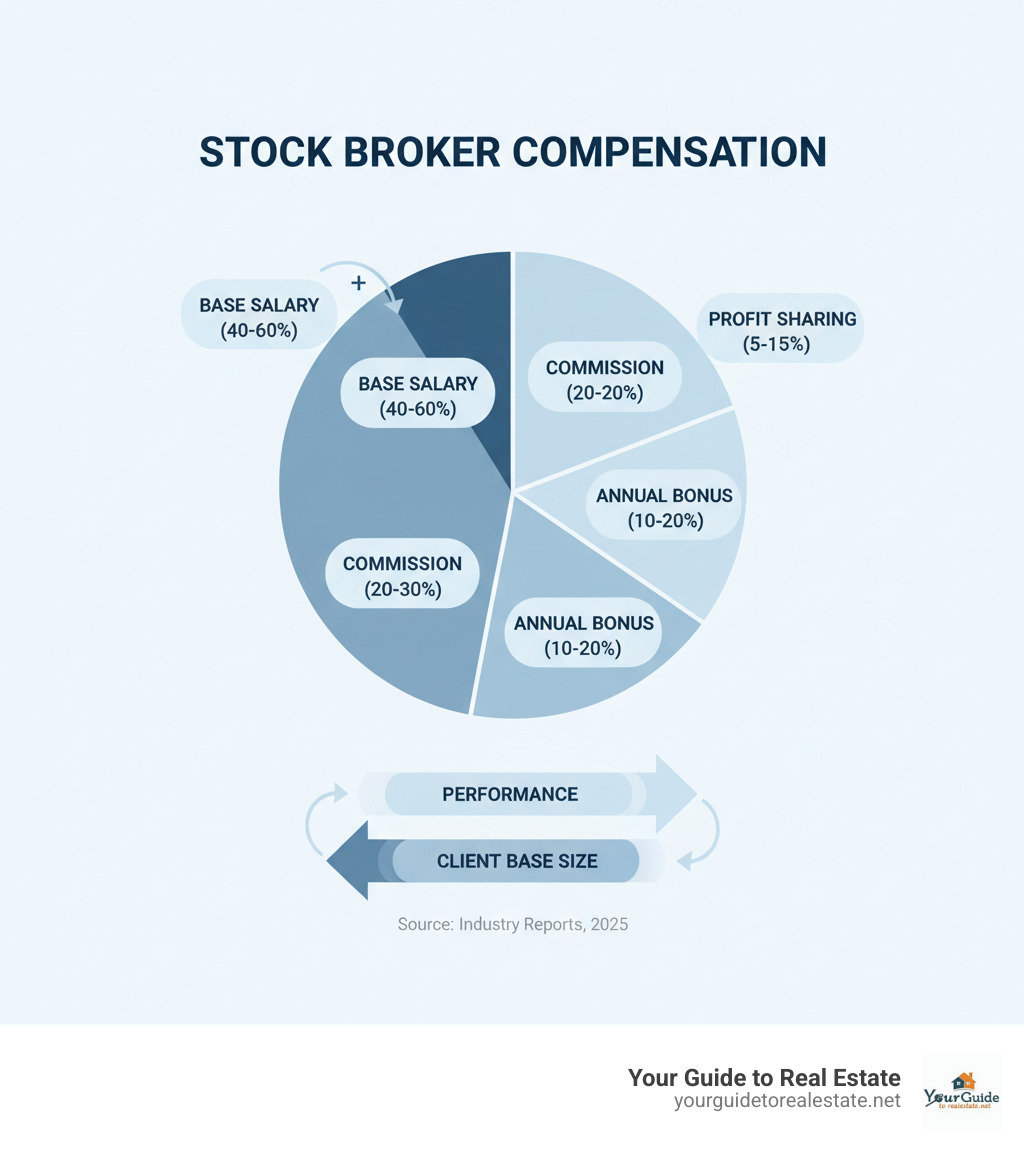
Stock brokers earn money through multiple income streams, not just a base salary. Their total compensation typically includes commissions from trades, performance bonuses, and profit-sharing arrangements. This creates significant earning potential for successful brokers but also means income can fluctuate based on market conditions and individual performance.
The financial services industry offers some of the highest-paying opportunities in the broader economy. According to the Bureau of Labor Statistics, securities and financial services sales agents earn a median wage of $78,140, with the top 10% earning more than $215,210 annually.
Location plays a massive role in earnings. Wall Street brokers can start at $134,000 and reach nearly $300,000, while brokers in smaller markets may earn considerably less. Experience matters too – entry-level brokers typically start around $46,000, while those with 20+ years of experience average over $100,000 in base salary alone.
Simple stock broker salary word guide:
- how do i get my real estate license
- how long does it take to get a real estate license
- choosing a real estate broker
What is the Typical Stock Broker Salary in 2024?
When you start researching stock broker salary figures, you’ll quickly notice something interesting – the numbers are all over the place! It’s like trying to predict which stock will perform best next week. The truth is, there’s no single “typical” salary because so many factors influence what brokers actually earn.
Let’s break down what the major sources are telling us about stock broker salary in 2024. Salary.com reports an average of $94,406 for stock brokers as of May 2024, with earnings typically ranging between $26,482 and $162,331. That’s quite a spread, isn’t it?
The U.S. Bureau of Labor Statistics (BLS) takes a slightly different approach. They group stock brokers under “Securities, Commodities, and Financial Services Sales Agents” and report a median annual wage of $78,140 as of May 2024. What’s really eye-opening is their range – the bottom 10% earned less than $47,080, while the top 10% pulled in more than $215,210. You can dive deeper into their data at Securities, Commodities, and Financial Services Sales Agents.
Here’s where things get really interesting. Glassdoor shows a much higher average stock broker salary of $232,288 per year, with typical pay ranging between $174,216 and $325,203 annually. Their top earners? They’re making up to $425,087 at the 90th percentile. These numbers might make your head spin, but there’s a good reason they’re so much higher.
PayScale offers another perspective with a base salary average of $64,413, but they note that total compensation can range much higher when you factor in bonuses and commissions.
So why such dramatic differences? It all comes down to what’s being measured. Some sources focus on base salary only – that’s your guaranteed paycheck before any performance bonuses. Others include total compensation, which adds in commissions, bonuses, and profit-sharing. This is where successful brokers really shine.
| Source | Average Salary | Median Salary | Typical Range | Lowest 10% | Highest 10% | Notes |
|---|---|---|---|---|---|---|
| Salary.com | $94,406 | N/A | $26,482 – $162,331 | N/A | N/A | May 2024 (base-focused) |
| BLS | N/A | $78,140 | N/A | < $47,080 | > $215,210 | May 2024 |
| Glassdoor | $232,288 | N/A | $174,216 – $325,203 | N/A | > $425,087 | July 2025 (total compensation) |
| PayScale | $64,413 | N/A | $49k – $191k | $49k | $191k | Base salary only |
The key takeaway? A stock broker salary isn’t just about the base pay. The real earning potential comes from performance-based compensation. Think of the base salary as your foundation, but the commissions and bonuses are where you can really build wealth. This explains why some brokers earn modest salaries while others are pulling in six figures or more.
Understanding this distinction is crucial if you’re considering this career path. Your actual earnings will depend heavily on your ability to build client relationships, make successful trades, and steer market conditions. The numbers show there’s serious money to be made – but it takes skill, dedication, and a bit of market savvy to reach those higher tiers.
Key Factors That Influence a Broker’s Earnings

Just like a stock’s value changes with market conditions, your stock broker salary depends on several key factors. These aren’t small tweaks either – they can create huge differences in what you earn. Think of it like buying a house: location, size, and condition all matter tremendously.
The most important factors that shape earnings are performance-based pay structures, client base size, firm type, and area of specialization. Each of these elements works together to determine your total compensation package.
The Impact of Experience on a Stock Broker’s Salary
Experience acts like compound interest for stock brokers – the longer you’re in the game, the more your earning power grows. It makes perfect sense when you think about it. Seasoned brokers have larger client books, deeper market knowledge, and stronger professional networks.
Entry-level brokers with 0-3 years of experience typically start with base salaries between $40,000 and $55,000. PayScale shows new brokers earning around $46,382 annually, while Glassdoor reports total compensation of about $54,045 for those with less than one year of experience. These early years are all about learning the business and building your first client relationships.
Mid-career professionals with 4-9 years of experience see their earnings jump significantly. PayScale data shows brokers with 5-9 years earning an average of $69,500 annually. This is when your client base starts paying real dividends, and you’ve developed the skills to steer different market conditions.
Senior-level brokers with 10-19 years of experience command even higher salaries, averaging around $90,000 according to PayScale research. At this level, you’ve likely weathered multiple market cycles and built a reputation that attracts high-value clients.
Veteran professionals with 20+ years of experience represent the top tier, earning base salaries of $99,000 to $102,000. These seasoned pros often manage the firm’s most important client relationships and mentor younger brokers. Their extensive experience and established client books make them incredibly valuable.
This career progression shows why many successful brokers view their early years as an investment. You can explore detailed career advancement data at PayScale data on career advancement.
Geographic Location: The Wall Street Effect and Beyond
Location creates some of the most dramatic differences in stock broker salary nationwide. The gap between Wall Street and Main Street earnings is honestly jaw-dropping.
Wall Street sets the gold standard for broker compensation. The median Wall Street broker starts at about $134,000 per year – that’s nearly double the national average! Experienced Wall Street traders average around $224,000 annually, while the top 10% approach $300,000 per year. Compare that to other parts of the country where the middle 50% of stock traders earn around $57,600, and you can see why so many brokers dream of making it to New York.
Other major financial hubs also offer premium salaries. Connecticut, New York, and Massachusetts consistently rank among the highest-paying states for securities professionals. Los Angeles brokers earn a whopping 146% more than the national average according to PayScale data. These cities have thriving financial sectors that support higher compensation levels.
Regional markets typically offer more modest salaries. For example, brokers in St. Louis earn about 26% less than the national average. While these markets may not match Wall Street’s glamour, they often provide a better work-life balance and lower cost of living.
Cost of living plays a crucial role here. That impressive Wall Street salary might not stretch as far when you’re paying Manhattan rent prices. Sometimes a smaller salary in a lower-cost area actually provides better purchasing power. You can learn more about these regional differences at The Wall Street salary difference.
Company and Industry: Where You Work Matters
The type of firm you choose can make or break your earning potential. Just like choosing the right partner for any major financial decision, picking the right employer is crucial for maximizing your stock broker salary.
Top-tier investment firms typically offer the most generous compensation packages. Goldman Sachs stock brokers earn around $87,000 annually (47% above average), while Charles Schwab pays about $86,000 (45% above average), and Merrill Lynch offers around $85,000 (43% above average). These figures likely represent base salaries, with total compensation including bonuses and commissions being much higher.
Large banks versus boutique firms present different opportunities. Major investment banks usually provide higher base salaries, comprehensive benefits, and substantial bonus potential due to their massive client bases and institutional relationships. Boutique firms might offer different advantages like higher commission splits or more specialized client focus, though their base salaries may be lower.
Industry specialization significantly impacts earnings potential. The Bureau of Labor Statistics shows that securities and commodity contracts firms pay the highest median wages at $103,370 annually. Management companies also pay well at $99,970 per year. Traditional banking roles in credit intermediation offer lower median wages around $60,900, suggesting that pure brokerage work commands premium compensation.
The key is finding the right match between your skills, career goals, and the firm’s compensation structure. Some brokers thrive in high-pressure, high-reward environments, while others prefer steadier base salaries with moderate commission potential.
How Stock Brokers Are Compensated: Beyond the Base Salary
Here’s something that might surprise you: when we talk about stock broker salary, we’re really talking about a financial puzzle with multiple pieces. Think of it like a real estate agent’s income – it’s not just one steady paycheck, but a combination of different revenue streams that can make the total much more exciting than the base alone.
The magic happens when you understand that most stock brokers earn their real money through performance-based compensation. While some brokers at larger investment firms might receive a modest base salary, the bulk of their income typically comes from how well they perform for their clients and their firm.
Commission structures form the heart of most brokers’ earnings. Every time they execute a trade for a client, they earn a percentage of that transaction’s value. It’s beautifully simple: the more trades they facilitate and the larger those trades are, the more they take home. This creates a direct connection between their hustle and their wallet – something many traditional salary workers never experience.
But wait, there’s more! Annual bonuses add another layer of earning potential. PayScale reports that stockbrokers earn an average yearly bonus of $5,833, though top performers can see bonuses that dwarf this figure. These bonuses often reflect not just individual performance, but how much value the broker brought to their firm’s bottom line.
Profit-sharing arrangements sweeten the deal even further. Some firms share their success directly with their brokers, with PayScale noting an average yearly profit share of $5,129. On Wall Street, the profit-sharing can get truly impressive – some arrangements split profits 50/50 with top-performing traders. Now that’s what we call skin in the game!

This multi-layered compensation model means your stock broker salary can swing dramatically from year to year. Market conditions, client activity levels, and your personal success in building and maintaining client relationships all play starring roles in your annual income. It’s definitely high-stakes and high-reward – your effort and results have a direct impact on your financial success.
For more detailed insights into how bonuses and profit-sharing contribute to a stock broker’s total earnings, check out PayScale reports on bonuses and profit sharing.
The Role of Education and Licensing in Your Earning Potential
You might have natural sales talent and an intuitive grasp of market trends, but in stock brokerage, credentials are your ticket to the dance. Your educational background and professional licenses don’t just open doors – they directly influence how much you can earn.
Let’s start with the bachelor’s degree requirement. Most successful stock brokers hold degrees in finance, economics, or business administration. These programs give you the foundation you need to understand financial markets, interpret economic data, and develop investment strategies that actually make sense to your clients.
If you’re serious about maximizing your stock broker salary and climbing the career ladder, an MBA or Master of Science in Finance can be a game-changer. Advanced degrees often signal deeper expertise and commitment, opening doors to senior positions and more complex advisory roles that come with higher compensation packages.
Now here’s where things get official: FINRA licenses are absolutely non-negotiable. The Financial Industry Regulatory Authority requires specific licenses before you can legally buy and sell securities for clients. The Series 7 exam is often called the main license – it’s comprehensive and allows you to sell most types of securities. You’ll also typically need the Series 63 exam, which qualifies you to conduct securities business in specific states.
Here’s the catch: to take most FINRA exams (except the introductory SIE), you need sponsorship from a FINRA-regulated financial firm. This means you’ll often start the licensing process after you’ve been hired, not before.
For brokers who want to stand out and command premium compensation, advanced certifications like the Chartered Financial Analyst (CFA) designation carry serious weight. The CFA is globally recognized and involves three rigorous levels of exams, but it signals expertise that clients and employers highly value.
Think of your education and licensing as an investment in your earning potential. Each credential you earn builds credibility and demonstrates your commitment to the profession – both invaluable assets when you’re working to maximize your income as a stock broker. Learn more about the specific regulatory requirements at the Financial Industry Regulatory Authority (FINRA).
Career Outlook and Maximizing Your Income
The future looks pretty solid for stock brokers and financial professionals. The Bureau of Labor Statistics projects 3 percent employment growth from 2024 to 2034 for securities, commodities, and financial services sales agents. That’s right in line with the average for all jobs, which means about 17,100 new positions will open up over the next decade.
Now, you might be wondering about all those automated trading systems you keep hearing about. Yes, they’ve changed the game somewhat, but here’s the thing – they haven’t made stock brokers obsolete. Instead, they’ve actually made the human touch more valuable than ever.
Automated trading handles the routine stuff, which frees up brokers to focus on what computers can’t do: building relationships, understanding complex client needs, and providing personalized financial guidance. Think of it like GPS navigation – it didn’t eliminate taxi drivers, but it changed what makes a great driver valuable.
The real growth opportunity lies in specialized advisory services. Our population is aging, traditional pensions are becoming rare, and people need more help than ever managing their finances. Whether it’s retirement planning, investment strategy, or navigating complex financial products, there’s growing demand for knowledgeable professionals who can explain things in plain English and provide trustworthy advice.

How to Negotiate a Higher Stock Broker Salary
Getting the stock broker salary you deserve isn’t just about hoping your boss notices your hard work. It’s about strategic preparation and confident presentation – skills that will serve you well in client relationships too.
Knowledge is your best negotiating tool. Before you walk into any salary discussion, spend time researching what other brokers with your experience and location actually earn. Glassdoor shows total compensation ranging from $134,727 to $425,087 depending on experience level. Salary.com and PayScale offer additional data points. Having these numbers gives you solid ground to stand on.
Document your wins. How much new business did you bring in last year? What’s your client retention rate? How have your recommendations performed? Put together a simple summary of your achievements with actual numbers. Your boss might not remember that big client you landed six months ago, but you should.
Practice makes perfect. Rehearse your key points beforehand. Try something like: “Based on my research of current market rates for professionals with my track record, I believe a compensation package of X would be fair and competitive.”
Don’t be afraid to aim high. Glassdoor suggests asking for 10% to 20% more than your current package. The worst thing that can happen is they say no, but you might be surprised how often they say yes – or at least meet you halfway.
Think beyond base salary. Your total compensation package includes more than just your paycheck. Consider negotiating for professional development funding (like CFA exam fees), tuition reimbursement for advanced degrees, better health insurance, additional vacation time, or even childcare benefits. These perks have real value and sometimes cost the company less than straight salary increases.
Comparing Stock Broker Salaries to Related Finance Roles
It helps to see where a stock broker salary fits in the broader financial services landscape. The picture is actually pretty encouraging.
Financial Managers top the charts at $161,700 median salary, but these are typically senior leadership roles requiring significant experience and often advanced degrees. They’re managing entire departments and making strategic company decisions.
Financial Planners earn a median of $102,140, which puts them in a similar range to stock brokers’ base salaries. However, stock brokers often have higher total compensation potential thanks to commission structures and performance bonuses.
Insurance Sales Agents make about $60,370 median, while Real Estate Brokers and Sales Agents earn around $58,960 median. Both of these roles share the commission-based structure that stock brokers know well, but the securities industry generally offers higher earning potential.
What’s interesting is that stock brokers often out-earn other sales-focused financial roles significantly, especially when you factor in bonuses, commissions, and profit-sharing. The securities industry simply handles larger transaction volumes and higher-value clients than most other financial sales positions.
The key takeaway? While your stock broker salary might start modestly, the total compensation potential puts you in excellent company within the financial services world. For more details about how financial managers compare, check out this comparison with financial planners.
Frequently Asked Questions about Stock Broker Salaries
Let’s be honest – when you’re considering a career as a stock broker, the money questions are probably keeping you up at night. We get it! The compensation structure can seem as complex as the stock market itself. Here are the answers to the most common questions we hear about stock broker salary expectations.
What is the typical starting salary for a stock broker?
If you’re just starting out, you can expect your initial stock broker salary to fall somewhere between $40,000 and $55,000 for base pay. That might sound modest compared to those Wall Street dreams, but hang on – there’s more to the story.
PayScale shows entry-level stockbrokers earning an average of $46,382 annually, while Jobted puts the starting figure around $41,850. But here’s the thing: these numbers represent just your base salary during those crucial first months.
Think of your early career like building a house. During your initial training period, you’re laying the foundation – studying for exams, learning the ropes, and slowly building your first client relationships. Many firms will pay you a lower base salary during this time while you’re getting licensed and finding your feet.
Once you start generating commissions and bonuses, though? That’s when things get interesting. Your total compensation can quickly jump well above that initial base pay. The key factors for new brokers include which firm you join, their compensation structure, and how quickly you can attract those first few clients who trust you with their money.
How much of a stock broker’s income is from commission?
Here’s where it gets exciting (and maybe a little nerve-wracking): PayScale puts it bluntly – “Stockbrokers earn most of their income through commissions.”
While some investment firms offer a small safety net with a base salary, the real money comes from performance. We’re talking about a commission-heavy structure where successful brokers often earn more than 50% of their total pay from commissions, bonuses, and profit-sharing combined.
This isn’t like a typical 9-to-5 job where you know exactly what your paycheck will be each month. Instead, your income directly reflects how well you serve your clients and how active their portfolios are. The more trades you facilitate and the better your clients do, the better you do.
Building a client book takes time, but it’s worth it. Once you have established relationships with clients who trust your advice, those commission checks can make all those late nights studying for your Series 7 exam feel totally worth it.
Do you need a degree in finance to become a stock broker?
Good news – while a finance degree certainly helps, it’s not the only ticket to success. A bachelor’s degree is typically required, but it can be in related fields like business or economics too.
What matters more than your specific major is understanding financial markets, basic accounting, and economic principles. Whether you learned these through a finance program or picked them up in business school, you’ll have the foundation you need.
Here’s what’s absolutely non-negotiable: getting your FINRA licenses. The Series 7 and Series 63 exams are legal requirements, not suggestions. These tests prove you understand securities regulations and can legally buy and sell investments for clients.
Think of it this way – your degree gets you in the door and helps you understand the big picture, but those licenses are what actually let you do the job. Many successful brokers have degrees in fields like communications, psychology, or even liberal arts. What they all share is the importance of licensing and the determination to master the technical side of the business.
The bottom line? While a finance degree might give you a head start on exam prep, dedicated study habits and finding a firm willing to sponsor your licensing journey matter more than the name on your diploma.
Conclusion
As we wrap up our deep dive into stock broker salary, one thing becomes crystal clear: this isn’t your typical 9-to-5 paycheck situation. The earning potential is genuinely impressive, but it comes with its own unique set of variables that can make your income swing like a volatile stock on a busy trading day.
What we’ve finded is that your stock broker salary isn’t just about showing up to work. It’s about where you work (hello, Wall Street premium!), how long you’ve been in the game, and most importantly, how well you perform. A fresh-faced broker in Kansas might start around $46,000, while their counterpart on Wall Street could be looking at $134,000 right out of the gate. That’s not just a difference – that’s a whole different financial universe.
The beauty of this career lies in its performance-driven nature. Your success directly translates to your wallet, whether through commissions on trades, annual bonuses, or profit-sharing arrangements. It’s like being an entrepreneur within a structured industry – you have the support of an established firm, but your earnings reflect your individual hustle and expertise.
Experience truly pays off in this field. We’ve seen how brokers can progress from that initial $46,000 to well over $100,000 in base salary alone after two decades of building relationships and mastering their craft. Add in the commissions and bonuses, and you’re looking at total compensation packages that can easily reach $200,000 to $300,000 for top performers.

Just as a skilled stock broker helps clients steer the complex world of financial markets and investment decisions, we understand that making major life investments requires expert guidance. Whether you’re building a stock portfolio or searching for your dream home, having the right professional by your side makes all the difference.
At Your Guide to Real Estate, we believe that every significant investment deserves thoughtful consideration and expert support. Our proven framework takes the stress out of real estate decisions, helping you make informed choices that align with your financial goals – much like how a great broker empowers their clients to build wealth through smart investment strategies.
Ready to make your next big investment move in real estate? Learn more about choosing a real estate broker who can provide you with the same level of expertise and dedication that top-earning stock brokers bring to their clients every day.