

Why Learning the Lingo is Your First Best Investment
Understanding stock market terminology is like learning the language of money itself. Without it, you’re navigating a foreign country without knowing how to ask for directions.
Essential Stock Market Terms You Need to Know:
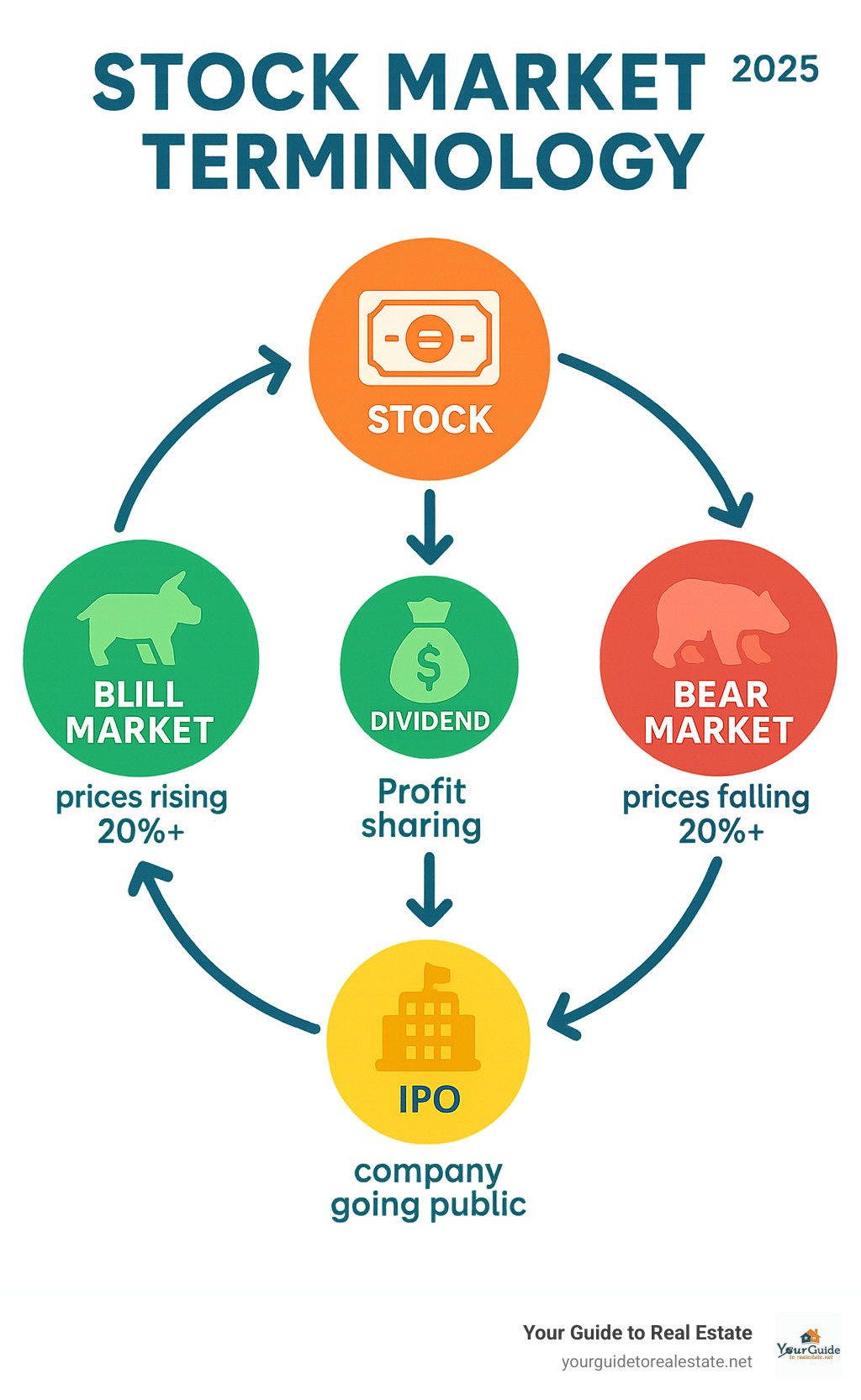
- Stock/Share – A piece of ownership in a company
- Bull Market – Period of rising stock prices (20%+ increase)
- Bear Market – Period of falling stock prices (20%+ decline)
- Dividend – Cash payment from company profits to shareholders
- IPO – Initial Public Offering when a private company goes public
- Bid/Ask – Highest price buyers will pay vs. lowest sellers will accept
- Market Cap – Total value of all company shares
- P/E Ratio – Stock price divided by earnings per share
- Volatility – How much a stock’s price fluctuates
Getting into the stock market can feel daunting when you’re just starting out, especially when you’re introduced to a whole lot of new terminology. But here’s the thing – learning stock market terms gives you a solid foundation and helps you make informed investment choices.
Think of it this way: you wouldn’t buy a house without understanding terms like “closing costs,” “escrow,” or “mortgage rates.” The same logic applies to stocks. When you master basic terminology, you gain the confidence to make smart decisions instead of gambling with your money.
The stock market is simply a platform where people buy and sell shares of publicly traded companies. It’s not a physical store – it’s a network of buyers and sellers. When you invest in a stock, you’re buying partial ownership of that company.
Why is understanding terminology crucial? Because it forms the foundation for everything else. It’s your gateway to crafting strategic approaches, understanding different trading strategies, and making sense of market fluctuations that will guide your future investment decisions.
The Building Blocks: Fundamental Stock Market Terminology
Now that you understand why stock market terminology matters, let’s build your foundation. Think of this as learning the ABCs before you can write your first sentence. These core concepts will pop up in every investment conversation you’ll ever have.

Essential Stock Market Terminology for Ownership and Trading
Let’s start with the basics. When you buy a stock (also called a share), you’re literally buying a tiny piece of a company. It’s like owning a slice of your favorite pizza – except this pizza might grow bigger over time and pay you dividends for holding onto your slice.
Most stocks come in two flavors. Common stock is what most people buy. It gives you voting rights in company decisions and the potential for dividends. Preferred stock is like having a VIP membership – you typically get paid dividends first, but you usually can’t vote on company matters. It’s a trade-off between influence and priority.
Here’s where it gets practical. You can’t just walk into the NYSE or Nasdaq (the major stock exchanges) and start buying shares. You need a broker – your middleman who handles the actual buying and selling. Think of brokers like real estate professionals who help you steer complex transactions. Just as how to select the best real estate agent requires research and careful consideration, choosing the right broker matters for your investment success.
Blue-chip stocks represent shares in large, established companies with solid reputations. These are the household names – companies that have been around for decades and are generally considered stable investments.
One exciting event you’ll hear about is an Initial Public Offering (IPO). This happens when a private company decides to sell shares to the public for the first time. It’s like a company’s debut party on the stock market. While IPOs can offer great opportunities, they often come with extra volatility as the market figures out what the company is really worth.
When placing orders, you might encounter specific instructions like All-Or-None orders, where your entire order must be filled or none at all. This prevents partial fills that might not align with your investment strategy.
Understanding Market Activity: Bids, Asks, and Volume
Picture a busy farmer’s market where buyers and sellers are constantly negotiating. The stock market works exactly the same way, and understanding this dance is crucial.
The bid price is the highest amount someone is willing to pay for a stock right now. The ask price is the lowest amount someone is willing to sell for. The difference between these two is the bid-ask spread – think of it as the negotiation gap. A tight spread usually means lots of people are trading that stock, while a wide spread might signal less interest or higher risk.
Volume tells you how many shares changed hands during a specific time period. High volume is like a busy restaurant – it usually means something interesting is happening with that stock. Low volume might mean investors are taking a wait-and-see approach.
Liquidity describes how quickly you can buy or sell a stock without affecting its price. Highly liquid stocks are like cash – you can convert them almost instantly. Less liquid investments, like real estate, take more time and effort to sell. Speaking of real estate, the principles of liquidity apply there too, which is why understanding market dynamics is crucial when you’re working with a real estate broker.
Finally, Market Capitalization (or market cap) is simply the total value of all a company’s shares. Take the share price, multiply by the number of shares outstanding, and you’ve got market cap. This helps you understand whether you’re looking at a small startup or a massive corporation. It’s one of the most straightforward ways to size up a company’s worth in the market’s eyes.
Executing Trades and Measuring Performance
Ready to put your knowledge into action? This is where the rubber meets the road – understanding how to actually place trades and track whether your investments are working for you. Think of this as learning to drive after studying the manual. The stock market terminology in this section will help you steer your trading journey with confidence.
Market Orders vs. Limit Orders: Taking Control of Your Trades
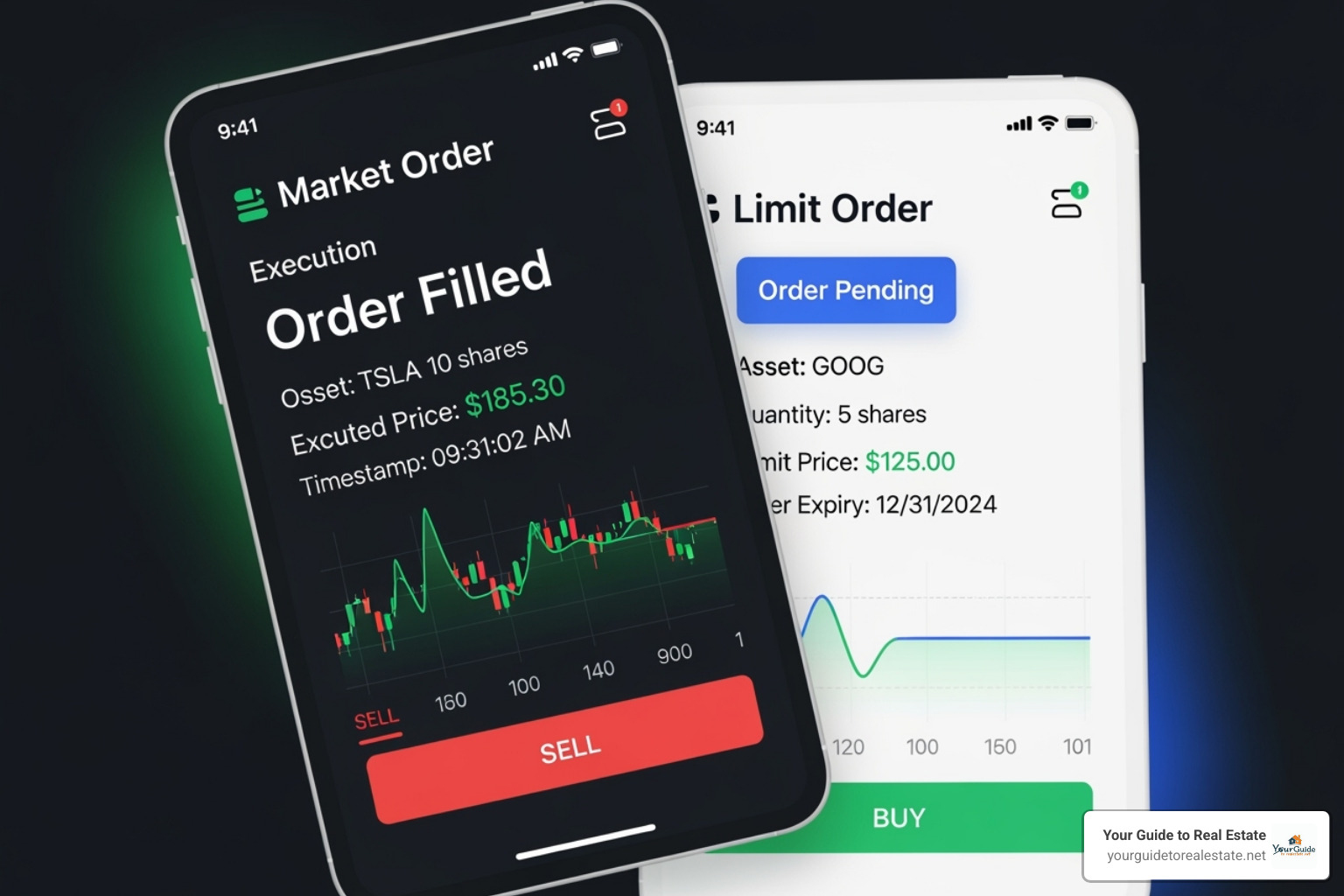
Picture yourself at a farmers market. You could either grab the first decent apple you see (that’s like a market order), or you could tell the vendor you’ll only buy apples if they’re under $2 per pound (that’s a limit order). Both approaches have their place, and knowing when to use each can save you money and frustration.
A market order is your “buy it now” button. When you place a market order, you’re telling your broker to execute the trade immediately at whatever the current best price is. Speed is the priority here, not getting the perfect price. Your trade will almost certainly go through, but the exact price might be slightly different from what you saw on your screen – especially if the stock is moving quickly.
On the flip side, a limit order gives you more control over price. You set the maximum you’ll pay for a stock (or minimum you’ll accept when selling), and your order only executes if the market reaches that price. It’s like setting a price alert and having your broker automatically make the trade when your conditions are met.
When should you use each? Go with a market order when you want to get in or out of a position quickly and you’re comfortable with the current price range. Choose a limit order when you want to be more precise about pricing, especially with less popular stocks that can have wider price swings.
Here’s where risk management gets smart: the stop-loss order. This is like having a safety net under your investments. You set a “stop price” below your purchase price, and if the stock drops to that level, your broker automatically sells to limit your losses. If you bought shares at $100 and set a stop-loss at $90, you’re capping your potential loss at $10 per share. Just remember that once triggered, a stop-loss becomes a market order, so you might get slightly less than your stop price in a fast-falling market.
For traders who need very specific execution terms, there are specialized orders like “Fill-Or-Kill” orders that demand immediate and complete execution or the entire order gets cancelled.
Understanding these order types is crucial for managing your investments effectively. And just like mastering different trading strategies helps you succeed in stocks, learning the fundamentals of property investment can open up another avenue for building wealth.
Key Stock Market Terminology for Your Returns
Now for the fun part – understanding how your money actually grows. These terms help you measure whether your investment strategy is working and how much profit you’re making along the way.
Let’s start with dividends – think of them as your share of the company’s success. When a profitable company decides to share its earnings with shareholders, it pays out dividends, usually every three months. It’s like getting a bonus check just for owning the stock. Not all companies pay dividends (some prefer to reinvest profits for growth), but for investors seeking regular income, dividend-paying stocks can be goldmines.
The dividend yield tells you how much bang you’re getting for your buck. It’s calculated by taking the annual dividend payment and dividing it by the stock’s current price. So if a $50 stock pays $2 in annual dividends, that’s a 4% dividend yield. Higher yields can be attractive, but be careful – sometimes a high yield signals that the stock price has fallen for good reasons.
When you sell a stock for more than you paid, you’ve made a capital gain – that’s your profit from the price increase. Sell for less than you paid, and you have a capital loss. Both affect your taxes, so keeping track of these is important for your financial planning.
Earnings Per Share (EPS) is like a company’s report card grade. It shows how much profit the company made for each share of stock. Calculate it by dividing the company’s total earnings by the number of shares outstanding. Higher EPS generally means a more profitable company, which often translates to a more valuable stock.
The Price-to-Earnings Ratio (P/E Ratio) is where things get interesting. This ratio compares a stock’s current price to its earnings per share, showing you how much investors are willing to pay for each dollar of company earnings. A high P/E might mean investors expect big growth ahead, or it could mean the stock is overpriced. A low P/E could signal a bargain or a company with limited growth prospects. It’s one of the most useful tools for comparing whether one stock is a better value than another.
These metrics work together to paint a picture of your investment’s performance and potential. Master them, and you’ll have the confidence to make informed decisions about your financial future.
Navigating Market Trends and Managing Risk
The stock market never sleeps, and neither does change. One day everything’s rosy, the next day panic sets in. Understanding how to read these shifts and protect your investments isn’t just smart—it’s essential for anyone serious about building wealth through stocks.

Are We in a Bull or Bear Market?
Picture this: you’re watching the news and the anchor says we’re in a “bull market.” What does that actually mean for your money? These iconic pieces of stock market terminology tell the story of where we’ve been and where we might be heading.
A bull market is when stock prices are climbing and everyone feels pretty good about investing. It’s like that friend who’s always optimistic—prices keep going up, companies are doing well, and people are buying stocks with confidence. Officially, we call it a bull market when major stock indices have risen 20% or more from their recent lows. Think of that famous Wall Street bull statue, head down, charging forward with unstoppable energy.
On the flip side, a bear market is when things get gloomy. Stock prices are falling, investors are nervous, and pessimism spreads like a cold. When major indices drop 20% or more from their recent highs, that’s officially bear territory. The bear statue swipes downward, just like those falling prices.
These market trends don’t happen in a vacuum. They’re driven by everything from interest rates and company earnings to world events and plain old human emotion. Sometimes people get scared and sell everything. Other times, they get excited and buy like there’s no tomorrow.
Understanding which type of market we’re in helps you make smarter decisions. Just like in real estate, timing and market awareness matter. Speaking of real estate, learning how to invest in real estate requires the same kind of market savvy—recognizing cycles and adapting your approach accordingly.
Assessing and Mitigating Investment Risk
Let’s be honest: every investment comes with risk. But here’s the thing—you can learn to manage that risk instead of letting it manage you. Think of it like driving a car. You know there’s always some danger, but you wear a seatbelt and follow traffic rules to stay safe.
Volatility is basically how jumpy a stock gets. Some stocks are like that nervous friend who changes their mind every five minutes—their prices swing up and down dramatically. Others are more like your calm, steady friend—their prices move slowly and predictably. High volatility means bigger price swings, which can mean bigger gains or bigger losses.
Here’s where beta comes in handy. It’s a number that tells you how wild a stock is compared to the overall market. If a stock has a beta of 1, it moves pretty much in sync with the market. A beta of 1.5 means it’s 50% more dramatic than the market—if the market goes up 10%, this stock might jump 15%. A beta of 0.5 means it’s calmer, moving only half as much as the market.
The golden rule of investing? Don’t put all your eggs in one basket. Diversification is your best friend here. Spread your money across different companies, industries, and even countries. If your tech stocks tank, maybe your healthcare stocks will hold steady. If U.S. stocks struggle, your international investments might pick up the slack.
Sometimes companies do something called a stock split. Don’t panic—it’s actually neutral for you as an investor. Let’s say you own one share worth $100, and the company does a 2-for-1 split. Now you own two shares worth $50 each. Your total investment value stays exactly the same, but the company hopes the lower price per share will attract more buyers.
Now, here’s something important: watch out for scams. One nasty trick is called a “pump and dump” scheme. Fraudsters spread fake good news about a stock to drive up the price (the “pump”), then sell all their shares at the inflated price (the “dump”), leaving everyone else holding worthless stock. If someone promises you guaranteed huge returns with no risk, run the other way. The U.S. Securities and Exchange Commission provides detailed information on “Pump and Dump Schemes” to help you spot these red flags.
Risk management isn’t about avoiding all risk—it’s about taking smart, calculated risks that align with your goals and timeline. Just like you wouldn’t buy a house without an inspection, don’t invest without understanding what you’re getting into.
Expanding Your Portfolio: ETFs and Mutual Funds
While picking individual stocks can be exciting, it’s a bit like trying to build an entire house by yourself. It’s possible, but wouldn’t it be easier to have a team of professionals help you? That’s exactly what Exchange-Traded Funds (ETFs) and Mutual Funds offer – professional management and instant diversification in a single purchase.
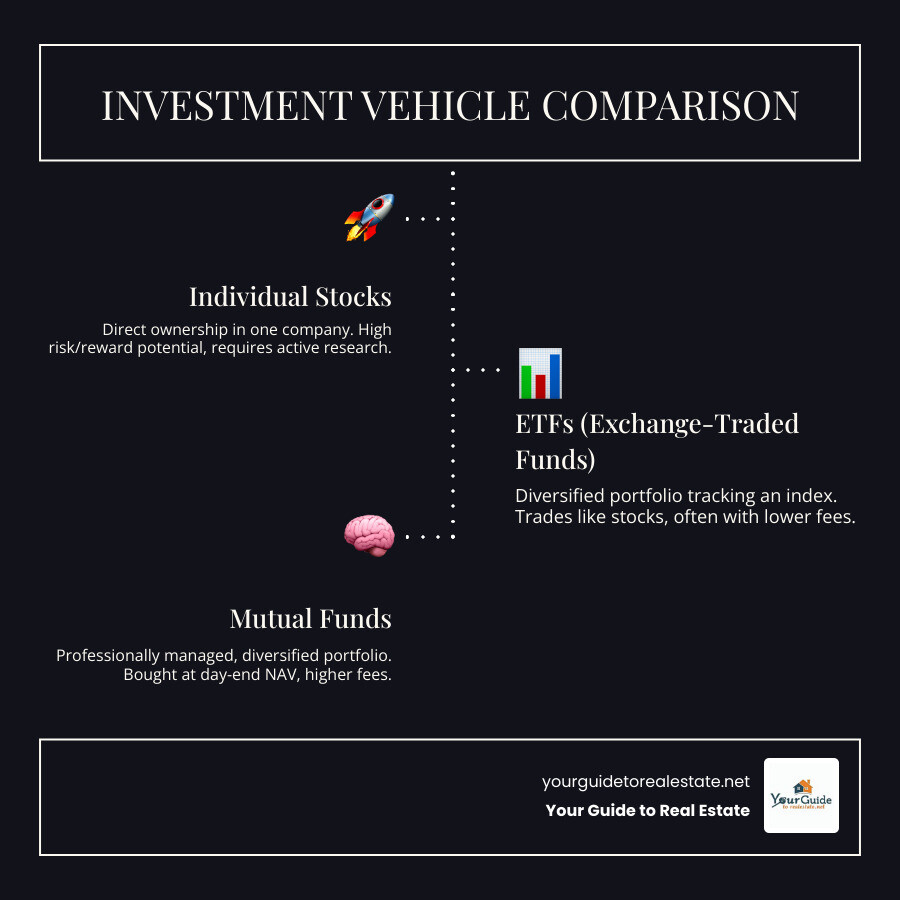
Think of these pooled investment vehicles as buying a slice of a giant pizza instead of making your own from scratch. When you invest in an ETF or mutual fund, you’re pooling your money with thousands of other investors. This combined pot of money is then used to buy a diversified mix of stocks, bonds, or other assets. Instead of researching and buying dozens of individual companies, you get exposure to all of them through one simple purchase.
An Exchange-Traded Fund (ETF) works much like a stock that you can buy and sell throughout the trading day. The beauty of an ETF is that it often tracks a specific index, like the S&P 500, which means you’re getting a piece of 500 different companies in one transaction. If you buy an ETF that follows the Nasdaq, you’re instantly invested in over 3,000 companies. That’s some serious diversification without the headache of managing individual positions.
Mutual funds work on a similar principle but with a different approach. While ETFs trade like stocks throughout the day, mutual funds are priced once daily after the market closes. When you place an order to buy or sell mutual fund shares, it gets executed at that day’s closing Net Asset Value (NAV). Professional money managers actively make decisions about what to buy and sell within the fund, aiming to achieve the fund’s stated investment objectives.
The key difference comes down to flexibility and timing. ETFs give you the freedom to trade anytime during market hours, just like individual stocks. Mutual funds require a bit more patience – you’ll get the price determined at the end of the trading day, regardless of when you placed your order.
Now, here’s an important piece of stock market terminology you’ll encounter with both options: the expense ratio. This is the annual fee that covers the fund’s operating costs, including paying those professional managers and keeping the lights on. It’s expressed as a percentage of your investment. For example, if you invest $10,000 in a fund with a 0.50% expense ratio, you’ll pay $50 in fees each year. Lower expense ratios mean more of your money stays invested and working for you.
Both ETFs and mutual funds offer significant diversification benefits. Instead of putting all your eggs in one basket, you’re spreading your investment across many different companies and sometimes even different asset classes. This helps reduce the risk that comes with betting everything on a single company’s success or failure. It’s the investment equivalent of not putting all your trust in one contractor when building a house – you want a reliable team working together for the best results.
Frequently Asked Questions about Stock Market Terms
Let’s be honest – when you’re starting your investment journey, questions pop up faster than you can Google them. We’ve gathered the most common queries about stock market terminology that new investors ask, and we’re here to give you straightforward answers that actually make sense.
What are the most basic stock market terms I should learn first?
Think of learning stock market terms like building a house – you need a solid foundation before you can add the fancy details. Here are the stock market terminology essentials that will serve as your bedrock:
Stock (or share) is your starting point. This represents a tiny slice of ownership in a company. When you buy Apple stock, you literally own a microscopic piece of Apple Inc. Pretty cool, right?
Dividend is like getting a thank-you card with money inside. It’s when profitable companies share their success by sending cash payments to shareholders. Not all companies pay dividends, but when they do, it’s a nice bonus on top of any price appreciation.
Understanding bull markets and bear markets helps you grasp the market’s mood. A bull market means prices are climbing and investors are feeling optimistic – think of a bull charging upward with its horns. A bear market is the opposite, with falling prices and pessimism – picture a bear swiping downward with its paws.
Bid and ask prices are like a negotiation happening in real-time. The bid is what buyers are willing to pay, while the ask is what sellers want to receive. The difference between these two is where trades happen.
Finally, your broker is your gateway to the market. You can’t just walk up to the New York Stock Exchange and start buying stocks – you need a broker to handle the transactions for you.
These five terms form the foundation for everything else you’ll learn. Master these, and financial news will start making a lot more sense.
How does a stock split actually affect my investment?
Stock splits often confuse new investors, but they’re actually pretty simple once you understand what’s happening behind the scenes.
When a company announces a stock split, they’re essentially cutting each existing share into multiple pieces while keeping your total investment value exactly the same. It’s like taking a pizza and cutting it into more slices – you don’t get more pizza, just smaller pieces.
Here’s how it works in practice: Let’s say you own 50 shares of a company trading at $100 per share. Your total investment is worth $5,000. If the company does a 2-for-1 split, you’ll wake up with 100 shares worth $50 each. Your total value? Still $5,000.
Companies split their stocks for a few smart reasons. Lower share prices make stocks more affordable for everyday investors. If a stock is trading at $500 per share, it might seem intimidating to new investors. But at $250 after a 2-for-1 split, it feels more accessible.
Stock splits also increase liquidity, meaning more people can afford to trade the stock. This creates more activity and can make it easier to buy and sell shares when you want to.
The key thing to remember is that a stock split doesn’t change the fundamental value of your investment or the company’s worth. It’s purely a cosmetic change that can have positive psychological effects on the market.
What’s the difference between investing and trading?
This is one of the most important distinctions in the financial world, and understanding it can save you from costly mistakes.
Investing is like planting an oak tree. You’re in it for the long haul, typically holding stocks for years or even decades. Investors focus on fundamental analysis – they study a company’s financial health, management quality, industry trends, and economic factors. They want to find solid companies that will grow over time, weathering market storms along the way.
The investing approach is often called buy and hold. You purchase shares in companies you believe will be more valuable in the future, then you wait patiently while collecting dividends and watching your investment grow. It’s less stressful and more forgiving if you make mistakes along the way.
Trading, on the other hand, is like tending a vegetable garden. You’re looking for quick results, often holding stocks for days, weeks, or at most a few months. Traders rely heavily on technical analysis – they study charts, patterns, and market indicators to predict short-term price movements.
Traders make frequent transactions and aim to profit from market volatility rather than long-term company growth. This approach requires more time, attention, and carries higher risk because you’re essentially trying to time the market.
For most beginners, we strongly recommend starting with investing rather than trading. It’s more forgiving, requires less daily attention, and historically has been the path to building long-term wealth. Just like understanding market fundamentals helps in stocks, grasping the basics is crucial in any investment arena, whether you’re dealing with equities or exploring property markets.
Conclusion: From Novice to Knowledgeable Investor
Congratulations! You’ve just taken a comprehensive journey through the essential stock market terminology that transforms beginners into confident investors. From understanding what a simple share represents to grasping complex concepts like beta and volatility, you’ve built a solid foundation for your investment journey.
Think about where you started. Terms like “bid-ask spread” or “P/E ratio” might have seemed like a foreign language. Now you understand that the bid-ask spread is simply the difference between what buyers want to pay and what sellers want to receive. You know that a P/E ratio helps you evaluate whether a stock might be overvalued or undervalued. These aren’t just random financial jargon anymore – they’re tools in your investment toolkit.
Mastering this vocabulary truly is your first best investment. It empowers you to read financial news with confidence, understand your broker’s recommendations, and most importantly, make informed decisions about your money. When you hear about a company announcing a stock split or the market entering bear territory, you won’t feel lost or overwhelmed. Instead, you’ll understand exactly what’s happening and how it might affect your investments.
Learning about finance is a lifelong journey. The stock market constantly evolves, new investment products emerge, and economic conditions shift. But you now have the essential foundation to build upon. Every new term you encounter will connect to these basics, making your continued learning much easier.
Building confidence in your financial endeavors starts with knowledge, whether you’re buying individual stocks, investing in ETFs, or exploring other opportunities. The analytical thinking you’ve developed here – understanding market trends, evaluating risk, and making informed decisions – applies far beyond the stock market.
Just as with stocks, understanding market trends is key to success in property, and you can start by learning how to perform a competitive market analysis in real estate. The same principles of research, analysis, and informed decision-making that make you a better stock investor will serve you well in real estate too.
Your journey from novice to knowledgeable investor has begun. With these fundamentals under your belt, you’re ready to start making the financial decisions that will shape your future. The market might seem complex, but you now speak its language.