
Why Storage Unit Insurance Protects Your Peace of Mind
Storage unit insurance is a specialized policy that protects your belongings while they’re stored away from home – whether you’re moving, downsizing, or just need extra space during life transitions.
Quick Answer for Storage Unit Insurance:
- What it is: Insurance that covers your stored belongings against theft, fire, water damage, and other perils
- Cost: Typically $8-$40 per month for coverage from $2,000 to $25,000
- Why you need it: Your homeowner’s insurance usually covers only 10% of your policy limit for off-premises items
- Key benefit: Protects against financial loss without affecting your primary home insurance rates
When you’re navigating real estate transitions – selling your current home, buying a new one, or investing in properties – storage units become essential. But here’s what many people don’t realize: your belongings aren’t automatically protected once they leave your home.
Storage facilities are responsible for keeping their premises secure, but they’re not liable for damage to your specific items. That’s where storage unit insurance comes in as your financial safety net.
The choice isn’t just between having insurance or not – it’s between using your existing homeowner’s or renter’s policy (with limitations) versus getting a dedicated storage policy. Most home insurance policies cover stored items for only 30-90 days and limit coverage to about 10% of your total policy limit.
Storage unit insurance differs from facility “protection plans” in important ways. True insurance is regulated and comprehensive, while protection plans are often basic liability waivers with minimal coverage.
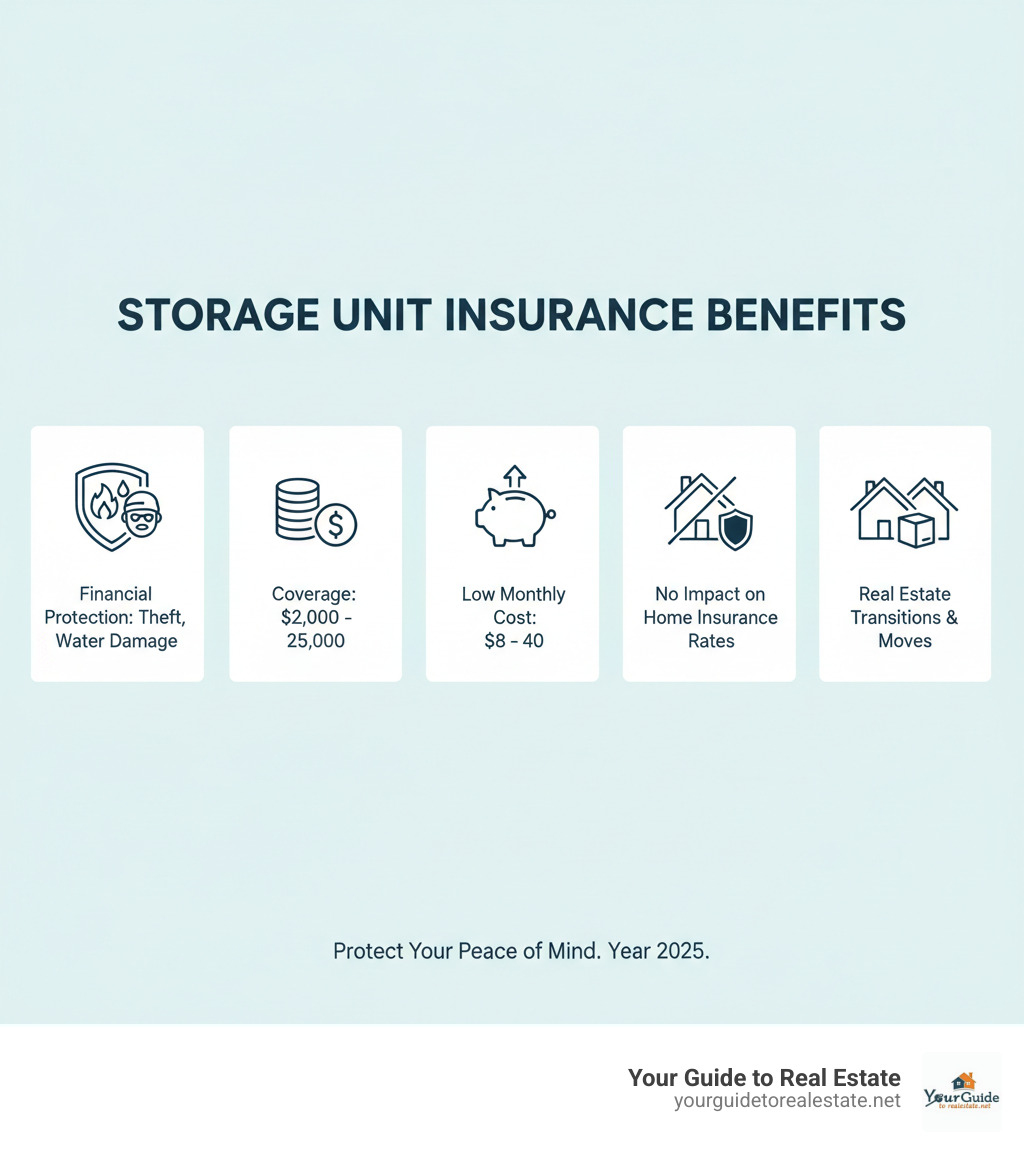
Quick look at storage unit insurance:
Understanding Your Coverage: What’s Included and Excluded

Picture this: you’ve carefully packed your belongings into a storage unit, locked the door, and walked away feeling secure. But what happens if disaster strikes? Storage unit insurance isn’t a one-size-fits-all solution, and knowing exactly what’s covered – and what isn’t – can save you from unpleasant surprises down the road.
Think of your policy like a safety net with specific holes in it. The good news is that most of these “holes” are clearly defined, so you can plan accordingly.
Typical Perils Covered
Most storage unit insurance policies protect you from the unexpected events that keep us awake at night. These are the sudden, unavoidable situations that can happen to anyone.
Fire and smoke damage top the list of covered perils, and for good reason. Whether it’s an electrical issue in the facility or a fire that spreads from nearby, flames don’t discriminate. Your policy should cover both direct fire damage and the sneaky smoke damage that can ruin items even in units far from the actual blaze.
Theft and burglary protection is often the main reason people buy storage insurance. If someone breaks into your unit and makes off with your belongings, you’re covered. Just remember that most policies require evidence of forced entry – like a cut lock or damaged door – to qualify as burglary rather than simple theft.
Weather-related damage from lightning strikes and windstorms is typically included. Mother Nature can be unpredictable, and severe weather can damage storage facilities and everything inside them.
Water damage from burst pipes or facility plumbing issues is usually covered, which is reassuring since these problems can happen without warning. This includes damage from leaking roofs or broken water mains that affect the building.
Vandalism coverage protects you if someone intentionally damages your belongings, while building collapse coverage handles the rare but devastating possibility of structural failure at the facility.
Common Policy Exclusions
Here’s where things get tricky. Insurance companies are very specific about what they won’t cover, and these exclusions can catch people off guard.
Natural disasters like flooding and earthquakes are the big ones. If a river overflows or the ground shakes, your standard policy likely won’t help. These require separate, specialized coverage that most people skip due to cost.
Pest problems are considered preventable, so damage from rats, mice, or insects typically isn’t covered. The same goes for mold and mildew – insurers expect you to pack properly and choose climate-controlled units when needed.
Gradual deterioration from age, rust, or normal wear and tear doesn’t qualify either. Insurance is for sudden accidents, not the slow march of time. War and nuclear hazards round out the standard exclusions, though hopefully, these aren’t daily concerns for most of us.
Special Coverage for High-Value Items
Not all belongings are treated equally by insurance companies. Some items need special attention and often separate coverage.
Jewelry, furs, collectibles, and art frequently have strict limits on standard policies. Your $20,000 policy might only cover $1,000 worth of jewelry unless you specifically list each piece with its appraised value.
Business inventory and equipment usually need commercial policies rather than personal coverage. If you’re storing items for work, your standard policy probably won’t cut it.
Motorized vehicles like cars, motorcycles, or boats require their own insurance policies entirely. Your storage unit coverage won’t protect these expensive items.
For these special items, you’ll need policy endorsements or separate riders that provide additional coverage beyond standard limits. The key is being upfront with your insurer about what you’re storing and getting everything properly documented with appraisals when necessary.
The bottom line? Read your policy carefully and ask questions. It’s better to find coverage gaps before you need to file a claim.
Homeowner’s Insurance vs. A Dedicated Storage Unit Insurance Policy
Deciding between using your existing home policy or buying a separate one is a key decision. This section breaks down the pros and cons of each approach, helping you find the best path for protecting your stored belongings.
Does Your Existing Policy Cover Storage?
Here’s the question we get all the time: “Doesn’t my homeowner’s or renter’s insurance already cover my stuff in storage?” The short answer is usually yes – but there’s a big “but” coming.
Most home, condo, or renter’s policies do include what’s called “off-premises” coverage for your belongings when they’re away from home. Sounds great, right? Well, here’s where it gets tricky.
The 10% coverage limit rule is your first hurdle. Most policies only cover about 10% of your personal property limit for items stored elsewhere. So if your home insurance covers $50,000 in personal belongings, you might only have $5,000 in coverage for your storage unit. When you’re storing valuable furniture, electronics, or family treasures, that $5,000 disappears fast.
Then there are short-term limits to consider. Many policies only extend coverage for 30 to 90 days. Planning to store items during a lengthy home renovation or while house hunting? Your coverage might expire long before you’re ready to move everything back home.
High deductibles add another layer of expense. Home insurance deductibles typically range from $1,000 to $3,000. If you have a $5,000 loss with a $2,000 deductible, you’re only getting $3,000 back – and that’s assuming you meet your coverage limit.
Here’s the kicker that catches most people off guard: filing a claim through your homeowner’s insurance can increase your home premiums by up to 17% for as long as seven years. That stolen furniture could cost you hundreds more in insurance premiums down the road.
We always recommend calling your current insurance provider to understand exactly what your off-premises coverage includes. The details matter more than you might think.
When to Choose a Separate Policy
Given those limitations, there are several situations where a dedicated storage unit insurance policy makes much more sense. These standalone policies are designed specifically for the unique risks of storing items away from home.
Long-term storage needs are the most obvious reason to go separate. If you’re storing items for more than 90 days – which is common during real estate transitions – your existing coverage likely expires. Dedicated policies offer flexible month-to-month terms that extend as long as you need.
High-value contents are another clear indicator. When your stored items are worth more than that 10% limit from your home policy, you need proper protection. Some dedicated policies offer coverage up to $25,000 per unit, giving you room to properly protect valuable belongings.
Lower deductibles make separate policies attractive too. Instead of paying $1,000 to $3,000 out of pocket, many storage policies offer deductibles as low as $100. That makes it actually feasible to file a claim for smaller losses.
Protecting your home insurance record might be the smartest financial reason of all. Claims on a separate policy won’t affect your homeowner’s insurance premiums. You avoid those potential rate hikes that can follow you for years.
And if you don’t currently have homeowner’s or renter’s insurance, a standalone storage unit insurance policy is your only option for protecting stored belongings.
[TABLE] comparing Homeowner’s/Renter’s Policy vs. Separate Storage Policy
| Feature | Homeowner’s/Renter’s Policy | Separate Storage Policy |
|---|---|---|
| Coverage Limit | Often limited to 10% of personal property coverage | Customizable, often much higher (e.g., up to $25,000/unit) |
| Deductible | Typically higher ($1,000 – $3,000) | Often lower (e.g., as low as $100) |
| Premium Impact | Claims can increase primary policy premiums for years | Claims affect only this specific policy, no impact on home insurance |
| Term Length | Short-term limits (e.g., 30-90 days) | Flexible, month-to-month, easily extendable |
| Scope of Coverage | Broad, but general; specific storage perils might be limited | Custom to storage risks; may cover transit |
| Enrollment | Automatic extension, but needs verification | Dedicated application, easy online options |
The choice often comes down to your specific situation. For short-term storage of low-value items, your existing policy might suffice. But for longer storage periods, valuable belongings, or when you want to protect your home insurance record, a separate policy usually offers better protection and peace of mind.
The Cost of a Policy and How the Claims Process Works

Understanding the financial aspects, from monthly costs to what happens when you need to make a claim, is essential for making an informed choice about your storage unit insurance. Let’s break down what you can expect to pay and what happens if you need to use your coverage.
How Much Does Storage Unit Insurance Cost?
The first thing most people want to know is simple: “What’s this going to cost me?” Here’s the good news – storage unit insurance is surprisingly affordable, especially when you consider what you’re protecting.
Most people pay between $8 and $40 per month for their coverage. The exact amount depends on how much coverage you need and what you’re storing. If you’re storing basic household items worth around $2,000, you might pay as little as $7.99 per month. But if you’re storing valuable furniture, electronics, or family heirlooms worth $25,000, you could pay up to $72.99 monthly.
The value of your stored goods is the biggest factor in determining your premium. Insurance companies need to know what they’re potentially covering, so an accurate assessment of your items’ replacement value is crucial. Don’t lowball this estimate – you’ll regret it if you need to make a claim.
Your deductible choice also affects your monthly cost. Choose a higher deductible (the amount you pay out-of-pocket before insurance kicks in), and your monthly premium drops. It’s a trade-off between what you pay monthly versus what you’d pay if something happens.
Where your storage facility is located matters too. A facility in an area prone to severe weather or higher crime rates will typically cost more to insure. On the flip side, facilities with excellent security features – think gated access, 24/7 surveillance, and on-site management – often qualify for lower rates because they’re simply safer.
The beauty of most storage unit insurance policies is their flexibility. Many offer month-to-month terms, so you’re not locked into a long commitment when your storage needs might change.
Filing a Claim: A Step-by-Step Guide for your storage unit insurance
Nobody plans to file an insurance claim, but if disaster strikes your storage unit, knowing what to do can save you time, stress, and money. Here’s how to steer the process smoothly.
The moment you find damage or theft, grab your phone and start documenting. Take photos and videos of everything – the unit itself, any damage to the facility, and every affected item you can see. Note the date and time you finded the problem. This documentation becomes your evidence, so be thorough.
Contact the storage facility management immediately. They need to know what happened and will likely conduct their own investigation, especially if security was breached. Ask for a copy of their incident report – you’ll need it for your claim.
If theft or vandalism occurred, call the police right away. File an official police report and get the report number. Insurance companies expect this step for criminal activity, and it strengthens your claim significantly.
Creating a detailed inventory is where your preparation pays off. List every damaged or stolen item with descriptions, estimated replacement values, and purchase dates if you remember them. Dig up any receipts, appraisals, or photos you have of the items. If you didn’t create an inventory before storing your items, now you understand why it’s so important for next time.
Contact your insurance provider as soon as you’ve gathered your documentation. Most insurers offer online claim forms or dedicated phone lines for claims. The sooner you report, the faster the process moves.
An insurance adjuster will likely be assigned to your case. They might want to inspect the storage unit or request additional documentation. Be responsive and thorough in your communications – it speeds up the process.
Remember your deductible when setting expectations. If you have a $250 deductible and your covered loss totals $2,000, you’ll receive $1,750 from your insurance company. The deductible is your share of the risk, designed to keep premiums affordable for everyone.
Getting a Quote for Your Storage Unit Insurance
Getting a quote for storage unit insurance is straightforward, but having the right information ready makes the process smooth and ensures accurate pricing.
You’ll need basic personal information – your name, contact details, and address. Nothing complicated there.
The storage facility details are important because location affects risk. Have the facility’s name and full address ready. Insurers use this information to assess area-specific risks like weather patterns and crime rates.
Accurately estimating your items’ value is the most crucial step. Walk through your storage unit (mentally or physically) and add up what it would cost to replace everything at today’s prices. Don’t use what you paid years ago – use current replacement costs. Being honest here protects you from being underinsured.
Think about how long you’ll need coverage. Many policies offer month-to-month flexibility, but you’ll still need to provide an estimated timeframe. The good news is most policies are easily extendable if your storage needs change.
If you’re storing high-value items like jewelry, art, or business inventory, be prepared to provide specific details. Some items might need appraisals or separate listing to ensure proper coverage.
Many insurance providers offer quick online quotes that take just a few minutes to complete. Short-term coverage options are available too, with policies ranging from one month to a full year. The key is being thorough and honest during the quote process – it ensures you get the right coverage at the right price.
The quote process is your chance to ask questions and understand your options. Don’t rush through it. Taking a few extra minutes now can save you significant headaches later.
Proactive Protection: Safeguarding Your Belongings
Insurance acts as your safety net, but taking smart preventive steps can save you from the stress and hassle of filing a claim altogether. Think of storage unit insurance as your backup plan – while these proactive measures are your first line of defense.
Choosing a Secure Storage Facility
The storage facility you choose can make or break your peace of mind. We’ve seen too many situations where people saved a few dollars on rent, only to lose much more when their belongings were damaged or stolen.
Security features should be your top priority. Look for facilities with gated access that requires a unique code – this immediately eliminates casual break-ins. The best facilities also have surveillance cameras watching every corner, not just the front office. Proper lighting throughout the property is another must-have, since most theft happens under cover of darkness.
On-site management makes a huge difference. A manager who lives on the property or works there regularly provides that human presence that deters criminal activity. They’re also your first point of contact if something goes wrong.
Don’t overlook the basics either. A well-maintained facility with clean premises, intact fencing, and proper drainage shows you’re dealing with professionals who care about protecting your belongings. Some facilities even offer individual unit alarms for extra protection – it’s worth the small additional cost if you’re storing valuable items.
Climate control isn’t just about comfort – it’s about preventing damage that your storage unit insurance might not cover. Remember those policy exclusions we discussed? Gradual deterioration from heat, cold, or moisture often falls into that category. For electronics, wooden furniture, artwork, or important documents, climate-controlled units are essential.
Best Practices for Packing and Storing
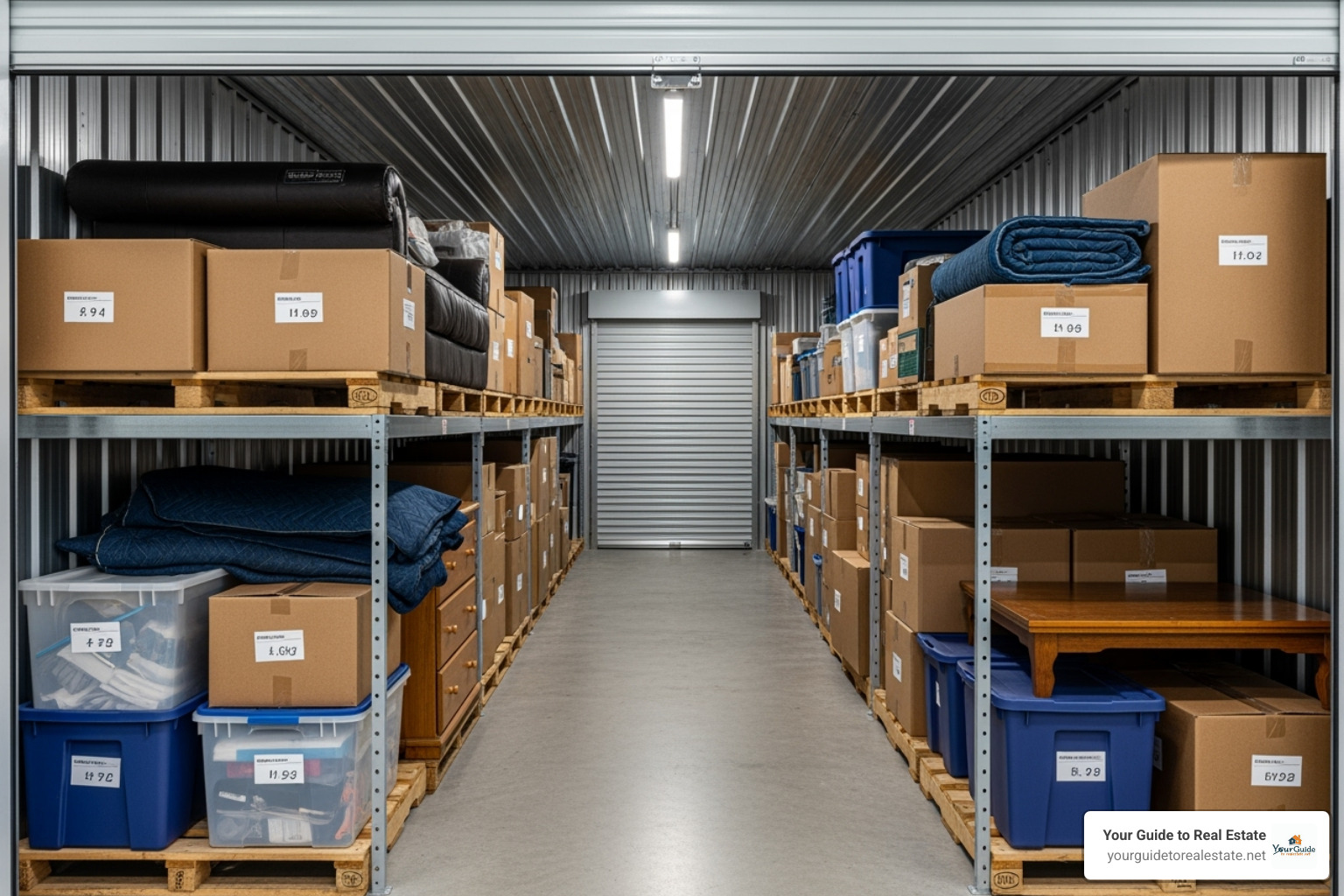
Even the best storage unit insurance policy can’t protect items that are poorly packed or stored. The good news? Most damage from improper storage is completely preventable with some simple techniques.
Plastic bins beat cardboard boxes every time. They’re waterproof, stackable, and pests can’t chew through them. Yes, they cost more upfront, but they’ll save you money in the long run. Label them clearly on multiple sides – trust us, you’ll thank yourself later when you’re searching for something specific.
Everything should be off the ground. This single rule prevents more damage than almost anything else. Use pallets, wooden skids, or even just some 2×4 lumber to create a barrier between your belongings and the floor. Ground-level moisture, small leaks, or pest problems won’t reach your items this way.
When it comes to wrapping furniture correctly, avoid plastic sheeting like the plague. It traps moisture and creates the perfect environment for mold and mildew – damage that insurance typically won’t cover. Instead, use furniture blankets, old sheets, or specialized stretch wrap that lets items breathe.
Create aisles in your unit so you can actually access and inspect your belongings. Cramming everything in might seem efficient, but it makes it impossible to check on your items or retrieve something without moving half the unit.
Here’s something many people overlook: create a detailed inventory with photos before you lock up your unit. This isn’t just good organization – it’s your proof of ownership and condition if you ever need to file a claim. Take pictures of valuable items from multiple angles and keep the photos somewhere safe.
Never store anything perishable. Food, plants, or anything that can spoil will attract pests and create problems that extend far beyond your unit. Most facilities prohibit these items anyway, and insurance certainly won’t cover the resulting damage.
Understanding Facility Liability
This might be the most important section for protecting your financial interests. There’s a widespread misconception that storage facilities are responsible if something happens to your belongings. Unfortunately, that’s rarely true.
Storage facilities are responsible for their premises – the gates, fences, buildings, and common areas. They must provide a reasonably secure environment. But here’s the key distinction: you’re responsible for everything inside your specific unit.
Your rental agreement almost certainly contains clauses that limit the facility’s liability for your stored items. These aren’t hidden in fine print – they’re usually prominently displayed because they’re so important. The facility isn’t acting as an insurer of your goods.
Limited liability clauses in lease agreements typically state that the facility isn’t liable for loss or damage from fire, theft, vandalism, water damage, or other perils. This is exactly why most facilities either require you to have your own storage unit insurance or strongly encourage you to purchase their protection plan.
Think of it this way: the facility provides the secure environment, but protecting the contents is up to you. This division of responsibility makes perfect sense when you consider that facility owners have no control over what you store or how you pack it.
Understanding these limitations shows why having your own dedicated storage unit insurance isn’t optional – it’s essential. It fills the gap between what the facility covers (their property) and what you need covered (your belongings). For more insights on protecting your real estate investments, check out our guide on Accounts Receivable.
Frequently Asked Questions about Storage Unit Insurance
We’ve covered a lot of ground, but there are always those questions that keep coming up in conversations about storage unit insurance. Let’s address the big ones that might be on your mind.
Is storage unit insurance mandatory?
Here’s the thing – storage unit insurance isn’t something the government requires you to have, like car insurance. But here’s where it gets interesting: most storage facilities absolutely require it as part of their rental agreement.
Think about it from their perspective. The facility owners know they’re not responsible for your belongings if something goes wrong. So they want to make sure you have some kind of protection in place. It protects both you and their business from potential disputes.
You usually have two options when you sign that rental agreement. You can either show proof that you already have coverage (whether that’s through your homeowner’s insurance, renter’s policy, or a dedicated storage policy), or you can purchase a basic protection plan right there at the facility.
The key is to always read your rental agreement carefully. Every facility has slightly different requirements, and you don’t want any surprises later.
What’s the difference between storage insurance and a “protection plan”?
This is honestly one of the most important questions you can ask, and we’re glad you did. The difference is huge, but it’s not always explained clearly when you’re signing up for storage.
True storage unit insurance is a regulated policy that comes from a licensed insurance company – think of it as a third-party safety net. You’re getting comprehensive coverage for specific risks like fire, theft, and water damage. The insurance company has to follow strict rules about how they operate, and you have a real contract with clear terms. Coverage limits can go quite high – often up to $25,000 per unit – and there’s usually a straightforward claims process if something happens.
A “protection plan,” on the other hand, is something the storage facility offers directly. It’s not actually insurance at all – it’s more like a liability waiver with some limited benefits attached. The facility sets all the rules, the coverage is usually much lower (often maxing out around $5,000), and the claims process might not be as transparent or regulated.
Here’s a simple way to think about it: insurance is like having a professional safety net, while a protection plan is more like the facility saying “we’ll try to help a little bit, but don’t expect too much.”
We always recommend going with real insurance rather than just a facility protection plan. The peace of mind and actual protection you get is worth the small difference in cost.
Does insurance cover damage from rats or other pests?
Unfortunately, this is usually a no. Damage from pests, rats, mice, mold, and mildew typically falls under the “exclusions” section of most storage unit insurance policies.
The reasoning behind this makes sense when you think about it. Insurance companies consider pest problems to be largely preventable. If you pack your items properly in sealed containers, choose a clean and well-maintained facility, and avoid storing anything that might attract critters, you can usually avoid these issues altogether.
The same logic applies to mold and mildew. These problems usually develop gradually due to moisture and poor ventilation – things that can often be prevented by choosing a climate-controlled unit and packing items correctly.
If you’re worried about pests specifically, focus on prevention. Choose a facility that looks well-maintained, pack everything in hard plastic containers rather than cardboard boxes, and never store food items or anything organic that might attract unwanted visitors.
Insurance is designed to protect against sudden, unexpected events – not problems that develop slowly over time or could have been prevented with proper care.
Conclusion
When it comes to protecting your belongings during life’s transitions, storage unit insurance is one of those things you hope you’ll never need but will be incredibly grateful to have if something goes wrong. We’ve walked through the ins and outs together, and the bottom line is simple: your stored items deserve protection that matches their value to you.
The choice between relying on your homeowner’s policy versus getting dedicated coverage becomes clear when you consider the limitations. Your existing home insurance typically covers only 10% of your policy limit for stored items, often for just 30-90 days, and any claims could bump up your home insurance rates for years. A dedicated storage unit insurance policy gives you higher coverage limits, lower deductibles, and keeps your home policy claims-free.
At $8 to $40 per month, this coverage is remarkably affordable for what it provides. Whether you’re storing $2,000 worth of seasonal items or $25,000 in valuable furniture during a move, there’s a coverage tier that fits your needs and budget.
Insurance works best when paired with smart choices. Pick a secure facility with good lighting, cameras, and on-site management. Pack your items properly using plastic bins and pallets to lift everything off the floor. Create that detailed inventory with photos – your future self will thank you if you ever need to file a claim.
The peace of mind that comes from knowing your belongings are protected is priceless, especially during already stressful times like moving or downsizing. Whether you’re transitioning between homes, investing in real estate, or simply need extra space, your stored items represent more than just stuff – they’re pieces of your life that deserve protection.
Before you store your items, it’s crucial to know their worth. Learn more with our guide to Valuation and Market Analysis in Real Estate.