

Understanding the Basics of Federal Student Loans
Subsidized vs unsubsidized student loans are the two main types of federal student loans available to help pay for college, and understanding their differences can save you thousands of dollars over the life of your loan.
Quick Answer: The Key Differences
| Feature | Subsidized Loans | Unsubsidized Loans |
|---|---|---|
| Who Pays Interest While in School | Government pays | Student pays |
| Eligibility | Financial need required | No financial need required |
| Available To | Undergraduates only | Undergraduates and graduates |
| Grace Period Interest | Government pays | Student pays |
Like choosing between a fixed-rate and adjustable-rate mortgage when buying your first home, picking the right student loan can significantly impact your financial future. Both loan types come from the U.S. Department of Education and are part of the Direct Loan Program, but they work very differently.
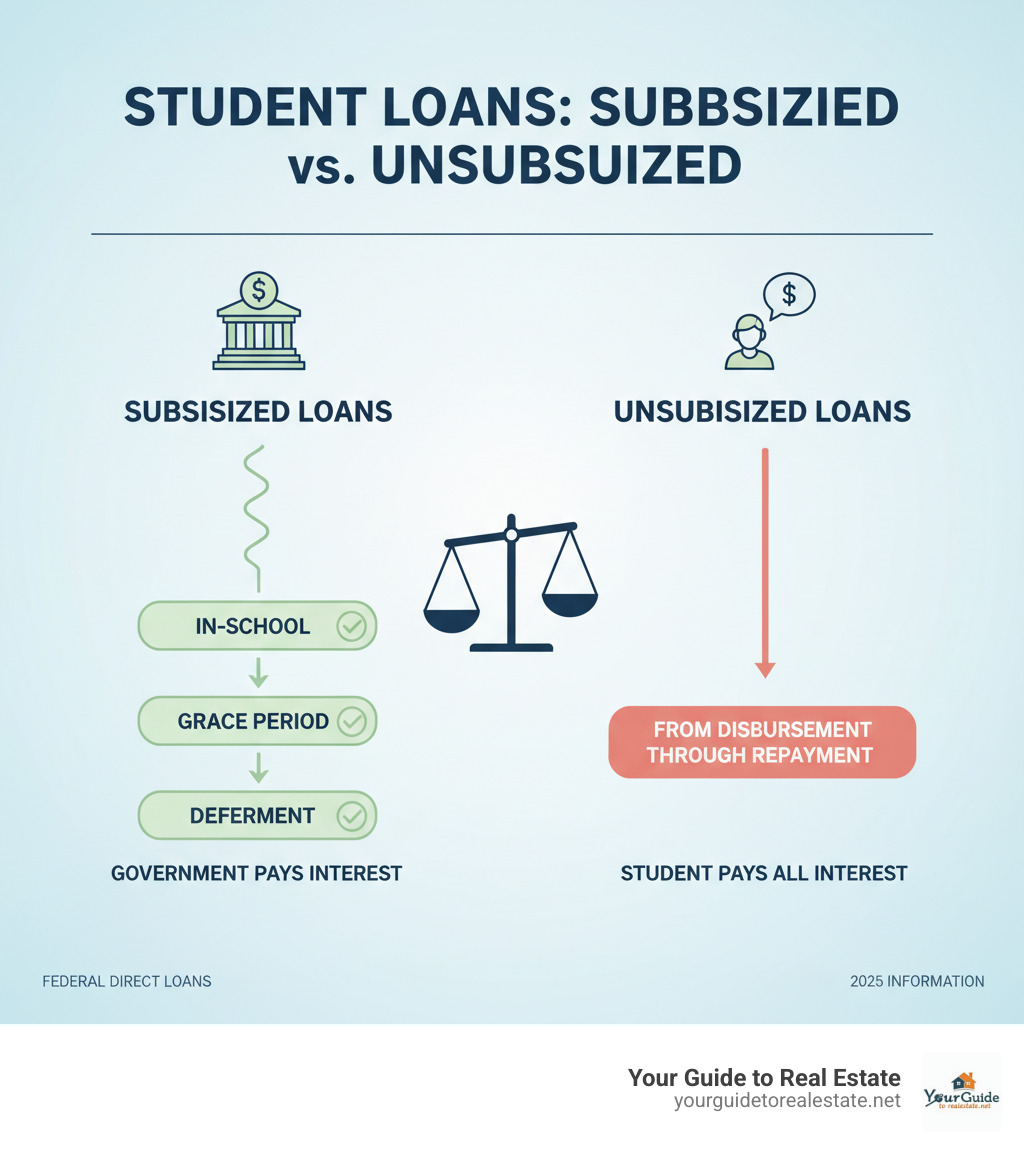
The main difference is simple: with Direct Subsidized Loans, the government covers your interest while you’re in school at least half-time, during your six-month grace period after graduation, and during deferment periods. With Direct Unsubsidized Loans, you’re responsible for all interest from day one.
This matters because 53% of undergraduates take on some level of federal loan debt, and many don’t realize how interest accrual affects their total repayment amount. Your financial aid package from your school will typically include both types if you’re eligible, giving you options to fund your education.
Whether you’re planning to buy your first home after graduation or considering real estate investment as a career path, understanding these loans now will help you make smarter financial decisions for your future.
Relevant articles related to subsidized vs unsubsidized student loans:
Subsidized vs. Unsubsidized Student Loans: A Detailed Comparison
When you’re comparing subsidized vs unsubsidized student loans, you’re essentially looking at two very different deals the government offers to help fund your education. Think of it like choosing between two mortgage options – one where someone else covers part of your interest payments, and another where you’re on your own from day one.
The difference might seem small on paper, but it can mean thousands of dollars over the life of your loan. Let’s break down exactly what makes these loans so different.
| Feature | Subsidized Loans | Unsubsidized Loans |
|---|---|---|
| Interest Payer (During In-School, Grace, Deferment) | U.S. Department of Education | Borrower |
| Eligibility Basis | Demonstrated Financial Need | No Financial Need Required |
| Student Type | Undergraduate Only | Undergraduate & Graduate/Professional |
| Grace Period Interest | Government Pays | Borrower Pays |
| Interest Capitalization | Does not occur during periods of subsidy | Occurs if interest is not paid |
| Borrowing Limits | Generally lower, capped by financial need | Generally higher |
The Primary Difference: How Interest Works
Here’s where things get interesting – and where you can either save or spend thousands of extra dollars. The interest subsidy is the game-changer that sets these loans apart.
With Direct Subsidized Loans, the government essentially becomes your financial fairy godmother. They cover your interest payments during three key periods: while you’re in school at least half-time, during your six-month grace period after graduation, and during any deferment periods if you qualify.
This means your loan balance stays put during these times. No sneaky interest building up while you’re cramming for finals or figuring out your post-graduation life.
Direct Unsubsidized Loans work differently. From the moment your loan money hits your school account, the interest clock starts ticking – and it’s your responsibility. Whether you’re in-school, enjoying your grace period, or dealing with forbearance, that interest keeps adding up.
Now, you don’t have to make payments while you’re in school, but that doesn’t mean the interest takes a vacation. It’s quietly accumulating in the background, waiting to surprise you later.
If you’re curious about how loan processes work in general, our guide about the loan process for buying a house covers similar concepts that might help you understand the bigger picture.
Who is Eligible for Each Loan Type?
Eligibility is where the government decides who gets the better deal. Subsidized loans are need-based aid, which means you have to demonstrate financial need through your FAFSA results. The formula is pretty straightforward: your school’s Cost of Attendance (COA) minus your Student Aid Index (SAI) and other financial aid equals your financial need.
There’s a catch though – subsidized loans are only for undergraduate students. If you’re pursuing a master’s degree or doctorate, you’re automatically in unsubsidized territory.
Unsubsidized loans are much more democratic. They’re non-need-based aid, available to both undergraduate and graduate and professional students regardless of their family’s financial situation. Whether your parents are millionaires or struggling to make ends meet, you can qualify for unsubsidized loans.
For the complete rundown on eligibility, check out the official requirements for federal student aid from the Department of Education.
The Impact of Interest Capitalization on Unsubsidized Loans
Here’s where unsubsidized loans can really bite you if you’re not careful. Remember all that accrued interest we mentioned? When you don’t pay it during school, something called capitalization happens.
Capitalization is basically interest joining forces with your principal balance. All that unpaid interest gets added to your original loan amount, and from that point on, you’re paying interest on a much larger sum.
Let’s say you borrowed $10,000 for college. After four years plus a six-month grace period, you might have $2,700 in accrued interest. When that interest capitalizes, your new loan balance becomes $12,700. Now you’re paying interest on $12,700 instead of the original $10,000 – which dramatically increases your total loan cost.

The smart move? Consider paying interest while in school if you can swing it financially. Even small monthly payments can prevent that interest from snowballing into a much bigger problem later. It’s like fixing a small roof leak before it becomes a major renovation project – a little prevention goes a long way.
Understanding these differences now will help you make smarter borrowing decisions, just like understanding mortgage types helps when you’re ready to buy your first home. The key is knowing what you’re signing up for before that first loan payment comes due.
How to Apply for Federal Student Loans
Here’s some great news: applying for subsidized vs unsubsidized student loans follows the exact same process, and it’s surprisingly straightforward. The federal government has done a nice job streamlining everything to make college funding as accessible as possible.
Your entire federal student loan journey starts with one simple application – the Free Application for Federal Student Aid, better known as the FAFSA. This single form opens the door to grants, work-study opportunities, and both types of federal student loans. Once you submit your FAFSA and get accepted to a school, their financial aid office will create your personalized aid package based on your eligibility.
But before any money hits your student account, you’ll need to complete two important steps if you’re borrowing for the first time. First, there’s Entrance Counseling – think of it as “Student Loans 101.” This online session walks you through your loan terms, your responsibilities as a borrower, and smart strategies for managing your debt after graduation.
Second, you’ll sign a Master Promissory Note (MPN). This legal document is essentially your promise to pay back everything you borrow, plus interest and fees, to the U.S. Department of Education. It spells out all the terms and conditions, so read it carefully – this is your financial commitment in black and white.

Completing the FAFSA
The Free Application for Federal Student Aid (FAFSA) is your golden ticket to federal financial aid. You’ll need to complete a fresh application every single year you want to be considered for aid – it’s not a one-and-done deal.
The FAFSA digs into your financial situation (and your parents’ finances if you’re considered a dependent student) to calculate your Student Aid Index (SAI). This number determines whether you qualify for need-based aid like subsidized loans. Your dependency status matters here because it affects whose financial information you’ll need to provide.
Timing is everything with the FAFSA. Submit yours as early as possible each year because some aid gets distributed on a first-come, first-served basis. You don’t want to miss out on free money or better loan terms because you procrastinated. The easiest way to get started is to Complete the FAFSA online through the official federal website.
Maintaining Eligibility for Your Loans
Getting approved for your loans is just the beginning – keeping them requires staying on track academically and administratively. The government wants to see that you’re making genuine progress toward your degree.
Satisfactory Academic Progress (SAP) is your school’s way of measuring whether you’re succeeding academically. Each school sets its own SAP standards, but they typically include maintaining a minimum GPA and completing a certain percentage of the courses you attempt. Fall behind on these requirements, and you could lose your financial aid eligibility entirely.
You’ll also need to maintain half-time enrollment in an eligible program to keep receiving federal student loans. If you drop below half-time or take a break from school, it can trigger your grace period and affect when you need to start repaying your loans.
There’s also something called the Maximum Eligibility Period or “150% Rule” that specifically affects subsidized loans. If you first borrowed a subsidized loan on or after July 1, 2013, you can only receive the interest subsidy for up to 150% of your program’s published length. So for a four-year degree, that’s six years maximum. Exceed this timeframe, and any remaining subsidized loans lose their subsidy and start accruing interest like unsubsidized loans.
The good news? This time limit doesn’t apply to unsubsidized loans at all. You can keep track of where you stand by regularly Monitoring your federal loans through the official Federal Student Aid website. Staying informed about your borrowing helps you make smarter decisions about your financial future – whether that’s buying your first home after graduation or planning for other major life goals.
Borrowing Limits, Rates, and Repayment
When you’re planning your education financing, understanding how much you can borrow, what you’ll pay in interest, and how you’ll repay your loans is just as important as knowing the difference between subsidized vs unsubsidized student loans. Think of it like planning to buy your first home – you need to know your budget, interest rates, and payment options before you sign on the dotted line.
The federal government sets specific annual loan limits and aggregate loan limits to help prevent students from borrowing more than they can reasonably repay. These limits vary significantly depending on whether you’re classified as a dependent student or an independent student.
Dependent students can borrow up to $31,000 total during their undergraduate years, with no more than $23,000 coming from subsidized loans. If you’re just starting college, your first-year limit is $5,500, with only $3,500 eligible for subsidized funding.
Independent students have higher borrowing limits – up to $57,500 total for undergraduate study, though the subsidized portion is still capped at $23,000. The government recognizes that independent students often have different financial circumstances and may need additional support.
Graduate students face a different landscape entirely. Since subsidized loans aren’t available at the graduate level, all federal borrowing comes through unsubsidized loans, with annual limits of $20,500 and aggregate limits of $138,500 (including any undergraduate loans).

Current Interest Rates and Fees
Here’s some good news: federal student loans come with fixed interest rates, which means your rate won’t change over the life of your loan. No surprises, no rate increases – just predictable payments you can plan around.
Congress sets these rates annually, and they apply to all loans disbursed during that academic year. For the 2024-2025 rate: 6.53% applies to all undergraduate Direct Subsidized and Unsubsidized loans. Graduate students pay slightly higher rates on their unsubsidized loans.
But there’s one small catch – the origination fee: 1.057%. This fee gets deducted from each loan disbursement before the money reaches your school. So if you borrow $5,000, you’ll actually receive about $4,947, but you’re still responsible for repaying the full $5,000. It’s a bit like paying closing costs on a mortgage – an upfront cost that’s part of the borrowing process.
You can always check the most current rates and fees at the official Current interest rates page, since these numbers change each academic year.
Repayment Terms for Subsidized vs. Unsubsidized Student Loans
The beauty of federal student loans is their flexibility when it comes to repayment. Unlike private loans that might lock you into rigid terms, federal loans offer multiple ways to structure your payments based on your post-graduation financial situation.
Every borrower gets a grace period (6 months) after graduation, leaving school, or dropping below half-time enrollment. During this time, you won’t need to make payments. For subsidized loans, the government continues paying your interest during this grace period. For unsubsidized loans, interest keeps building up, so consider making small payments if you can.
Your default option will be the Standard Repayment Plan, which spreads your payments over 10 years with fixed monthly amounts. It’s straightforward and gets you debt-free fastest, but the payments might feel steep right out of college.
If you need breathing room, Income-Driven Repayment (IDR) plans calculate your payments based on your actual income and family size. These plans can extend repayment up to 20 or 25 years, and any remaining balance gets forgiven at the end – though you might owe taxes on that forgiven amount.
For those pursuing public service careers, loan forgiveness programs like Public Service Loan Forgiveness can eliminate your remaining federal loan balance after 120 qualifying payments while working for qualifying employers.
The key is choosing a repayment strategy that fits your post-graduation life. Whether you’re planning to jump into real estate, start your own business, or work in public service, there’s likely a repayment option that makes sense for your situation. You can explore all your options and get personalized guidance at Managing loan repayment.
Just like buying a house, borrowing for education is a long-term financial commitment. Borrow only what you truly need, and always have a clear plan for how you’ll repay what you owe.
Frequently Asked Questions about Subsidized vs. Unsubsidized Loans
When it comes to subsidized vs unsubsidized student loans, we hear the same questions over and over again. That’s totally understandable – navigating student loans can feel as complex as understanding mortgage terms when you’re buying your first home! Let’s tackle the most common concerns we encounter.
Which loan is better: subsidized or unsubsidized?
Here’s the straightforward answer: subsidized loans are hands-down better if you qualify for them. Think of it this way – would you rather have someone else pay part of your bills or handle them all yourself? That’s essentially what’s happening here.
With subsidized loans, the government acts like a generous relative who covers your interest payments while you’re focused on your studies. This happens during your in-school period, your grace period after graduation, and any deferment periods. Your loan balance stays exactly the same during these times, which can save you thousands of dollars over the life of your loan.
Always prioritize subsidized loans first if you’re eligible. Accept the full amount offered before even considering unsubsidized options. However, don’t worry if you don’t qualify for subsidized loans or need to borrow more than the limits allow. Unsubsidized loans are still a solid choice, especially compared to private loans, because they offer fixed interest rates and more flexible repayment options.
What happens if I don’t pay the interest on my unsubsidized loan while in school?
This is where things can get expensive if you’re not careful. When you don’t pay the interest that accrues daily on your unsubsidized loan, it doesn’t just disappear – it keeps building up like a snowball rolling downhill.
Eventually, all that unpaid interest gets capitalized. This means it’s added directly to your principal balance, making your loan bigger than what you originally borrowed. From that moment forward, you’ll be paying interest on interest, which significantly increases your total repayment amount.
Let’s say you borrowed $10,000 and let $2,000 in interest accumulate during school. After capitalization, you now owe $12,000, and all future interest calculations are based on that higher amount. It’s like watching your debt grow while you sleep – not exactly the kind of surprise you want after graduation!
Can I receive both subsidized and unsubsidized loans?
Absolutely! In fact, most students often receive both types as part of their complete financial aid package. Your school’s financial aid office puts together this package like a puzzle, using different pieces to help cover your total costs.
Here’s how it typically works: Based on your FAFSA results and your school’s cost of attendance, you might first be offered subsidized loans if you demonstrate financial need. If those don’t cover all your expenses, or if you don’t qualify for subsidized loans, unsubsidized loans can fill the gap.
Your financial aid package is determined by your school after they review your FAFSA information. They’re essentially creating a customized funding plan that combines grants, work-study opportunities, and both types of loans to help make your education affordable. It’s their job to maximize your aid opportunities, so trust their expertise in putting together the best possible package for your situation.
Conclusion: Making the Right Choice for Your Future
You’ve made it through the complexities of subsidized vs unsubsidized student loans, and honestly, you should feel pretty good about that! Understanding these differences puts you miles ahead of many students who dive into borrowing without really knowing what they’re signing up for.
Think of it this way: choosing the right student loans is like picking the right foundation for your dream home. Get it right, and everything else becomes easier to build on. Get it wrong, and you might find yourself dealing with costly problems down the road.
The golden rule is simple: always prioritize subsidized loans first. If you qualify for Direct Subsidized Loans, grab them with both hands. The government paying your interest while you’re hitting the books? That’s essentially free money, and you’d be crazy to turn it down. Take every subsidized dollar you’re offered, up to your maximum eligibility.
When it comes to unsubsidized loans, think smart, not desperate. They don’t come with that sweet interest subsidy, but they’re still federal loans with better protections and terms than most private alternatives. If you need to borrow beyond your subsidized limits, unsubsidized loans are typically your next best move. Just remember – if your budget allows, paying that interest while you’re still in school can save you serious money later.
Here’s the advice we give to every student, and it’s probably the most important thing you’ll read today: borrow only what you actually need. We get it – seeing that big loan offer can feel like winning the lottery. But every extra dollar you take is a dollar you’ll pay back with interest. Be realistic about your expenses and resist the temptation to live large on borrowed money.
Your student loan decisions today directly shape your financial freedom tomorrow. Whether you’re dreaming of buying your first home, starting a family, or launching that business idea you’ve been sketching in your notebook margins, smart borrowing now gives you more options later.
Speaking of homeownership, managing your student debt wisely can make all the difference when you’re ready to apply for a mortgage. Lenders look at your overall debt picture, and keeping those student loans manageable helps strengthen your financial profile. Check out our First Time Homebuyer Tips when you’re ready to take that next big step.
For those curious about how different types of loans work, our guide on Understanding Mortgages, A Beginner’s Guide to Home Loans offers insights that might surprise you. At Your Guide to Real Estate, we believe in building that solid financial foundation from day one.
You’re not alone in this journey. The folks at StudentAid.gov are there to help, and their website is packed with official information straight from the source.
Your future self will thank you for taking the time to understand these loans now. Smart decisions today, financial freedom tomorrow – that’s what we’re all working toward.