
What You Need to Know About Trump Stimulus Plans
The trump stimulus topic has sparked widespread interest and confusion, especially with recent proposals for tariff-funded rebates and ongoing rumors about new direct payments. Here’s what’s actually happening right now:
Current Status:
- No new stimulus checks confirmed – The IRS has officially debunked rumors of $1,390 or $1,400 payments
- One active proposal – Sen. Josh Hawley’s American Worker Rebate Act of 2025 suggests $600-$2,400 rebates funded by tariffs
- Past payments still claimable – Deadline for third COVID stimulus: April 15, 2025
- Legislative uncertainty – No guarantee any new rebate will pass Congress
President Trump recently stated that the next stimulus package would be “very generous” and mentioned considering rebates from tariff revenue. However, this remains in the proposal stage with significant political and economic problems ahead.
The confusion stems from mixing two different concepts: the historic COVID-19 Economic Impact Payments that provided over $814 billion to American households, and the proposed new system that would fund rebates through taxes on imported goods rather than government borrowing.
Key differences matter for your finances. COVID stimulus checks were emergency payments during a pandemic crisis. The proposed tariff rebates would be ongoing returns of trade revenue – if they ever become law.
For real estate investors and homebuyers, understanding these policies is crucial. Previous stimulus payments boosted consumer spending and affected housing demand. Any future payments could similarly impact home prices and affordability.
Learn more about trump stimulus:
- what changes are coming to social security in 2025
- why are mortgage rates going up
- fresh start program student loans
A Look Back: COVID-19 Stimulus Under the Trump Administration
When COVID-19 turned our world upside down in early 2020, millions of Americans suddenly found themselves facing job losses, business closures, and financial uncertainty. The Trump administration responded with what became the largest economic relief effort in U.S. history – and trump stimulus payments became a lifeline for families across the country.
The numbers tell an incredible story: over 476 million payments totaling $814 billion went directly into American households. That’s not just a statistic – it represents real help for real people who needed it most during an unprecedented crisis.
These relief payments came in three waves, each addressing the ongoing economic challenges as the pandemic stretched on longer than anyone expected.
The first round arrived in spring 2020 through the CARES Act, delivering up to $1,200 per adult plus $500 for each child under 17. A typical family of four could receive up to $3,400 – money that helped cover rent, groceries, and other essentials when paychecks disappeared overnight.
The second wave hit in December 2020, providing $600 per person including children. While smaller than the first payment, it came at a crucial time when many families were still struggling and the pandemic showed no signs of ending.
The third and final payment arrived in March 2021 under President Biden, but it continued the relief framework established during the Trump era. This round was the most generous, offering $1,400 per person and expanding eligibility to include adult dependents and older children.
The beauty of these payments was their simplicity. Most people didn’t need to apply or jump through hoops – the money showed up automatically based on tax returns and Social Security records. It was government assistance that actually worked efficiently when people needed it most.
Beyond the direct checks, the trump stimulus era also launched the Paycheck Protection Program, helping businesses keep their doors open and employees on payroll. Extended unemployment benefits provided additional support for those who lost work through no fault of their own.

For complete details about these historic payments, you can visit the Internal Revenue Service for more information.
The CARES Act: A Historic Relief Package
The CARES Act wasn’t just big – it was absolutely massive. When President Trump signed it into law on March 27, 2020, this $2.2 trillion package became the largest economic stimulus in American history. To put that in perspective, it was roughly 10% of our entire economy and made the 2009 recession stimulus look small by comparison.
Think about what $2.2 trillion actually means. That’s enough money to buy every home sold in America for an entire year, with billions left over. The scale was necessary because the economic damage was unlike anything we’d seen before.
The CARES Act spread relief across every corner of the economy. Direct payments to individuals received $300 billion, forming the backbone of those first stimulus checks. Unemployment benefits got a $260 billion boost, including an extra $600 per week that made a real difference for families. The program also expanded to cover gig workers and self-employed people who traditionally couldn’t get unemployment help.
Small businesses received $350 billion through the Paycheck Protection Program, with forgivable loans that kept millions of people employed. Larger corporations got access to $500 billion in loans, while state and local governments received nearly $340 billion to maintain essential services.
The legislation passed with remarkable speed and bipartisan support – 96-0 in the Senate and nearly unanimous in the House. Yes, there were debates about adding to the national debt and concerns about some implementation details. But when families are facing eviction and businesses are closing permanently, sometimes you have to act first and worry about the fine print later.
The trump stimulus approach was bold and immediate, recognizing that economic emergencies require emergency-sized responses.
Claiming Past Payments
Here’s something many people don’t know: you might still be able to claim stimulus money you never received. The IRS created something called the Recovery Rebate Credit specifically for this situation, and it could put real money back in your pocket.
If you were eligible for those COVID stimulus payments but never got them – or got less than you should have – you can claim the missing amount through your tax return. This happens more often than you’d think, especially for people who moved, changed banks, or had complicated family situations.
The deadlines are crucial, though. For the first two stimulus rounds from 2020, you would claim the credit on your 2020 tax return. For the third payment from 2021, the deadline was April 15, 2025. Unfortunately, if you missed that deadline, the opportunity is gone.
We know that sounds harsh, but federal deadlines are firm. The good news is that if you think you missed earlier payments, you can still check your eligibility for the 2020 credits.
Your IRS Online Account shows exactly how much you received in stimulus payments, which helps you figure out if you’re missing anything. The IRS also sent Letter 6475 confirming your third payment amount – keep that letter safe if you still have it.
What happens to unclaimed money? It goes back to the U.S. Treasury, which is why acting quickly matters if you think you’re owed stimulus funds.
For complete information about claiming missing payments, get more info on the Recovery Rebate Credit directly from the IRS website.
Proposals and Debates Around a New Trump Stimulus
The conversation around a trump stimulus has taken an interesting turn from the pandemic-era emergency payments we’ve seen before. This time, it’s not about responding to a crisis – it’s about a completely different approach to putting money back in Americans’ pockets.
In July 2025, former President Trump made some intriguing comments about the revenue flowing in from tariffs. He suggested the government was “thinking about a little rebate” funded by all that tariff money coming in. It’s a fascinating concept when you think about it – instead of borrowing money like we did during COVID, this would use taxes collected on imported goods to fund direct payments to citizens.
Senator Josh Hawley jumped on this idea and turned it into actual legislation. The Missouri Republican introduced what he calls the “American Worker Rebate Act of 2025.” It’s his attempt to make Trump’s tariff rebate concept a reality through the formal legislative process.
But here’s where things get tricky. Legislative uncertainty is putting it mildly – this proposal faces a mountain of challenges to become actual law. Congress would need to pass it through both chambers, and as anyone who’s watched politics knows, getting lawmakers to agree on spending taxpayer money (even if it’s tariff revenue) is never simple.
The political landscape around fiscal policy is particularly complex right now. Some Republicans worry about adding any new government payments, while others see this as returning money that rightfully belongs to American workers. Democrats have their own concerns about tariff policies and their economic impacts.
What makes this different from the COVID stimulus is the funding mechanism. Instead of the government borrowing money and adding to the national debt, this proposal would use revenue that’s already being collected from tariffs on imported goods. It’s essentially a rebate system rather than emergency relief.
For anyone following this closely, you can track the legislative progress and find details on the proposed legislation directly through Congress.gov. Just remember – proposals and actual laws are two very different things, and there’s a long road between introducing a bill and seeing checks in mailboxes.
What is the American Worker Rebate Act of 2025?
Senator Josh Hawley’s legislation is pretty straightforward in concept, even if the politics around it aren’t. The American Worker Rebate Act of 2025 would create a system where tariff revenue gets distributed directly back to American citizens as rebate checks.
Here’s how the numbers would work: eligible individuals would receive at least $600, while families could see much larger amounts – up to $2,400 for a family of four. The exact amounts would depend on how much tariff revenue the government actually collects.
The funding comes entirely from tariffs – those taxes on imported goods that Treasury Secretary Scott Bessent expects to generate around $300 billion annually. What’s clever about Hawley’s approach is that he’s tied the rebate amounts directly to tariff performance. If tariff revenues exceed expectations, the rebates could increase. If they fall short, the payments would be smaller.
Senator Hawley frames this as allowing “hard-working Americans to benefit from the wealth that Trump’s tariffs are returning to this country.” His argument is simple: if the government is collecting all this money from tariffs, why not share some of it directly with the taxpayers who ultimately bear the cost?
This isn’t emergency stimulus like we saw during COVID. It’s designed as an ongoing rebate system that would theoretically continue as long as the U.S. maintains its tariff policies. Think of it more like a dividend payment from the government’s trade activities rather than crisis relief.
The legislation represents a unique approach to economic policy – using international trade revenue to fund domestic economic support. Whether it’s good policy or not depends on who you ask, but it’s certainly creative. You can read more about the proposal directly from Hawley’s official announcement.
Economic Impacts and Criticisms of a new trump stimulus
Not everyone thinks tariff-funded rebates are a brilliant idea. In fact, this trump stimulus proposal has sparked some pretty heated debates among economists and politicians who worry about unintended consequences.
The inflation concern is probably the biggest worry among economists. They point out that putting more cash in people’s pockets – even if it comes from tariff revenue – could drive up demand for goods without increasing supply. That’s a recipe for higher prices, which could eat up the rebate benefits pretty quickly.
Think about it this way: if everyone gets $600 to spend, but there aren’t more products on the shelves, prices tend to rise. You might get your rebate check, but then pay more for groceries, gas, and housing. It’s like giving someone a gift card while simultaneously raising the prices at the store.
Conservative lawmakers are pushing back hard on the spending aspect. Senator Ron Johnson didn’t mince words when he said, “People love spending money and granting new tax cuts when we can’t afford it.” His point hits home when you look at the numbers: the national debt sits at $37 trillion, with annual deficits running about $2 trillion.
From this perspective, any new government payout program – regardless of how it’s funded – adds to fiscal concerns. Even if tariff revenue technically pays for the rebates, critics argue it’s still government spending that could otherwise reduce the deficit.
Economists are skeptical about the basic math too. Here’s the thing about tariffs: importers pay them, but they usually pass those costs onto American consumers through higher prices. So the rebate might just be returning money that consumers already paid indirectly through more expensive imported goods. It’s like taking money out of your left pocket to put it in your right pocket.
For real estate markets, these debates matter a lot. Any policy that significantly affects consumer spending power or triggers inflation could impact housing affordability and mortgage rates. Previous stimulus payments boosted home buying demand and contributed to price increases in many markets.
The administrative costs of collecting tariffs and distributing rebates also need consideration. Government programs aren’t free to run, and those costs come out of the revenue that would otherwise fund the rebates.
The whole debate shows how complex economic policy can be. What sounds like a simple idea – give people back some tariff money – turns into questions about inflation, debt, trade policy, and economic theory. You can read more about how conservative lawmakers pan the idea and their specific concerns about fiscal responsibility.
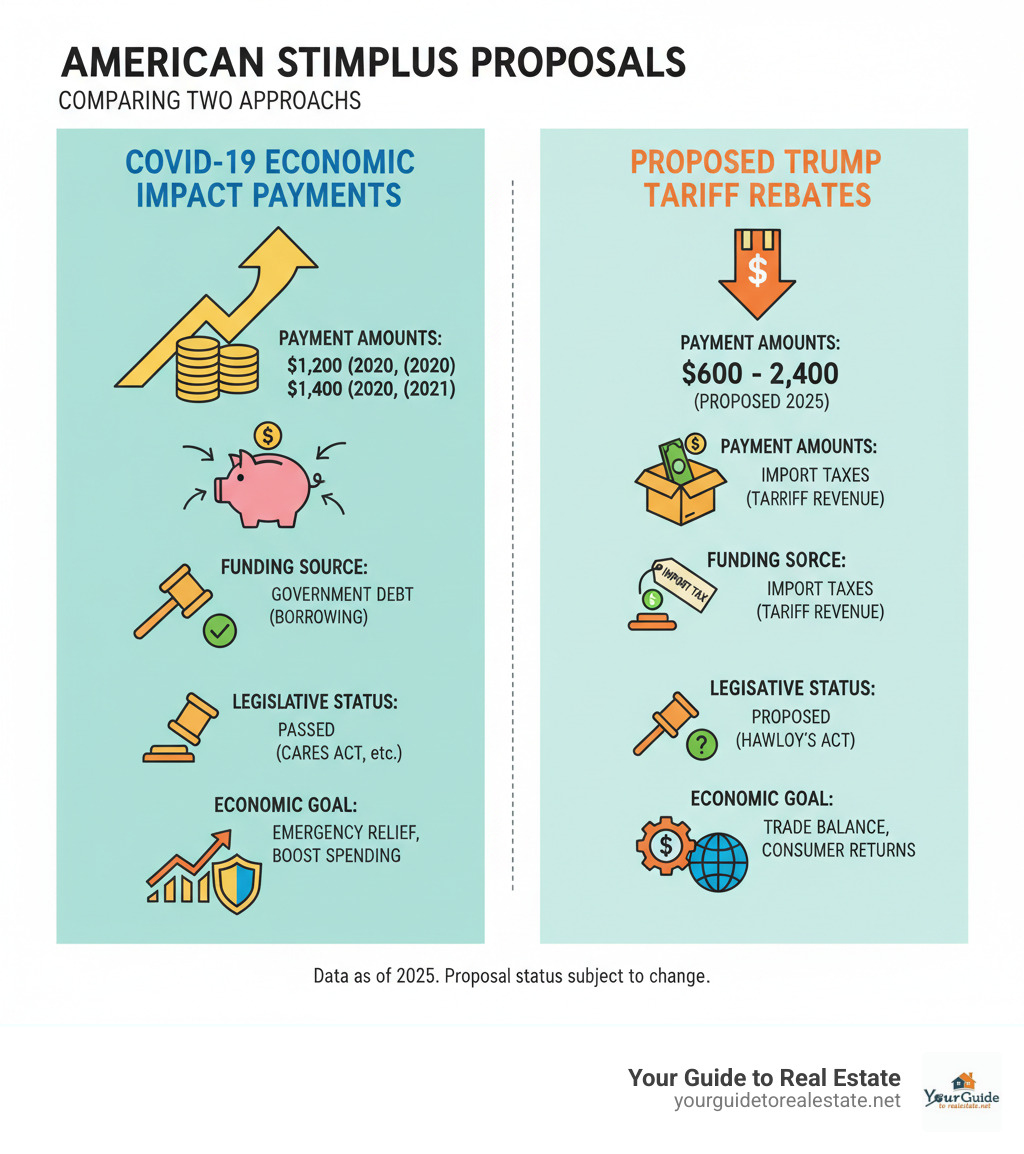
Tariff Rebates vs. COVID-Era Checks: What’s the Difference?
When people hear about potential new trump stimulus payments, it’s natural to think back to those COVID-19 checks that helped so many families during the pandemic. But here’s the thing – what’s being proposed now is actually quite different from what we experienced before.
Think of it this way: the COVID stimulus checks were like emergency financial aid during a crisis, while the proposed tariff rebates would be more like getting a refund from money the government collected through trade taxes.
The funding tells the whole story. Those pandemic payments came from government borrowing – essentially putting the cost on the national credit card. The proposed tariff rebates would come from actual revenue collected when companies import goods from other countries. It’s the difference between borrowing money to help people and returning money already collected.
The purpose is different too. COVID-era checks were all about emergency response – getting money into people’s hands quickly to prevent economic collapse during lockdowns. The tariff rebate idea is more about making trade policy work better for regular families by giving back some of the money collected from import taxes.
| Feature | COVID-19 Stimulus Checks | Proposed Tariff Rebates |
|---|---|---|
| Funding Source | Government borrowing (added to national debt) | Revenue from tariffs on imported goods |
| Legislative Status | Enacted laws (CARES Act and others) | Proposed legislation (not yet law) |
| Economic Goal | Emergency crisis response and economic stabilization | Return tariff revenue to offset consumer costs |
| Timing | One-time emergency payments during pandemic | Potentially ongoing payments tied to trade revenue |
| Scale | Broad nationwide relief ($814 billion total) | Smaller, focused distribution of trade revenue |
Here’s what matters for your family finances. The COVID payments were designed as a one-time boost during an unprecedented crisis. The tariff rebates, if they ever happen, would likely be smaller but potentially more regular – tied to how much revenue comes in from trade policies.
The proposed American Worker Rebate Act suggests $600 per person, up to $2,400 for a family of four – less than most COVID payments but funded differently. Instead of adding to government debt, it would redistribute money already collected from companies importing goods.
Understanding Tax Rebates and Stimulus Checks
The words “stimulus” and “rebate” get thrown around a lot, but they actually mean different things – and understanding this can help you make sense of any future payments.
Those COVID payments were technically advance tax credits. When you received your $1,200, $600, or $1,400 check, the government was essentially giving you a tax credit early. If you got the full amount you were entitled to, great – nothing more to do. But if you missed out or got less than you should have, you could claim the difference on your tax return through something called the Recovery Rebate Credit.
Tax rebates work differently. A rebate is usually the government giving back money it already collected – kind of like getting a refund on something you overpaid for. We’ve seen this at the state level recently. States like Georgia gave residents “inflation relief” payments when they had budget surpluses. Pennsylvania offered rebate checks to help with rising costs. These weren’t emergency measures – they were states returning excess revenue to taxpayers.
The proposed tariff rebates would work more like those state programs. Since tariffs are essentially taxes on imported goods, giving that revenue back to citizens would be a true rebate – returning money the government collected rather than borrowing new money.
Here’s a real example: New York offered inflation relief checks of $200 for individuals earning up to $75,000 and $400 for married couples earning up to $150,000. That money came from state revenue, not borrowing. It was designed to help residents cope with higher prices by giving back some of what they’d already paid in taxes.
The key difference is where the money comes from and why it’s being distributed. Emergency stimulus involves borrowing to inject money into a struggling economy. Rebates involve returning money already collected to provide relief or distribute surplus funds.
If you’re still wondering about past COVID payments or need to claim missing amounts, the Recovery Rebate Credit information from TurboTax can help you understand your options.
Fact vs. Fiction: Debunking Current Stimulus Rumors
In today’s social media world, rumors spread faster than fact-checkers can keep up. We’ve all seen those exciting posts about “new stimulus checks coming soon!” or “$1,400 payments approved!” But here’s the reality check we all need: most of these claims are simply not true.

The IRS has spoken clearly: there are no new federal stimulus checks confirmed for 2025. Those viral posts about $1,390 direct deposit payments or $1,400 checks for middle-income families in August? The IRS has officially debunked them all. Zero confirmation from Congress. Zero confirmation from the Treasury. Just rumors that refuse to die.
Yes, President Trump has mentioned the possibility of “generous” future payments and tariff rebates. And yes, Senator Hawley’s American Worker Rebate Act is a real proposal. But here’s the key word: proposal. It’s not law. It hasn’t passed Congress. No checks are in the mail.
The confusion around trump stimulus plans is understandable. We’ve been through multiple rounds of real payments during the pandemic, so it’s natural to wonder when the next ones might arrive. But right now, if you’re budgeting for a new stimulus payment, you’re setting yourself up for disappointment.
Social media speculation has become particularly problematic. Facebook posts claiming “breaking news” about stimulus approvals spread like wildfire, often shared by well-meaning friends and family. Instagram stories promise “easy money” with official-looking graphics. TikTok videos claim insider knowledge about secret government payments.
Here’s how to protect yourself from both misinformation and actual scams. Never pay a fee to receive any government payment – real stimulus checks and rebates are always free. The IRS will never contact you by phone, email, or text asking for personal information about payments. Always verify through official sources like IRS.gov before believing any payment claims.
Fake check scams have become especially sophisticated. Scammers send realistic-looking checks, ask you to deposit them, then request you send back a portion of the money. By the time the bank finds the check is fake, you’re out the money you sent.
If you’re concerned about missing past stimulus payments, use the official IRS website to check your status. Don’t rely on third-party sites or services that promise to help you claim missing money for a fee.
The bottom line? Until Congress actually passes new legislation and the IRS makes official announcements, treat all trump stimulus rumors with healthy skepticism. Your financial planning will be much more accurate that way.
For reliable information from official sources, check out NBC Chicago’s coverage debunking current speculation. The FTC also provides excellent tips on avoiding Economic Impact Payment scams that everyone should read.
Frequently Asked Questions about Stimulus Plans
We know stimulus checks and economic relief can feel overwhelming. Between past payments, current proposals, and endless rumors swirling around social media, it’s no wonder people have questions. Let’s clear up the most common concerns we hear about trump stimulus plans and what they mean for your wallet.
Is a fourth trump stimulus check confirmed?
Here’s the straight answer: No, absolutely not. There is no confirmed fourth federal trump stimulus check coming your way.
What we do have is Senator Josh Hawley’s American Worker Rebate Act of 2025, but that’s just a proposal sitting in Congress – not a done deal. Think of it like a house blueprint versus an actual house. The blueprint exists, but nobody’s moved in yet.
The IRS has been pretty clear about this too. They’ve officially shot down all those rumors floating around about $1,390 or $1,400 payments coming in 2025. No confirmation from Congress, no confirmation from the IRS, no new checks.
The reality is that getting any new rebate program through Congress is like trying to herd cats. There’s significant pushback even from within Republican ranks, with lawmakers worried about our $37 trillion national debt. So while proposals exist, turning them into actual payments is a whole different ballgame.
How do the proposed tariff rebates work?
The proposed tariff rebates are actually pretty clever in concept, even if they’re controversial in practice. Here’s how they would work if they ever became law.
When the U.S. government puts tariffs on imported goods, it’s essentially collecting taxes from companies bringing those products into the country. The government expects to collect around $300 billion annually from these tariffs. Instead of that money just disappearing into general government coffers, the rebate proposal would send a portion directly back to American taxpayers.
Under Senator Hawley’s plan, you’d get at least $600 as an individual, or up to $2,400 for a family of four. The exact amount could even go higher if tariff collections exceed expectations – kind of like a bonus based on how well the trade policy performs.
This is fundamentally different from the COVID stimulus checks. Those were emergency payments funded by government borrowing during a crisis. The tariff rebates would be ongoing returns of money the government collected from import taxes. It’s designed to offset the higher prices consumers might pay due to tariffs, creating a circular system where tariff revenue comes back to help with tariff-related costs.
Of course, economists debate whether this actually helps consumers or just creates an expensive shell game. But that’s the basic mechanism if it ever becomes reality.
How can I check for missing stimulus payments from the pandemic?
This is where timing becomes really important, and unfortunately, some windows have already closed.
For the first two stimulus payments from 2020, you would have needed to claim the 2020 Recovery Rebate Credit on your 2020 tax return. If you missed those payments and haven’t filed that return yet, you might still have options, but you’d need to consult with a tax professional about your specific situation.
For the third stimulus payment from 2021, here’s the tough news: the deadline to claim it was April 15, 2025. If you missed that deadline, you’re unfortunately out of luck for that $1,400 payment.
If you’re not sure what you received, check your IRS Online Account – it’s like your personal government financial dashboard. You can see exactly what payments hit your account and when. The IRS also sent out Letter 6475 confirming your third payment amount, so dig through your mail pile if you kept it.
The key thing to remember is that you can’t just call the IRS and ask them to send a missing check. You had to claim these through the Recovery Rebate Credit system on your tax returns. It’s not a direct payment request – it’s a tax credit process.
For current information and any tools that might still be available, check the status of your Economic Impact Payment on the official IRS website. While the active tracking tools are mostly shut down now, the site still has helpful guidance about past payments.
The bottom line? If you think you missed a pandemic-era payment, act quickly and consider getting professional tax help to explore your remaining options.
Conclusion: What This Means for Your Finances
After sorting through all the rumors, proposals, and facts about trump stimulus plans, let’s get to what really matters for your wallet and your future.
Here’s where we stand right now: No new federal stimulus checks are coming your way. The IRS has been crystal clear about debunking those social media rumors promising $1,390 or $1,400 payments. Senator Hawley’s tariff-rebate proposal sounds interesting on paper, but it’s just that – a proposal sitting in Congress with no guarantee of ever becoming reality.
If you missed claiming your third COVID stimulus payment, that ship has sailed. The April 15, 2025 deadline has passed. But don’t beat yourself up about it – focus on what you can control moving forward.
The real estate connection matters more than you might think. Those massive stimulus payments during the pandemic didn’t just disappear into thin air. They boosted consumer spending, helped people build emergency funds, and created a surge in housing demand that we’re still feeling today. When people have more money in their pockets, they’re more likely to buy homes, upgrade their living situations, or invest in rental properties.
Any future economic policies – whether they’re tariff rebates, tax cuts, or other forms of government assistance – could shake up the housing market again. More money flowing to consumers often means higher home prices and increased competition for buyers. It’s a double-edged sword that affects both your purchasing power and housing affordability.
At Your Guide to Real Estate, we’ve seen how quickly economic changes can create both challenges and golden opportunities in the real estate world. The key is staying informed and being ready to adapt your strategy when conditions shift.
Whether you’re saving for your first home, considering an investment property, or thinking about selling, understanding these broader economic trends helps you make smarter decisions. Our proven framework takes the stress out of navigating these market changes, giving you the confidence to move forward regardless of what Washington decides to do next.
Ready to take control of your real estate future? Learn more about real estate financing options and find how we can help you succeed in any economic climate.