

Understanding Federal Unsubsidized Loans: Your Complete Guide
An unsubsidized loan is a federal student loan available to undergraduate and graduate students that doesn’t require financial need but charges interest from the moment funds are disbursed. Unlike subsidized loans, you’re responsible for all interest that accumulates on unsubsidized loans.
Quick Facts About Unsubsidized Loans:
- Available to: All undergraduate and graduate students
- Financial need: Not required
- Interest rates: 6.53% for undergraduates, 8.08% for graduates (2023-2024)
- Annual limits: $5,500-$12,500 for undergraduates, $20,500 for graduates
- Interest responsibility: Borrower pays all interest from disbursement
Federal student loans help millions of students pay for college each year. The two main types are subsidized and unsubsidized Direct Loans, both offered through the U.S. Department of Education.
The key difference is simple: with subsidized loans, the government pays your interest while you’re in school. With unsubsidized loans, you pay all the interest.
This means unsubsidized loans cost more over time, but they’re also more accessible since they don’t require proof of financial need. According to federal data, 19% of college costs are paid with borrowed money, making it crucial to understand your options.
Whether you’re an undergraduate who doesn’t qualify for subsidized aid or a graduate student (who can only get unsubsidized loans), these loans can bridge the gap between your college costs and other financial aid.
Basic unsubsidized loan terms:
Unsubsidized vs. Subsidized Loans: A Detailed Comparison
Understanding the difference between subsidized and unsubsidized federal student loans is like comparing two different mortgage types – both help you reach your goal, but the financial impact can be quite different over time.
The biggest difference comes down to who pays the interest and when. With a Direct Subsidized Loan, the government acts like a helpful friend who covers your interest payments while you’re in school (enrolled at least half-time), during your six-month grace period after graduation, and during any deferment periods. It’s essentially free money – your loan balance stays the same while you focus on your studies.
But here’s the catch: subsidized loans require financial need. The government calculates this by looking at your cost of attendance, subtracting your expected family contribution and any other aid you’re receiving. Only undergraduate students can get subsidized loans, and the amounts are typically smaller.
An unsubsidized loan works differently. Think of it as a more accessible but costlier option. You’re responsible for all the interest from day one – from the moment the money hits your school account until you pay off the last penny. If you don’t pay the interest while you’re in school, it gets added to your loan balance through a process called capitalization. This means you’ll end up paying interest on interest, which can really add up over time.
The good news? Unsubsidized loans don’t require financial need. Whether your family makes $30,000 or $300,000 a year, you can still qualify as long as you meet basic federal aid requirements. They’re also available to graduate and professional students – in fact, since 2012, grad students can only get unsubsidized federal loans.
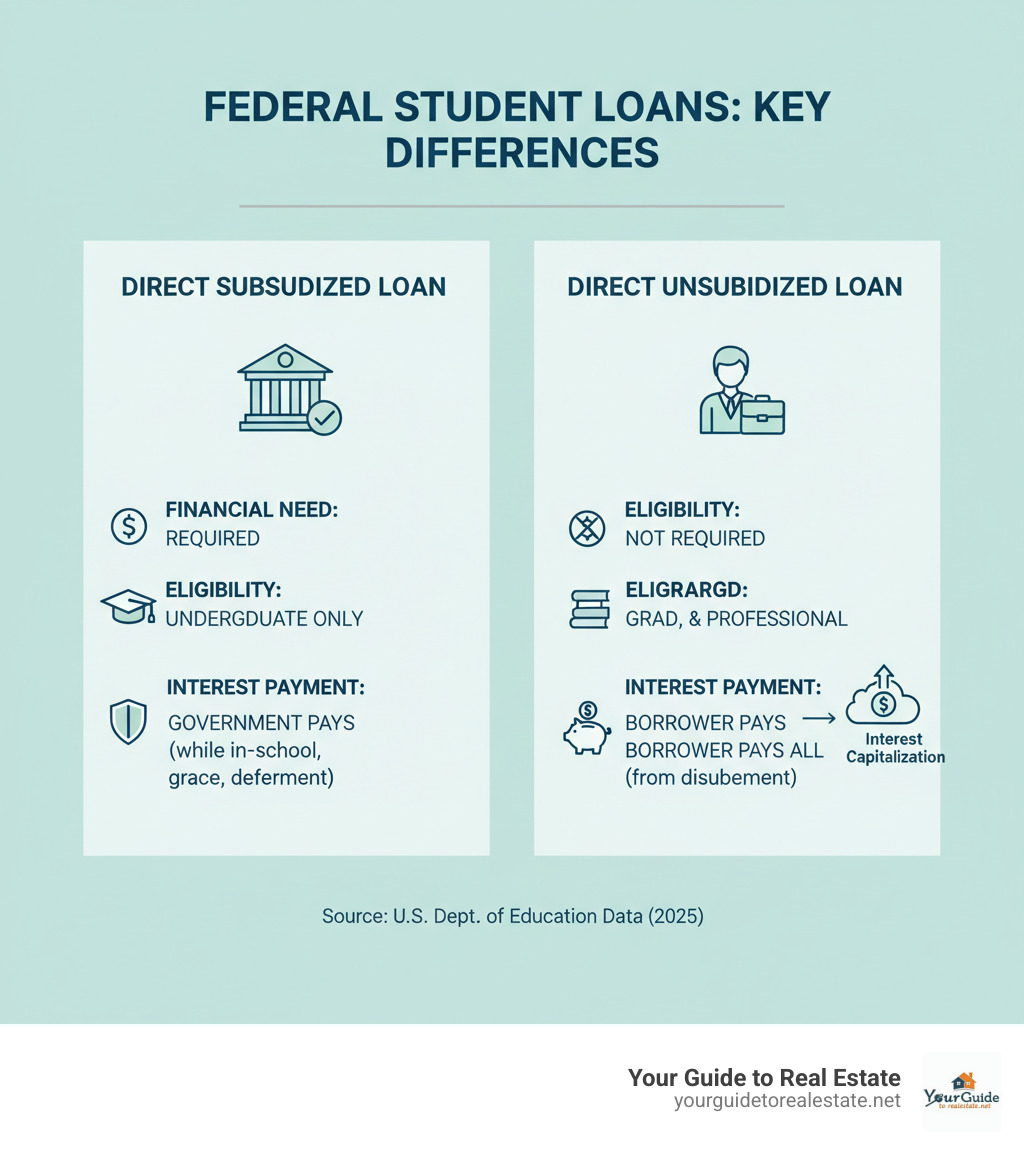
Here’s a quick comparison to help you see the differences:
| Feature | Direct Subsidized Loan | Direct Unsubsidized Loan |
|---|---|---|
| Financial Need | Required | Not Required |
| Eligibility | Undergraduate students only | Undergraduate, graduate, and professional students |
| Interest Payment | Government pays while in school (half-time), grace period, and deferment | Borrower responsible for all interest from disbursement |
| Interest Accrual | Interest does not accrue during specific periods | Interest accrues from disbursement |
| Capitalization | No capitalization during specific periods | Interest can capitalize if not paid |
| Borrowing Limits | Lower annual and aggregate limits | Higher annual and aggregate limits, especially for graduate students |
Both loans have fixed interest rates and come with the same federal protections like income-driven repayment plans and potential loan forgiveness programs. The key is understanding which option fits your situation and how the interest structure affects your long-term costs.
Making smart borrowing decisions now sets you up for better financial health later – just like understanding mortgage options helps you make informed real estate investments. For the official government comparison, check out Direct Subsidized Loans vs. Direct Unsubsidized Loans – Federal Student Aid.
Eligibility, Limits, and Costs of an Unsubsidized Loan
Understanding the nuts and bolts of unsubsidized loans – who can get them, how much you can borrow, and what they’ll actually cost you – is just as important as knowing your budget when house hunting. Let’s break down everything you need to know so there are no surprises down the road.

Who Is Eligible for an Unsubsidized Loan?
The beauty of unsubsidized loans lies in their accessibility. While subsidized loans play hard to get with their financial need requirements, unsubsidized loans welcome a much broader group of students with open arms.
Undergraduate students can qualify regardless of their family’s financial situation. Whether you’re from a wealthy family or struggling to make ends meet, an unsubsidized loan can help bridge the gap between your college costs and other aid. If you don’t qualify for subsidized loans or need more money than those loans provide, unsubsidized loans step in to fill that void.
Graduate and professional students rely heavily on these loans since they’re essentially locked out of the subsidized loan program. If you’re pursuing your master’s degree, doctorate, or professional degree in law or medicine, unsubsidized loans become your primary federal student loan option.
The eligibility requirements are pretty straightforward. You need to be a U.S. citizen or eligible noncitizen and stay enrolled at least half-time in a degree or certificate program that qualifies for federal aid. You’ll also need to maintain satisfactory academic progress according to your school’s standards.
Here’s the kicker though – even though financial need doesn’t matter for unsubsidized loans, you still must complete the FAFSA every year. Think of the FAFSA as your golden ticket to all federal student aid, including these loans. Without it, you’re locked out completely.
You also can’t be in default on any federal student loans or owe money back on federal grants. It’s like having a clean credit history – the government wants to see you’re responsible with the money they’ve already lent you.
How Much Can You Borrow?
The amount you can borrow depends on where you are in your academic journey and your dependency status. The federal government sets these limits to encourage responsible borrowing – they don’t want students drowning in debt any more than you do.
For undergraduate students, your borrowing power varies significantly based on whether you’re considered dependent or independent. Dependent students (those whose parents are expected to help with college costs) face lower limits. A first-year dependent student might max out at $5,500 total between subsidized and unsubsidized loans.
Independent undergraduate students get much higher limits because they’re on their own financially. First-year independent students can borrow up to $9,500 annually, with that number climbing to $12,500 by their third year and beyond. The exact split between subsidized and unsubsidized portions depends on your financial need, but you could potentially get $7,000 in unsubsidized loans alone during your final years.
Graduate students get the biggest borrowing power with up to $20,500 annually in Direct Unsubsidized Loans. This reflects the reality that graduate programs often cost significantly more than undergraduate education.
The government also caps how much you can borrow over your entire academic career. Independent undergraduates can borrow up to $57,500 total, while graduate students can access up to $138,500 in their lifetime (including any loans from their undergraduate years).
These are maximums, not recommendations. You can find detailed borrowing limit information on the federal student aid website, but the smart move is borrowing only what you absolutely need.
Understanding Interest Rates and Fees
Just like when you’re shopping for a mortgage and need to understand Understanding Mortgage Rates, grasping the interest rates and fees on your unsubsidized loan is crucial for your financial future.
The good news? Federal Direct Unsubsidized Loans come with fixed interest rates that won’t change over the life of your loan. No surprises, no sudden rate jumps – what you sign up for is what you’ll pay.
For the 2023-2024 academic year, undergraduate students face a 6.53% interest rate, while graduate and professional students pay 8.08%. These rates are set annually by Congress, so they can change for new loans each year, but your existing loans stay locked at their original rate.
Here’s where unsubsidized loans get expensive: you’re responsible for every penny of interest from the moment your loan money hits your school’s account. That interest keeps growing whether you’re cramming for finals, enjoying your grace period after graduation, or taking a deferment.
There’s also an origination fee of 1.057% that gets deducted from each loan disbursement before the money reaches your school. It might seem small, but if you borrow $10,000, you’ll actually receive about $894 less after this fee.
The real kicker comes with interest capitalization. If you don’t pay the interest as it accumulates, it gets added to your principal balance. From that point forward, you’re paying interest on your original loan amount plus all that unpaid interest. It’s like a financial snowball rolling downhill, getting bigger and more expensive as it goes.
Even making small interest payments while you’re in school can save you hundreds or thousands of dollars over the life of your loan. Check the official site for current interest rates to stay updated on the latest figures.
The Application and Disbursement Process
Getting your unsubsidized loan might feel overwhelming at first, but think of it like applying for any major financial commitment – there’s paperwork involved, but each step builds toward your goal. The good news? Millions of students successfully steer this process every year, and with the right guidance, you’ll join them.
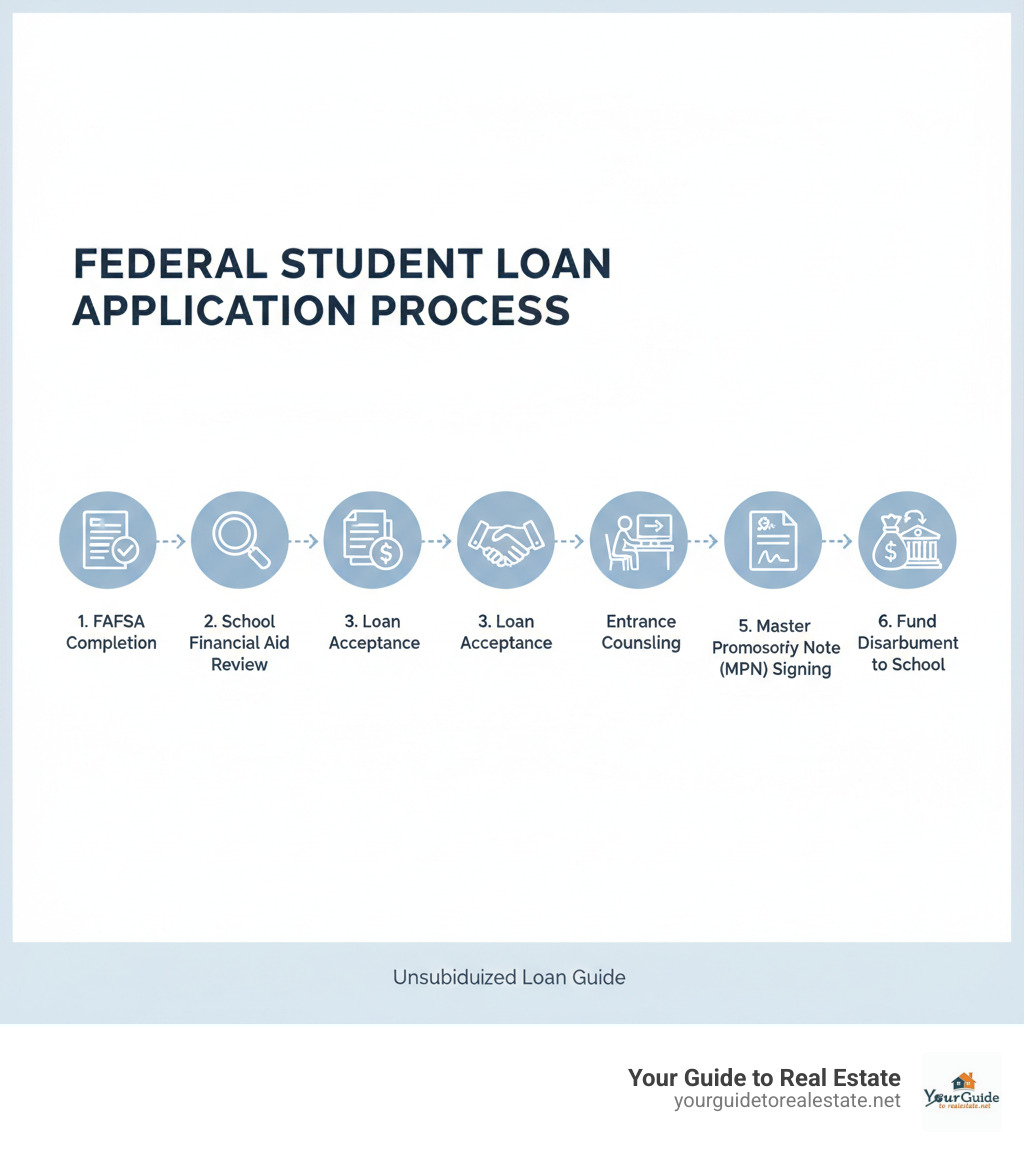
How to Apply for an Unsubsidized Loan
Everything starts with one crucial form: the FAFSA. Even though unsubsidized loans don’t require financial need, the Free Application for Federal Student Aid (FAFSA) is still your gateway to all federal student aid programs.
Before you can even touch the FAFSA, you’ll need an FSA ID. This username and password combination becomes your digital signature for all federal student aid websites. If you’re a dependent student, your parents will need their own FSA ID too. It’s like getting the keys before you can start the car.
Once you have your FSA ID, completing the FAFSA becomes your main mission. This form collects financial information about you (and your family, if applicable) to determine what aid you’re eligible for. The process has gotten much smoother over the years, with many tax details now imported automatically.
Timing matters tremendously here. Federal deadlines are firm, but many states and schools have their own earlier deadlines. Missing these can cost you thousands in aid. Mark your calendar and submit early – there’s no prize for waiting until the last minute.
When filling out the FAFSA, you’ll select the schools you’re considering. The Department of Education sends your information directly to these schools, so their financial aid offices can prepare your aid package.
After submission, you’ll receive your Student Aid Report (SAR). This document summarizes everything you submitted and shows your Expected Family Contribution. Review it carefully – any errors here can affect your aid eligibility. Think of it as proofreading before the final draft.
Steps for First-Time Borrowers
If this is your first rodeo with federal student loans, there are a few extra steps designed to make sure you understand what you’re signing up for. These aren’t bureaucratic problems – they’re actually protective measures to help you borrow responsibly.
Your school’s financial aid office will send you an award letter detailing all the aid you’re eligible for, including your unsubsidized loan. Here’s where you have control: you can accept the full amount, accept a partial amount, or decline it entirely. Smart borrowers only take what they truly need – remember, you’ll be paying this back with interest.
Next comes the Master Promissory Note (MPN). This legal document is essentially your promise to repay the loan, along with all the terms and conditions. The good news is you typically only need to Complete a Master Promissory Note (MPN) once for each loan type during your entire college career, even if you borrow multiple years.
Federal Direct Loan Entrance Counseling is your required crash course in student loan responsibility. This online session covers everything from your rights as a borrower to what happens if you can’t make payments. It might seem tedious, but the information could save you thousands later. You can knock this out at Complete the Federal Direct Loan Entrance Counseling.
The Annual Student Loan Acknowledgement isn’t always mandatory, but it’s incredibly valuable. This yearly check-in shows your total loan balance and estimated monthly payments after graduation. It’s like getting a financial reality check – sometimes uncomfortable, but always useful for planning ahead.
Receiving Your Loan Funds
Once you’ve completed all the paperwork and requirements, it’s time for the money to actually flow. Understanding this process helps you plan your finances and avoid any surprises.
Your school receives the funds first, not you. This might seem backward, but it ensures your educational expenses get covered before anything else. The money typically arrives in at least two disbursements per academic year – think fall semester, then spring semester.
Your school acts like a financial middleman, automatically applying loan funds to your tuition, fees, and any on-campus housing charges. This happens without any action on your part, which is actually pretty convenient.
Here’s where it gets interesting: if there’s money left over after all school charges are covered, the school must pay that balance to you, usually within 14 days. This leftover money is meant for other educational expenses like books, supplies, transportation, and living costs. Some students forget this step and wonder where their money went!
After each disbursement, you’ll receive loan disclosure statements from the Federal Loan Origination Center. These documents contain important details about your loan amounts, interest rates, and disbursement dates. File these away safely – you’ll want them for your records, especially when it comes time to start repayment.
The entire process typically takes a few weeks from acceptance to actual fund disbursement, so plan accordingly. Just like timing is crucial when buying real estate, timing matters for your educational financing too.
Managing Your Unsubsidized Loan: Repayment and Other Options
Getting an unsubsidized loan is just the beginning of your journey – managing it wisely is where you’ll really set yourself up for financial success. Think of it like buying your first home: getting approved for the mortgage is exciting, but the real work happens in the years of payments that follow. We’re here to help you steer this next phase with confidence.

When Repayment Begins
Here’s some welcome news: you won’t need to start making payments on your unsubsidized loan the moment you receive your diploma. Federal student loans come with a built-in buffer called a grace period.
Your six-month grace period starts after you graduate, leave school, or drop below half-time enrollment. This breathing room is designed to help you find a job, settle into your new routine, and get your finances organized before those monthly payments begin.
But here’s the catch with unsubsidized loans – and it’s an important one. Even during your grace period, interest keeps building up on your loan balance. It’s like a meter that never stops running. If you don’t pay this interest as it accumulates, it will likely be added to your principal balance when your official repayment period starts. This process is called capitalization, and it means you’ll end up paying interest on a larger amount.
Your loan servicer will reach out to you before your grace period ends. They’ll send you information about your first payment due date and explain your repayment options. Make sure they have your current address and phone number – you don’t want to miss these important communications.
Repayment, Reduction, and Cancellation
Managing your unsubsidized loan successfully means understanding all your options. The federal government offers quite a bit of flexibility, which is one of the major advantages of federal loans over private ones.
Paying interest while you’re still in school is one of the smartest moves you can make with an unsubsidized loan. Even small payments – maybe $25 or $50 a month – can prevent that interest from snowballing. Think of it as preventive maintenance for your financial future.
When it comes to repayment, you’re not stuck with just one option. The government offers several flexible repayment options to match different financial situations. The Standard Repayment Plan gives you fixed payments for up to 10 years – it’s straightforward and gets you debt-free fastest. The Graduated Repayment Plan starts with lower payments that increase every two years, which can help if you expect your income to grow over time.
If you need more breathing room, the Extended Repayment Plan stretches your payments over up to 25 years, lowering your monthly amount but increasing your total interest cost. For borrowers facing financial hardship, Income-Driven Repayment plans base your payments on your income and family size. These plans can even lead to loan forgiveness after 20 or 25 years of qualifying payments.
Sometimes you might realize you’ve borrowed more than you actually need. If your loan hasn’t been disbursed yet, you can usually reduce or cancel it online through your school’s financial aid portal. If the loan has already been disbursed but it’s been less than 120 days, you can typically still reduce or cancel it through your school – though keep in mind this might create a balance you’ll owe directly to your school.
While widespread loan forgiveness programs have faced legal challenges, several established student loan forgiveness programs remain available. Public Service Loan Forgiveness can eliminate remaining debt for borrowers working full-time for qualifying non-profit organizations or government agencies. Teachers working in low-income schools might qualify for Teacher Loan Forgiveness after five consecutive years of service.
Just like using a Mortgage Payment Calculator Online helps you plan for homeownership, understanding your student loan repayment options is crucial for long-term financial health.
Where to Find Updates and More Information
The world of federal student aid evolves constantly, so staying informed is key to making the best decisions about your unsubsidized loan.
StudentAid.gov should be your first stop for reliable information. This official federal website lets you access your complete loan history, find your loan servicer’s contact information, compare repayment plans, and get answers to common questions. It’s like having a 24/7 financial aid office at your fingertips.
Your loan servicer becomes your main point of contact once your loan is disbursed. They’re the company that handles the day-to-day management of your account. They can tell you your exact balance, help you change repayment plans, process payments, and answer specific questions about your loan terms. If you’re not sure who your servicer is, you can find this information on StudentAid.gov.
Don’t forget about your school’s financial aid office. These professionals are experts in federal aid and can help you understand how changes in your enrollment status might affect your loans. They’re also great resources if you’re considering additional borrowing or have questions about your school’s specific policies.
Finally, keep an eye on federal student aid updates for any major policy changes, interest rate adjustments, or new program announcements. Staying informed helps you take advantage of opportunities and avoid surprises.
Managing your student loans successfully is a lot like managing any major financial commitment. Just as understanding a home loan is vital for successful property investment, mastering your student loan options sets the foundation for your financial future. The key is staying engaged, asking questions when you need help, and making informed decisions along the way.
Frequently Asked Questions about Unsubsidized Loans
We get it – even after diving deep into unsubsidized loans, you probably still have some lingering questions. That’s completely normal! Student loans can feel overwhelming at first, but once you understand the basics, they become much more manageable. Think of it like learning about mortgages – initially complex, but totally doable once you know what you’re dealing with.
Here are the questions we hear most often about unsubsidized loans, along with straightforward answers that’ll put your mind at ease:
Do I need good credit to get an unsubsidized loan?
This is probably the most common worry we hear from students, and here’s the great news: No, you don’t need good credit to get an unsubsidized loan!
Federal unsubsidized loans for students don’t require a credit check at all. They also don’t require a cosigner, which is a huge relief for many families. Your eligibility is based on factors like your FAFSA information and your school’s cost of attendance – not your credit history.
This accessibility is one of the biggest advantages of federal student loans over private loans. Whether you’re 18 with no credit history or you’ve had some financial bumps in the road, you can still qualify for an unsubsidized loan as long as you meet the basic federal aid requirements we covered earlier.
Can I pay off my unsubsidized loan early without a penalty?
Absolutely, and we actually encourage it! Yes, you can make extra payments or pay off your federal student loans in full at any time without incurring a prepayment penalty.
This flexibility is fantastic because it means every extra dollar you put toward your loan goes directly to reducing your balance and saving you money on interest. Whether you get a tax refund, a bonus at work, or just want to throw an extra $50 at your loan each month, you’re free to do so without any fees.
Paying off your loan early – or even just making extra payments when you can – will save you a significant amount of money over the life of the loan. It’s one of the smartest financial moves you can make with student debt.
What happens if I don’t pay the interest on my unsubsidized loan while in school?
This is where the “unsubsidized” part really shows its teeth, so pay attention to this one! If you choose not to pay the interest while in school, during your grace period, or during deferment, it will be capitalized.
Here’s what that means in plain English: all that unpaid interest gets added to your principal loan balance. So if you borrowed $10,000 and $2,000 in interest accumulated while you were in school, your new loan balance becomes $12,000. From that point forward, you’ll be paying interest on $12,000 instead of your original $10,000.
This capitalization process can significantly increase the total amount you owe over time because you end up paying interest on interest. It’s like a snowball rolling downhill – it starts small but can get quite large if you don’t keep it in check.
The good news? Even small payments toward the interest while you’re in school can make a big difference in your total loan cost. You don’t have to pay it all, but paying what you can will save you money down the road.
Conclusion
Understanding unsubsidized loans is like having a roadmap for one of your biggest financial decisions. These federal student loans open doors for millions of students each year, offering access to education funding regardless of financial need. But as we’ve seen throughout this guide, they come with important responsibilities that can shape your financial future.
The most crucial takeaway? You’re responsible for all interest from day one. This fundamental difference from subsidized loans means every month you’re in school, that interest meter is running. It’s not meant to scare you – it’s meant to empower you to make smart choices about when and how much to borrow.
Unsubsidized loans are incredibly flexible, serving everyone from undergraduates who need extra funding to graduate students pursuing advanced degrees. With annual limits reaching $20,500 for graduate students and reasonable fixed interest rates, they’re often a sensible choice for financing your education. The key is treating them with the respect they deserve.
Think of interest like a small leak in your roof – ignore it, and it becomes a much bigger problem over time. Paying even small amounts toward your interest while in school can save you thousands of dollars later. And remember, there’s no penalty for paying extra or paying off your loan early, so any windfall – whether it’s birthday money or a summer job bonus – can work in your favor.
Just as understanding a home loan is vital for a successful property investment, mastering student loan options sets you up for future financial health. Both require careful planning, understanding of interest rates, and a clear repayment strategy.
At Your Guide to Real Estate, we believe financial literacy is your foundation for every major life decision. Whether you’re calculating student loan payments now or planning for a future mortgage, the principles remain the same: borrow wisely, understand your terms, and pay strategically.
Ready to build that financial foundation even stronger? Our comprehensive resource Understanding Mortgages: A Beginner’s Guide to Home Loans applies these same smart borrowing principles to help you steer your future home purchase with confidence.