
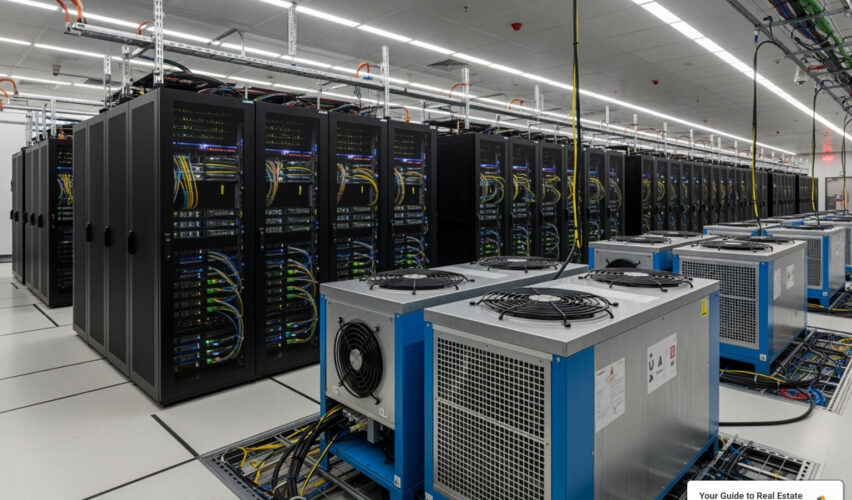
Why VRT Stock Matters in Today’s AI-Driven Market
VRT stock represents Vertiv Holdings Co., a critical infrastructure company powering the AI revolution through data center cooling and power solutions. Here’s what you need to know:
Key VRT Stock Facts:
- Current Price: ~$101-107 (highly volatile)
- Market Cap: ~$41 billion
- Industry: Electrical Equipment & Data Center Infrastructure
- 1-Year Return: +71%
- 5-Year Return: +414%
- Analyst Rating: Strong Buy consensus
- Primary Growth Driver: AI data center boom
Vertiv Holdings isn’t your typical stock pick. This Ohio-based company, founded in 1946, has transformed from a traditional electrical equipment manufacturer into a critical player in the AI infrastructure boom.
The company provides the cooling systems, power management, and integrated solutions that keep data centers running – the same data centers that power ChatGPT, cloud computing, and the entire digital economy.
Why investors are paying attention: VRT stock has delivered exceptional returns, with a 71% gain over the past year alone. But this growth comes with significant volatility – the stock has a beta of 1.6, meaning it moves 60% more than the broader market.
Recent earnings show the AI tailwind is real. Vertiv reported 25% organic sales growth in Q1 2025, beating analyst expectations and raising full-year guidance to $9.2 billion in sales.
However, VRT stock trades at a premium valuation with a P/E ratio over 80, making it both an opportunity and a risk for investors.
Basic vrt stock vocab:
Understanding Vertiv Holdings (VRT): The Business Behind the Ticker
When you invest in VRT stock, you’re backing a company that’s been quietly powering our digital world for decades. Every time you stream your favorite show, video chat with family, or watch AI generate content, there’s a massive data center humming away somewhere – and it needs to stay cool, powered, and running 24/7. That’s exactly what Vertiv Holdings does.
Think of Vertiv as the unsung hero of the digital age. While tech companies get all the headlines, Vertiv provides the critical infrastructure that keeps everything running smoothly. Without their cooling systems and power management solutions, those powerful AI servers would overheat faster than your laptop during a video call marathon.
You can explore their full range of solutions at www.vertiv.com, where you’ll see just how comprehensive their offerings really are.
What is Vertiv Holdings Co.?
Here’s something that might surprise you: Vertiv has been around since 1946. That’s right – this company has nearly eight decades of experience in electrical and power solutions. What started as a traditional manufacturing business has evolved into a critical player in today’s AI-driven economy.
The company operates from Westerville, Ohio, and falls squarely within the Industrials sector, specifically the Electrical Equipment & Parts industry. But don’t let those traditional categories fool you – Vertiv is anything but old-fashioned.
Their mission is straightforward yet vital: provide the backbone for the world’s most important digital infrastructure. From hospitals running life-saving equipment to financial institutions processing millions of transactions, Vertiv’s solutions keep the digital world spinning.
The beauty of Vertiv’s business model is that it’s become more essential over time, not less. As our world becomes increasingly digital and AI-dependent, the demand for their cooling and power management solutions continues to grow.
Vertiv’s Core Business Segments
Vertiv’s success comes from offering a complete ecosystem of solutions rather than just individual products. Their business breaks down into several interconnected segments that work together seamlessly.
Power management products form the foundation of their offerings. These include AC and DC power management solutions, switchgear, and busbar products that ensure clean, consistent power delivery. Think of it as the electrical equivalent of a surge protector – but for entire data centers worth millions of dollars.
Thermal management solutions represent Vertiv’s fastest-growing segment, especially with the AI boom. Modern AI chips generate incredible amounts of heat – we’re talking about temperatures that could literally fry an egg. Vertiv’s precision cooling technologies, including cutting-edge liquid cooling systems, keep these powerful processors running at optimal temperatures.
The company also specializes in integrated rack systems and modular solutions that allow for rapid deployment and scaling. When a company needs to expand their data center capacity quickly (which happens a lot in today’s fast-moving tech world), Vertiv’s modular approach makes it possible in weeks rather than months.
Beyond hardware, Vertiv provides comprehensive services for data centers, communication networks, and commercial and industrial environments. This includes everything from installation and maintenance to optimization services that help clients maximize their infrastructure investments over time.
What makes VRT stock particularly attractive is how these segments complement each other. A client might start with power management, then add cooling solutions, and eventually upgrade to a full integrated system – creating multiple revenue streams from a single customer relationship.
Analyzing VRT Stock’s Financial Health and Performance
Let’s be honest – understanding the business behind VRT stock is just the beginning. What really matters to investors like you and me is whether the numbers add up. Does Vertiv have the financial strength to capitalize on the AI boom? Can it handle the inevitable market bumps ahead?
The good news is that Vertiv’s financial story is compelling, though it comes with some important caveats we need to discuss.

Key Financial Metrics to Watch
When we dig into VRT stock, several key numbers jump out that tell the real story of this company’s financial health.
The market capitalization sits at around $41-42 billion, which puts Vertiv firmly in large-cap territory. This isn’t some speculative penny stock – it’s a substantial company with real market presence.
But here’s where things get interesting (and a bit concerning). The price-to-earnings ratio is running hot at 83-87 times trailing earnings. That’s pretty steep, even for a growth stock. Essentially, investors are paying $83-87 for every dollar of current earnings, betting heavily on future growth. The forward P/E of 31 suggests analysts expect earnings to nearly triple, which is quite optimistic.
Revenue tells a more encouraging story. Vertiv brought in between $7.5-8.4 billion over the past twelve months, with earnings per share around $1.28-$1.72. The recent Q1 2025 results were particularly strong, with revenue of $2.04 billion beating expectations and adjusted EPS of 64 cents also coming in ahead of forecasts.
The return on equity of 33% is genuinely impressive – it shows management is doing a great job generating profits from shareholder investments. However, the debt-to-equity ratio of 120-172% gives us pause. That’s a lot of debt relative to equity, which isn’t unusual for capital-intensive companies but does add financial risk.
Think of it like buying investment property with heavy leverage – great when times are good, but potentially problematic if the market turns. For more insights on how leverage affects investment decisions, check out our guide on valuation and market analysis in real estate.
VRT Stock Performance and Volatility
If you’re looking for a smooth, predictable ride, VRT stock probably isn’t for you. This stock moves with the intensity of a Dallas thunderstorm – dramatic and sometimes unpredictable.
The 52-week range tells the whole story: from a low of $53.60 to a high of $155.84. That’s nearly a 200% swing in just one year! Recent performance has been remarkable though, with 1-year returns of 71-74% and absolutely stunning 5-year returns of 414-756%.
Let’s put that in perspective. If you had invested $10,000 in VRT stock five years ago, you’d be sitting on somewhere between $51,400 and $85,600 today. That’s the kind of performance that gets investors excited.
But here’s the reality check: VRT stock has a beta of 1.6-2.2, meaning it typically moves 60-120% more than the broader market. When the market goes up 10%, VRT might jump 16-22%. When it falls 10%, VRT could drop 16-22%. Recent months have shown this volatility, with the stock down 12-14% over the past month despite strong long-term performance.
This volatility isn’t necessarily bad – it’s just something you need to be comfortable with. It’s like investing in a high-growth area versus a stable, established neighborhood. Both can be great investments, but they require different temperaments.
Dividend Profile
Let’s manage expectations here – if you’re hunting for dividend income, VRT stock won’t be your golden goose. The company pays a modest quarterly dividend of $0.0375, which translates to an annual yield of just 0.1-0.14%.
With a forward annual dividend of $0.15, you’re looking at pocket change rather than meaningful income. The most recent ex-dividend date was December 3, 2024.
This low dividend makes perfect sense when you understand Vertiv’s strategy. Like many growth companies, they’re reinvesting profits back into the business rather than paying them out to shareholders. Given the explosive growth in AI data centers, this approach seems smart.
If dividend income is important to your investment strategy, you might want to explore our resource on 5StarsStocks.com Dividend Stocks for companies with more generous payouts.
The bottom line? Vertiv’s financial health is solid, with strong revenue growth and impressive profitability. But the high valuation and significant debt load mean this investment comes with real risks alongside its compelling growth story.
Key Drivers and Recent News Impacting VRT Stock
The story of VRT stock isn’t just about numbers on a screen – it’s about being in the right place at the right time. Vertiv Holdings has found itself sitting pretty at the intersection of two massive trends: the explosive growth of artificial intelligence and the desperate need for better data center infrastructure. Think of it like owning the only ice cream truck in a desert town during a heat wave.
Several powerful forces are shaping Vertiv’s journey, and understanding these drivers helps explain why VRT stock has delivered such impressive returns. From breakthrough earnings reports to the AI revolution reshaping entire industries, there’s a lot happening behind the scenes.
The AI Data Center Boom: Vertiv’s Primary Growth Engine
Here’s where things get really interesting. The AI revolution isn’t just changing how we work and play – it’s creating an enormous demand for the infrastructure that makes it all possible. Every time you ask ChatGPT a question or watch a streaming service recommend your next binge-worthy show, massive data centers are working overtime in the background.
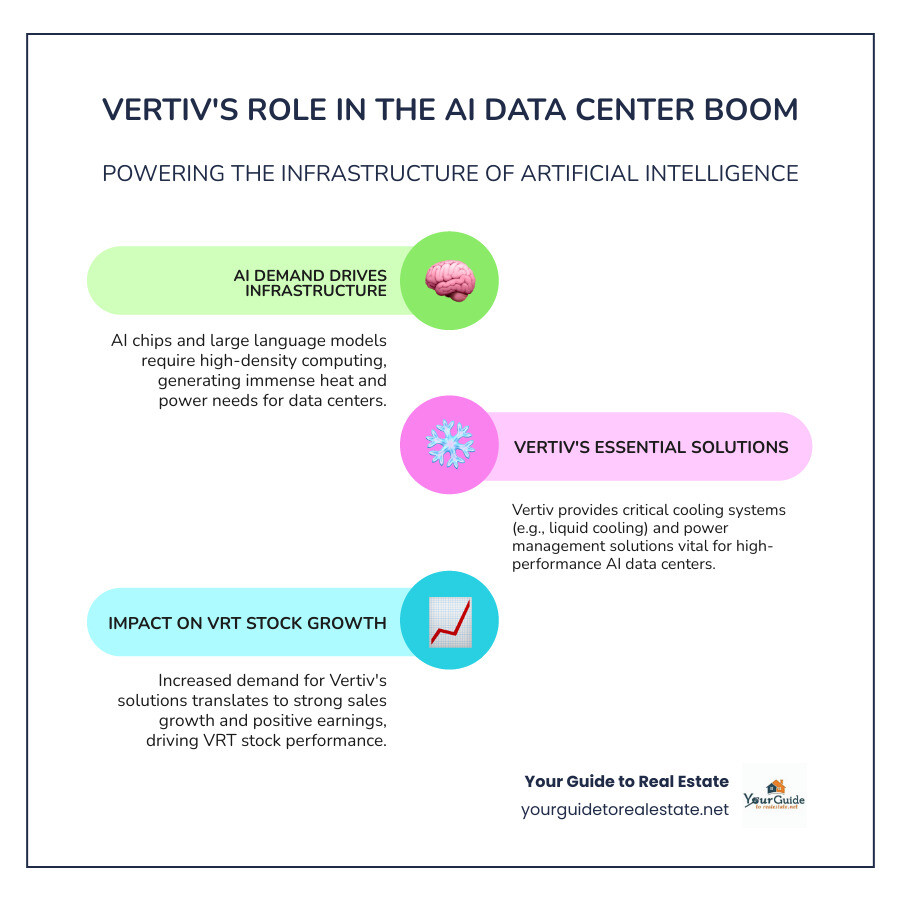
Those AI chips powering these services? They run incredibly hot. We’re talking about high-density cooling challenges that traditional air conditioning systems simply can’t handle. It’s like trying to cool down a blast furnace with a household fan – it just won’t work.
This is where Vertiv’s liquid cooling technology becomes absolutely critical. The company has positioned itself as a leader in advanced cooling solutions that can handle the intense heat generated by AI processors. When tech giants need to keep their AI systems running smoothly, they turn to companies like Vertiv.
The power infrastructure for AI chips presents another huge opportunity. These systems consume enormous amounts of electricity, and they need that power delivered reliably and efficiently. Any interruption could cost companies millions in downtime, making Vertiv’s power management solutions incredibly valuable.
Market analysts have taken notice. Many are calling companies in this space some of the smartest investments available, as highlighted in reports like Analysts Love This AI Data Center Stock. The connection between AI growth and infrastructure demand isn’t just theory – it’s driving real revenue growth for Vertiv.
For investors interested in exploring the broader AI investment landscape, resources like 5StarsStocks.com AI can provide valuable insights into this rapidly evolving sector.
Recent Earnings and Corporate Updates
The numbers don’t lie, and Vertiv’s recent performance has been nothing short of impressive. The company’s Q1 2025 earnings beat sent a clear message to Wall Street: this AI infrastructure boom is real, and Vertiv is capitalizing on it.
When Vertiv reported adjusted earnings per share of 64 cents – beating the consensus estimate of 62 cents – investors took notice. But the real story was in the revenue numbers. The company brought in $2.04 billion against expectations of $1.94 billion, showing that demand for their products is stronger than many anticipated.
Perhaps even more telling was the 25% organic sales growth the company achieved. This isn’t growth from buying other companies or financial engineering – it’s pure, old-fashioned business expansion driven by customer demand. That’s the kind of growth that gets investors excited.
Management clearly felt confident about what they were seeing. Vertiv raised full-year guidance significantly, now projecting sales of $9.2 billion for the full year. They also bumped up their earnings expectations, forecasting adjusted EPS between $3.45 and $3.65.
The company’s CEO has been particularly vocal about gaining market share in the AI data center space. This isn’t just about riding the wave of industry growth – Vertiv is actively winning business from competitors and establishing itself as a go-to provider for critical infrastructure.
These strong results and optimistic outlook were well-covered in financial media, with many outlets noting how Vertiv’s Earnings Call Highlights Strong Growth and AI Focus positioned the company for continued success.
Of course, like any public company, Vertiv has steerd its share of corporate challenges over the years, including some shareholder-related legal matters in 2022. But current investor sentiment is largely focused on the company’s strong operational performance and the massive growth opportunities ahead in the AI infrastructure space.
VRT Stock Outlook: Forecasts, Risks, and Opportunities
Looking ahead, VRT stock presents a fascinating investment story that’s equal parts opportunity and challenge. We’ve spent time diving deep into the numbers and the business fundamentals, and now it’s time to paint the picture of what tomorrow might bring for Vertiv Holdings.
Analyst Ratings and Price Targets for VRT Stock
Wall Street is sending a clear message about VRT stock: they love the story, even if they’re getting a bit more cautious about the price. The overall consensus remains a ‘Strong Buy’ rating, which tells you that most analysts believe this stock has room to run.
But here’s where it gets interesting – and a little messy. The average analyst price target ranges from around $105 to $142, depending on which analysis you’re looking at. That spread alone should tell you something about the uncertainty surrounding this high-growth stock.
What’s really caught our attention is the recent flurry of target adjustments. TD Cowen trimmed their target from $141 down to $139. Barclays went from $142 to $131, though they’re sticking with their ‘Hold’ rating. Mizuho Securities dropped from $145 to $115 but kept their ‘Buy’ rating intact.
The bigger moves came from some major players. Citi made a significant cut from $153 down to $98. Goldman Sachs went from $135 to $85. JPMorgan reduced their target from $132 to $100.
Now, before you panic about all these cuts, remember what we always say about real estate markets – sometimes price adjustments reflect changing conditions, not changing fundamentals. These target reductions often happen when analysts recalibrate their models for market volatility or updated economic outlooks. The key thing? Firms like Evercore ISI and Mizuho are still reaffirming their ‘Buy’ ratings, showing continued confidence in the long-term story.
Future Growth Opportunities
When we look at Vertiv’s growth runway, it’s hard not to get excited about the possibilities. The expanding AI market isn’t just a trend – it’s a fundamental shift in how our digital world operates. Every time someone uses ChatGPT, streams a movie, or runs a complex data analysis, there’s a data center working behind the scenes. And those data centers need Vertiv’s cooling and power solutions to keep running.
Vertiv isn’t just riding this wave – they’re gaining market share as the AI buildout continues. The CEO has been clear about this strategic advantage, and it shows in their recent performance. When a company can grow both with the market and take share from competitors, that’s a powerful combination.
The company’s focus on innovation in liquid cooling technology is particularly exciting. As AI chips get more powerful and generate more heat, traditional cooling methods just can’t keep up. It’s like trying to cool a race car engine with a household fan – you need industrial-strength solutions. Vertiv’s liquid cooling innovations position them perfectly for this shift.
There’s also the strong order backlog factor. While we don’t have exact numbers, that 25% organic sales growth and raised guidance typically signal a healthy pipeline of future revenue. For investors, this provides some visibility and confidence in near-term performance.
If you’re interested in exploring other players in the AI infrastructure space, our insights on CoreWeave Stock might give you additional perspective on this rapidly evolving market.
Potential Risks and Challenges
Of course, no investment story is complete without acknowledging the bumps in the road. VRT stock comes with its fair share of risks that investors need to understand before jumping in.
The high valuation is probably the biggest elephant in the room. With a trailing P/E ratio hovering around 80-86, investors are paying a premium price for future growth. Even the forward P/E of about 31 reflects high expectations. If Vertiv stumbles on execution or if the AI boom takes longer to materialize than expected, that premium could evaporate quickly.
Then there’s the stock volatility factor. With a beta between 1.6 and 2.19, VRT stock moves more dramatically than the broader market. When the market goes up 10%, VRT might go up 16-20%. But when the market drops 10%, VRT could fall 16-20% too. It’s like buying a sports car instead of a sedan – more thrilling, but you better be ready for the ride.
Vertiv’s high debt levels also deserve attention. That debt-to-equity ratio of 120-172% isn’t unusual for capital-intensive industrial companies, but it does create some financial risk. If economic conditions tighten or growth slows, that debt burden could become more challenging to manage.
Tariff impacts are another near-term headwind. The CEO has acknowledged these challenges, though they expect mitigation by 2026. It’s a temporary issue, but one that could pressure margins in the short term.
Finally, industry competition is always a factor. The digital infrastructure market is attracting lots of players who want a piece of the AI boom. Vertiv’s current advantage is strong, but they’ll need to keep innovating and executing to maintain their lead.
Understanding these risks doesn’t mean avoiding VRT stock – it means going in with realistic expectations and appropriate position sizing. Just like in real estate, the best investments often come with both significant opportunities and meaningful risks.
Conclusion: The Final Verdict on VRT Stock
After diving deep into VRT stock, we’ve uncovered a fascinating investment story that’s tied directly to the future of artificial intelligence and digital infrastructure. Think of Vertiv Holdings Co. as the unsung hero keeping our digital world humming – while everyone’s talking about flashy AI companies, Vertiv is quietly making sure those data centers don’t melt down from all the computing heat.
The numbers tell a compelling tale. With a 71% return over the past year and an incredible 414% gain over five years, VRT has delivered the kind of performance that makes investors sit up and take notice. The company’s recent Q1 2025 earnings beat, coupled with raised full-year guidance projecting $9.2 billion in sales, shows this isn’t just hype – it’s real business growth driven by real demand.
What makes VRT stock particularly interesting is its position in the AI infrastructure boom. Every ChatGPT query, every cloud computing task, every AI model training session generates tremendous heat that needs sophisticated cooling systems. Vertiv’s thermal management solutions and power infrastructure products are becoming increasingly critical as AI chips get more powerful and data centers get denser.
The analyst community seems to agree with this assessment. The ‘Strong Buy’ consensus rating and average price targets around $105-141 suggest Wall Street sees continued upside potential. When major investment firms are raising their price targets, it usually means they’re seeing something promising in the fundamentals.
But let’s be honest about the risks too. That P/E ratio hovering around 80 means you’re paying a premium for future growth that hasn’t happened yet. The stock’s beta of 1.6 also means it’s going to be a bumpier ride than the overall market – when VRT moves, it really moves. The company’s debt-to-equity ratio above 120% isn’t alarming for an industrial company, but it’s something to keep an eye on.
For investors considering VRT stock, it really comes down to your comfort level with volatility and your belief in the AI revolution’s staying power. If you think we’re still in the early innings of the AI boom – and that data centers will need increasingly sophisticated cooling and power solutions – then Vertiv looks well-positioned to benefit.
The beauty of this investment story is its simplicity. As long as our digital world keeps expanding and AI keeps getting more powerful, companies like Vertiv will be essential. It’s not about picking the next hot AI startup; it’s about investing in the picks and shovels of the digital gold rush.
Whether VRT stock belongs in your portfolio depends on your individual goals and risk tolerance. Just like in real estate, where Choosing a Real Estate Broker requires careful consideration of your specific needs, picking stocks requires understanding what you’re comfortable with and what fits your investment timeline.
One thing’s for certain – Vertiv has positioned itself at the intersection of two powerful trends: the digitization of everything and the AI revolution. That’s not a bad place to be for a company that’s been around since 1946 and knows how to adapt to changing times.