

Why Understanding Your Competition Is Your Secret Weapon
Website competitor analysis is the process of studying your rivals to see what they’re doing well and where they’re falling short. This helps you uncover gaps, spot threats, and build strategies that give you an edge. In today’s crowded digital marketplace, a good website isn’t enough—you need a strategy based on real data about your competition.
This analysis involves reviewing a competitor’s traffic sources, SEO strategy, content, user experience (UX), technology, and paid advertising. The power of this process lies in turning insights into actionable steps. It’s not about copying; it’s about learning from what works and identifying opportunities others have missed.
While market analysis looks at your whole industry, competitor analysis focuses on the companies you’re directly competing with, giving you tactical insights you can implement immediately.
For real estate professionals, this means understanding exactly how other agents are winning online. Are they dominating local search? Using effective lead capture forms? Leveraging video content? The goal isn’t just to keep up—it’s to find ways to leap ahead.
Laying the Groundwork: Identifying Competitors and Tools
Before you can uncover what makes your competitors tick, you need to figure out who you’re analyzing and gather the right digital detective tools. This groundwork is the difference between shooting in the dark and hitting the bullseye with your marketing.

Identifying Your Digital Competitors
Your online competition isn’t always who you’d expect. You’re competing with more than just the obvious players.
- Direct competitors offer the same services to the same audience. For a Dallas real estate agent, this is another agent in Dallas targeting the same clients.
- Indirect competitors don’t offer the same service but capture your audience’s attention. Think of national property portals or real estate blogs that attract potential homebuyers.
- SERP competitors are sites that rank for your target keywords, even if they’re not in your industry, like a news site ranking for “Dallas housing market.”
To find these competitors, search Google for keywords your clients would use, like “real estate agent near me,” and see who appears. Also, check social media platforms where your audience is active.
For more detailed strategies, check out our guide on How to Do a Competitive Market Analysis Real Estate.
Assembling Your Analysis Toolkit
With your competitors identified, it’s time to gather your tools.
- SEO Analysis Tools: Platforms like Semrush and Ahrefs are essential for analyzing competitor search strategies, keyword gaps, and backlink profiles. Semrush’s Keyword Gap Analysis tool and Backlink Gap tool are particularly useful for finding missed opportunities.
- Traffic Analytics Platforms: Tools like Similarweb estimate competitor traffic volume and sources, offering detailed insights into their audience patterns. You can start a free trial to explore its features.
- Social Media and Tech Tools: Sprout Social helps with social media listening, while Wappalyzer and BuiltWith identify the technologies behind a competitor’s website, from their CMS to their marketing plugins.
- Free Tools: Don’t underestimate Google’s free suite. Google Search Console, Google Ads Keyword Planner, and Google Trends provide powerful data on keywords, traffic, and emerging topics.
The key is to find a combination of tools that fits your budget and needs. Start with the basics and expand your toolkit as you grow more comfortable with the analysis process.
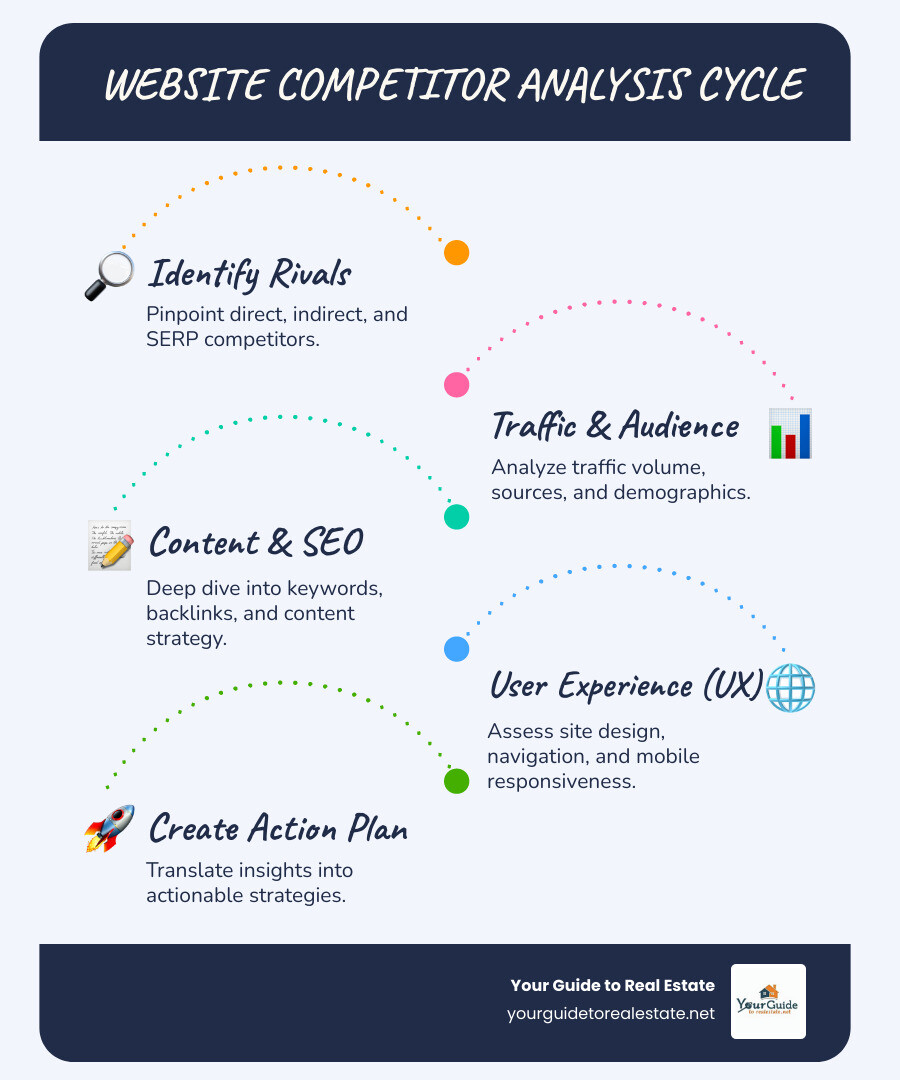
The Core Investigation: A 6-Point Website Competitor Analysis Framework
Now that we’ve identified our rivals and gathered our tools, it’s time for the deep dive. This systematic approach ensures we benchmark performance, uncover strategies, and find gaps without missing anything crucial.

1. Traffic and Audience Analysis
Understanding competitor traffic is foundational. Use tools like Similarweb or Semrush to analyze:
- Traffic Volume and Sources: Estimate their monthly visitors and where they come from (Organic Search, Paid, Social, Referral, Direct). This reveals their SEO strength, ad spend, and brand recognition.
- Audience Demographics: Analyze their audience’s age, gender, interests, and location (e.g., Dallas vs. Oklahoma City).
- Mobile vs. Desktop Traffic: With mobile accounting for ~65% of web traffic, check if competitors are mobile-optimized. A poor mobile experience is your opportunity.
This data helps you understand their market share and informs your own Valuation and Market Analysis in Real Estate.
2. SEO Strategy and Keyword Gaps
SEO drives organic visibility. Uncover their strategies by looking at:
- Organic Keywords and Rankings: Use Semrush’s Organic Research to see which keywords they rank for and how high.
- Keyword Gap Analysis: Use a tool like Semrush’s Keyword Gap Analysis tool to find valuable keywords your competitors rank for, but you don’t.
- Backlink Profile: Analyze who links to them using Ahrefs or Semrush’s Backlink Gap tool. This reveals their domain authority and helps you find new link-building opportunities.
- On-page SEO: Manually check their page titles, meta descriptions, and header tags to see how they optimize pages.
3. Content and Engagement Deep Dive
Analyze not just what content competitors produce, but how well it performs.
- Content Types and Quality: Do they use blogs, videos, or neighborhood guides? Is the content high-quality and relevant?
- Publishing Frequency: How often do they post new content?
- Top-Performing Content: Identify their most popular pages to understand what resonates with their audience.
- Engagement and CTAs: Look at social shares and comments to gauge engagement. Analyze their calls to action (CTAs) to see how they convert visitors.
This can inspire your own content strategy, helping you align with trends like those in Top 7 Real Estate Trends Shaping 2025 and Beyond.
4. User Experience (UX) and Website Design
A good user experience is critical for conversions. Evaluate their:
- Navigation and Structure: Is the site easy to steer? Can users find listings and contact information quickly?
- Mobile Responsiveness and Speed: How does the site perform on mobile? Use Google PageSpeed Insights to check its load time.
- Design and CTAs: Is the design professional and trustworthy? Are the CTAs clear and compelling?
- Customer Journey: Map the path from landing on the site to converting. Identify any friction points you can improve upon on your own site.
5. Paid Advertising (PPC) Strategies
Analyzing competitor PPC campaigns reveals their ad spend and messaging. Look at:
- Ad Copy and Landing Pages: What messages and offers are they using? Are their landing pages optimized for conversion?
- Keywords and Spend: Use tools like SpyFu or Semrush to see which keywords they bid on and estimate their budget.
- Ad Networks: Are they advertising on Google, social media, or other platforms?
6. Technology Stack and Integrations
Knowing what technologies competitors use offers insight into their operations.
- CMS and Analytics: Use Wappalyzer or BuiltWith to identify their Content Management System (e.g., WordPress) and analytics tools.
- Marketing and CRM: Look for marketing automation software or CRM integrations that show how they manage leads.
This provides a glimpse into their operational backbone, which is often influenced by trends discussed in How Technology is Revolutionizing Real Estate: 2025 Trends to Watch.
From Data to Dominance: Turning Insights into Actionable Strategy
Gathering data is only half the battle. The true power of website competitor analysis lies in translating insights into a blueprint for success, turning intelligence into a competitive advantage.

Conducting a SWOT Analysis
A SWOT analysis organizes your findings into four categories: Strengths, Weaknesses, Opportunities, and Threats. This gives you a 360-degree view of the competitive landscape and clarifies where you stand.
- Strengths: Internal advantages you already have (e.g., strong local reputation).
- Weaknesses: Internal areas needing improvement (e.g., slow website).
- Opportunities: External factors you can leverage (e.g., competitors have poor mobile sites).
- Threats: External challenges to prepare for (e.g., a new, well-funded competitor).
Here’s a sample SWOT for a real estate website:
| Category | Description |
|---|---|
| Strengths | Strong local SEO, excellent client testimonials, user-friendly navigation |
| Weaknesses | Slow mobile page speed, few interactive tools, gaps in keyword rankings |
| Opportunities | Competitors lack mobile optimization, untapped content niches (e.g., first-time buyer guides) |
| Threats | New competitors with large ad budgets, search algorithm changes |
This framework provides a clear roadmap and is essential for sustainable Real Estate Business Growth.
Building Your Action Plan for website competitor analysis
Turn your analysis into action by prioritizing. You can’t do everything at once, so focus on the opportunities that align with your business goals.
- SEO Strategy: Use the keyword gaps you found to create new content and target the backlink opportunities you finded.
- User Experience (UX): With 65% of traffic coming from mobile, a mobile-first approach is critical. Improve page speed and clarify your calls-to-action to guide users from browsing to contacting you.
- Content and PPC: Refine your content marketing by filling gaps your competitors have missed. Optimize PPC campaigns by testing ad copy and targeting profitable keywords others overlook.
The secret is to pick 2-3 key initiatives, define success, and start small. To stay organized, download a free competitor analysis spreadsheet template to document findings and track progress. The goal is to leapfrog ahead by making smarter, more informed decisions.
Best Practices and Pitfalls to Avoid
Conducting a thorough website competitor analysis can be incredibly illuminating, but it’s not without its challenges. The key to success lies in approaching your analysis with the right mindset and methodology to guide your decisions and help you stay ahead of the curve.

Best Practices for Effective Analysis
- Set clear goals: Know what you want to achieve before you start, whether it’s improving SEO or finding content ideas. This keeps you focused.
- Use multiple data sources: Combine insights from tools like Semrush, Similarweb, and Google Analytics for a complete picture.
- Stay objective: Acknowledge where competitors outperform you. The most valuable insights come from an honest assessment.
- Schedule regular reviews: The digital landscape changes quickly. Conduct a deep analysis quarterly, with lighter monthly check-ins to stay current.
- Focus on actionable insights: Every piece of data should lead to a potential action. Don’t just collect trivia.
- Gather data ethically: Stick to publicly available information and legitimate research tools to protect your reputation. For guidance, Read the SBA’s guide on market and competitive analysis.
Common Pitfalls in website competitor analysis
- Analysis paralysis: Don’t get stuck endlessly researching. A good strategy implemented today is better than a perfect one that never launches.
- Blindly copying competitors: Understand why a competitor’s strategy works before trying to replicate it. Adapt, don’t just imitate.
- Ignoring indirect competitors: A popular blog ranking for your keywords is a competitor for visibility, even if they don’t sell the same services.
- Using outdated data: Digital marketing moves fast. Relying on old information is like using an old map.
- Focusing only on weaknesses: Identifying competitor weaknesses is useful, but the real gold is in finding gaps you can fill and underserved markets you can target.
Competitor analysis isn’t about keeping score; it’s about understanding the playing field to position yourself for a sustainable advantage.
Frequently Asked Questions about Website Competitor Analysis
Let’s tackle the most common questions about website competitor analysis so you can move forward with confidence.
How often should I conduct a competitor analysis?
The ideal frequency depends on your market. Start with a deep dive when launching a new site or strategy. After that, schedule quarterly reviews to spot major shifts, which is usually sufficient for most real estate markets. For specific campaigns or important keywords, you may want to do more frequent, even daily, check-ins to react quickly to competitor moves.
What’s the difference between market analysis and competitor analysis?
It’s a matter of scope.
- Market analysis is broad, looking at the entire industry (the “forest”). It examines big-picture trends, market size, and overall customer behavior.
- Competitor analysis is narrow, focusing on specific rivals (the “trees”). It examines their websites, keywords, content, and performance to find ways to outperform them.
Market analysis tells you if real estate is a good business to be in; competitor analysis tells you how to beat other agents.
How can I find my competitors’ keywords for free?
You don’t need expensive tools to start uncovering what keywords your competitors are targeting. While paid tools give you more detailed data, there are several free methods that work surprisingly well.
- Use Google Search: Type in your target keywords and see which websites rank at the top. Analyze their page titles and meta descriptions for keyword clues.
- Use the “site:” search operator: Search
site:competitorwebsite.com "keyword"to see all the pages a competitor has on a specific topic. - Use free versions of SEO tools: Tools like Semrush or Ahrefs offer limited free searches that provide useful snapshots of competitor data.
- View page source: Right-click on a competitor’s page and select “View Source.” Look at their H1 and H2 heading tags to identify their primary keyword targets for that page.
Conclusion
Website competitor analysis is more than just spying on rivals; it’s a strategic process for building a smarter online presence. It provides a roadmap to digital success, showing you where competitors are winning and, more importantly, where opportunities lie waiting for you to claim them.
We’ve covered the entire process, from identifying competitors and gathering tools to analyzing the six core areas of their digital strategy. But remember, this is not a one-time project. The digital landscape is always changing, so the most successful businesses treat competitor analysis as an ongoing conversation with their market.
The real magic happens when you turn insights into action. The goal isn’t to copy but to understand why certain strategies work, spot the gaps they’ve missed, and find your unique angle. Perhaps they dominate SEO but ignore video, or have high traffic but a poor user experience. These findings become your competitive advantages.
Analysis without action is just procrastination. Start with one or two key insights from your research. Maybe it’s optimizing your mobile experience because you found competitors are falling short, or creating content around keywords they’re missing. Pick your battles and execute them well.
At Your Guide to Real Estate, we believe in giving you the tools to succeed. We provide expert insights and resources to help you steer buying, selling, and investing in real estate. The principles covered here are perfect for real estate professionals looking to dominate their local markets online.
Ready to put this knowledge to work? Start by mastering competitive market analysis in real estate and see how a systematic approach to understanding your competition can transform your business.