
Understanding the Financial Help Available When Buying a Home
What are seller concessions? They’re costs that a seller agrees to pay on behalf of the buyer during a real estate transaction—typically covering things like closing costs, inspection fees, or loan origination charges. This arrangement reduces the amount of cash a buyer needs to bring to the closing table.
Quick Answer:
- Definition: Seller concessions (also called seller contributions or seller assist) are expenses related to buying a home that the seller agrees to pay for the buyer
- Purpose: They help buyers afford homeownership by reducing upfront out-of-pocket costs
- Common uses: Closing costs, appraisal fees, title insurance, inspection fees, and loan origination fees
- Typical limits: Usually 3-6% of the purchase price, depending on your loan type
- Who benefits: Both parties—buyers save cash at closing, sellers can close deals faster or attract more buyers
If you’ve ever wondered why a house listing mentions “$10,000 in seller concessions” or heard your agent suggest asking the seller to “cover your closing costs,” you’re not alone. According to the National Association of Realtors, 20% of sellers offered incentives to attract buyers in 2023. These concessions have become a common negotiation tool, especially when mortgage rates rise or inventory increases.
Seller concessions are negotiated as part of your purchase agreement. They can be structured as a flat dollar amount ($5,000 toward closing costs) or as a percentage of the sale price (3% concessions). The key is understanding that while the seller pays these costs, there are strict limits based on your loan type—and getting too aggressive with concessions can backfire if it affects your home’s appraisal.
Whether you’re a first-time buyer trying to minimize your cash at closing or a seller looking to sweeten your offer in a competitive market, understanding how concessions work is essential for a smooth transaction.
What are seller concessions terms to learn:
What Are Seller Concessions and How Do They Work?
Let’s get practical about what are seller concessions really mean for your home purchase. Picture this: you’ve saved up for a down payment, found your dream home, and then—bam—you realize closing costs could add another $8,000 to $15,000 to your bill. That’s where seller concessions come in as a genuine lifeline.
At its heart, a seller concession is when the seller agrees to pay certain costs that would normally come out of your pocket. It’s written directly into your purchase agreement during negotiations. Instead of just going back and forth on the home’s price, you’re adding another layer to the conversation—one that can make homeownership possible for buyers who might otherwise struggle with the upfront cash needed at closing.
This isn’t just charity, though. Sellers often use concessions strategically to close deals faster, attract more offers, or compensate for issues found during inspections. It’s a financial tool that, when used wisely, creates opportunities for both sides to walk away happy.

A Deeper Look at What Are Seller Concessions
You might hear different terms tossed around—seller assist, seller contributions, or seller concessions—but they all describe the same thing. The seller pays specific expenses on your behalf, reducing what you need to bring to the closing table.
Here’s why this matters so much: saving for a down payment is hard enough. But then you find that closing costs typically run between 3% and 6% of the purchase price. On a $300,000 home, that’s potentially $18,000 in additional expenses. For many buyers, especially those purchasing their first home, that’s a deal-breaker.
Seller concessions act as a negotiated incentive that makes the closing process smoother and more affordable. Let’s say you’ve scraped together enough for your down payment but your savings are tapped out. A seller offering to cover $5,000 in closing costs could be the difference between getting the keys to your new home or having to keep renting.
It’s not just about affordability, either. These concessions give buyers breathing room to keep some cash reserves for moving costs, furniture, or unexpected repairs after moving in. That financial cushion matters more than most people realize.
The Mechanics: From Offer to Closing
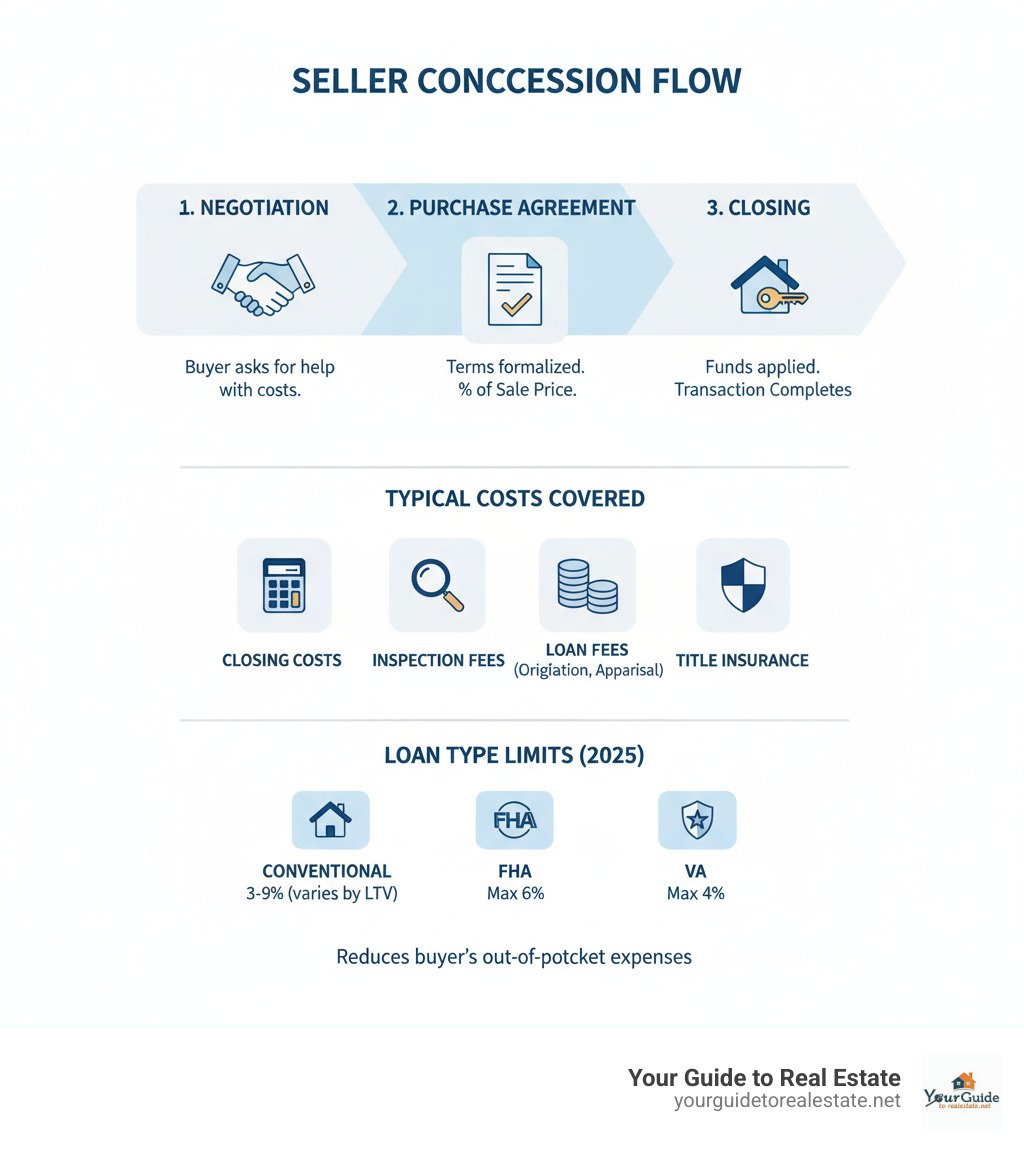
So how does this actually play out in a real transaction? The process starts when you make an offer on a home. Either in that initial offer or during negotiations, you can request seller concessions. Your real estate agent will help you include this as a specific clause in the purchase agreement.
You have two main options for structuring the concession. You can request a fixed dollar amount—something like “$7,500 toward buyer’s closing costs.” Or you can ask for a percentage of the sale price, such as “4% of the purchase price as a seller concession.”
Here’s where it gets interesting: sometimes sellers agree to the concession but increase the purchase price to cover it. Imagine a home listed at $300,000. You ask for a $6,000 concession, and the seller counters with a sale price of $306,000. You’re essentially financing that concession through your mortgage rather than paying it upfront. You still don’t pay out-of-pocket at closing, but your loan amount is higher.
In other situations—particularly in a buyer’s market where sellers need to be competitive—the seller might agree to the concession without raising the price. This means they simply accept lower net proceeds from the sale. They walk away with less money, but they get the deal done.
Either way, the concession never comes to you as cash. At closing, the amount is applied directly to your eligible costs on the closing statement. The seller’s proceeds are reduced by that amount, and your closing costs are covered accordingly.
Common Costs Covered by Concessions
The real beauty of seller concessions is their flexibility. They can cover almost any legitimate closing cost, giving you options to reduce your upfront expenses where it matters most.
Loan origination fees are often the biggest ticket item. These are the fees your lender charges to process your loan application, typically ranging from 0.5% to 1% of your total loan amount. On a $250,000 mortgage, that could be $2,500 right there.
Appraisal fees are another common expense sellers can cover. Before your lender approves the loan, they need a professional appraiser to confirm the home’s value matches what you’re borrowing. This usually runs $300 to $500.
Title insurance protects you and your lender from future claims against the property. It’s a one-time cost at closing, but it’s mandatory for most loans. Sellers can contribute toward both the lender’s policy and your owner’s policy.
Inspection fees are perfect candidates for concessions. Whether it’s a general home inspection, pest inspection, or specialized checks for radon or mold, these costs add up quickly. Some buyers negotiate concessions specifically to cover repairs identified during inspections rather than asking the seller to fix everything.
Property taxes often get prorated at closing, and sellers might agree to cover your portion. The same goes for attorney fees in states where lawyers handle real estate closings.
Here’s one that really helps long-term: mortgage discount points. These are upfront fees you pay to “buy down” your interest rate. Each point typically costs 1% of your loan amount but can lower your rate by about 0.25%. If a seller covers one or two points, you’ll have lower monthly payments for the entire life of your loan.
Other expenses sellers commonly cover include homeowners insurance premiums, HOA dues for properties in homeowners associations, recording fees charged by local governments, and even home warranties that protect you from major repair costs during your first year of ownership.
The specific costs a seller can cover depend on your lender’s rules and the overall concession limits we’ll discuss next. But the takeaway is this: if it’s a legitimate closing cost, there’s a good chance a seller concession can cover it.
Seller Concession Limits by Loan Type
Here’s the thing about what are seller concessions—they’re wonderful, but they’re not unlimited. Lenders put specific caps on how much a seller can contribute toward your purchase. And honestly, this makes sense when you think about it.
Lenders want to make sure the housing market stays healthy and that you’re not borrowing yourself into a corner. If sellers could cover unlimited costs, it would be too easy to inflate home prices artificially or essentially finance your entire down payment through the loan itself. That’s a recipe for financial trouble down the road.
These limits are based on a percentage of your home’s purchase price, and they vary quite a bit depending on which type of loan you’re getting. The limits also help maintain a healthy loan-to-value ratio, which is basically how much you’re borrowing compared to what the home is worth. Lenders pay close attention to this number.
For both buyers and sellers, knowing these limits upfront is crucial. If you accidentally exceed them, the extra money doesn’t just disappear—it gets returned to the seller at closing. Even worse, going over the limit could potentially mess up your loan approval, which is the last thing anyone wants when you’re so close to getting your keys.
Here’s how the numbers typically break down across the most common loan types:
| Loan Type | Down Payment | Seller Concession Limit |
|---|---|---|
| Conventional | Less than 10% | 3% of purchase price |
| 10% to 25% | 6% of purchase price | |
| 25% or more | 9% of purchase price | |
| Investment Property (any DP) | 2% of purchase price | |
| FHA | Any | Up to 6% of purchase price |
| VA | Any | Up to 4% of purchase price |
| USDA | Any | Up to 6% of purchase price |
Conventional Loan Concession Limits
Conventional mortgages are the workhorses of the lending world. They’re the most common type of home loan you’ll encounter, often backed by Fannie Mae and Freddie Mac. What makes them interesting for our conversation is their tiered approach to seller concessions.
The amount a seller can contribute depends entirely on how much you’re putting down. It’s a sliding scale that rewards larger down payments with more flexibility.
If you’re putting down less than 10%, which is pretty typical for many buyers (especially first-timers who are doing everything they can to scrape together that down payment), the seller can chip in up to 3% of the purchase price. That might not sound like a ton, but on a $300,000 home, that’s $9,000 toward your closing costs—nothing to sneeze at.
When you bump up to a down payment between 10% and 25%, the concession limit increases to 6% of the purchase price. This gives you significantly more room to negotiate. On that same $300,000 home, you’re now looking at up to $18,000 in potential seller contributions. That’s enough to cover nearly all your closing costs in most cases.
For buyers who can manage a down payment of 25% or more, the limit jumps to 9% of the purchase price. At this level, you’re demonstrating serious financial stability to the lender, so they’re comfortable with higher concessions. On a $300,000 home, that’s up to $27,000—which could cover closing costs plus mortgage discount points to lower your interest rate.
Now, if you’re buying an investment property with a conventional loan, the rules get stricter. The concession limit drops to just 2% of the purchase price, regardless of how much you’re putting down. Lenders view investment properties as riskier since you won’t be living there, so they’re more conservative with what sellers can contribute.
Government-Backed Loan Concession Limits
Government-backed loans serve a special purpose in our housing market. They’re designed to open doors for buyers who might not qualify for conventional financing or who deserve special benefits for their service to our country. Each program has its own approach to seller concessions.
FHA loans are a lifeline for many first-time homebuyers. The Federal Housing Administration allows seller concessions of up to 6% of the home’s purchase price or appraised value—whichever is lower. This is particularly helpful because FHA loans typically require only a 3.5% down payment, so that 6% concession can cover virtually all your closing costs. For someone buying their first home with limited savings, this can be the difference between homeownership and continuing to rent.
VA loans are one of the best benefits available to our veterans, active-duty service members, and eligible surviving spouses. These loans require no down payment, which is already incredible. When it comes to seller concessions, VA loans allow up to 4% of the purchase price to cover things like prepaid items and certain fees. But here’s where it gets even better—sellers can also pay 100% of your customary closing costs on top of that 4%. This means you could potentially walk into your home with very little cash out of pocket.
USDA loans help make homeownership possible in rural and suburban areas. Like VA loans, they require no down payment for eligible buyers. Sellers can contribute up to 6% of the home’s purchase price toward your costs. This can cover your closing costs, part of the USDA guarantee fee, and even help you buy down your interest rate for lower monthly payments.
For anyone just starting their homeownership journey, these government-backed options and their generous concession limits are worth exploring. They’re specifically designed to reduce the financial barriers that keep people from buying their first home. Understanding what each program offers gives you more tools to work with when you’re ready to make your move.
Strategic Use of Concessions for Buyers and Sellers
Understanding what are seller concessions means recognizing they’re far more than just a line item on a closing statement. They’re a powerful strategic tool in real estate negotiations, and knowing when and how to use them can make or break a deal.
The effectiveness of seller concessions shifts dramatically with market dynamics. In a buyer’s market—where there are more homes available than eager buyers—sellers often need to get creative to stand out. Offering concessions becomes a compelling way to attract offers and move a property. On the flip side, in a hot seller’s market where multiple offers are the norm, buyers might find sellers less willing to negotiate concessions. After all, why sweeten the deal when three other buyers are lined up behind you?
This is where having a skilled real estate agent becomes invaluable. They understand the pulse of your local market, know what’s working in current negotiations, and can guide you on whether to offer or request concessions. At Your Guide to Real Estate, our proven framework is built around helping you steer these strategic decisions with confidence, ensuring you’re positioned for a truly win-win scenario. Whether you’re buying or selling, we provide the stress-free guidance you need to make smart moves.

The Pros and Cons for Each Party
Like any negotiation tactic, seller concessions come with trade-offs. Let’s look at how they impact both sides of the transaction so you can make informed decisions.
For Buyers, the biggest advantage is obvious: reduced upfront costs. Seller concessions can save you thousands of dollars at closing, which is especially meaningful if you’re a first-time buyer who’s already stretched thin with your down payment. Instead of scrambling to cover appraisal fees, title insurance, and loan origination charges, those costs get handled by the seller. This also means you have more cash reserves available for moving expenses, immediate repairs, or furnishing your new home.
Concessions also give you negotiation flexibility. Rather than getting stuck in a back-and-forth over the sale price, you can negotiate concessions to address specific concerns. If the home inspection reveals the water heater is on its last legs, asking for a $1,500 concession to replace it might be easier than getting the seller to drop the price by the same amount. And if you use concessions to buy down your interest rate through mortgage discount points, you’re looking at lower monthly payments for the life of your loan—a smart move in today’s high-rate environment.
But there are drawbacks to consider. If the seller agrees to a concession by slightly inflating the purchase price (say, agreeing to sell at $305,000 with a $5,000 concession instead of $300,000), you end up financing more money. That means you’ll pay more interest over the life of your mortgage. There’s also the risk of appraisal issues—if the inflated price doesn’t match the home’s actual value, you could face an appraisal gap that requires you to bring extra cash to closing or renegotiate the entire deal. And in competitive markets, asking for concessions might make your offer less attractive compared to cleaner offers with fewer demands.
For Sellers, concessions can be a strategic way to attract more buyers without actually lowering your list price. This is particularly valuable because maintaining your asking price protects comparable sales in your neighborhood. Homebuilders use this strategy all the time—they’d rather offer $10,000 in concessions than drop the price by $10,000, because that lower sale price could affect the value of other homes they’re trying to sell in the same development.
Concessions can also help you close deals faster. If you’ve already purchased your next home or need to relocate for a job, offering to cover some of the buyer’s costs can be the incentive that gets your home sold quickly. And if a home inspection turns up issues, offering a credit for repairs is often simpler than coordinating contractors and managing the work yourself while still living in the home.
The downside? Concessions reduce your net profits. Every dollar you contribute to the buyer’s costs is a dollar that doesn’t end up in your pocket. There’s also the risk that if you inflate your price to accommodate concessions, the home might not appraise at that higher value, which can delay or derail the sale. And in some markets, offering very generous concessions might signal desperation, potentially encouraging buyers to make even lower offers.
The key for both parties is understanding these trade-offs and working with an experienced agent who can help you weigh them against your specific situation and goals.
When and How to Negotiate Concessions
Timing is everything when it comes to negotiating what are seller concessions. Knowing when to ask, when to offer, and how to structure the conversation can significantly impact your success.
Buyer’s markets are prime territory for concessions. When inventory is high and demand is soft, sellers are motivated to make their properties stand out. This is when you’ll see concessions advertised upfront in listings, sometimes even before a buyer asks. Similarly, if a home has been sitting on the market for weeks or months without offers, the seller’s motivation increases dramatically. They’re often willing to negotiate concessions just to finally get the property sold.
The home inspection is another classic opportunity for concessions. Let’s say the inspector finds that the roof needs repairs or the HVAC system is past its prime. Rather than walking away from the deal or demanding the seller fix everything, you can request a concession to cover those costs. This gives you control over choosing your own contractors and ensures the work gets done to your standards. Sellers often prefer this approach too, since they don’t have to coordinate repairs while trying to move out.
Sometimes a home’s list price is simply too high for the market. Instead of getting into an uncomfortable negotiation about lowering the price (which can feel like a personal critique of the seller’s home), asking for concessions can achieve a similar financial outcome while preserving everyone’s dignity. The seller maintains their asking price on paper, and you get the financial relief you need.
Seller urgency is another factor. If someone needs to relocate quickly for work, has already closed on their next home, or is dealing with a life change like divorce or estate settlement, they’re typically more open to concessions that speed up the closing process.
When it comes to the actual negotiation, start with your initial offer. For buyers, it’s usually best to include your concession request right from the beginning rather than bringing it up later. Be specific about what you want—”$5,000 toward closing costs” or “credit for HVAC replacement” is much clearer than a vague request for “some help with expenses.” Your agent will write this directly into the purchase agreement as part of the offer terms.
For sellers, you have options. You can advertise concessions upfront to attract buyers, though with recent industry changes, these offers need to be carefully worded and cannot be tied to using a specific agent. According to the National Association of Realtors, about 20 percent of sellers offered incentives to attract buyers in 2023, and that number fluctuated to around 24% in 2024, showing how these strategies respond to market conditions.
Your real estate agent is your most valuable asset in these negotiations. They understand local customs, know what’s working in current deals, and can help you structure a request that’s reasonable for the market. They’ll also help you steer counteroffers and prioritize your requests so you get the best possible outcome. At Your Guide to Real Estate, this kind of expert guidance is exactly what we provide—helping you make confident, informed decisions at every step.
Understanding What Are Seller Concessions vs. Agent Compensation
Here’s something that trips up a lot of people: the difference between what are seller concessions and payments to a buyer’s agent. They’re related to the transaction, but they serve completely different purposes and follow different rules.
Seller concessions are payments the seller makes to help cover the buyer’s costs—things like closing costs, appraisal fees, inspection fees, title insurance, and sometimes even discount points to lower the buyer’s interest rate. These concessions are subject to strict limits based on your loan type, as we discussed earlier. They’re designed to help the buyer afford the home by reducing their out-of-pocket expenses at closing.
Buyer’s agent compensation, on the other hand, is the fee paid to the agent who represents the buyer in the transaction. Historically, this was often offered by the seller or the listing agent and displayed on the Multiple Listing Service (MLS) for all agents to see.
But here’s where things have changed recently. Following industry lawsuits and settlements, listing agents can no longer include compensation offers to buyer’s agents on the MLS. This means that while sellers can still contribute to a buyer’s agent’s commission, it has to be negotiated separately and handled off-MLS. It might be structured as a direct agreement between the buyer and seller, or as part of the overall purchase negotiations.
The important distinction is this: buyer’s agent compensation is generally excluded from seller concession limits. That means a seller can offer to pay the buyer’s agent commission without it counting against the 3-6% concession cap that applies to the buyer’s loan costs. This is a crucial point because it means you can potentially negotiate both—concessions to help with your closing costs and have the seller cover your agent’s fee—without running afoul of lender restrictions.
Think of it this way: concessions are about helping you afford the home purchase itself, while agent compensation is about paying for the professional service that helped you find and negotiate for that home. Both involve the seller writing a check, but they’re separate line items with separate rules.
If this sounds confusing, don’t worry—it is! This is exactly why working with an experienced agent is so valuable. They’ll help you steer these distinctions and structure your offer in a way that maximizes your benefits while staying within all the rules. Whether you’re looking to find a buyer’s agent or trying to understand how to find a good buyers agent, having the right professional guidance makes all the difference.
Common Questions and Final Considerations
We’ve walked through the ins and outs of what are seller concessions are, how they work, and who can benefit from them. But as with any financial tool in real estate, a few important questions tend to linger in the back of our minds. Let’s tackle these head-on so we can move forward with complete confidence, whether we’re buying our first home or selling a property we’ve loved for years.

How do seller concessions impact the home appraisal?
Here’s where things get real, and it’s something we absolutely need to understand before negotiating concessions. When an appraiser evaluates a home, their job is to determine its fair market value—what a willing buyer would reasonably pay for it in the current market. They’re not just rubber-stamping the number on our purchase agreement.
If we’ve negotiated a seller concession by increasing the purchase price, the appraiser will scrutinize that inflated number. Let’s say a home is realistically worth $300,000, but to accommodate a $10,000 concession, the sale price is bumped to $310,000. The appraiser will compare this home to similar properties in the area, and if those comps don’t support a $310,000 value, we’ve got a problem.
This is what’s called an appraisal gap—when the home appraises for less than the agreed-upon purchase price. If that happens, the lender will only finance the loan based on the appraised value, not our inflated contract price. Suddenly, we’re on the hook to cover that difference in cash, or we’re back at the negotiating table trying to work something out with the seller. Neither scenario is fun when we’re already excited about moving into our new home.
This is exactly why lenders set those concession limits we discussed earlier. They’re protecting both themselves and us from artificially inflating home prices just to shuffle money around at closing. The bottom line? Concessions are fantastic for reducing upfront costs, but we need to be strategic and realistic about pricing to avoid appraisal headaches down the road.
Are seller concessions the same as a price reduction?
This is one of those questions that comes up constantly, and it’s easy to see why—both options reduce how much money changes hands in a transaction. But they work in fundamentally different ways, and understanding that difference can save us thousands of dollars over time.
A price reduction lowers the actual purchase price of the home. If a seller drops their price from $300,000 to $290,000, we’re now borrowing less money. Our monthly mortgage payment will be lower, we’ll pay less interest over the life of the loan, and if we’re putting down a percentage-based down payment, that amount drops too. It’s straightforward savings that compound over the years.
A seller concession, on the other hand, gives us immediate cash relief at closing without necessarily changing the purchase price—or sometimes even increasing it. If we’re buying that same $300,000 home with a $10,000 concession, we might still be taking out a $300,000 loan (or even more if the price was bumped to accommodate the concession). The seller covers our closing costs, which is wonderful for our bank account today, but we’re potentially paying more in monthly payments and long-term interest.
So which is better? It honestly depends on our financial situation. If we’re stretched thin on cash and need help covering closing costs, appraisal fees, or inspection charges, a concession can be a lifeline that gets us to the closing table. If we’re comfortable with our cash reserves and want the lowest possible monthly payment with maximum long-term savings, pushing for a price reduction makes more sense.
Sometimes the smartest move is a combination of both. We might negotiate a modest price reduction plus a concession to cover specific costs. We can even use concessions strategically for things like mortgage discount points or a 2-1 buydown, where the seller pays to temporarily reduce our interest rate, giving us breathing room in those crucial first couple of years of homeownership.
Can I get cash back from seller concessions?
Let’s clear this up right now because it’s a common misconception that can derail a transaction: no, we cannot get cash back from seller concessions. This isn’t just a guideline—it’s a hard rule enforced by lenders, and violating it can put our entire loan approval at risk.
Here’s why this rule exists. Lenders want to make absolutely certain that concessions are used for legitimate homebuying expenses, not as a backdoor way to pocket cash or avoid coming up with a proper down payment from our own verified funds. Our down payment has to come from us—from our savings, a gift from family, or another documented source. Concessions can’t touch it.
The way it works in practice is straightforward: if we negotiate $8,000 in seller concessions but our actual eligible closing costs only add up to $6,000, that extra $2,000 doesn’t come to us. It gets returned to the seller at closing. We can’t use concessions to fund our down payment, and we can’t walk away from closing with a check in our pocket for the difference.
This no cash back rule is actually a good thing. It keeps the real estate market honest and ensures that everyone—buyers, sellers, and lenders—is playing by the same rules. Seller concessions remain what they’re meant to be: a helpful tool for covering the real costs of buying a home, making homeownership more accessible without gaming the system.
Understanding these final considerations helps us use concessions wisely and avoid surprises at closing. With this knowledge in hand, we’re ready to make informed decisions that truly serve our financial goals.
Conclusion: Making an Informed Decision
We’ve covered a lot of ground together, exploring the ins and outs of what are seller concessions really mean for your real estate journey. If there’s one thing to take away from all this, it’s that concessions aren’t just fine print in a contract—they’re a genuine strategic tool that can make or break your homebuying or selling experience.
Think of seller concessions as a financial bridge. For buyers, especially those of us who’ve been saving every penny for that down payment, they offer breathing room. Instead of scrambling to cover closing costs, appraisal fees, and a dozen other expenses that pop up right before closing, concessions let us redirect those funds toward moving, furniture, or just having a safety net in our new home. For sellers, they’re a way to stand out in a crowded market, keep your list price intact, and get to closing day faster without the hassle of making repairs yourself.
But here’s the thing—understanding the rules is absolutely crucial. Each loan type comes with its own limits, and pushing beyond those boundaries can throw a wrench in the whole transaction. Whether you’re working with a conventional loan with its tiered limits based on down payment, or a government-backed option like FHA, VA, or USDA, knowing your ceiling prevents nasty surprises at the closing table. And remember, while concessions are incredibly helpful, they can’t be used as a backdoor to fund your down payment or get cash back. They’re strictly for covering legitimate closing costs and related expenses.
The negotiation dance around concessions is deeply tied to market conditions. In a buyer’s market, sellers are often eager to offer concessions to attract offers and move their property. In a hot seller’s market, you might find less wiggle room. This is where having an experienced guide makes all the difference. A skilled real estate agent—someone who knows the local market, understands current trends, and can spot opportunities—becomes your greatest asset. They’ll help you craft an offer that’s competitive yet strategic, or advise you on how to position concessions to make your listing irresistible.
We’ve also tackled some of those nagging questions that keep buyers and sellers up at night. How do concessions affect the appraisal? Can I get cash back? Is a concession better than a price reduction? Each of these considerations plays into your bigger financial picture, and there’s rarely a one-size-fits-all answer. Your unique situation—how much cash you have on hand, your long-term financial goals, the specific property you’re dealing with—all of these factors matter.
At Your Guide to Real Estate, we believe that real estate doesn’t have to be overwhelming or stressful. Our proven framework is built around giving you the knowledge and support you need to make confident decisions. Whether you’re a first-time buyer trying to stretch your budget or a seller looking to close quickly, understanding how to leverage what are seller concessions can truly be a game-changer in your real estate success story.
Ready to put this knowledge into action? Let’s connect you with a professional who can provide personalized guidance custom to your specific situation. With the right support, your real estate journey can be smooth, stress-free, and successful. Find a buyer’s agent with our help and let’s get you moving toward your goals.