
Protecting Your Property and Payments
What is a lien waiver? A lien waiver is a legal document signed by a contractor, subcontractor, or supplier confirming they have been paid for their work or materials. By signing, they waive their right to file a mechanic’s lien against your property for that specific payment amount.
Quick Answer: The Four Types of Lien Waivers
- Conditional Waiver on Progress Payment – Signed before payment; takes effect only when payment clears.
- Unconditional Waiver on Progress Payment – Signed after payment; takes effect immediately for partial work.
- Conditional Waiver on Final Payment – Signed before final payment; takes effect only when payment clears.
- Unconditional Waiver on Final Payment – Signed after final payment; releases all lien rights immediately.
If you’re renovating, buying, or selling a home, understanding lien waivers can prevent a financial nightmare. Without them, you could pay for the same work twice—once to your general contractor and again to unpaid subcontractors who file a lien against your property.
A mechanic’s lien creates a “cloud” on your property title, making it difficult to sell or refinance until the claim is resolved. Lien waivers are the solution. They act as legally-binding receipts in the construction world, documenting payments and protecting property owners from future claims. Knowing when and how to use them is essential for protecting your investment.
Easy what is a lien waiver word list:
What is a Lien Waiver and Why is it Important?
Let’s get straight to the heart of the matter: what is a lien waiver, and why should you care about it?
A lien waiver is a legal document that contractors, subcontractors, and material suppliers sign to confirm they’ve received payment. By signing, they give up their right to file a mechanic’s lien against your property for that payment amount. It’s essentially a receipt with legal teeth—proof that your property is protected for the amount paid.
This matters because anyone who works on your property has a legal right to be paid. If they aren’t, they can file a mechanic’s lien, which turns your property into collateral for their unpaid debt. This creates a “cloud” on your property title that can stop you from selling or refinancing your home. Imagine a subcontractor you never met placing a legal claim on your home because your general contractor failed to pay them. Lien waivers prevent this scenario.
Think of lien waivers as your financial safety net during a construction project. They provide peace of mind by documenting that everyone in the payment chain has been paid. For property owners, collecting lien waivers isn’t just good practice—it’s essential protection for your investment and a fundamental part of construction finance. For more on safeguarding your ownership, see our guide on Understanding Title Insurance.
Lien Waiver vs. Lien Release: A Critical Distinction
Though often used interchangeably, a lien waiver and a lien release are different documents for different situations.
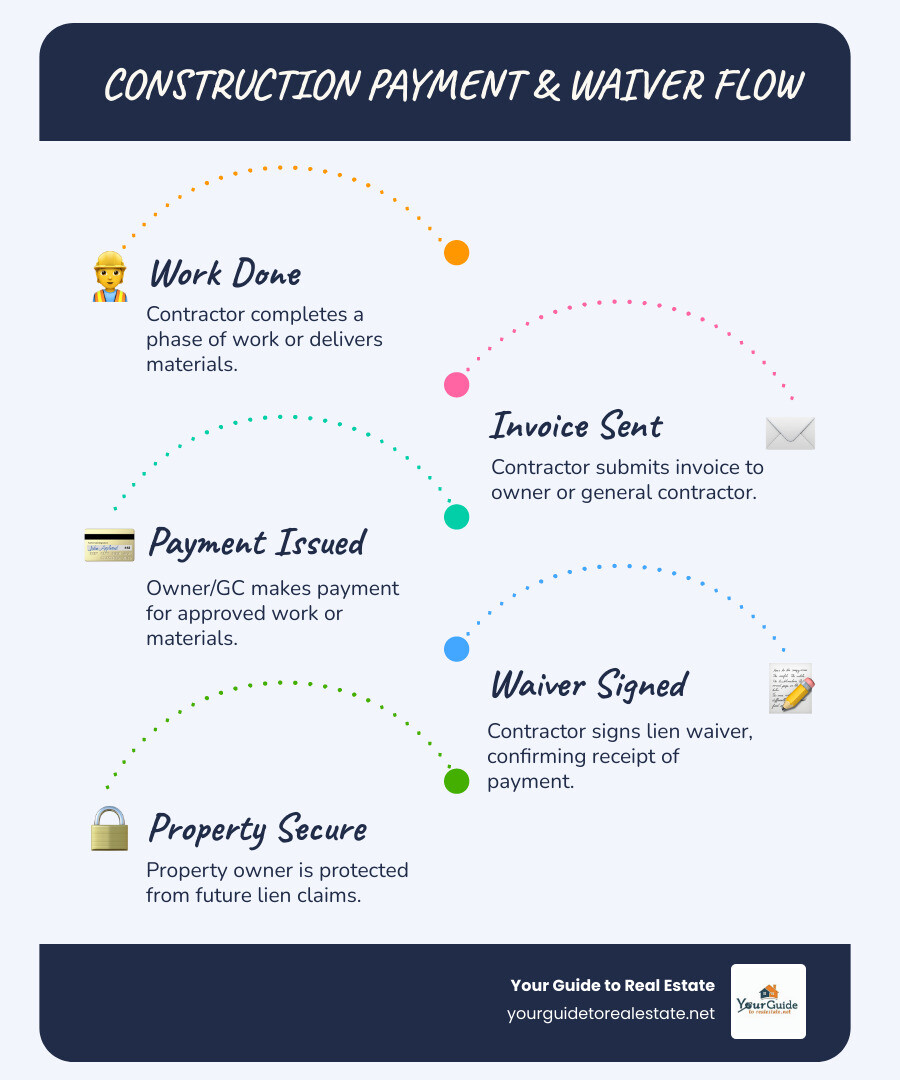
A lien waiver is proactive. It’s used during a project as part of the payment process. When you pay a contractor, they sign a waiver confirming receipt of funds and waiving their right to file a lien for that amount. The lien is prevented before it can ever be filed.
A lien release is reactive. It’s used after a lien has already been filed against your property. Once you settle the debt, the claimant signs a release to have the existing lien removed from your property records. In short, a waiver prevents the fire, while a release puts it out.

The Role of Lien Waivers in Real Estate Transactions
Lien waivers are crucial when you sell or refinance a home, especially after recent construction work. Imagine you’ve finished a kitchen renovation and are ready to sell. During the title search, a mechanic’s lien appears from a supplier your contractor never paid. Your sale grinds to a halt because you can’t transfer a clear title.
This is why collecting lien waivers is so important. During a sale, title companies search for any clouds on your title, and unresolved liens are major red flags. A complete set of lien waivers proves everyone was paid and clears the way for a smooth closing. The same applies to refinancing; lenders require proof that your property is free from potential claims.
In the escrow process for newly built or improved homes, lenders and title companies routinely request lien waivers as part of their due diligence. Without these documents, transactions can be delayed or fall through. As our Guide to Selling Your Home explains, a clear title is non-negotiable for a successful sale.
The Four Main Types of Lien Waivers Explained
Not all lien waivers offer the same protection. Understanding the four distinct types is key to managing construction payments and avoiding costly mistakes. Think of them as existing on a spectrum of risk and protection for both the property owner and the person getting paid.
These four types are based on two questions: Has payment been received? (Conditional vs. Unconditional) and Is this a partial or final payment? (Progress vs. Final). Combining these gives us the four waivers used throughout construction projects.
Conditional vs. Unconditional: Understanding What is a Lien Waiver’s Power
The difference between conditional and unconditional waivers determines who carries the risk during payment.
A conditional waiver is effective only when payment is received. A contractor can sign it before being paid, knowing their lien rights are safe if the check bounces. The waiver is conditional upon the funds clearing. This is the safest option for the person signing the waiver (the claimant).
An unconditional waiver is effective immediately upon signing. It states that payment has already been received. For a property owner, this offers the strongest protection, as it instantly eliminates the threat of a lien for that payment. However, a contractor who signs an unconditional waiver before verifying funds is at great riskthey could lose both their payment and their lien rights.
As a best practice, contractors should only sign an unconditional waiver after funds are confirmed in their bank account. Property owners should expect this caution.
Progress vs. Final Payment: Clarifying What is a Lien Waiver Covers
This distinction clarifies how much of the project the waiver covers.
Progress payment waivers (or partial waivers) are used for incremental payments during a project. When a contractor is paid for completing a phase, they sign a progress waiver covering only the work done up to a specific date or for a specific amount. They retain lien rights for all future work, which is fair and logical.
Final payment waivers are used at the very end of a project. When you make the last payment, the contractor signs a final waiver that relinquishes all remaining lien rights for the entire job. For property owners, this is the ultimate goal, providing confirmation that the project is paid in full and the property title is protected from any future construction-related claims.
Combining these gives you the four types:
- Conditional Waiver on Progress Payment: Used when making a progress payment. Becomes effective once payment clears.
- Unconditional Waiver on Progress Payment: Used after a progress payment has been verified. Effective immediately.
- Conditional Waiver on Final Payment: Used when making the final payment. Becomes effective once the final payment clears.
- Unconditional Waiver on Final Payment: Used after the final payment is verified. Effective immediately and releases all lien rights.
Comparing the Four Types of Lien Waivers
Here’s a quick reference to help you remember which waiver to use when:
| Type of Lien Waiver | When to Use | Risk Level (for Signer) | Effect Upon Signing | Safest For… |
|---|---|---|---|---|
| Conditional Progress Waiver | When a progress payment is expected | Low | Becomes effective only when payment is received and clears. | Claimant |
| Unconditional Progress Waiver | When a progress payment has already been received | Moderate | Effective immediately upon signing, regardless of payment status. | Owner |
| Conditional Final Waiver | When final payment is expected | Low | Becomes effective only when final payment is received and clears. | Claimant |
| Unconditional Final Waiver | When final payment has already been received | Moderate | Effective immediately upon signing, releases all lien rights. | Owner |
The key to success is timing. Use the right waiver at the right time to ensure everyone is protected.
Navigating the Legal Landscape of Lien Waivers
Understanding what is a lien waiver is one thing, but navigating their legal landscape is another. These are legally binding documents, not informal receipts. A signed waiver fundamentally shifts the legal rights of everyone involved, so diligence is essential.
For contractors, signing means giving up the powerful right to file a lien. For property owners, it means gaining protection against claims that could cloud your home’s title. An improperly drafted waiver can be voided, leading to costly disputes. This is why following best practices is critical to protecting your investment.

What Should Be Included in a Lien Waiver?
A valid lien waiver needs specific information to be enforceable. Think of it as a recipe: leave out a key ingredient, and it falls apart. Every waiver should include:
- Parties Involved: Full legal names and addresses of the claimant (contractor/supplier) and the paying party (owner/general contractor).
- Property Description: The street address or legal description of the property where work was performed.
- Payment Details: The exact payment amount the waiver covers.
- Through Date: For progress waivers, this date specifies that lien rights are waived only for work done up to this point.
- Exclusions: Any disputed amounts or claims not covered by the waiver should be explicitly listed.
- Signatures: A dated signature from the claimant or their authorized representative is required.
Do Lien Waiver Requirements Vary by Jurisdiction?
Yes, significantly. Lien waiver laws are governed at the state or provincial level, and the rules can be surprisingly different from one place to the next.
In the United States, twelve states—including Arizona, California, Florida, Georgia, Massachusetts, Michigan, Mississippi, Missouri, Nevada, Texas, Utah, and Wyoming—have mandatory statutory lien waiver forms. In these states, you must use the exact form provided by state law; any deviation can render the waiver void. Some states also have unique rules, such as Mississippi and Wyoming, which require waivers to be notarized.
This patchwork of laws means a one-size-fits-all approach is dangerous. Before using a lien waiver, you must identify the project’s location and research the specific requirements for that jurisdiction. For complex legal questions, resources like the American Bar Association’s Forum on Construction Law can provide further insight, though consulting a local attorney is always the safest bet. This location-specific diligence is a cornerstone of smart real estate practice.
Frequently Asked Questions about Lien Waivers
Lien waivers can feel complex, but a few key principles can clear up most of the confusion. Here are straight answers to the most common questions we hear from property owners and contractors.
When is the right time to sign a lien waiver?
Timing is everything. The right time depends on which side of the transaction you’re on and, crucially, the type of waiver.
-
For Contractors/Suppliers (the Signer): Only sign a conditional waiver before you’ve been paid. It protects you if the payment fails. For an unconditional waiver, do not sign until you have confirmed the funds are secure in your bank account. Signing an unconditional waiver too early is a huge risk.
-
For Property Owners (the Payer): Exchange the waiver for the payment. When making a payment, provide a check in exchange for a signed conditional waiver. Once you confirm the payment has cleared, you can request a signed unconditional waiver. Never release a final payment without receiving a signed unconditional final waiver in return. It’s your ultimate proof that the project is paid in full.
Can I revoke an unconditional lien waiver if I don’t get paid?
Almost certainly no. An unconditional lien waiver is legally binding the moment it’s signed. It is a declaration that you have already been paid. If you sign one and the payment later fails, you have likely lost your right to file a mechanic’s lien. You may have to pursue other legal actions, like suing for breach of contract, but your most powerful tool is gone. This is why you must verify funds before signing an unconditional waiver.
Does a lien waiver from my general contractor protect me from their subcontractors?
No, not completely. A waiver from your general contractor (GC) only protects you from liens filed by the GC themselves. It does not protect you from claims made by subcontractors or suppliers whom the GC failed to pay. This is how property owners end up paying twice for the same work.
To fully protect your property, you need tiered protection. The best practice is to collect lien waivers from not only your general contractor but also from all key subcontractors and major material suppliers. This creates a complete chain of proof that everyone has been paid.
Other strategies include:
- Two-Party Checks: Write checks payable to both the general contractor and the subcontractor. This ensures the money gets to the right person, as both must endorse the check.
- Final Payment Affidavit: In many states, you can require your GC to sign a sworn statement that all parties have been paid in full. This adds a layer of legal accountability.
Managing these documents is extra work, but it’s essential for keeping your property title clear and protecting your investment.
Conclusion: Ensuring a Smooth and Secure Real Estate Project
Understanding what is a lien waiver is a critical skill for any property owner, turning a potentially stressful process into a secure transaction. These documents are your financial safeguard during any construction or renovation project.
We’ve covered the four types of waivers, emphasizing that conditional waivers protect the signer until payment clears, while unconditional waivers offer immediate protection to the payer. The key is to match the waiver to the payment situation: use conditional waivers before or during payment exchange, and unconditional waivers only after funds are verified.
Remember these key takeaways:
- Timing is critical. Never sign an unconditional waiver before you’re paid.
- Get waivers from everyone. A waiver from your general contractor doesn’t protect you from unpaid subcontractors.
- Know your local laws. Requirements for forms and notarization vary by state.
Lien waivers are the foundation of financial security in construction. They protect your property title, ensure fair payment, and provide the documentation needed for a clean sale or refinance down the road. If you feel unsure, consult a construction attorney. A small investment in legal advice can save you from major disputes later.
Your real estate journey has many parts, from financing to closing. For a broader look at the financial side of homeownership, our Understanding Mortgages: A Beginner’s Guide to Home Loans can help connect the dots. At Your Guide to Real Estate, we’re here to provide the stress-free guidance you need to protect your investment and your peace of mind.