

Introduction to Accounts Receivable
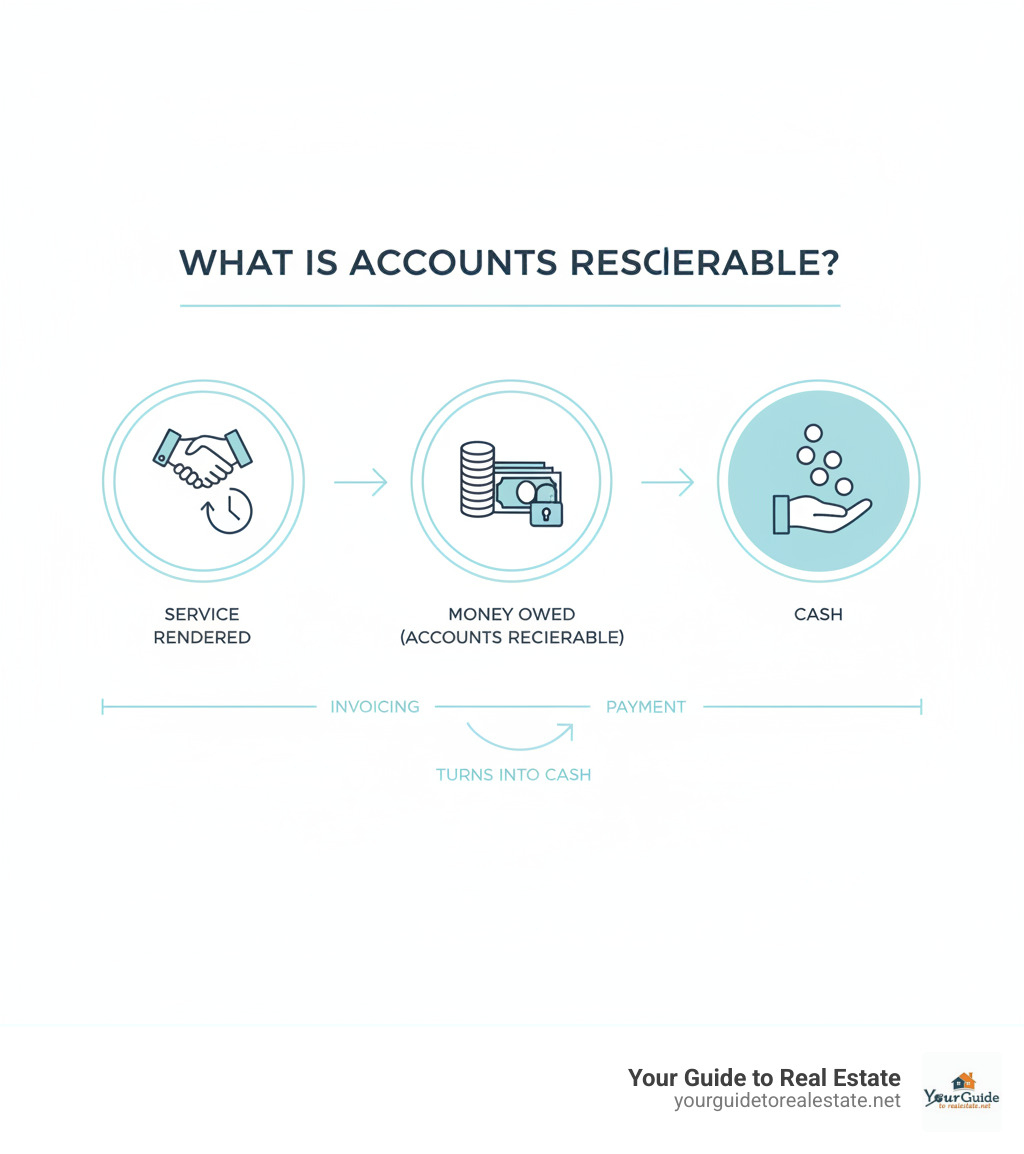
What is accounts receivable? It’s simply the money owed to your business for goods or services you’ve already delivered but haven’t been paid for yet. Think of it as an IOU from your customers.
Here’s a quick overview:
- Money owed: Funds your customers owe you.
- Goods/Services delivered: You’ve already provided the product or service.
- Not yet paid: The payment is still pending.
- Current Asset: It’s a valuable resource expected to turn into cash soon, typically within one year.
Running any business means dealing with money coming in and money going out. For real estate professionals, this is especially true. Whether you’re a property manager collecting rent, a broker waiting for commission, or a developer with outstanding project payments, accounts receivable is a daily reality.
Understanding this financial concept helps you know exactly how much money your business is due. This insight is vital for managing your cash flow and keeping your operations smooth. It’s about tracking the future payments that will turn into cash for your business.
What is accounts receivable terms to remember:
The Core Concepts: What is Accounts Receivable and How Does it Work?
At its very core, what is accounts receivable (AR)? It’s a fundamental idea in business finance, and it’s essentially a promise of money coming your way. For us in the real estate world, it’s the financial lifeblood that ensures our hard work turns into real income. Let’s dig a little deeper into what this means for your business.
Defining Accounts Receivable (AR): Money Owed to Your Business
Imagine you’ve just helped someone find their dream home, or you’ve managed a property perfectly for a month. When you send them a bill and they promise to pay you later, you’ve just created an accounts receivable. This isn’t just a casual agreement; it’s a legally enforceable claim for payment that your business holds. Simply put, it’s money that’s on its way to you, even if it hasn’t landed in your bank account yet.
On your company’s balance sheet, AR proudly sits as a current asset. Why “current”? Because we expect to collect this money pretty soon – usually within a year or so. This makes AR one of the quickest assets you can turn into cash, right after cash itself! It’s solid proof that you’ve delivered value, and payment for that value is just around the corner.
In real estate, AR shows up in many ways:
- Rent Collection: When you manage a property, and your tenants owe you rent for the current month, that outstanding rent is your AR.
- Broker Commissions: You close a fantastic deal, and your commission is due from the sale. Until that check clears, it’s your AR.
- Property Management Fees: You’ve done the work, and your management fee has been invoiced but not yet collected. Yep, that’s AR too!
These aren’t just numbers on a page; they’re real financial obligations that your clients have to you. As Investopedia clearly explains, accounts receivable are assets because your customer has a legal duty to pay, and you fully expect to collect. Understanding this simple definition is the first big step toward smart financial management. For more details on what is accounts receivable, you can also check out resources like the Cornell Law School’s Legal Information Institute and AccountingCoach.
Accounts Receivable vs. Accounts Payable: A Clear Distinction
To truly get a handle on AR, it helps to look at its counterpart: accounts payable (AP). Think of them as two sides of the same financial coin. While AR is money coming into your business, AP is money your business owes to others.
| Feature | Accounts Receivable (AR) | Accounts Payable (AP) |
|---|---|---|
| Definition | Money owed to your business by customers for goods/services delivered. | Money your business owes to suppliers/vendors for goods/services received. |
| Financial Type | Current Asset | Current Liability |
| Impact on Cash | Future cash inflow | Future cash outflow |
| Balance Sheet | Appears on the asset side | Appears on the liability side |
| Perspective | Seller/Service Provider | Buyer/Customer |
| Example | A real estate agent’s commission due from a closed sale. | Our real estate office paying the monthly utility bill. |
Let’s use an example: When you, as a property manager, send a tenant a bill for rent, that creates your accounts receivable. But when you pay your cleaning service for keeping a property spotless, that creates your accounts payable. Both are super important for managing your everyday cash and understanding your short-term financial health. Think of it this way: your AR is someone else’s AP, and your AP is someone else’s AR. It’s a beautifully connected dance of money!
Why AR Management is Crucial for Your Real Estate Business
Taking good care of your accounts receivable isn’t just about neat accounting; it’s absolutely essential for the long-term success and growth of your real estate business. Here’s why:
- Cash Flow Management: This is probably the most important reason. Making sales is great, but cash is king! Your AR represents sales you’ve made but haven’t actually collected money for yet. If you don’t manage it well, you could have tons of sales but no actual cash to pay bills, invest in new properties, or even pay yourself. Collecting payments on time ensures a steady stream of cash into your business.
- Liquidity and Working Capital: AR directly affects your business’s liquidity – how quickly you can turn assets into cash. A healthy AR balance means you have funds readily available (or very soon to be available) to cover your short-term needs. This contributes to strong working capital, which is the difference between your current assets and current liabilities, and it’s a key sign of how well your business is running.
- Business Health Indicator: Your AR can tell you a lot about your customers and how well your own processes are working. A growing AR balance might mean more sales, which is fantastic! But if that balance is growing much faster than you’re collecting, it could be a warning sign about your credit policies or collection efforts. It’s like a financial thermometer for your business’s overall health.
- Financial Planning and Forecasting: With well-managed AR, you can more accurately predict the money coming in. This allows you to make smarter choices about investments, expansions, or even when to look into Real Estate Financing. This helps you plan for Real Estate Business Growth and execute your How to Invest in Property Strategy effectively.
- Building Customer Relationships: Believe it or not, a clear and efficient AR process can actually make your customer relationships stronger! Clear invoices and professional follow-up build trust, while a messy process can lead to frustration and arguments. As we often talk about in Real Estate Business Systems, having smooth systems in place is always a win.
So, managing your AR isn’t just about chasing money; it’s about making the most of your financial resources, lowering risks, and making sure your real estate business thrives for the long haul. It’s a core part of the stress-free guidance and proven framework we offer to help you succeed in the exciting real estate market.
The Accounts Receivable Process from Invoice to Payment
Think of managing accounts receivable as tending to a garden. It’s not a one-and-done task; it’s a continuous cycle that, when cared for properly, ensures a healthy harvest of cash for your business. From the moment you deliver a service to the joyous day the payment lands in your bank, there’s a structured path designed to keep things running smoothly, minimize delays, and maximize your cash flow.
Key Steps in the AR Lifecycle
Let’s walk through the AR process like a journey. Each step is important to make sure your hard-earned money arrives safely and on time:
-
Establishing a Clear Credit Policy: Before you even extend credit or offer payment terms, you need a roadmap. Who gets to pay later? What are the exact payment terms – for example, Net 30, meaning payment is due in 30 days? What happens if someone pays late? Having these rules clearly laid out from the start, especially for bigger real estate deals, is like having a strong fence around your financial garden. It protects your business!
-
Invoicing: This is your official, friendly request for payment. Once you’ve done the work – perhaps completed a property appraisal or managed a month’s rent collection – you send out an invoice. This document should be crystal clear. It needs to say what’s owed, by whom, for what specific service, the total amount due, and the exact due date. Sending invoices promptly and accurately is super important for transparency and makes it much easier to get paid. Many real estate businesses today use accounting software to create these invoices quickly and professionally, which really helps cut down on busywork.
-
Tracking Receivables: Once an invoice is out there, it’s not set it and forget it! You need to keep an eye on its journey. This means knowing exactly who owes you money, how much, and for how long. Your best friend here is an Accounts Receivable (AR) aging report. It neatly organizes all your outstanding invoices by how long they’ve been due – think categories like 1-30 days, 31-60 days, 61-90 days, and those 90+ days that need a bit more attention. This report gives you a quick snapshot of your financial health.
-
Collection Process: Sometimes, a gentle nudge is needed. This is where you politely, but firmly, remind customers about overdue payments. This could be an automated email reminder, a friendly phone call, or even a more formal letter for those really stubborn ones. The main goal here is to encourage timely payment without making anyone feel bad or harming your valuable customer relationships.
-
Payment Application and Reconciliation: Hooray! When a customer finally pays, you record that payment and “apply” it to the correct invoice. This reduces your what is accounts receivable balance. But the work isn’t quite done. Reconciliation means regularly comparing your internal AR records with your bank statements. This ensures everything matches up perfectly, helping you catch any little discrepancies and keep your financial statements super accurate.

Following this systematic approach means no payment falls through the cracks, and you always have a crystal-clear picture of your financial standing. It’s a core part of building the stress-free guidance and proven framework we champion for real estate success.
How to Record Accounts Receivable in Your Books
Recording accounts receivable correctly is like building a strong foundation for your financial house. It’s absolutely essential for accurate financial reporting. Most businesses, especially in real estate, use something called accrual accounting. This fancy term simply means we record revenue (money earned) when we’ve actually earned it, not just when the cash hits our bank account. This way, your financial statements give a much truer picture of how your business is performing over time.
Let’s look at a simple example for a real estate business:
Imagine you just closed a big deal and earned a $5,000 commission, but it won’t be paid for 30 days.
-
When you make that credit sale (e.g., earning a commission or billing for property management services):
- You Debit the “Accounts Receivable” account. Think of “Debit” as adding to an asset account. This increases your assets because, hurray, money is now officially owed to you!
- You Credit a “Revenue” account (like “Commission Revenue” or “Management Fee Revenue”). Think of “Credit” as adding to a revenue account. This shows that you’ve earned that money for the period, even if it’s not in your pocket yet.
- Here’s what that looks like in your books:
- Debit Accounts Receivable: $5,000
- Credit Commission Revenue: $5,000
- (This records the commission you earned on credit)
-
Then, when your customer finally pays you:
- You Debit the “Cash” account. This increases your actual cash balance.
- You Credit the “Accounts Receivable” account. This decreases your AR balance because that debt has now been happily settled.
- And here’s how that looks:
- Debit Cash: $5,000
- Credit Accounts Receivable: $5,000
- (This records the cash you received for that commission)
On your balance sheet, that total amount of outstanding accounts receivable is proudly listed under Current Assets. This way, anyone looking at your financial health can quickly see how much money is still making its way to your business. Using smart Real Estate Business Systems or good accounting software can automate much of this record-keeping, taking a huge load off your shoulders!
Understanding the Different Types of AR
While the general idea of “money owed” is pretty straightforward, accounts receivable actually comes in a few different “flavors.” Knowing these distinctions helps you manage your finances even better:
-
Trade Receivables: These are your everyday, bread-and-butter receivables. They come directly from your normal business operations. For us in real estate, this includes things like:
- Rent that tenants haven’t paid yet.
- Commissions you’re waiting for from property sales or leases.
- Unpaid fees for property management, appraisals, or consulting services.
These are usually short-term, meaning you expect to collect them within a year.
-
Non-Trade Receivables: These are amounts owed to you that don’t come from your main business activities. They’re not as common as trade receivables, but they’re still important to track. Examples could be:
- Loans or advances you’ve given to your employees.
- Insurance claims you’re waiting to receive.
- Interest income you’ve earned but haven’t been paid yet.
- Tax refunds that the government owes your business.
-
Notes Receivable: This is a more formal type of receivable. It’s backed by a written legal document called a promissory note. This note is a formal promise from a borrower to pay a specific amount of money on a certain date (or dates), often with interest. In real estate, you might see this if you:
- Provide seller financing for a property, where the buyer signs a note promising to pay you back over time.
- Make a significant loan to a business partner or another entity, and you want that loan formally documented.
Understanding these different types helps you categorize your assets correctly and use the right strategies for collecting each kind of debt. Whether it’s a simple rent check or a complex, seller-financed note, every type of what is accounts receivable needs your attention and a clear plan to get it into your bank account.
Managing Risks and Optimizing Your AR Performance
Even with the best processes in place, collecting money isn’t always smooth sailing. Late payments and, unfortunately, debts that never get paid can really hurt our profits and make cash flow tight. But don’t worry! By understanding these challenges and using smart strategies, we can make our accounts receivable work better for us and keep our finances strong.
Common Challenges: From Late Payments to Bad Debt
The journey from sending an invoice to getting cash isn’t always a straight line. Here are the common bumps we might hit along the way:
Sometimes, a payment simply misses its deadline. We call these past-due accounts. If rent was due on the 1st and it’s the 5th, it’s already past-due. Catching these early with a friendly reminder is key, as Investopedia points out. Ignoring them can lead to bigger problems down the road.
Then there are doubtful accounts. These are payments we’re not so sure about anymore. Maybe a tenant is having financial trouble, or there’s a disagreement about a service. We haven’t given up on these, but our chances of getting paid in full are looking a bit shaky. Smart businesses often set aside a special fund, an “allowance for doubtful accounts,” to prepare for this uncertainty, as Quadient explains. It’s like having a rainy-day fund for potential lost income.
Sadly, sometimes a debt is just uncollectible. This becomes bad debt expense. This happens when a client goes bankrupt, or all our efforts to collect have failed. When this happens, we have to “write off” the debt. It means we earned the money, but we’ll never see it. This loss shows up on our income statement, affecting our profits.
The allowance for doubtful accounts is a clever accounting trick to keep our financial picture realistic. Instead of pretending every penny will come in, we estimate how much we might not collect. This estimate reduces the total amount of accounts receivable shown on our balance sheet. It gives us a clearer, more honest view of the money we realistically expect to receive. For more on this important accounting concept, you can check out Versapay and AccountingTools.
What is accounts receivable turnover and why does it matter?
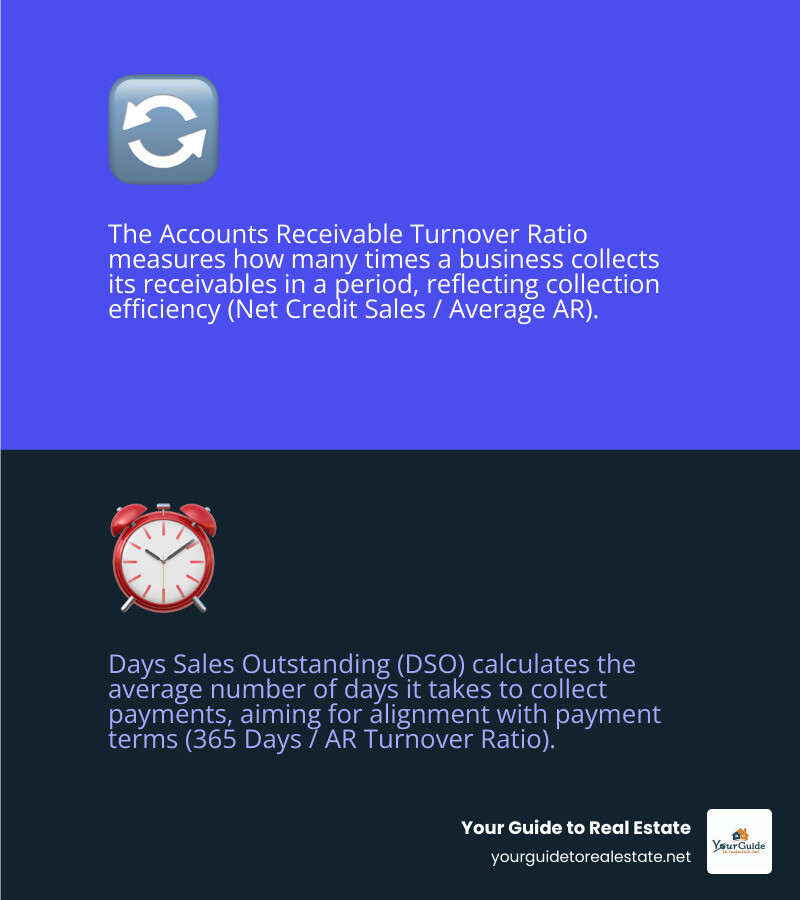
Beyond just tracking individual payments, we need a way to see how well our whole collection process is working. This is where the accounts receivable turnover ratio comes in. Think of it as a speedometer for your cash collections! It tells us how many times, on average, we collect our accounts receivable during a certain time period.
Here’s how we figure it out:
Accounts Receivable Turnover Ratio = Net Credit Sales / Average Accounts Receivable
- Net Credit Sales is simply the total money we earned from sales on credit (not cash sales) during the period.
- Average Accounts Receivable is the average amount of money owed to us during that same period.
A high turnover ratio is usually a good sign! It means we’re collecting money quickly and efficiently, which is great for our cash flow. A low ratio, however, might mean we’re taking too long to get paid, and our valuable cash is stuck out there.
Closely related to this is Days Sales Outstanding (DSO). This tells us the average number of days it takes for us to collect payment after making a sale.
DSO = 365 Days / Accounts Receivable Turnover Ratio
So, if our AR turnover ratio is 10, our DSO would be about 36.5 days. This means it takes us just over a month to collect our money. We usually want our DSO to be close to the payment terms we offer (e.g., if we say “Net 30,” a DSO of 30-35 days is fantastic!).
By watching these numbers, we can see if our credit policies are working and if our collection efforts are effective. It also helps us gauge our Real Estate Valuation and overall financial health. It’s also smart to compare your numbers to similar real estate businesses to see how you stack up – these are called industry benchmarks.
Best Practices for Improving Your Collection Process
Let’s be honest, nobody loves chasing payments. But it’s a vital part of running a successful business. By following these best practices, we can make our accounts receivable management much smoother, reduce bad debts, and keep our cash flow healthy:
First off, set clear payment terms and expectations. Make sure every invoice and contract clearly states when payment is due (e.g., “Net 30” means 30 days). Also, be upfront about any late fees or discounts for early payment. No surprises for anyone!
Next, invoice promptly and accurately. Don’t sit on an invoice! The sooner a client gets an accurate bill, the sooner they can pay it. Using electronic invoicing can really speed things up.
Consider automated reminders and follow-ups. Many accounting software programs can send friendly nudges before and after a payment is due. These gentle reminders can prevent payments from becoming overdue without you having to lift a finger every time.
Prioritize good communication. It might surprise you, but a study in 2022 found that 78% of executives believed better communication could have solved accounts receivable disputes (Source: Nuvo.credit). A quick phone call or email can often clear up confusion before it becomes a problem. Keep those lines of communication open with your clients, especially if they’re having trouble paying.
Sometimes, a little incentive goes a long way. Offer early payment discounts. For example, “2% off if paid within 10 days” can encourage clients to pay faster, which is great if you need cash quickly.
Before you extend credit for a big real estate deal, it’s smart to evaluate a customer’s creditworthiness. A quick check can save you a lot of headaches (and lost money) later on.
Make it a habit to regularly review your AR aging reports. At least once a month, check which accounts are overdue and how long they’ve been outstanding. The older an invoice gets, the harder it usually is to collect.
Finally, for businesses dealing with a lot of accounts receivable, exploring Real Estate Financing options can be helpful. This might include solutions like factoring or asset-based lending, where you can get cash for your outstanding invoices right away, even if it comes at a cost. It’s a way to open up cash flow that’s tied up in your AR.
By putting these strategies into action, we can turn accounts receivable management from a stressful chore into a proactive system that truly supports our financial stability and our mission to provide stress-free guidance in real estate.
Frequently Asked Questions about Accounts Receivable
Phew! We’ve journeyed through the ins and outs of what is accounts receivable. But even after a deep dive, a few common questions always pop up. Let’s clear the air and make sure you feel confident about this vital part of your real estate business.
Is accounts receivable an asset or a liability?
This is a really important question, and the answer is wonderfully clear: accounts receivable is an asset!
Think of it this way: an asset is something your business owns that has value. Since accounts receivable represents money that is owed to you by your clients – money you expect to receive soon – it’s definitely an asset. Specifically, it’s called a current asset because you typically expect to collect these payments within one year. This future cash inflow adds to your business’s overall financial strength. It’s like having a legal claim to money that’s on its way to your bank account.
On the flip side, a liability is money your business owes to others. So, while accounts payable (the money you owe) is a liability, accounts receivable (the money owed to you) is always a valuable asset for your real estate venture.
What happens when an account receivable cannot be collected?
Unfortunately, in the real world, not every invoice gets paid. When you’ve tried everything reasonable to collect a payment and it just isn’t coming, that uncollectible amount becomes what we call bad debt. It’s a tough pill to swallow, but it’s part of doing business.
Here’s how it generally works:
First, you’ll need to write off that uncollectible amount. This means removing it from your accounts receivable records. Then, that written-off amount is recognized as a bad debt expense on your income statement. This directly reduces your reported profit for that period, showing the financial loss your business took. Bad debts hit your bottom line because it’s revenue you earned but will never actually see as cash.
To prepare for this, many smart businesses use an allowance for doubtful accounts. This is like setting aside a small portion of your expected receivables as an estimate for what might become bad debt. It helps give a more realistic picture of how much money you truly expect to collect. For those particularly stubborn or large uncollectible debts, you might even turn to a collection agency. These agencies specialize in getting payments and often take a percentage of what they recover.
While writing off bad debt isn’t ideal, it’s a necessary accounting step to keep your financial statements honest and accurate.
Can a business use its accounts receivable for financing?
Yes, absolutely! Your accounts receivable can be a powerful tool for financing, especially when you need cash now but are waiting for clients to pay their invoices. This is often called AR financing or invoice financing, and it’s a common strategy to boost your cash flow.
Here are a few ways you can tap into the value of your outstanding invoices:
- Factoring: Imagine selling your invoices to a specialized company (a “factor”) at a small discount. The factor then takes over the job of collecting from your customers, and you get immediate cash, minus their fee. This is super helpful if you need quick access to working capital and don’t want to deal with collections. You can learn more about this from resources like the Office of the Comptroller of the Currency.
- Asset-Based Lending (ABL): With ABL, you use your accounts receivable (and sometimes other business assets) as collateral for a loan. You still own your AR and are responsible for collecting payments, but the lender gives you a percentage of your AR’s value upfront. This is a flexible option, especially for real estate businesses with strong, reliable receivables.
- Securitization: While usually for much larger companies, securitization involves bundling many accounts receivable together and selling them as investments to others. It’s another way to turn future payments into immediate cash.
These financing options can open up the value of your invoices much sooner, giving you the capital to seize new opportunities, cover daily expenses, or simply maintain a healthy cash flow. Just remember to always understand the costs and details of each option before jumping in!
Conclusion: Mastering AR for Financial Health
We’ve covered a lot of ground together, and by now you should have a solid grasp of what is accounts receivable and why it matters so much for your real estate business. Think of AR as the bridge between the work you do today and the cash that keeps your business running tomorrow.
Throughout this guide, we’ve seen how accounts receivable is fundamentally about money owed to your business – whether that’s rent from tenants, commissions from sales, or fees for your professional services. It’s not just an accounting entry on your balance sheet; it’s a vital current asset that directly impacts your ability to pay bills, invest in opportunities, and grow your real estate ventures.
The key takeaway? Proactive management makes all the difference. When you establish clear credit policies, send invoices promptly, and follow up consistently, you’re not just chasing money – you’re building a foundation for sustainable success. Statistic about 78% of executives believing better communication could solve AR disputes? That’s the power of staying engaged with your clients and addressing issues before they become problems.
Your AR turnover ratio and days sales outstanding aren’t just numbers on a report. They’re your financial pulse, telling you how efficiently you’re converting your hard work into actual cash. When these metrics are healthy, your entire business runs smoother.
Don’t forget that your accounts receivable can also be a financing tool when you need it. Whether through factoring or asset-based lending, these options can provide the cash flow flexibility that real estate professionals often need to seize new opportunities or weather temporary challenges.
Managing accounts receivable well is really about creating predictable cash flow – the kind that lets you sleep well at night knowing your business is on solid ground. It’s part of that stress-free guidance and proven framework we believe every real estate professional deserves.
For more insights into managing your real estate finances and making informed decisions, we invite you to continue exploring our resources. Explore our beginner’s guide to home loans to further improve your financial literacy.