
Understanding the Mortgage Rate Surge: What’s Behind the Numbers
Why are mortgage rates going up is the question on every homebuyer’s mind right now. The answer isn’t simple – it’s a mix of economic forces, Federal Reserve policies, and market dynamics all working together.
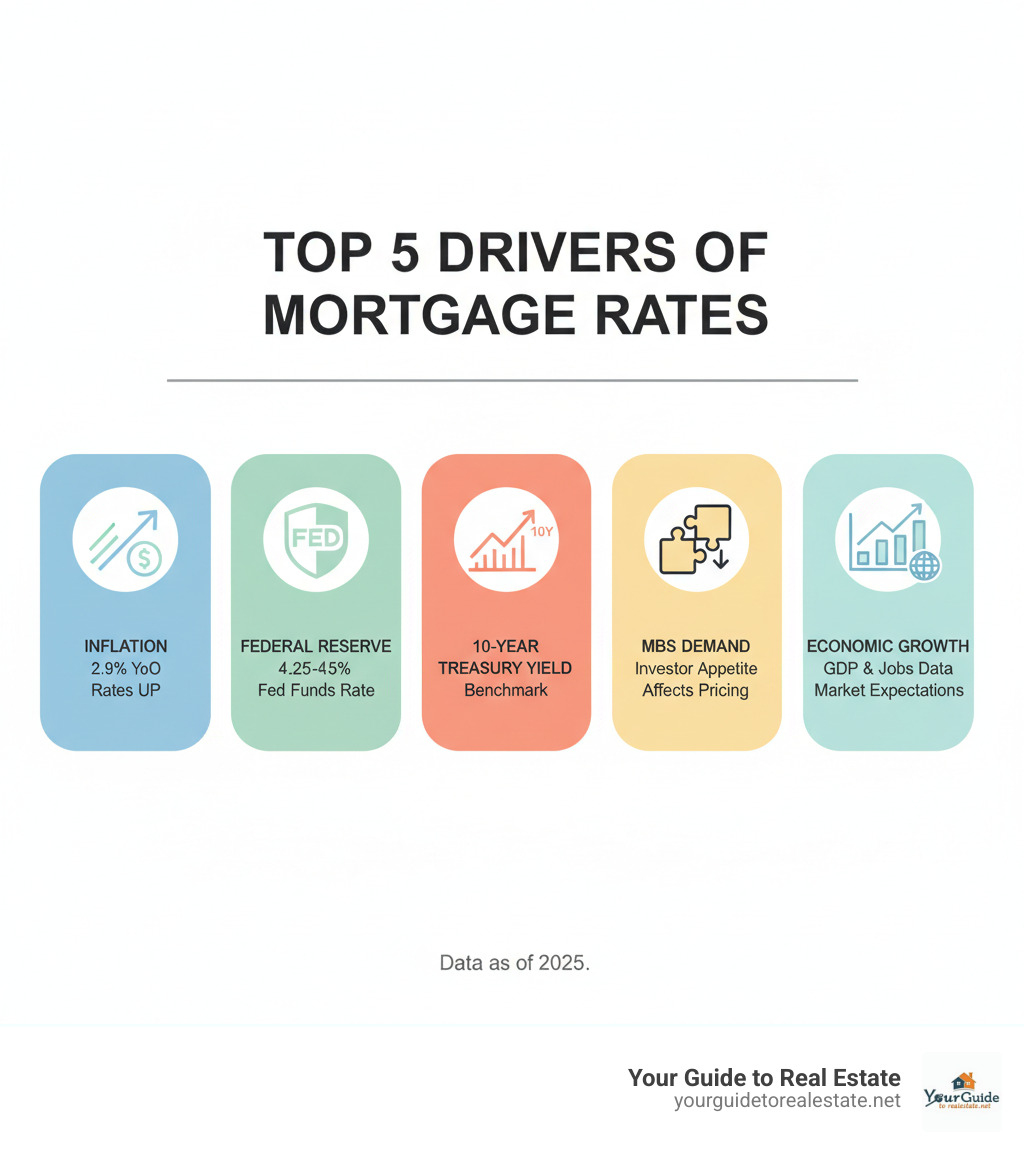
Here are the main reasons mortgage rates are rising:
- Inflation pressures – Higher prices for goods and services push rates up
- Federal Reserve policy – The Fed’s actions to control inflation affect borrowing costs
- Strong economic growth – A hot economy typically means higher interest rates
- 10-Year Treasury yields – Mortgage rates closely follow these government bond rates
- Reduced demand for mortgage-backed securities – Less investor appetite means higher rates
After hitting historic lows of 2.65% in 2021 during the pandemic, 30-year mortgage rates have climbed dramatically. As of early 2025, they’ve settled around 7.09% according to current market data.
This surge has left many potential buyers wondering if homeownership is still within reach. The reality is that while today’s rates feel high compared to the pandemic lows, they’re actually closer to historical norms. The average 30-year rate peaked at 18.44% in 1981.
The key is understanding that mortgage rates don’t move in isolation. They respond to a complex web of economic signals, from jobs reports to inflation data to global events. When the economy shows strength, rates typically rise. When uncertainty hits, they often fall.
Why are mortgage rates going up definitions:
The Economic Engine: Macro Factors Driving Rates Higher
Understanding why are mortgage rates going up means taking a step back to look at the bigger economic picture. Think of the economy as a giant machine with many moving parts – and mortgage rates respond to nearly every gear that turns.
When economists talk about economic growth, they’re looking at things like GDP numbers and unemployment rates. A strong jobs report might sound like great news (and it is for workers!), but it often sends mortgage rates climbing. Why? Because a booming economy tends to create inflation pressure, and lenders need to protect themselves from that risk.
Consumer spending also plays a huge role. When people are out shopping and the economy is humming along, it can signal that rates might need to rise to keep things from overheating. Even global events and market sentiment can push rates around – uncertainty in one part of the world can ripple through to your local mortgage rate.
The relationship between economic health and mortgage rates isn’t always intuitive, which is why we’ve put together detailed guides on How the Economy Affects Interest Rates and our comprehensive Housing Market Forecast to help you steer these complex waters.
The Pervasive Role of Inflation
If there’s one economic villain in the story of rising mortgage rates, it’s inflation. Here’s how it works: when the prices of everyday things – from groceries to gas – keep going up, the money you’ll pay back on your mortgage in the future is worth less than the money you’re borrowing today.
Lenders aren’t in the business of losing money, so they bump up interest rates to make sure they’re still earning a real return after inflation eats away at the value of those future payments. It’s like a built-in protection mechanism.
We saw this play out dramatically after the pandemic. The Consumer Price Index (CPI) showed inflation running hot, and mortgage rates responded accordingly. After hitting those incredible lows of 2.65% in 2021, rates shot up as inflation became a real concern.
The Fed’s response to inflation typically involves raising rates to cool things down, which creates a ripple effect throughout the entire lending market. When inflation runs at 2.9% year-over-year (as we’ve seen recently), it’s no wonder that mortgage rates feel the pressure. You can dive deeper into this relationship in our guide on More on how inflation impacts rates.
Economic Health vs. Interest Rates
Here’s where things get a bit counterintuitive: good news for the economy can actually be bad news for mortgage rates. It sounds backwards, but stick with me.
When we get a strong jobs report showing lots of new hiring, or when GDP growth signals point to a robust economy, investors start worrying about inflation. They figure the Federal Reserve will need to step in and cool things down by raising rates. Sometimes, just the expectation of higher rates is enough to push mortgage rates up.
On the flip side, when the economy shows signs of weakening or recession fears start creeping in, something interesting happens. Investors often make a flight to safety, moving their money into government bonds. This increased demand for bonds can actually push mortgage rates down.
We saw this recently when job growth came in weaker than expected – mortgage rates dropped as investors repositioned themselves. It’s a reminder that the relationship between economic strength and mortgage rates isn’t always straightforward, which is why staying informed through resources like our U.S. Housing Market Update 2025: Prices, Inventory, and Buyer Behavior can help you make better timing decisions.
The Fed, Bonds, and the Bond Market: Why Are Mortgage Rates Going Up?
Understanding why are mortgage rates going up requires diving into the fascinating world of Federal Reserve policy and bond markets. While these might sound like dry financial topics, they’re actually the puppet masters pulling the strings behind your mortgage rate. Think of it as a financial ecosystem where every move creates ripples that eventually reach your monthly payment.
The relationship between these financial forces isn’t always obvious, but once you understand the connections, mortgage rate movements start to make perfect sense. For a deeper dive into these dynamics, our guide on Understanding Mortgage Rates breaks down all the moving pieces.
The Federal Reserve’s Indirect Influence
Here’s something that surprises many people: the Federal Reserve doesn’t actually set mortgage rates directly. Instead, the Fed controls the federal funds rate, which is what banks charge each other for overnight loans. During early 2025, this rate sat at 4.25% to 4.5%.
But here’s where it gets interesting. While the Fed’s federal funds rate primarily affects short-term borrowing costs, mortgage rates are long-term commitments that respond more to what investors think the Fed will do in the future. It’s like trying to predict where a river will flow by watching the weather upstream.
When the Fed signals it’s serious about fighting inflation, even without raising rates immediately, investors start betting on “higher for longer” interest rates. This expectation alone can push mortgage rates up before the Fed even makes a move. The Fed’s dual mandate of controlling inflation while maintaining employment creates a delicate balancing act that mortgage markets watch closely.
The Fed also wields enormous influence through Quantitative Easing (QE) and Quantitative Tightening (QT). During QE periods, like we saw after 2008 and during the pandemic, the Fed becomes a massive buyer of mortgage-backed securities and Treasury bonds. This flood of demand drives prices up and yields down, creating those record-low mortgage rates we enjoyed in 2020-2021.
QT works in reverse. When the Fed stops buying or starts selling these securities, it reduces demand and puts upward pressure on rates. This process is a major reason why are mortgage rates going up today. Even when the Fed cuts its benchmark rate, mortgage rates won’t drop significantly until we see more stability in inflation and improved investor demand for mortgage-backed securities. To understand how rates can move independently of Fed actions, check out Why Mortgage Rates Change Even When the Fed Doesn’t Move.
The Crucial Link to the 10-Year Treasury Yield
If you want to predict where mortgage rates are heading, keep your eye on the 10-year Treasury yield. These two move together like dance partners, and understanding this relationship is key to grasping mortgage rate movements.
Why the 10-year Treasury specifically? Most homeowners either sell their home or refinance their mortgage within about 10 years, even with a 30-year loan. This makes the 10-year Treasury note the perfect benchmark for pricing mortgages.
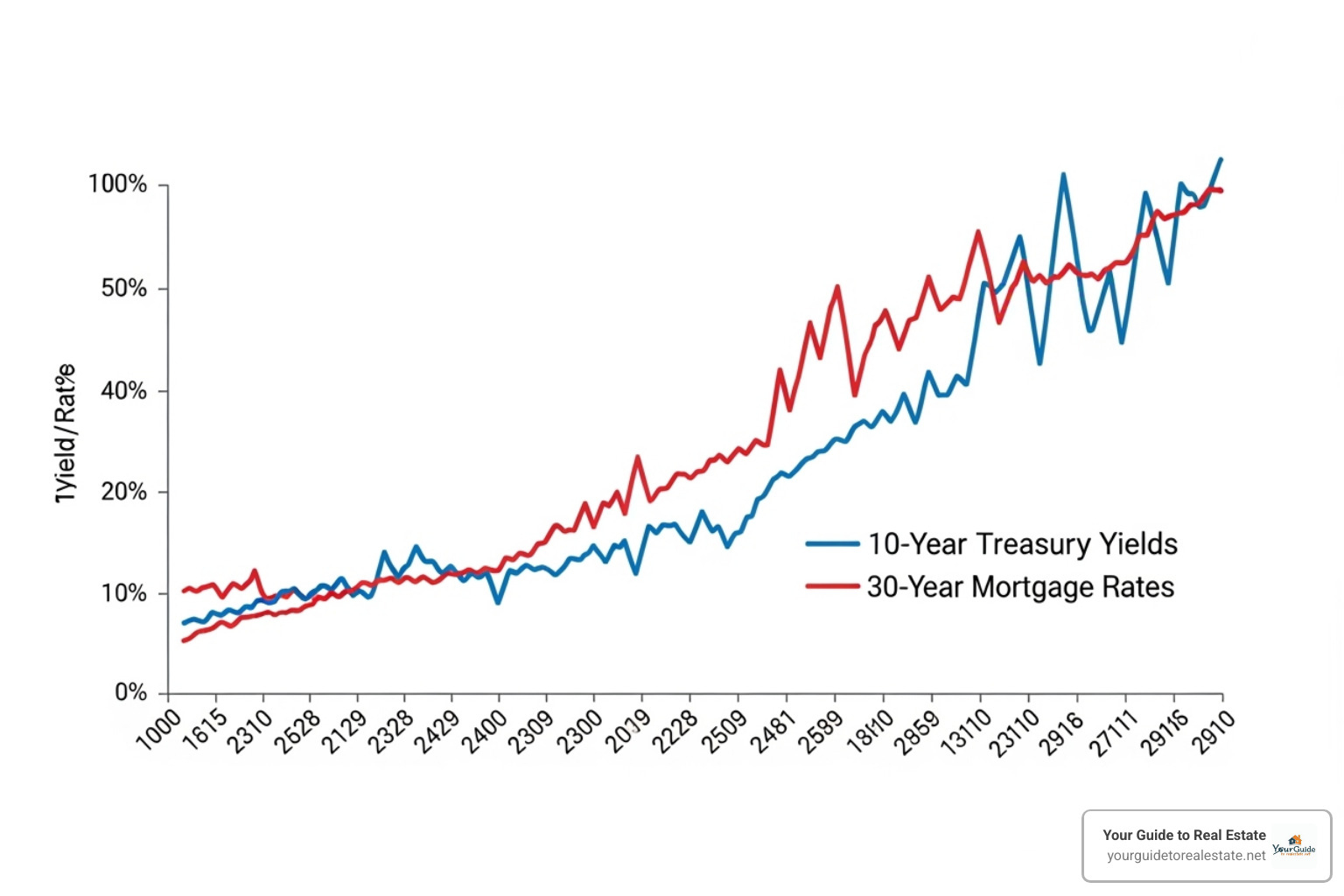
Lenders typically add a risk premium or “spread” above the 10-year Treasury yield to account for the extra risk that comes with mortgage lending. Historically, this spread averaged around 1.70%, but recent market conditions have pushed it much higher. Currently, the spread between 30-year mortgage rates and 10-year Treasury yields is nearly 3%! This wider gap reflects increased uncertainty and reduced investor appetite for mortgage risk.
When Treasury yields rise, mortgage rates follow like a shadow. When we see mortgage rates dropping, it’s usually because “they follow the rate on 10-year Treasuries, and right now, those rates are edging down.” This tight correlation means that anything affecting Treasury demand—from inflation fears to global economic uncertainty—directly impacts your potential mortgage rate.
You can track the current 10-year bond yield to get a real-time pulse on where mortgage rates might be heading. For insights into how different loan structures can help you steer rate changes, explore our 30-Year Mortgage Options.
Why Mortgage-Backed Securities (MBS) Matter
Here’s where the mortgage market gets really interesting. Most banks don’t keep your mortgage on their books forever. Instead, they bundle home loans together into Mortgage-Backed Securities (MBS) and sell them to investors. Think of it as turning individual mortgages into tradeable bonds backed by pools of home loans.
The health of the MBS market directly affects your mortgage rate. When investors are hungry for these securities, they bid up prices, which drives down yields and translates to lower mortgage rates for homebuyers. When investor demand cools, the opposite happens—prices fall, yields rise, and mortgage rates climb.
Prepayment risk is a major concern that affects MBS demand. This is the possibility that homeowners will refinance their mortgages if rates drop, cutting short the investors’ expected returns. As our research shows, “Investors may be hesitant to buy MBS due to concerns over prepayment risk—the possibility that homeowners will refinance if rates drop, cutting into investors’ expected returns. This reduced demand is keeping mortgage rates from falling as quickly as some had hoped.”
The Federal Reserve’s role as a major MBS buyer during QE periods cannot be overstated. When the Fed steps back through QT, it removes a huge source of demand from the market. This reduction in buying power is another significant factor explaining why are mortgage rates going up. The supply and demand dynamics of the MBS market create a direct pipeline from investor sentiment to your monthly mortgage payment.
Understanding these market forces helps explain why mortgage rates can seem disconnected from other economic indicators at times. For a comprehensive look at how MBS markets work, see our guide on More on MBS demand.
Putting It in Perspective: Historical Context and Current Trends
Understanding why are mortgage rates going up isn’t just about current economics – it’s also about historical context. While today’s rates might feel high, a look back at the past can offer valuable perspective and help us understand where we might be headed.

For a deeper dive into future market conditions, our Real Estate Market Projections for 2025: Key Numbers to Watch provides a comprehensive outlook.
How Today’s Rates Compare to the Past
If you’re feeling sticker shock from current mortgage rates, you’re not alone. Many homebuyers who got used to the pandemic’s ultra-low rates are wondering if homeownership is still within reach. But here’s some perspective that might help: today’s rates aren’t actually that unusual when you look at the bigger picture.
The record low of 2.65% we saw in January 2021 was truly extraordinary. It was the result of a perfect storm – a global pandemic, massive government intervention, and the Federal Reserve buying mortgage bonds like there was no tomorrow. Those rates were never meant to last forever.
Let’s put things in perspective. Back in October 1981, mortgage rates peaked at a jaw-dropping 18.44%. Can you imagine? A $300,000 mortgage at that rate would cost you over $4,600 per month in principal and interest alone. Even in the early 2000s, rates regularly hung around 7-8%, and people still bought homes and built wealth through real estate.
As of early 2025, rates have settled around 7.09%, with recent data showing the average 30-year fixed-rate mortgage at 6.35% for the week ending September 11. That was actually down from 6.50% the week before – the lowest average since last October. While rates have been above 6.5% for most of the last year and climbed above 7% in January, they’re still within what we’d consider normal historical ranges.
The truth is, the pandemic years spoiled us with artificially low rates. What feels expensive today is actually closer to what our parents and grandparents considered normal. You can explore more Historical mortgage rate data and view Mortgage rates over time to see just how much rates have fluctuated over the decades.
Mortgage Rate Forecasts
Predicting where mortgage rates will go next is like trying to forecast the weather six months out – even the experts get it wrong sometimes. But that doesn’t stop leading housing market analysts from making educated guesses based on economic trends and Federal Reserve signals.
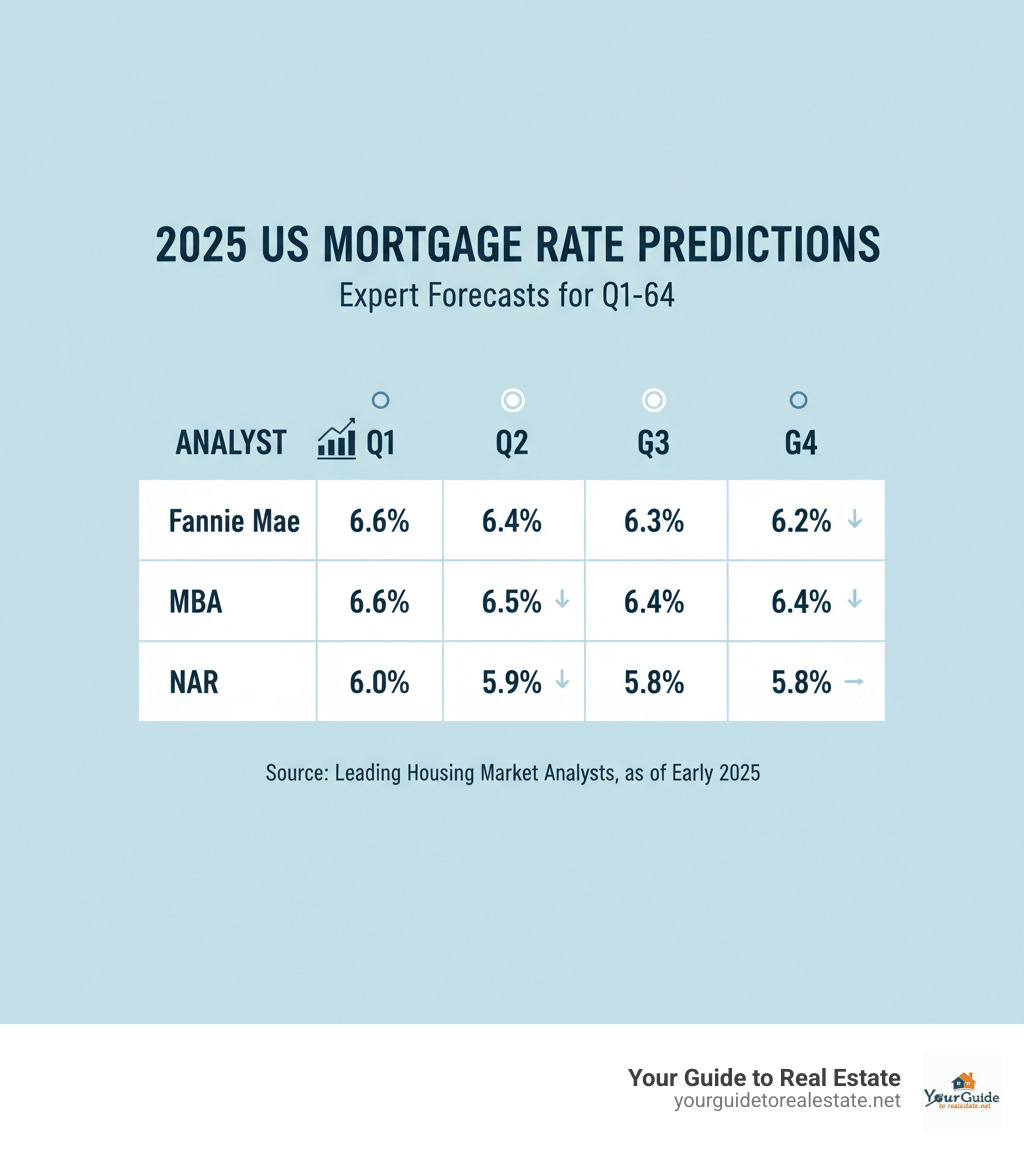
Here’s what some of the biggest names in housing are predicting for 2025:
| Source | Q1 2025 | Q2 2025 | Q3 2025 | Q4 2025 |
|---|---|---|---|---|
| Fannie Mae | 6.6% | 6.4% | 6.3% | 6.2% |
| MBA | 6.6% | 6.5% | 6.4% | 6.4% |
| NAR | 6.0% | 5.9% | 5.8% | 5.8% |
The good news? There’s a general consensus for rates to trend downward throughout 2025. Lawrence Yun at the National Association of Realtors is particularly optimistic, expecting the 30-year fixed-rate to hit 6% by year’s end. These predictions assume that inflation will continue cooling and the Federal Reserve might start cutting its benchmark rates.
But here’s the thing about forecasts – they’re only as good as the assumptions they’re built on. A surprise spike in inflation, unexpected geopolitical tensions, or major changes in employment could throw these predictions right out the window. The mortgage market is influenced by so many moving parts that even small changes can create big ripples.
What’s most important to remember is that market volatility is normal. Rates will go up, they’ll come down, and they’ll surprise us in both directions. The key is focusing on what you can control – your credit score, down payment, and the timing that works best for your personal situation.
From Market Rate to Your Rate: Personal Factors and Loan Choices
While economic forces might explain the broader question of why are mortgage rates going up, your personal financial picture determines the actual rate you’ll pay. Think of the market rate as the starting point – your individual circumstances either work for you or against you from there.
The good news? You have more control than you might think. Even in a high-rate environment, smart preparation and strategic choices can save you thousands over the life of your loan. Whether you’re just starting your homebuying journey or ready to make an offer, our First-Time Homebuyer Tips and guide on How to Shop Mortgage can help you steer this process with confidence.
What personal factors explain why are mortgage rates going up for some borrowers?
Here’s the reality: that “average” mortgage rate you see in headlines might not be anywhere close to what you’ll actually pay. Lenders look at your financial profile like a report card, and every factor either earns you a better rate or costs you more.
Your credit score carries the most weight in this equation. A score of 780 or higher opens the door to the lowest available rates, while anything below 620 can push you into significantly higher territory. Even a 40-point difference can mean paying thousands more over the life of your loan.
How much you put down matters enormously too. A larger down payment means you’re borrowing less relative to the home’s value – what lenders call your loan-to-value (LTV) ratio. Hit that magic 20% down payment, and you’ll not only avoid private mortgage insurance but also qualify for better rates since you represent less risk to the lender.
Lenders also scrutinize your debt-to-income (DTI) ratio carefully. If most of your monthly income already goes toward debt payments, they’ll charge more to compensate for the increased risk. The lower your DTI, the better your rate prospects.
Even the type of property you’re buying affects your rate. Your primary residence gets the best treatment, while second homes and investment properties come with rate premiums. Loan size plays a role too – jumbo loans that exceed conforming limits often carry different rates than standard loans.
Choosing Your Loan: Fixed-Rate vs. Adjustable-Rate (ARM)
The type of mortgage you choose becomes especially important when why are mortgage rates going up is a constant concern. Both fixed-rate and adjustable-rate mortgages have their place, but they work very differently in volatile rate environments.
Fixed-rate mortgages offer the ultimate peace of mind. Your rate stays locked for the entire 15 or 30-year term, which means predictable monthly payments no matter what happens in the broader market. When rates are high or expected to climb, this stability becomes incredibly valuable. You’ll know exactly what you’re paying each month for decades to come.
Adjustable-rate mortgages (ARMs) take a different approach. They typically start with an attractive “teaser” rate that’s lower than fixed rates, but that rate adjusts after an initial period – usually 3, 5, 7, or 10 years. If market rates fall during your adjustment period, your payments could decrease. But if rates rise, your payments could jump significantly.
ARMs can make sense if you’re planning to sell or refinance before the rate adjusts, or if you genuinely expect rates to fall in the coming years. However, they require careful risk assessment since you’re essentially betting on future rate movements. Our Mortgage Options Explained guide can help you think through these trade-offs.
How to Steer a High-Rate Environment
Don’t let rising rates discourage you from homeownership. Smart borrowers know how to work the system, even when rates feel uncomfortably high. The key is approaching the process strategically rather than just accepting the first offer that comes your way.
Shopping multiple lenders is your most powerful tool. Mortgage rates and fees can vary dramatically between lenders for identical loan scenarios. We recommend getting quotes from at least 3-5 different lenders – the savings often add up to thousands of dollars over your loan’s lifetime.
Improving your credit score before you apply can pay massive dividends. Even bumping your score from 740 to 780 can open up meaningfully better rates. Check your credit report for errors, pay down high-interest debt, and avoid opening new credit accounts while you’re shopping for a mortgage.
Consider paying for discount points if you’re planning to stay in your home for many years. These upfront payments to your lender can permanently reduce your interest rate. While it costs more initially, the long-term savings can be substantial, especially in a high-rate environment.
Locking your rate protects you from further increases once you’ve found a favorable offer. Most lenders offer 30 to 60-day rate locks, giving you time to close without worrying about market movements. If rates are climbing, this protection becomes invaluable.
Remember the saying “marry the house, date the rate.” If you find the right home, don’t let current interest rates derail your plans entirely. Rates change over time, and refinancing opportunities will likely emerge. We’ve already seen this recently – refinance applications surged when rates dropped even modestly, as homeowners who bought at higher rates jumped at the chance to lower their payments.
When that opportunity comes, our Mortgage Refinancing Explained guide will walk you through the entire process, helping you take advantage of better rates when they become available.
Frequently Asked Questions about Rising Mortgage Rates
We know you have questions, and we’re here to provide clear, straightforward answers about why are mortgage rates going up and what it means for your homebuying journey.
Do Fed rate hikes automatically mean higher mortgage rates?
This is one of the biggest misconceptions we hear! The answer is no – Fed rate changes don’t automatically translate to immediate mortgage rate changes, and understanding this distinction can save you a lot of confusion.
Here’s what actually happens: The Federal Reserve controls the federal funds rate, which affects short-term borrowing between banks. But your 30-year mortgage? That’s tied to longer-term investments, particularly the 10-year Treasury yield. Think of it like this – the Fed controls the speed of a speedboat (short-term rates), but mortgage rates follow the current of a much larger ship (long-term market expectations).
Mortgage rates respond more to what investors think will happen with inflation and economic growth over the next decade. They also depend heavily on demand for mortgage-backed securities. That’s why we sometimes see mortgage rates rise even when the Fed cuts rates, or stay steady when the Fed raises them. Market expectation is the key driver here, not the Fed’s direct action.
The Fed’s influence is definitely there, but it’s more like a gentle nudge than a direct command.
If rates are high, should I wait to buy a house?
This question keeps us up at night because we know how personal and important this decision is for you. The honest answer? There’s no crystal ball that tells us when rates will drop, and timing the market is incredibly difficult – even the experts get it wrong regularly.
Here’s what we want you to consider instead of trying to time the market: While you’re waiting for rates to potentially drop, home prices often continue climbing. This means any savings from a lower rate might get eaten up by higher purchase prices. It’s a bit like waiting for gas prices to drop while taxi fares keep going up.
Building equity is powerful. Every month you own a home, you’re building wealth instead of paying someone else’s mortgage. Rent payments typically increase each year, but a fixed mortgage payment stays the same for 30 years. That predictability and equity building can be more valuable than trying to save a percentage point on your rate.
The real question isn’t whether rates are high – it’s whether you can comfortably afford the monthly payment and you’ve found a home that meets your needs. If the answer is yes, you can always “marry the house and date the rate” by refinancing later if rates drop.
What is the best way to get a lower mortgage rate right now?
Even when why are mortgage rates going up is the trending question, you still have plenty of control over the rate you actually get. Your personal financial profile makes a huge difference – sometimes more than the overall market conditions.
Your credit score is your best friend here. A score of 740 or higher opens doors, but 780+ gets you into the VIP section of mortgage rates. Before you start shopping, check your credit report for errors and pay down high-interest debt if possible.
Think bigger down payment if you can swing it. The more you put down, the less risk you represent to the lender. This often translates directly into a lower rate. If you can hit that 20% down payment sweet spot, you’ll avoid private mortgage insurance costs too.
Shop around like your wallet depends on it – because it does! We can’t stress this enough: rates can vary significantly between lenders for the exact same borrower profile. Get quotes from at least three to five different lenders, including banks, credit unions, and mortgage brokers. This competition alone can save you thousands over the life of your loan.
Consider paying discount points if you’re planning to stay in the home for many years. These upfront payments can lower your rate permanently, though you’ll want to calculate whether the upfront cost makes sense for your situation.
Don’t forget to ask about different loan programs too. Sometimes a 15-year mortgage or an adjustable-rate mortgage might offer better terms that align with your specific plans and timeline.
Conclusion
If there’s one thing we hope you take away from this deep dive, it’s that why are mortgage rates going up isn’t a mystery with a single villain. It’s more like a complex recipe with many ingredients – inflation pressures, Federal Reserve policies, bond market dynamics, and economic growth signals all mixing together to create today’s rate environment.
The story we’ve told here reveals how interconnected our financial system really is. When inflation heats up, lenders demand higher returns to protect their investments. When the economy shows strength, it often pushes rates higher as investors anticipate the Fed stepping in to cool things down. And when the 10-year Treasury yield moves, mortgage rates typically follow along for the ride.
Here’s what really matters for your homebuying journey: While market forces set the general direction of rates, your personal financial situation has enormous power over the rate you’ll actually pay. A strong credit score, a solid down payment, and shopping around with multiple lenders can make a meaningful difference in your monthly payment – sometimes more than waiting for the “perfect” market conditions.
Yes, rates have climbed dramatically from those pandemic lows of 2.65%. But remember, today’s rates around 7% aren’t historically outrageous. Your parents or grandparents likely paid much higher rates and still built wealth through homeownership. The key is understanding that high rates are not a barrier to achieving your homeownership goals – they’re simply one factor to work with.
The housing market has always been about timing that works for your life, not trying to predict the unpredictable. If you’re financially ready and find a home you love, the old saying “marry the house, date the rate” holds true. You can always refinance later when conditions improve.
At Your Guide to Real Estate, we’re here to help you steer these waters with confidence. Whether you’re trying to understand complex market forces or need practical advice on securing the best mortgage terms, our goal is to give you the knowledge and tools for success. Real estate decisions are big ones, but they don’t have to be overwhelming when you have the right guidance.
Ready to dive deeper into the mortgage process? Our comprehensive guide Understanding Mortgages: A Beginner’s Guide to Home Loans will walk you through everything you need to know to make informed decisions in today’s market.