
Why Investing is Important for Building Long-Term Wealth
Why is investing important? Investing allows your money to grow over time, helps you beat inflation, and builds wealth for long-term goals like retirement or real estate purchases. While saving protects your money, investing makes it work harder for you.
Here are the key reasons why investing matters:
- Wealth Building: Historical data shows investments provide significantly higher returns than savings accounts over the long term
- Inflation Protection: With 3% average inflation, $1,000 today will cost $1,344 in ten years – investing helps maintain purchasing power
- Compound Growth: Your earnings generate their own earnings, accelerating wealth accumulation over time
- Goal Achievement: Investing increases your chances of reaching financial milestones like homeownership or retirement
Most schools never taught you these critical financial lessons. You learned algebra and history, but nobody explained how a $10,000 investment in a diversified portfolio could grow to over $30,000 in ten years, while that same amount in a savings account earning 0.5% interest would only reach $10,500.
The financial world operates on principles that seem counterintuitive at first. The “safe” choice of keeping all your money in savings actually becomes risky over time because inflation quietly erodes your purchasing power. Meanwhile, investments that feel scary in the short term often provide the security you need for long-term financial goals.
As one financial expert put it: “Investing is not a get-rich-quick scheme and it is not gambling.” It’s a systematic approach to making your money work harder than you do.
Basic why is investing important terms:
Lesson 1: Your Savings Account is Losing the Race
We’ve all heard the advice: “Save your money!” And truly, saving is super important. We all need a little cushion for emergencies, a short-term fund for that shiny new gadget, or even a down payment for a car or home. But here’s a crucial lesson that often gets missed in school: saving and investing are two very different financial tools. And if you rely only on saving for your long-term financial health, you might find yourself falling behind.
Think of it this way: a savings account is like keeping your money tucked safely under your mattress (but with a tiny bit of interest!). It’s great for keeping your cash accessible and secure. For example, most bank deposits are insured by the FDIC up to $250,000, which offers wonderful peace of mind. But this feeling of safety often comes with a trade-off: minimal returns. Your money isn’t really growing; it’s just there.
Investing, on the other hand, is about putting your money to work! Whether it’s in stocks, bonds, or, as we love to explore here at Your Guide to Real Estate, actual real estate, the goal is to make your money grow significantly over time. Historically, smart investments have offered much higher returns in the medium to long term compared to typical savings accounts.
Now, let’s talk about the silent “villain” in this story: inflation. Inflation is like a sneaky thief that slowly, quietly, steals away your money’s buying power. If the cost of everyday things goes up by just 3% each year, something that costs $1,000 today could cost about $1,344 in ten years, and a whopping $1,808 in twenty years!
Imagine your savings account earning a tiny 0.5% interest. Your money isn’t just sitting still; it’s actually losing value in real terms because inflation is outpacing your earnings. To truly keep up and maintain your purchasing power, your money needs to earn a return that beats inflation, even after taxes. This is a huge reason why investing is important. It’s the key way to ensure your money not only keeps pace but ideally grows faster than the rising cost of living. Holding onto too much cash might feel safe, but it can be surprisingly risky over the long haul because you miss out on growth and inflation eats away at its worth.
To really see this in action, let’s look at a simple comparison:
| Scenario | Initial Investment ($) | Annual Return (%) | 10 Years Later ($) | 20 Years Later ($) | Real Value After 20 Years (3% Inflation) ($) |
|---|---|---|---|---|---|
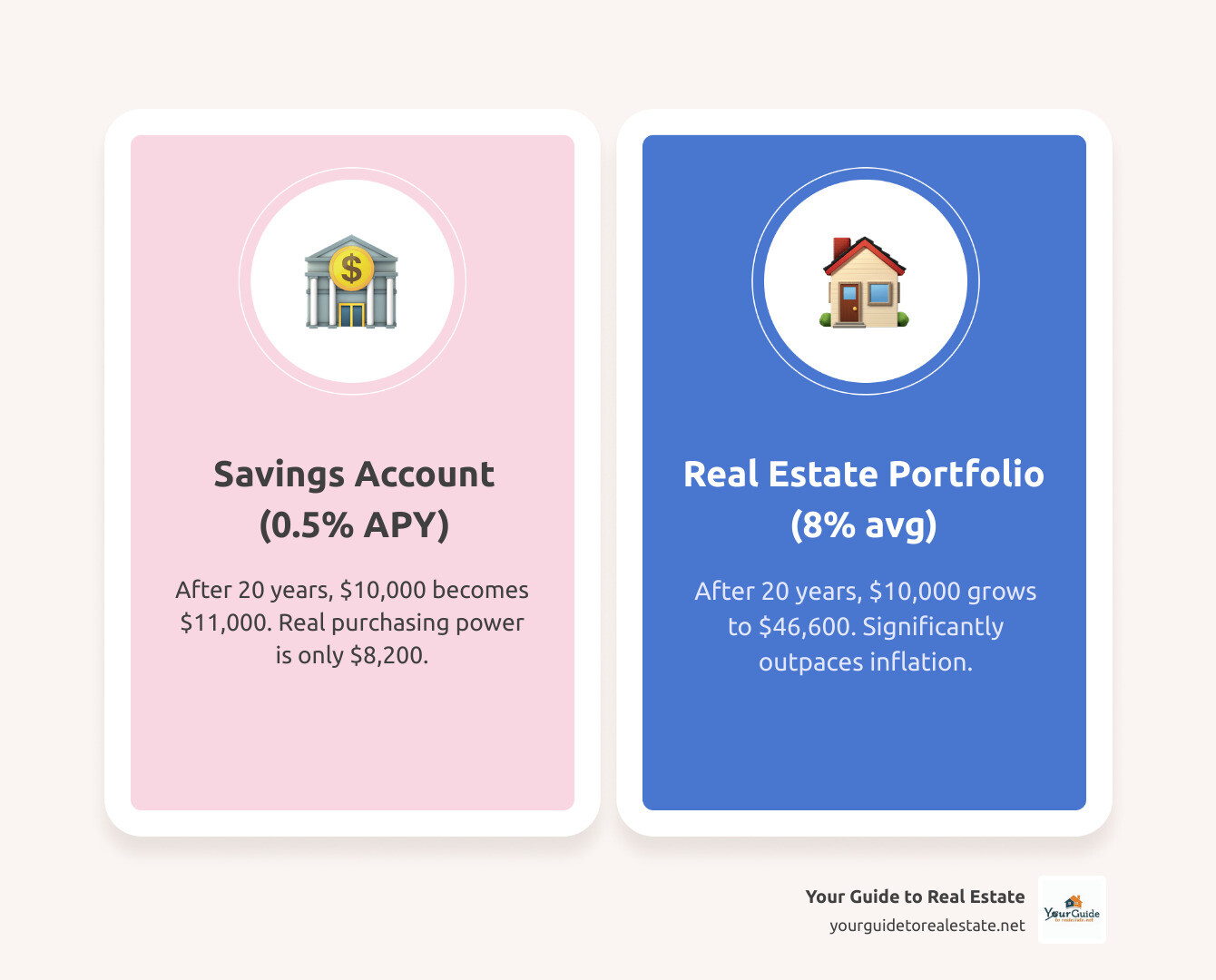
| Savings Account | 10,000 | 0.5% | 10,512 | 11,051 | 8,200 |
| Diversified Real Estate Investment (Estimate) | 10,000 | 8% | 21,589 | 46,609 | 34,500 |
Note: Real Estate returns are illustrative and vary widely based on market conditions, location, and property type. Inflation calculation assumes a constant 3% rate and applies to the purchasing power of the final value.
The table really tells the story, doesn’t it? The difference is quite eye-opening. While your savings account offers security, it leaves your money with less actual buying power over time. Meanwhile, a diversified real estate investment, though it comes with more risk, has the exciting potential to significantly boost your wealth and help you stand strong against rising costs.
Learning how to wisely manage your money – balancing what you have with what you spend – is the very first step toward making smarter financial decisions. You can dive deeper into this concept by checking out What is a plan in which an individual balances available resources and expenses?.
Lesson 2: Using the “Eighth Wonder of the World”
Albert Einstein supposedly called compound interest “the eighth wonder of the world.” Whether he actually said this or not, the sentiment rings true. Compound growth is the closest thing to magic in the financial world, and it’s one of the most compelling reasons why investing is important.
Here’s how compound growth works: instead of just earning returns on your original investment, you earn returns on your returns too. Think of it like planting a tree. The tree grows, drops seeds, and those seeds grow into more trees. Each generation creates more potential for growth.
Let’s say you invest €1,000 and earn 8% in the first year. You now have €1,080. In year two, you don’t just earn 8% on your original €1,000 – you earn 8% on the full €1,080. That extra €80 starts working for you too. This reinvesting of earnings creates a snowball effect that accelerates over time.

The penny-doubling example above shows just how powerful exponential growth can be. If you doubled a single penny every day for 30 days, you’d end up with over €5 million. While real investments don’t double daily, the principle remains the same – small amounts can grow into substantial wealth given enough time.
Time is your greatest ally when it comes to compound growth. The longer your money stays invested, the more dramatic the results become. This is why starting early matters so much, even if you can only invest small amounts.
Consider Sarah and Mike. Sarah starts investing €100 per month at age 25. Mike waits until 35 to start investing €200 per month – twice as much. Assuming an 8% annual return, Sarah will have about €350,000 by age 65, while Mike will have roughly €175,000. Sarah invested €48,000 total over 40 years, while Mike invested €72,000 over 30 years. Yet Sarah ends up with twice as much money because she gave her investments an extra 10 years to compound.
This is the beauty of having a long time horizon for your investments. Even modest amounts can grow significantly when compound growth has decades to work its magic. The key is consistency – making regular contributions and letting your earnings reinvest automatically.
Real estate investing offers excellent opportunities for compound growth. When you reinvest rental income into additional properties or improvements, you’re using the power of compounding. Each property can generate income that helps you acquire more properties, creating an expanding portfolio over time.
Want to see compound growth in action with your own numbers? Use this compound interest calculator to see for yourself how your investments could grow over different time periods. You might be surprised by what consistent investing can accomplish.
The bottom line? Compound growth rewards patience and consistency. Start investing as early as possible, reinvest your earnings, and let time work its magic. Your future self will thank you.
Understanding Why is Investing Important for Your Future
Lesson 3: Strategic Goal Setting – A Key Reason Why Investing is Important
Think of investing like planning a road trip. You wouldn’t just hop in your car and start driving without knowing where you’re going, right? The same principle applies to your money. Why is investing important becomes crystal clear when you realize it’s not about randomly throwing money at investments and crossing your fingers.
Your investment journey starts with one simple question: What do you actually want to achieve? Maybe you’re dreaming of a cozy retirement home in Dallas, or you want to buy your first property in Oklahoma City. Perhaps you’re thinking about your kids’ college fund, or you want to reach true financial independence where work becomes optional instead of mandatory.
Write these goals down. Seriously, grab a pen right now. When you have specific targets with actual dates attached, your money has direction and purpose. If you’re saving for something you need in the next year or two, a regular savings account makes perfect sense. But if you’re planning for something five, ten, or twenty years down the road, that’s where investing shows its real power.
Next up is understanding your risk tolerance – basically, how well you sleep at night when your investments go up and down. Some people are comfortable with the roller coaster ride of higher-risk investments because they know the potential for bigger returns. Others prefer the gentle hills of more stable investments, even if it means slower growth.
Ask yourself these questions: How would you feel if your investment dropped 20% in a month? Do you have other sources of income? Are you paying off debt? Your honest answers shape what types of investments make sense for your situation.
Here’s what investing is not: it’s not a lottery ticket or a casino game. Real investing is methodical, patient, and strategic. It’s about creating a plan that considers your budget, your timeline, and your comfort level with risk. The best part? This plan isn’t carved in stone. You should review and adjust it at least once a year as your life changes.
Many people find that understanding why investing is important connects directly to feeling more in control of their future. There’s something empowering about knowing your money is working toward your goals, even while you sleep. If you’re curious about what true financial freedom looks like, check out What Does It Mean to Be Financially Free?.
Lesson 4: The Risk-Return Tradeoff: No Guts, No Glory
Friend who always played it safe in school but wondered why others got the exciting opportunities? The investment world works similarly. Generally speaking, if you want the chance for higher returns, you need to accept higher risk. This risk-return tradeoff is one of those life lessons they definitely didn’t teach in algebra class.
Every single investment carries some level of risk. Even that “safe” savings account has the risk of inflation eating away at your purchasing power, as we learned in Lesson 1. Stocks can bounce around based on company news or economic changes. Real estate values can shift with local market conditions. The key isn’t avoiding risk entirely – it’s understanding and managing it wisely.

But here’s the thing: risk isn’t the villain in this story. If you’re investing for long-term goals like retirement or that dream house, taking calculated risks often becomes necessary to beat inflation and reach your targets. The people who keep everything in cash might feel safe today, but they could find themselves struggling to afford the same lifestyle in twenty years.
Think of it like learning to ride a bike. Yes, you might fall a few times, but staying on training wheels forever means you’ll never experience the freedom of really riding. Smart investors learn to balance on the bike by mixing different types of investments based on their goals and timeline.
At Your Guide to Real Estate, we help people steer this balance every day. Whether you’re looking at properties in Dallas’s dynamic market or exploring opportunities in Oklahoma City’s growing economy, understanding local risks and potential returns makes all the difference. Each market has its own personality and opportunities.
The real estate market is always evolving, and understanding these changes helps you make smarter decisions about risk and reward. For deeper insights into current market dynamics, take a look at Why is the Real Estate Market Changing?.
Lesson 5: Diversification – Why Investing is Important for Managing Risk
Your grandmother probably told you not to put all your eggs in one basket. Turns out, Grandma was giving you million-dollar investment advice. Diversification is just a fancy word for spreading your money around, and it’s a huge part of why investing is important for building lasting wealth.
The beautiful thing about diversification is that it lets you manage risk without giving up on growth. When you spread your investments across different types of assets, industries, and locations, you’re creating a safety net. If one investment has a bad month, others in your portfolio might be having a great month, helping to smooth out the bumps.
Imagine your portfolio as a dinner party. You wouldn’t serve only one dish, right? You’d have appetizers, main courses, and desserts to please different tastes. Your investment portfolio works the same way. You might have some stocks for growth potential, some bonds for stability, and some real estate for income and inflation protection.
Even within real estate itself, smart diversification matters. You wouldn’t want all your properties on the same street, just like you wouldn’t want all your stocks in the same company. Maybe you have a rental property in Dallas’s booming tech corridor, another in Oklahoma City’s stable energy sector, and perhaps you’re exploring emerging markets with strong growth potential.
Index funds and ETFs make diversification incredibly easy. These investment vehicles automatically spread your money across dozens or hundreds of companies, giving you instant diversification without having to research individual stocks. It’s like getting a professionally prepared meal instead of having to cook everything from scratch.
Your personal diversification strategy should match your risk tolerance, timeline, and goals. A 25-year-old saving for retirement can handle more aggressive investments than someone who’s 55 and planning to retire in ten years. The key is building a portfolio that helps you sleep well at night while still growing toward your goals.
In real estate, diversification opens up exciting possibilities. You can invest directly in properties, try real estate investment trusts (REITs), or explore real estate crowdfunding platforms. Each approach has different risk levels and potential returns. To explore these options in detail, check out How to Invest in Real Estate and Property Investment.
Your Toolkit for Building Wealth (Lessons 6 & 7)
Lesson 6: Know Your Options: Common Investment Vehicles
Now that you understand why investing is important, let’s explore the actual vehicles that can help you build wealth. Think of these as different cars in a dealership – each one serves a different purpose and takes you to different destinations.
When most people think about investing, they picture stocks and bonds. But here’s what your high school economics class probably didn’t teach you: real estate offers some of the most powerful wealth-building opportunities available. Let’s walk through your options, from the most hands-on to the most passive.
Residential real estate is where many investors cut their teeth. You buy a single-family home, duplex, or small apartment building, then rent it out to tenants. The beauty here is twofold: you collect monthly rental income and benefit from property appreciation over time. The downside? You might get calls about broken toilets at 2 AM unless you hire a property manager. This option carries medium to high risk, depending on your local market, tenant quality, and how well you manage the property.
Commercial real estate takes things up a notch. We’re talking office buildings, retail spaces, warehouses, and industrial properties. These investments often come with longer lease terms and potentially higher returns than residential properties. However, they require more capital upfront and specialized knowledge about commercial markets. The risk level is similar to residential – medium to high – but influenced more by economic cycles and business trends.
For those who want real estate exposure without the headaches of direct ownership, Real Estate Investment Trusts (REITs) offer an neat solution. These companies own and operate income-producing real estate, and you can buy shares just like stocks. You get diversification across multiple properties and the ability to sell your shares easily. The trade-off is that REITs are subject to stock market volatility on top of real estate market conditions, putting them at medium risk.
Real estate crowdfunding has revolutionized how everyday investors access larger projects. Through online platforms, you can pool your money with other investors to participate in developments or acquisitions that would otherwise require millions of dollars. It’s like being part of a real estate investment club, but digital. The risk varies widely depending on the specific project and the track record of the sponsors involved.
Finally, there’s land investment – perhaps the most speculative but potentially rewarding option. Buying undeveloped land is a long-term play that requires patience. You’re betting on future development, population growth, or agricultural demand. While it typically generates no income until you sell or develop it, land can offer significant appreciation over time. This is high-risk territory due to factors like zoning changes, environmental regulations, and market demand.
The key is matching these options to your goals, timeline, and risk tolerance. To develop a comprehensive approach that fits your situation, explore How to Invest in Property Strategy.
Lesson 7: Use the Right Accounts to Maximize Growth
Here’s another lesson that somehow never made it into your school curriculum: where you invest can be just as important as what you invest in. Understanding why investing is important includes grasping how tax-advantaged accounts can boost your wealth-building efforts.
Think of taxes as friction in your investment engine. The more friction, the slower you go. Tax-advantaged accounts reduce that friction, allowing your money to compound more efficiently over time.
Self-directed Individual Retirement Accounts (SDIRAs) are game-changers for real estate investors. While traditional IRAs limit you to stocks, bonds, and mutual funds, SDIRAs open up a world of possibilities. You can buy rental properties, invest in raw land, or participate in real estate crowdfunding – all within your retirement account.
Here’s the magic: all the rental income and appreciation happens tax-deferred (in traditional SDIRAs) or tax-free (in Roth SDIRAs). Imagine owning a rental property that generates $500 monthly income, and instead of paying taxes on that income every year, it all compounds within your retirement account. Over decades, this advantage becomes substantial.
1031 exchanges represent one of the most powerful tools in real estate investing. When you sell an investment property, you typically owe capital gains taxes on the profit. But a 1031 exchange allows you to defer those taxes by reinvesting the proceeds into a “like-kind” property within specific timeframes.
This isn’t just about saving money on taxes – it’s about keeping more capital working for you. Instead of paying Uncle Sam a chunk of your profits, you can roll everything into your next investment, effectively leveraging the government’s money to build more wealth.
Don’t overlook employer-sponsored retirement plans like 401(k)s either. While these don’t directly involve real estate, they’re foundational to your overall wealth-building strategy. Many employers offer matching contributions – literally free money that compounds over decades. Traditional 401(k) contributions reduce your current taxes, while Roth 401(k) contributions offer tax-free growth.
The beauty of these accounts is that they work behind the scenes while you focus on building your real estate portfolio. You’re essentially running multiple wealth-building engines simultaneously.
Understanding how these specialized accounts fit into your investment strategy can dramatically impact your long-term results. For a comprehensive breakdown of how to leverage these tools effectively, check out The Beginner’s Guide to Real Estate Investment Accounts.
Frequently Asked Questions about Investing
What is the fundamental difference between saving and investing?
Think of saving and investing as two different tools in your financial toolbox – each with its own purpose and best use case.
Saving is your financial safety net. It’s where you keep money for emergencies, short-term goals, or expenses you’ll need within the next few years. Your savings account might not earn much (often just 0.5% interest), but it offers something invaluable: security and instant access to your money. The FDIC insures deposits at nearly all banks up to $250,000, so you know your principal is protected.
Investing is your wealth-building engine. This is where you put money to work for long-term goals – retirement, buying a home, or building generational wealth. Unlike saving, investing involves some risk, but it also offers the potential for significantly higher returns that can outpace inflation over time.
Here’s a simple way to think about it: saving preserves your money, while investing grows it. Both are essential, but they serve completely different purposes in your financial life.
The key insight that many people miss is this: why investing is important becomes clear when you realize that “playing it safe” with only savings can actually be risky over the long term. While your savings account protects your money today, inflation quietly chips away at its purchasing power year after year.
How can I start investing if I don’t have much money?
Here’s some great news: the idea that you need thousands of dollars to start investing is completely outdated. You can begin building wealth with surprisingly small amounts – sometimes as little as $50 to $100.
Start small and stay consistent. Many investment platforms today let you begin with minimal amounts. The secret isn’t having a huge sum upfront; it’s developing the habit of investing regularly. Even $50 per month, invested consistently over decades, can grow into substantial wealth thanks to compound growth.
Dollar-cost averaging is your friend. This fancy term simply means investing the same amount regularly, regardless of market ups and downs. When prices are high, your money buys fewer shares. When prices drop, you get more shares for the same dollars. Over time, this strategy can smooth out market volatility and potentially improve your returns.
For real estate enthusiasts, real estate crowdfunding opens doors that were once reserved for wealthy investors. These platforms let you pool your money with others to invest in properties, giving you real estate exposure without needing a massive down payment or dealing with property management.
Micro-investing apps can help you start by investing your spare change. They round up your everyday purchases and invest the difference. While these amounts seem tiny, they add up and help you build the investing habit.
If your employer offers a 401(k) with matching contributions, that’s literally free money. Even if you can only contribute enough to get the full match, you’re instantly doubling part of your investment.
The most important step? Just start. Time is your greatest asset when it comes to investing, and even small amounts can grow significantly over decades.
What are the biggest risks of NOT investing?
While people often worry about the risks of investing, the risks of not investing can be far more dangerous to your financial future. Understanding these hidden dangers helps explain why investing is important for everyone.
Inflation is slowly stealing your money. Right now, as you read this, inflation is quietly eroding your purchasing power. With average inflation around 3%, something costing $1,000 today will cost about $1,800 in twenty years. If your savings account earns 0.5% while inflation runs at 3%, you’re actually losing 2.5% of your buying power every year. Over decades, this can devastate your financial security.
You’re missing massive growth opportunities. The difference between a savings account and a diversified investment portfolio isn’t just a few percentage points – it can mean hundreds of thousands of dollars over a lifetime. When you don’t invest, you’re essentially choosing to leave that money on the table. Historical data shows that investments have provided significantly higher returns over the long term compared to savings accounts.
Your big financial goals become nearly impossible. Want a comfortable retirement? Hoping to buy a home? Planning to help your kids with college? Without investment growth, these goals require you to save enormous amounts from your current income. With investing, your money works alongside you, making these dreams much more achievable.
You can’t build generational wealth. For many families, investing isn’t just about personal financial security – it’s about creating opportunities for future generations and supporting causes they care about. Not investing limits your ability to leave a meaningful financial legacy.
The statistics are eye-opening: almost half of Americans don’t own any stocks or stock-related investments. This means millions of people are vulnerable to inflation and may struggle to achieve their long-term financial goals.
The reality is that in today’s economy, not investing has become the riskier choice. While investing involves some uncertainty, not investing almost guarantees that inflation will slowly diminish your financial security over time.
Conclusion: Your Journey to Financial Empowerment Starts Now
Congratulations! You’ve just completed a financial education that most people never receive. We’ve walked through seven essential lessons about why investing is important – knowledge that should have been taught alongside algebra and history, but rarely makes it into any classroom.
Think about how far you’ve come in understanding these concepts. You now know that your savings account, while safe, is actually losing purchasing power to inflation over time. You’ve finded the incredible force of compound growth – that “eighth wonder of the world” that can turn modest investments into substantial wealth. You’ve learned how to set strategic financial goals, balance risk and return, and use diversification to protect your investments while still pursuing growth.
Most importantly, you’ve seen that investing is accessible to everyone. Whether you start with €50 a month or €500, whether you’re interested in real estate crowdfunding or direct property ownership, the key is simply to begin. The sooner you start, the more time your money has to work its magic.
Wealth creation isn’t about having a high income – it’s about making smart decisions with whatever income you have. It’s about understanding that the “risky” choice of keeping all your money in savings actually becomes dangerous over decades, while the seemingly “scary” choice of investing often provides the security you need for long-term goals.
At Your Guide to Real Estate, we’ve seen countless individuals transform their financial futures by applying these principles. Whether they’re buying their first home in Dallas, investing in commercial properties in Oklahoma City, or building a diversified real estate portfolio across multiple markets, the foundation always starts with understanding these core investing concepts.
Your financial empowerment journey doesn’t end here – it’s just beginning. Every month you delay is a month of potential compound growth you’re giving up. Every dollar you leave sitting in a 0.5% savings account is a dollar that could be working harder for your future self.
Ready to take the next step toward homeownership? Understanding how mortgages work is crucial for most real estate investments. We’ve created a comprehensive resource to help you steer this important topic: Understanding Mortgages: A Beginner’s Guide to Home Loans.
We’re here to provide that proven framework and stress-free guidance you need for success in the real estate market. Your future self will thank you for the actions you take today.